EduNinja

IGCSE Biology Extended3.3.1—Active transport as the movementTopic Practice

3.3.1—Active transport as the movement

• Describe active transport as the movement of particles through a cell membrane from a region of lower concentration to a region of higher concentration (i.e. against a concentration gradient), using energy from respiration

Question 1(b)(i)

[Maximum number: 3]

Fig. 1.1 shows several villi from the ileum, which is part of the small intestine.

Fig. 1.2 shows the tip of a villus in more detail.
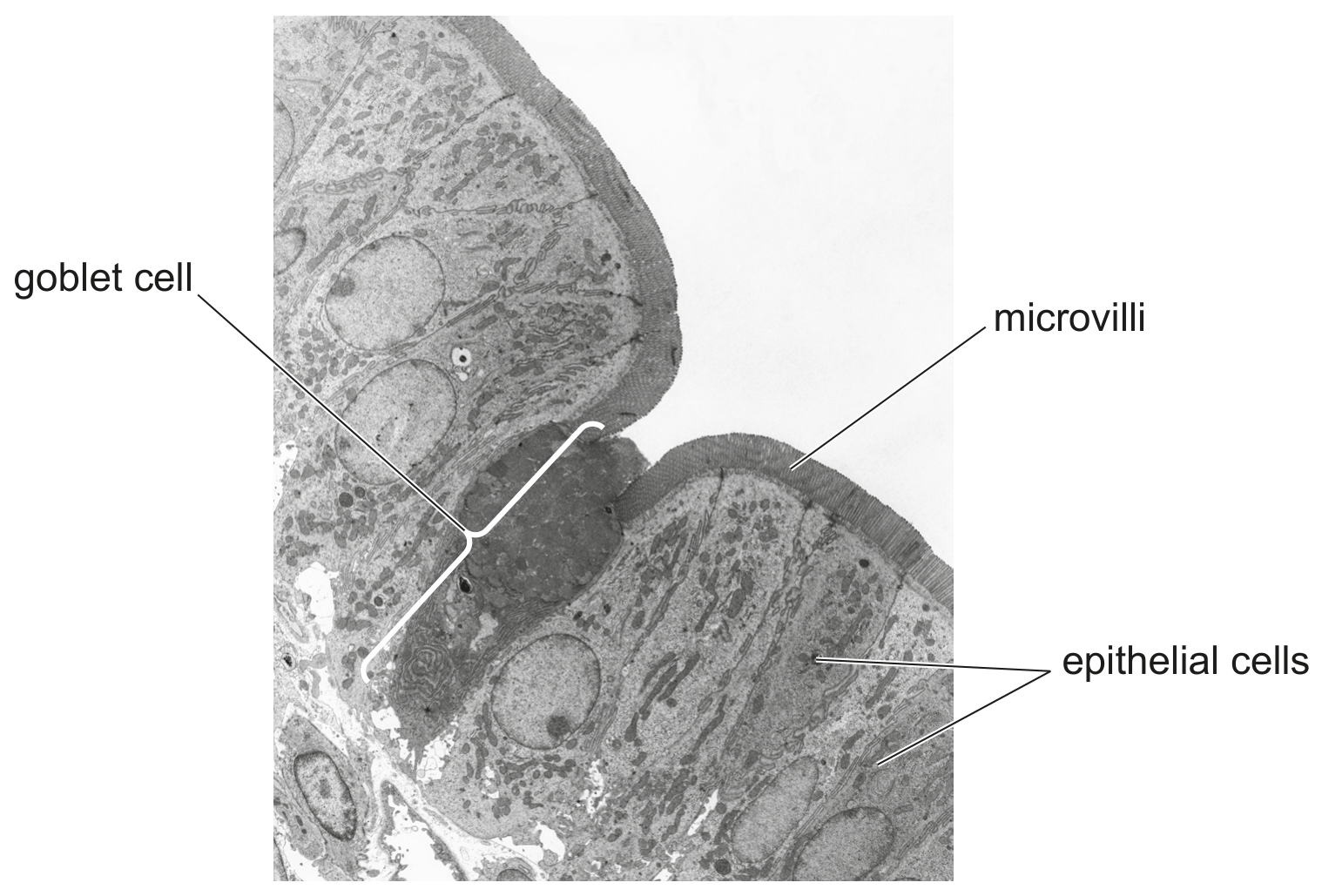
Fig. 1.2

Fig. 1.2

The epithelial cells of the villi absorb nutrients by diffusion and active transport.

Describe how active transport differs from diffusion.
Question 5

[Maximum number: 1]

Some examples of substances moving across membranes are listed.
1 glucose molecules into the epithelium that lines the small intestine
2 nitrate ions from a dilute solution in soil into a more concentrated solution in root hair cells

3 water molecules from mesophyll cells into the air spaces of a leaf
For which examples must oxygen be present?

A

1, 2 and 3

B

1 and 2 only

C

1 and 3 only

D

2 and 3 only

Question 6

[Maximum number: 1]

Which is an example of active transport?

A

carbon dioxide entering a leaf

B

ion uptake by root hair cells

C

oxygen moving from the alveoli into the blood

D

water uptake by root hair cells

Question 6

[Maximum number: 1]

Which process is involved in the uptake of glucose by the epithelial cells of kidney tubules?

A

active transport

B

diffusion

C

osmosis

D

transpiration

Question 6

[Maximum number: 1]

Which statement describes active transport?

A

the movement of ions through proteins in a cell membrane, releasing energy

B

the movement of ions through proteins in a cell membrane, using energy

C

the movement of water through lipids in a cell membrane, releasing energy

D

the movement of water through lipids in a cell membrane, using energy

Question 6

[Maximum number: 1]

Which statement about diffusion is correct?

A

The process requires energy from respiration.

B

The particles must cross a cell membrane.

C

The net movement of particles is up a concentration gradient.

D

The process involves the random movement of particles.

Question 6

[Maximum number: 1]

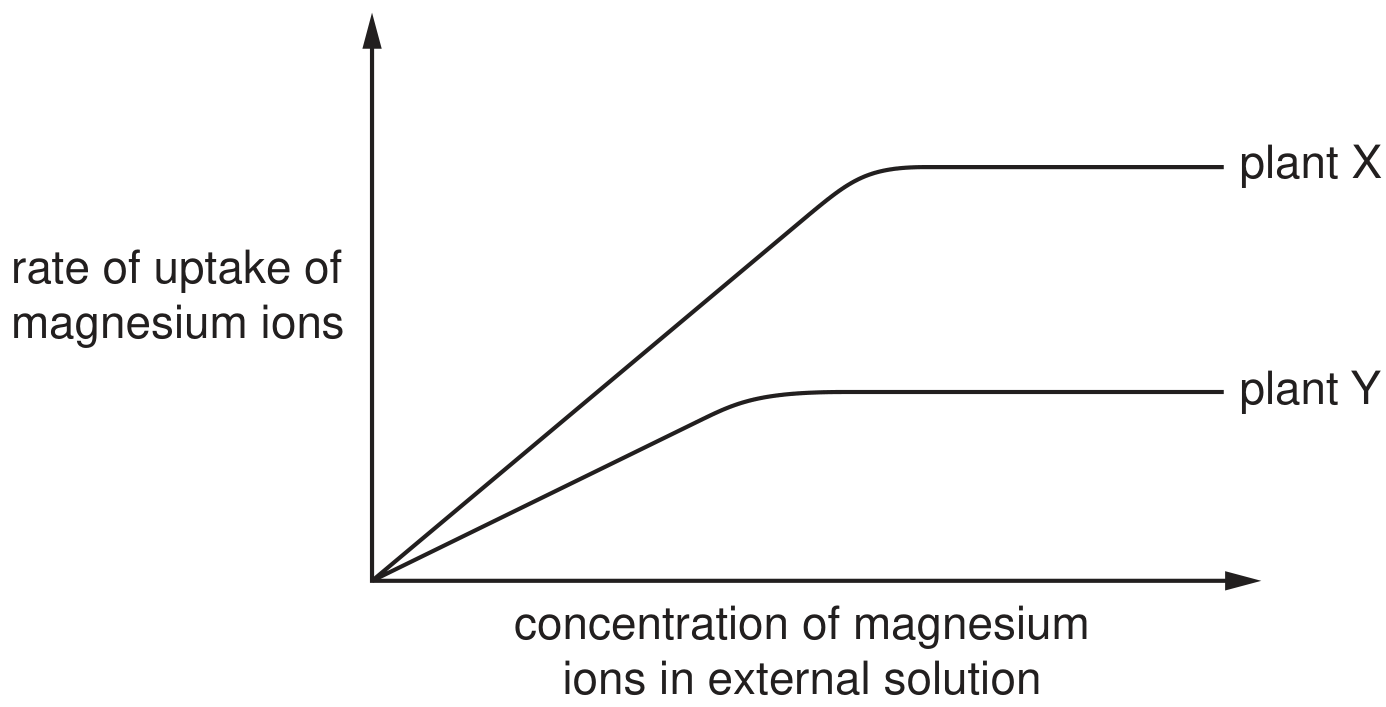
The graph shows the rate of uptake of magnesium ions by two similar plants, X and Y .
The roots of each plant were placed in a range of solutions. Each solution contained a different concentration of magnesium ions. All other conditions were kept constant.

Question image

What is a possible explanation for the difference in the results for the two plants?

A

Plant Y has fewer protein carriers for magnesium ions in its cell membranes.

B

Plant Y has a higher rate of respiration.

C

Plant Y has more root hair cells.

D

The root hair cells in plant Y have a lower water potential.

Question 6

[Maximum number: 1]

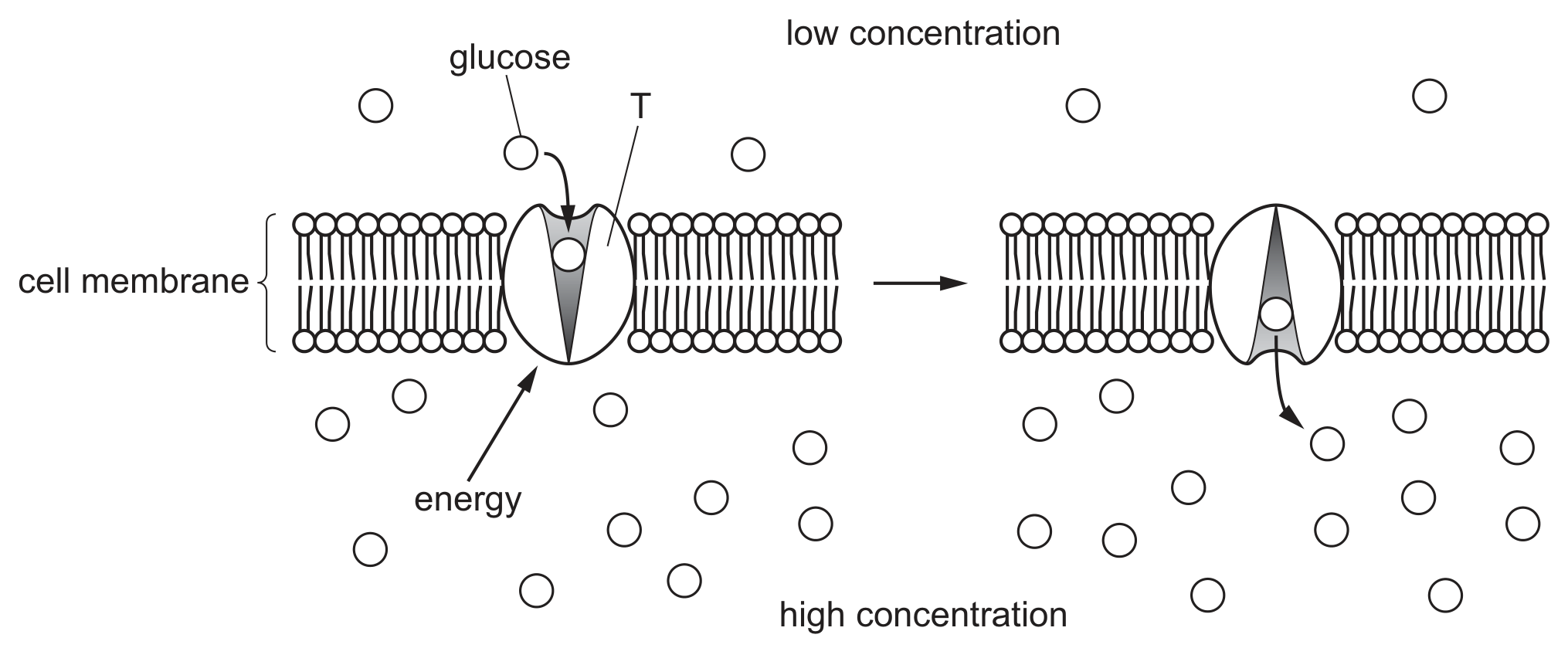
The diagram shows the movement of glucose molecules across a cell membrane.

Question image

Which statement describes molecule T?

A

It is a fat molecule used to transport glucose down a concentration gradient.

B

It is a fat molecule used to transport glucose against a concentration gradient.

C

It is a protein molecule used to transport glucose down a concentration gradient.

D

It is a protein molecule used to transport glucose against a concentration gradient.

Question 6

[Maximum number: 1]

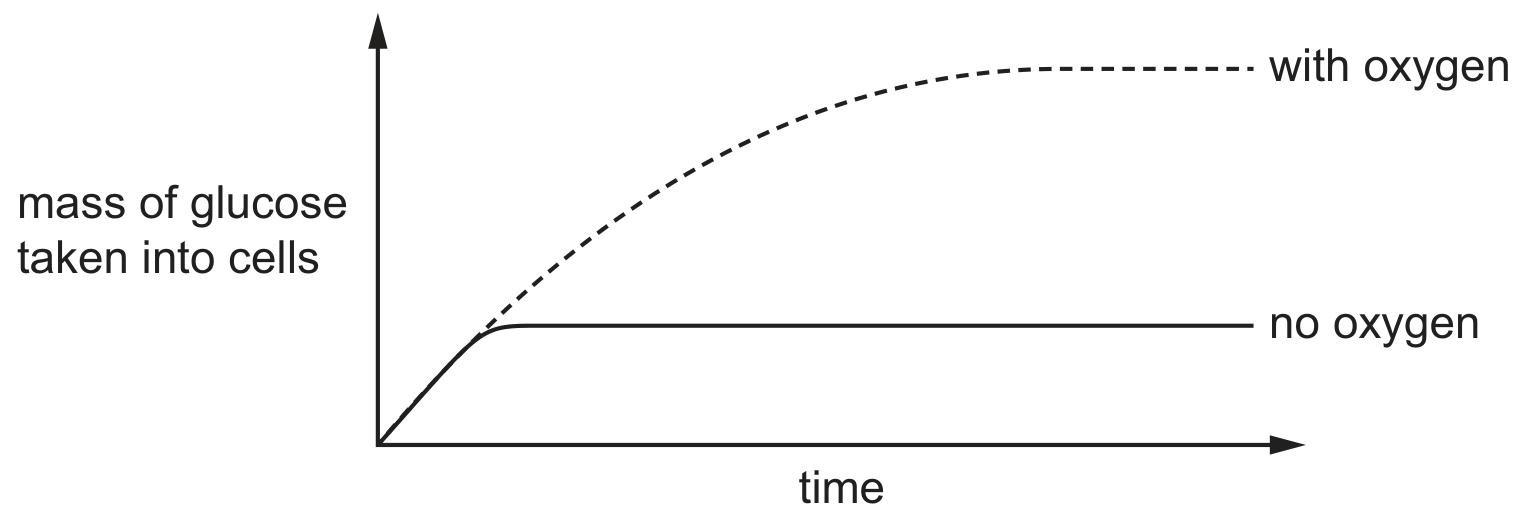
The graph shows the results of an investigation into the effect of oxygen on the uptake of glucose by cells.

Question image

Which conclusion can be made about these data?

A

Glucose only enters the cells by active transport.

B

Glucose only enters the cells by diffusion.

C

Glucose enters the cells by both active transport and diffusion.

D

Glucose enters the cells by osmosis.

Question 6

[Maximum number: 1]

Which process requires energy from respiration?

A

active transport

B

diffusion

C

osmosis

D

transpiration

0 selected