EduNinja

IB Biology HLB1.2 ProteinsQuestion Bank

Question 3

[Maximum number: 1]

The table shows some essential and non-essential amino acids.
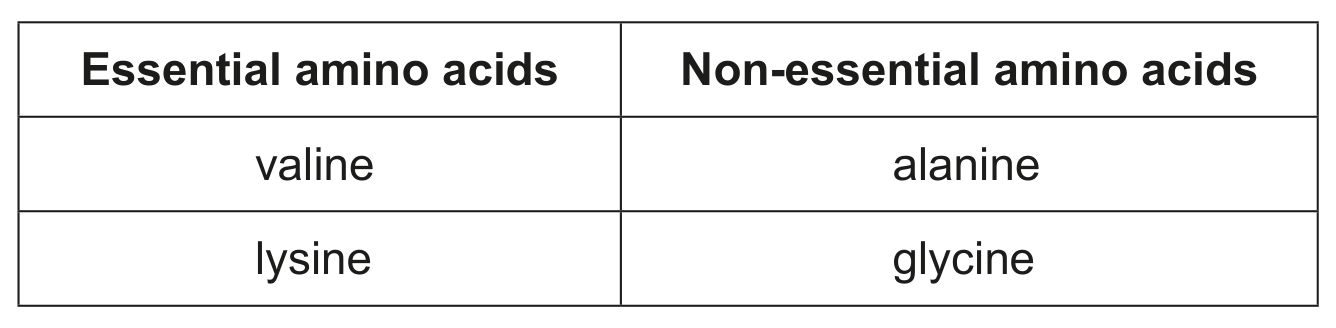
Table

What is a valid conclusion for an amino acid in the table?

A

Lysine is synthesized by the human body.

B

Alanine can only be obtained from food.

C

Glycine is not used in the human body.

D

Valine must be supplied in the diet.
Question 4

[Maximum number: 1]

Which row correctly matches the level of structure of a protein molecule with the bonds that stabilize it?

Level of structure

Bonds

primary

peptide and hydrogen bonds between amine and
carboxyl groups

secondary

hydrogen bonds between R-groups of amino acids

tertiary

disulfide, hydrogen and ionic bonds between R-groups
of amino acids

quaternary

covalent bonds between hydrophobic and hydrophilic
regions on the polypeptide subunits

Question 4

[Maximum number: 1]

Myoglobin is a globular protein in which nearly all the non-polar R-groups point towards the inside of the molecule. The outside surface contains all the polar R-groups. What can be deduced from this?

A

Disulfide bonds occur on the inside.

B

Hydrogen bonds form with water on the outside.

C

Ionic bonds form with water on the outside.

D

Covalent bonds occur on the inside.

Question 4

[Maximum number: 1]

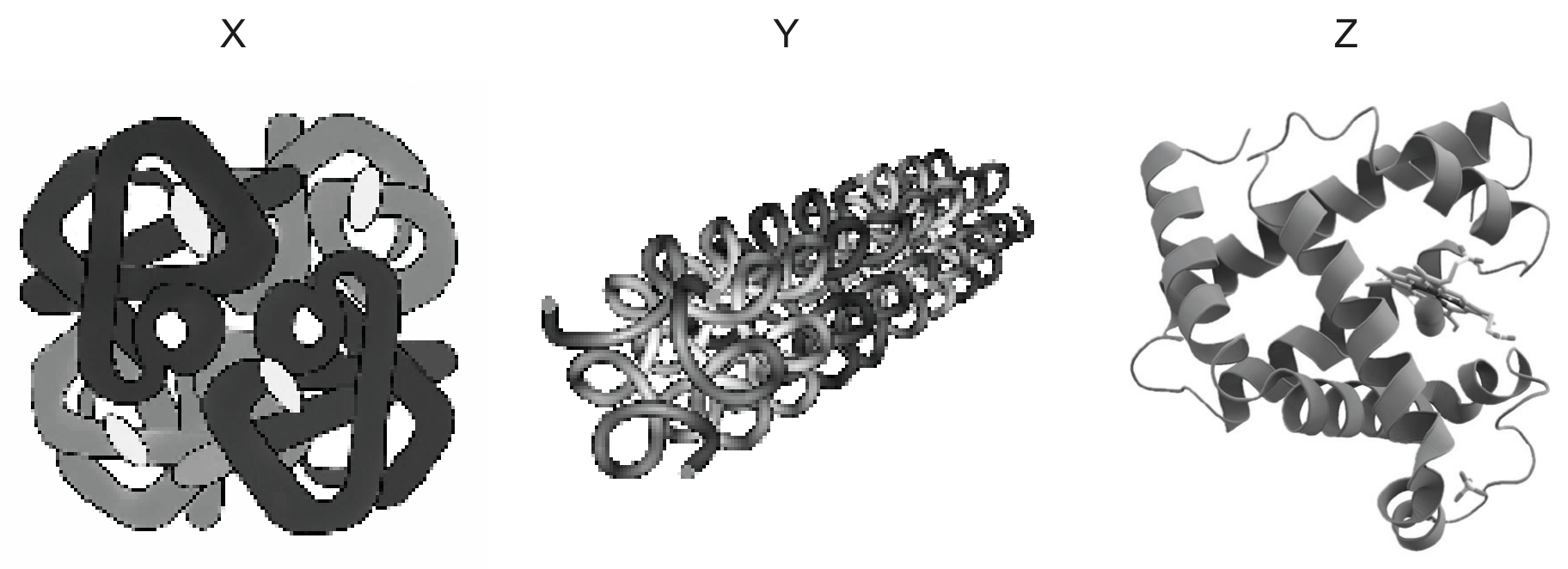
Diagrams of three different proteins, X, Y and Z , are shown.

Question image

Which row describes the structure of each protein shown?

X

Y

z

quaternary

globular

secondary

conjugated

fibrous

globular

tertiary

quaternary

primary

globular

secondary

fibrous

Question 6

[Maximum number: 1]

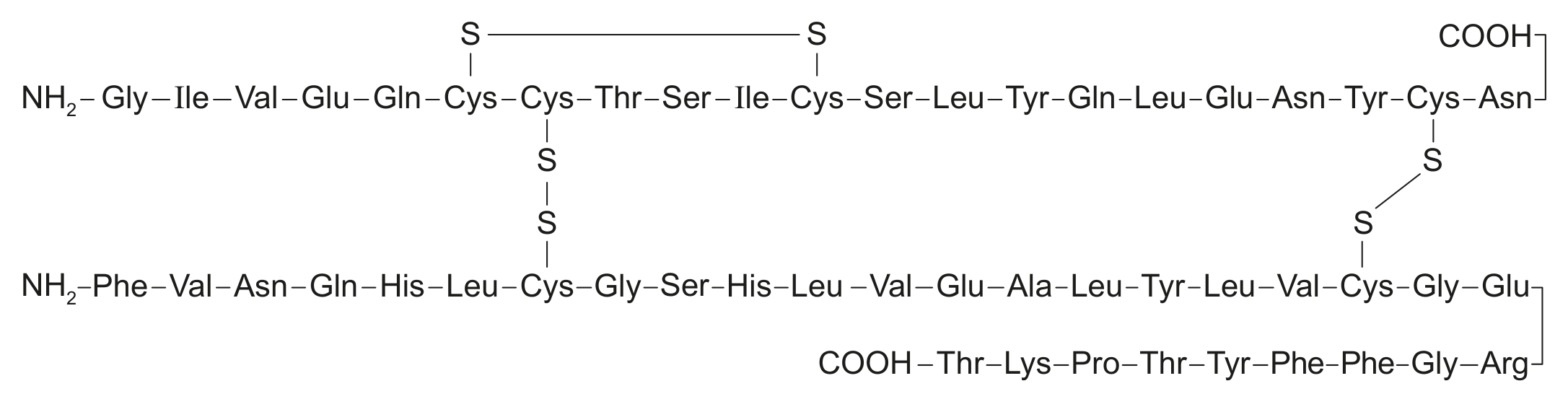
This diagram shows the amino acids present in a molecule of insulin, using three-letter abbreviations.

Question image

What describes the structure of insulin?

A

Insulin is a fibrous protein, since the amino acids are arranged in a linear pattern.

B

Insulin consists of a single continuous polypeptide chain with one free amino terminal and one free acid terminal.

C

Insulin has three disulphide bridges giving it tertiary structure and two polypeptide chains giving it quaternary structure.

D

Insulin has primary and secondary structure only, as there is no evidence of a three-dimensional shape in the diagram.

Question 6

[Maximum number: 1]

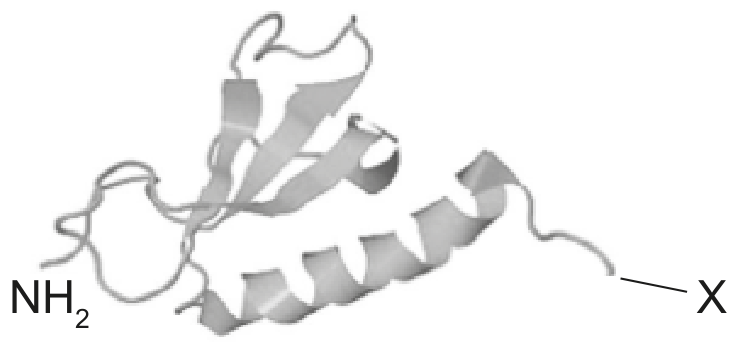
The diagram shows the structure of the protein CXCL12.

Question image

Which chemical group is found at X ?

A

NH2\mathrm{NH}_{2}

B

NOH

C

COH

D

COOH

Question 6

[Maximum number: 1]

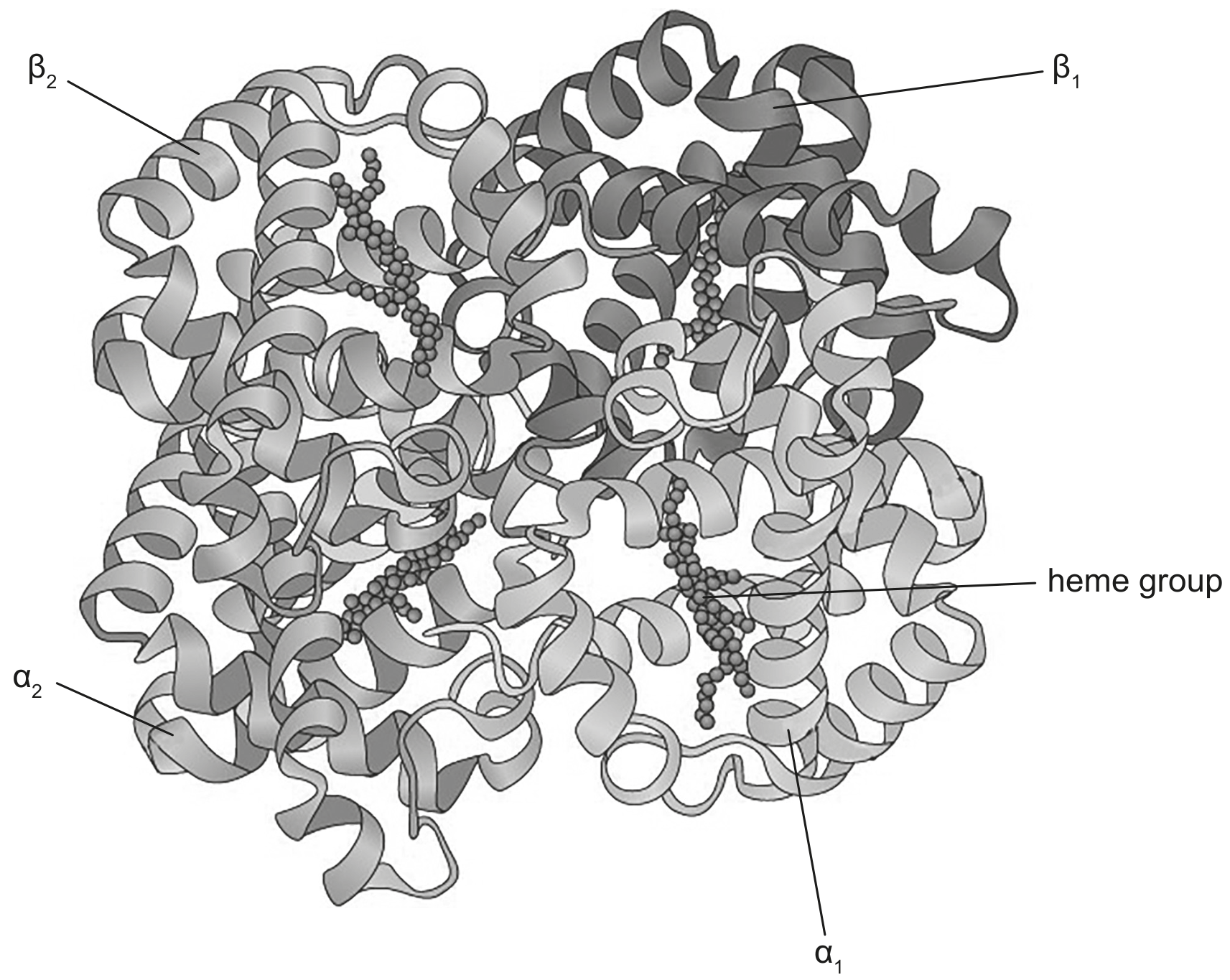
The image shows the structure of the protein hemoglobin.

Question image

What level of protein structure bonds the α\alpha and β\beta chains together?

A

Primary

B

Secondary

C

Tertiary

D

Quaternary

Question 7

[Maximum number: 1]

Which organic molecules may contain the element sulphur?

A

Proteins

B

Carbohydrates

C

Phospholipids

D

Nucleic acids

Question 8

[Maximum number: 1]

Which element is most common in proteins?

A

Sodium

B

Nitrogen

C

Phosphorus

D

Iron

Question 8

[Maximum number: 1]

Which protein has the highest tensile strength (ability to resist breaking when stretched)?

A

Cellulose

B

Actin

C

Spider silk

D

Albumin

0 selected