EduNinja
IB Maths AI HL/Question Bank/3.2 Geometry and trigonometry - AHL content

IB Maths AI HL3.2 Geometry and trigonometry - AHL contentQuestion Bank

HL65 questions10 previewsSyllabus linked
[Maximum number: 8]

In this question you will use graph theory and transition matrices to solve problems about a manager visiting five factories.
Audrey is the quality control manager for a manufacturing company that has five factories, A, B, C, D and E .
She is planning a route to visit each factory once, starting and finishing from her home, H .
She determines the distance between each location, in kilometres, as shown in the table.
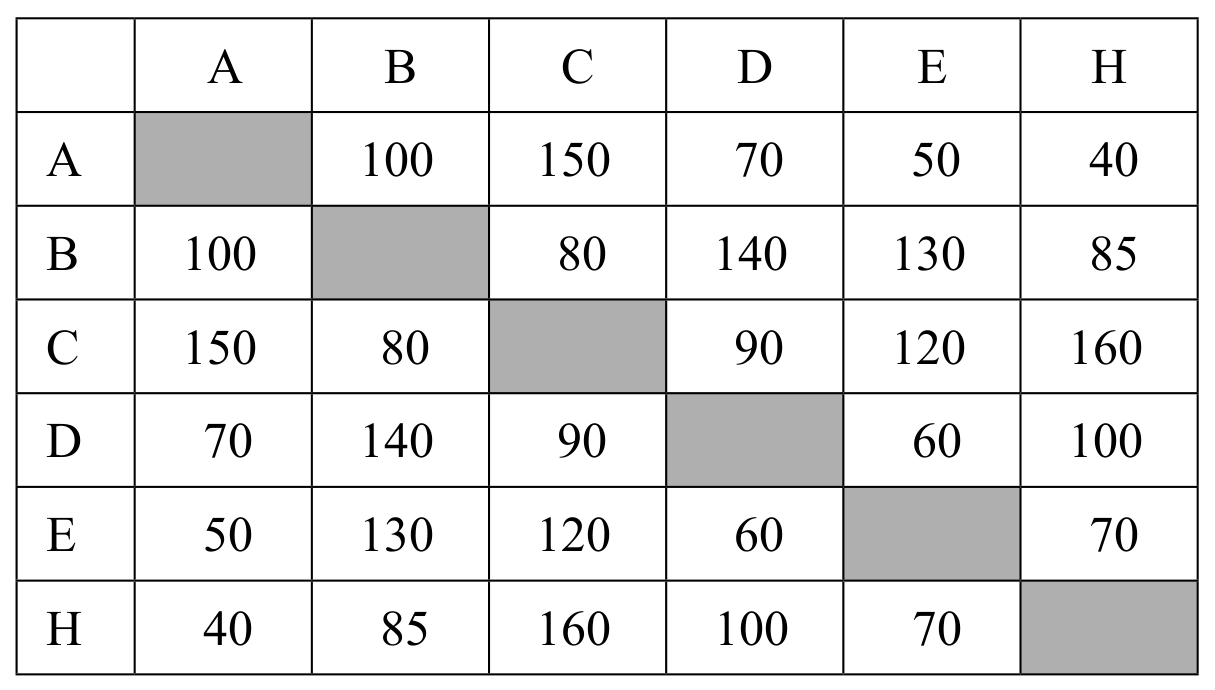
Table

Audrey wants to find an upper and lower bound for the shortest total distance travelled on her route.

(a)

Starting at H, use the nearest-neighbour algorithm to find an upper bound.

To find a lower bound, Audrey uses the deleted vertex algorithm and deletes vertex H .

[ 3 ]
(b)
(i)

Use Prim's algorithm, starting at E , to find the weight of the minimum spanning tree for A, B, C, D and E. You should clearly state the order in which the edges are selected by the algorithm.

[ 3 ]
(ii)

Hence, find a lower bound.

After her initial visit to all factories, Audrey now decides she will visit one factory each day. She decides which factory to visit according to the following transition matrix, T.

A BCDEA BCDE00.30.100.1000.20.20.400.20.2p0.20.70.25qr00.30.250.20.20.3)\left.\begin{array}{c} \\ \mathrm{A} \\ \mathrm{~B} \\ \mathrm{C} \\ \mathrm{D} \\ \mathrm{E} \end{array} \begin{array}{ccccc} \mathrm{A} & \mathrm{~B} & \mathrm{C} & \mathrm{D} & \mathrm{E} \\ 0 & 0.3 & 0.1 & 0 & 0.1 \\ 0 & 0 & 0.2 & 0.2 & 0.4 \\ 0 & 0.2 & 0.2 & p & 0.2 \\ 0.7 & 0.25 & q & r & 0 \\ 0.3 & 0.25 & 0.2 & 0.2 & 0.3 \end{array}\right)

After visiting factory D , there is a probability of 0.4 that Audrey will visit factory C next.
[ 2 ]
[Maximum number: 13]

In this question, you will explore possible approaches to using historical sports results for making predictions about future sports matches.
Two friends, Peter and Helen, are discussing ways of predicting the outcomes of international football matches involving Argentina.
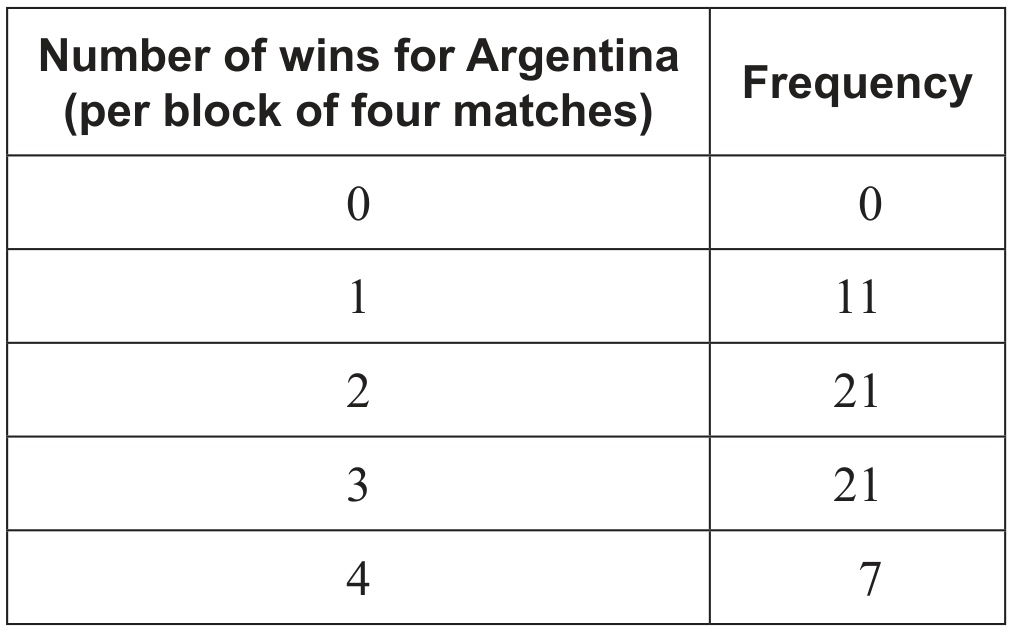
Peter suggests analysing historical data to help make predictions. He lists the results of the most recent 240 matches in which Argentina played, in chronological order, then considers blocks of four matches at a time. He counts how many times Argentina has won in each block. The following table shows his results for the 60 blocks of four matches.

Table
(a)
(i)

Write down the transition matrix, T, for Helen's model.

[ 2 ]
(b)
(i)

Show that the characteristic polynomial of T is 1363λ21263λ100=01363 \lambda^{2}-1263 \lambda-100=0.

[ 3 ]
(ii)

Hence or otherwise, find the eigenvalues of T.

[ 1 ]
(iii)

Find the corresponding eigenvectors.

[ 3 ]
(c)

In her retirement, many years from now, Helen is planning to travel to three consecutive international football matches involving Argentina. Use Helen's model to find the probability that Argentina will win all three matches.

[ 4 ]
[Maximum number: 11]

A suitable site for the landing of a spacecraft on the planet Mars is identified at a point, A. The shortest time from sunrise to sunset at point A must be found.
Radians should be used throughout this question. All values given in the question should be treated as exact.
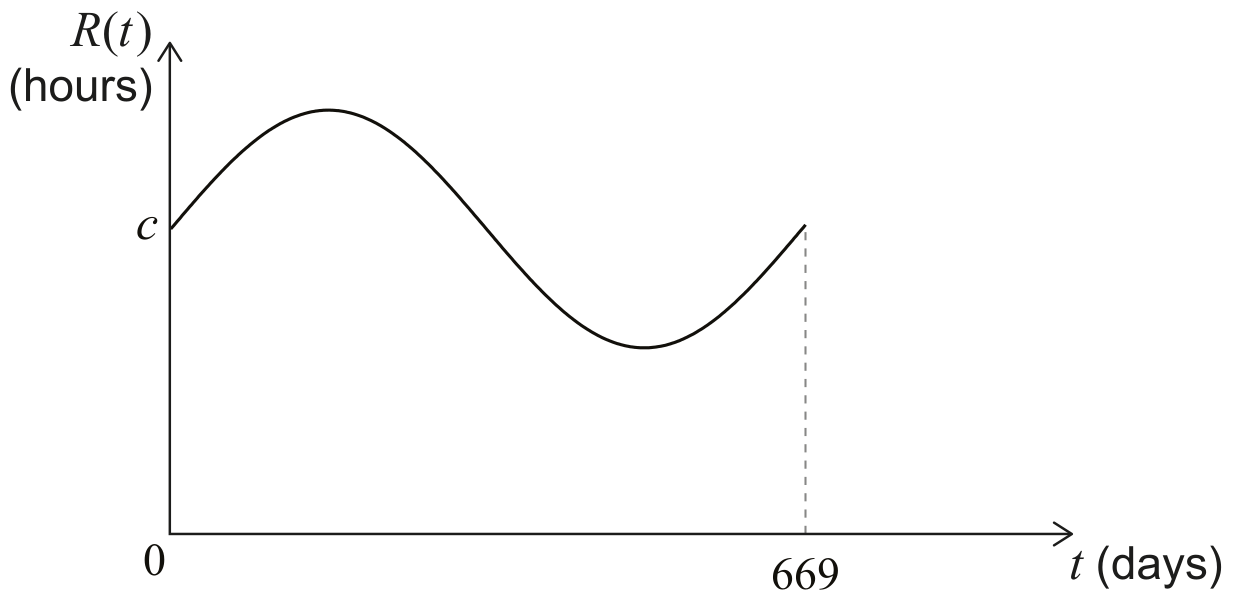
Mars completes a full orbit of the Sun in 669 Martian days, which is one Martian year.

Question image

On day t, where tZt \in \mathbb{Z}, the length of time, in hours, from the start of the Martian day until sunrise at point A can be modelled by a function, R(t), where

R(t)=asin(bt)+c,tR.R(t)=a \sin (b t)+c, t \in \mathbb{R} .

The graph of R is shown for one Martian year.

Question image
(a)

Show that b0.00939b \approx 0.00939.

Mars completes a full rotation on its axis in 24 hours and 40 minutes.

[ 2 ]
(b)

Find the angle through which Mars rotates on its axis each hour.

The time of sunrise on Mars depends on the angle, δ\delta, at which it tilts towards the Sun. During a Martian year, δ\delta varies from -0.440 to 0.440 radians.

The angle, ω\omega, through which Mars rotates on its axis from the start of a Martian day to the moment of sunrise, at point A , is given by cosω=0.839tanδ,0ωπ\cos \omega=0.839 \tan \delta, 0 \leq \omega \leq \pi.

[ 3 ]
(c)
(i)

Show that the maximum value of ω=1.98\omega=1.98, correct to three significant figures.

[ 3 ]
(ii)

Find the minimum value of ω\omega.

[ 1 ]
(d)

Hence show that a=1.6, correct to two significant figures.

[ 2 ]
[Maximum number: 7]

The following question explores how sequences, series and Markov chains may be used in modelling the number of customers in a commercial setting.
In a town, there are three stores: Aroma, Bodega and Clover.
Ashley is the manager of Aroma. She gathers data to determine whether there is significant movement of customers between the three stores over the course of one year.
She found that:
- 91 % of Aroma customers stayed with Aroma, 5 % moved to Bodega, and 4 % moved to Clover.
- 95 % of Bodega customers stayed with Bodega, 4 % moved to Aroma, and 1 % moved to Clover.
- 92 % of Clover customers stayed with Clover, 6 % moved to Aroma, and 2 % moved to Bodega.
This information is used to form a transition matrix, T.

(a)

Write down the transition matrix T.

It is assumed that the movement of customers between stores remains constant from year to year.

[ 3 ]
(b)

Determine the percentage of Clover customers expected to move to Aroma over a 5 -year period.

[ 4 ]
[Maximum number: 22]

This question explores how graph algorithms can be applied to a graph with an unknown edge weight.
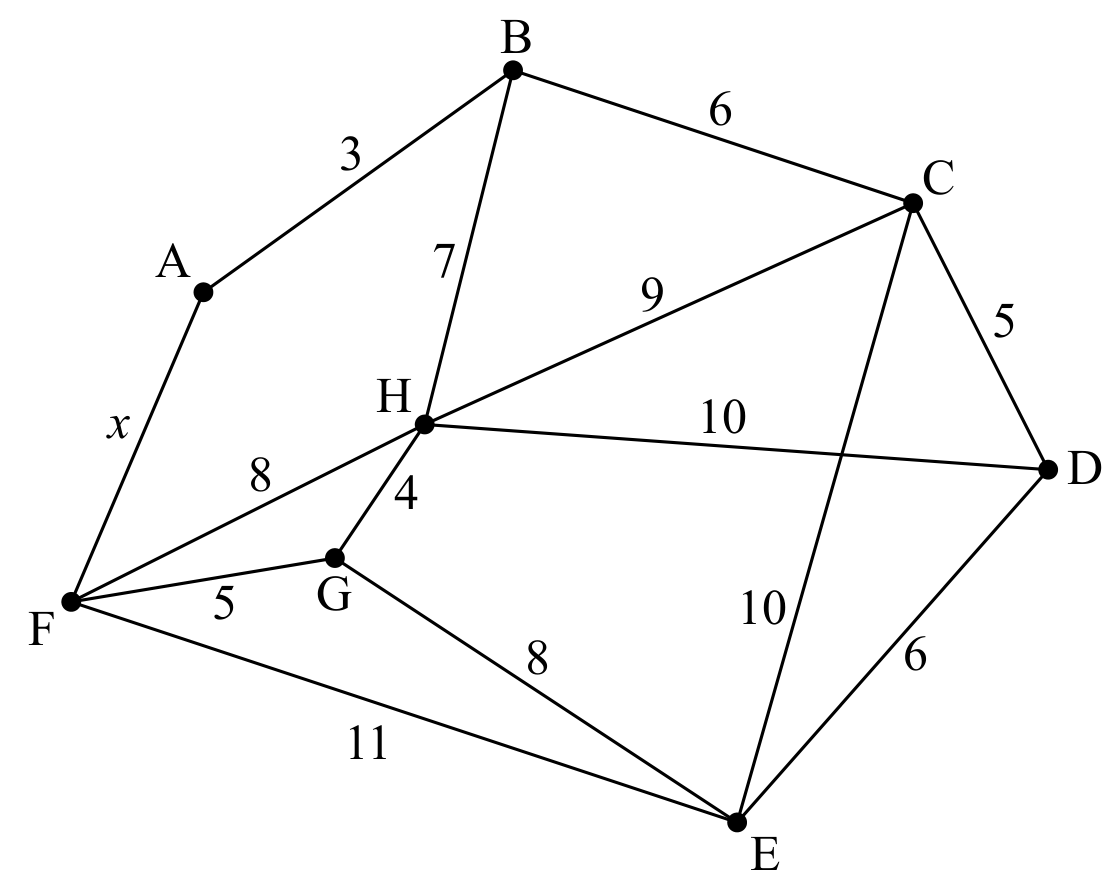
Graph W is shown in the following diagram. The vertices of W represent tourist attractions in a city. The weight of each edge represents the travel time, to the nearest minute, between two attractions. The route between A and F is currently being resurfaced and this has led to a variable travel time. For this reason, AF has an unknown travel time x minutes, where xZ+x \in \mathbb{Z}^{+}.

Question image
(a)

Write down a Hamiltonian cycle in W.

Daniel plans to visit all the attractions, starting and finishing at A. He wants to minimize his travel time.

To find a lower bound for Daniel's travel time, vertex A and its adjacent edges are first deleted.

[ 1 ]
(b)
(i)

Use Prim's algorithm, starting at vertex B, to find the weight of the minimum spanning tree of the remaining graph. You should indicate clearly the order in which the algorithm selects each edge.

[ 5 ]
(ii)

Hence, for the case where x<9, find a lower bound for Daniel's travel time, in terms of x.

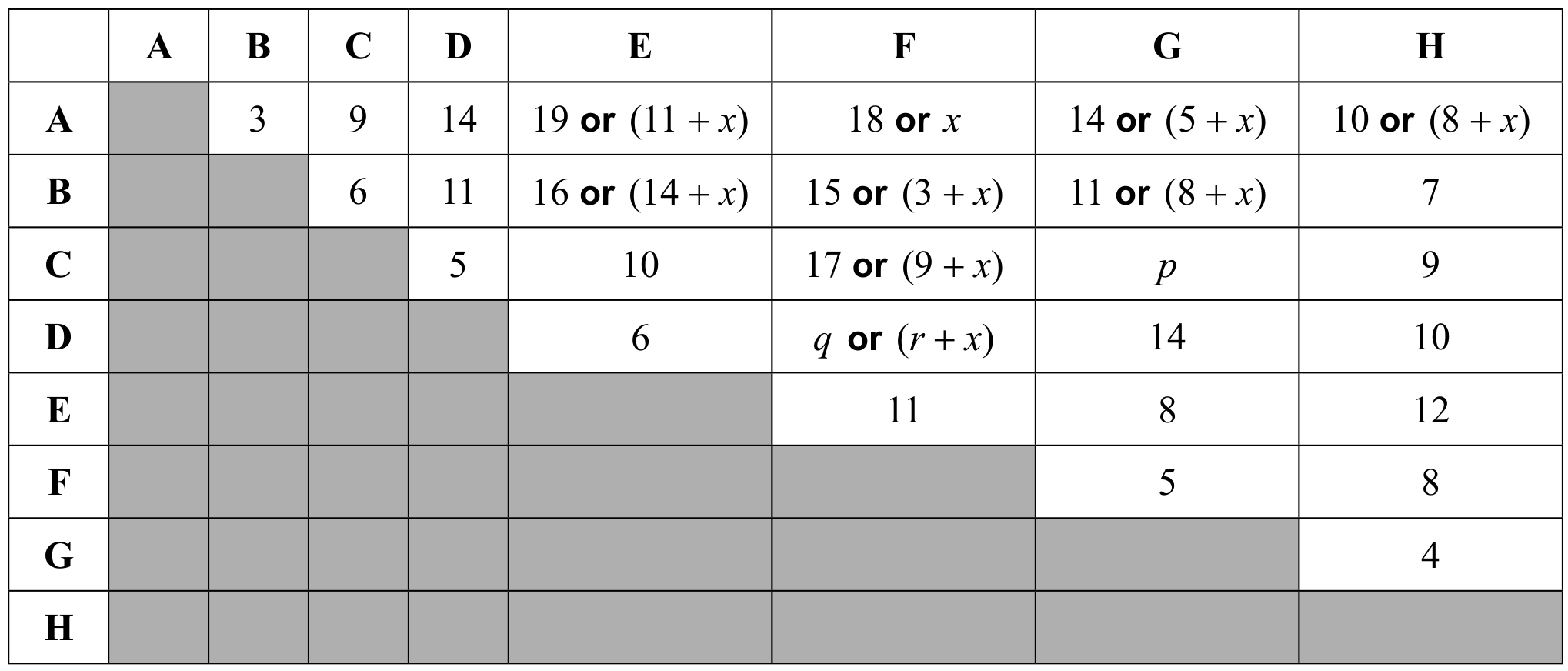
Daniel makes a table to show the minimum travel time between each pair of attractions.

Table
[ 2 ]
(c)

Consider the case where x=3.

[ 5 ]
(i)

Use the nearest neighbour algorithm to find two possible cycles.

[ 3 ]
(ii)

Find the best upper bound for Daniel's travel time.

[ 2 ]
(d)

Consider the case where x>3.

[ 4 ]
(i)

Find the least value of x for which the edge AF will definitely not be used by Daniel.

[ 2 ]
(ii)

Hence state the value of the upper bound for Daniel's travel time for the value of x found in part (e)(i).

The tourist office in the city has received complaints about the lack of cleanliness of some routes between the attractions. Corinne, the office manager, decides to inspect all the routes between all the attractions, starting and finishing at H . The sum of the weights of all the edges in graph W is (92+x).

Corinne inspects all the routes as quickly as possible and takes 2 hours.

[ 2 ]
(e)

Find the value of x during Corinne's inspection.

[ 5 ]
[Maximum number: 16]

This question considers whether it is reasonable to go on all the rides in a theme park and get back to the entrance in two and a half hours.
Martin is visiting a theme park. He will enter the park at 09:00 and must leave the park by 11:30. He uses information available on the internet to calculate whether he will be able to go on all of the rides in the two and a half hours.
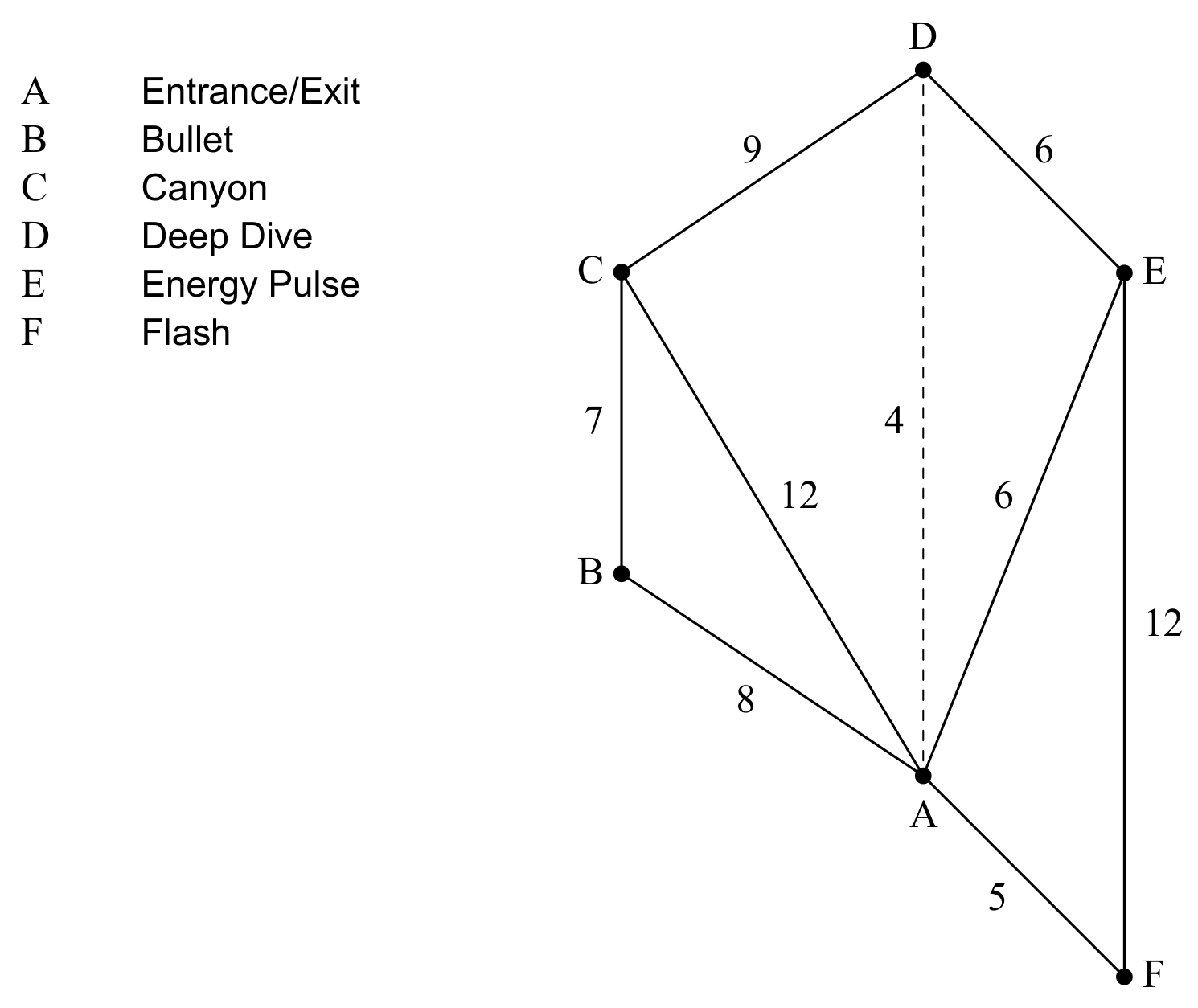
He begins by constructing a graph which shows the main paths between the rides and the route of the cable car between the entrance/exit A and ride D.
His graph and the names of the rides are shown in the following diagram.

Question image

The weights on the edges of the graph represent the times, in minutes, to walk between the rides and the time to travel by cable car between A and D.

Let T be the shortest possible time, in minutes, taken to visit all the rides, beginning and ending at A .

Martin notices that the graph contains a Hamiltonian cycle. He decides to use the weight of the Hamiltonian cycle as an upper bound for T.

(a)

Find the weight of this Hamiltonian cycle.

[ 2 ]
(b)

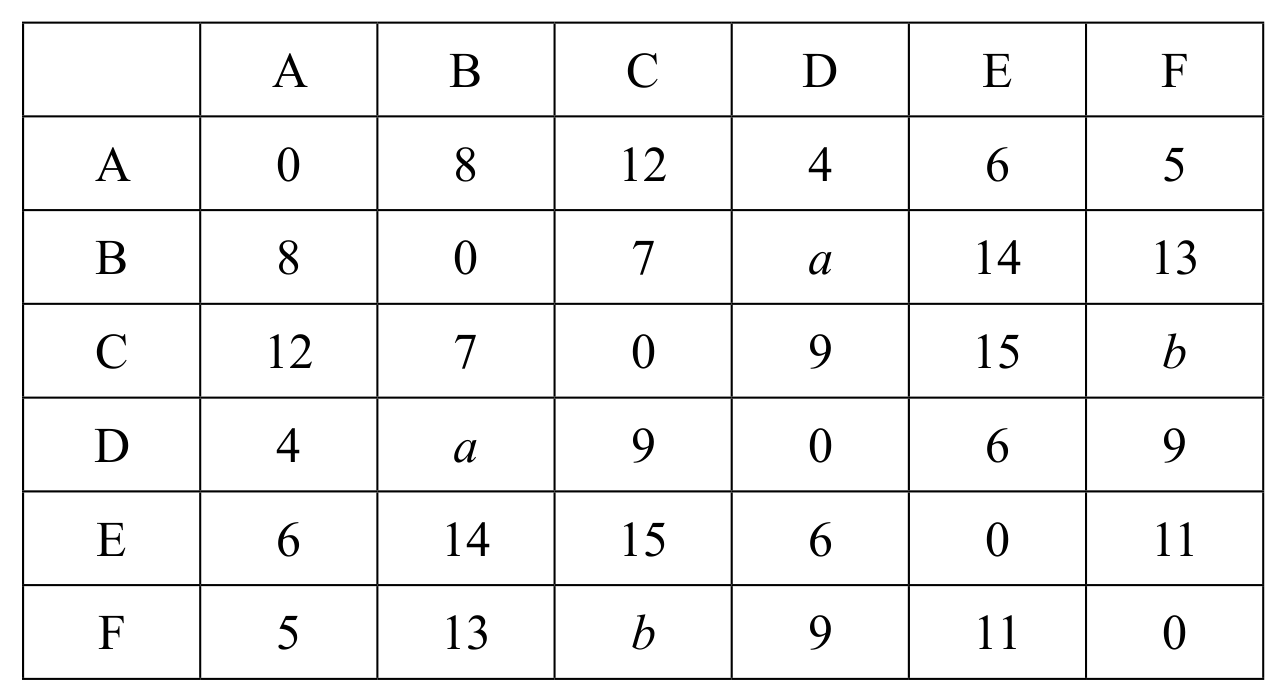
Martin constructs Table 1 to show the shortest possible time it takes to travel between any two rides and between the entrance and any ride.

Table 1

Table 1

Write down the value of

[ 2 ]
(i)

a;

[ 1 ]
(ii)

b.

[ 1 ]
(c)

Use the nearest neighbour algorithm on Table 1 to find an upper bound for T.

[ 3 ]
(d)

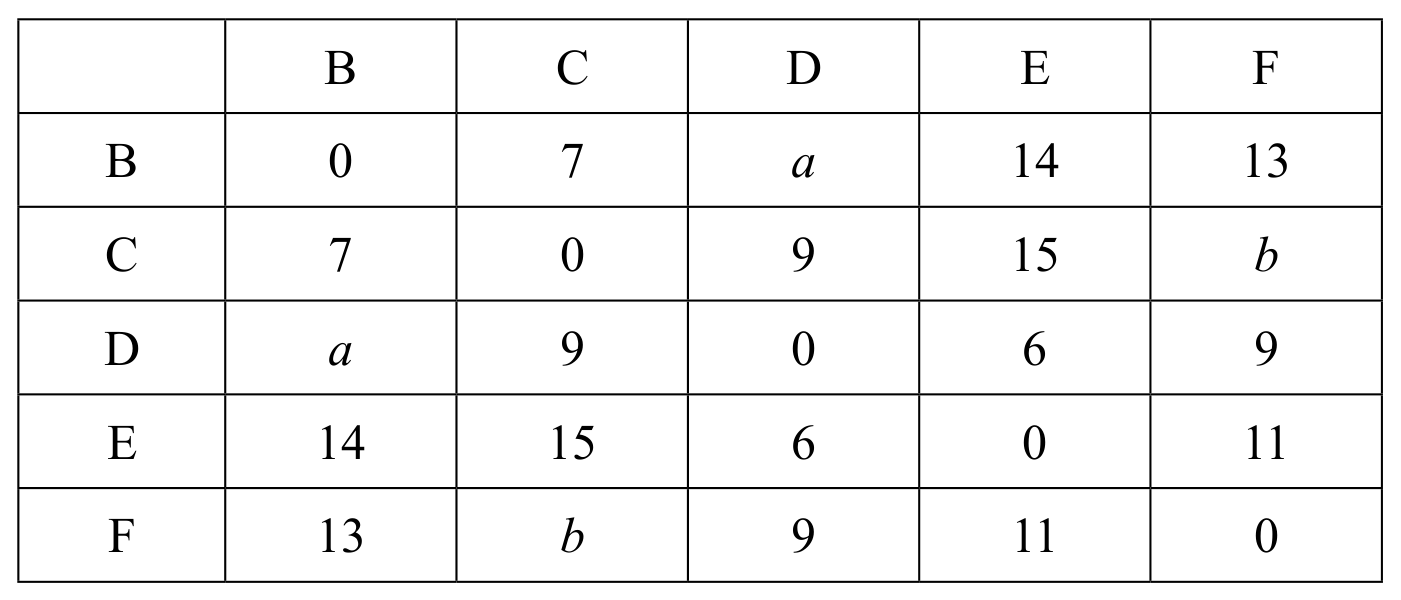
Martin decides to use the deleted vertex algorithm to find a lower bound for T by first deleting vertex A. The shortest possible time to travel between each ride, with vertex A deleted, is given in Table 2.

Table 2

Table 2

[ 5 ]
(i)

Use Prim's algorithm on Table 2 to find the weight of the minimum spanning tree for the graph with vertices B, C, D, E and F.
Start at vertex B and write down the order in which the edges are selected.

[ 3 ]
(ii)

Hence find a lower bound for T.

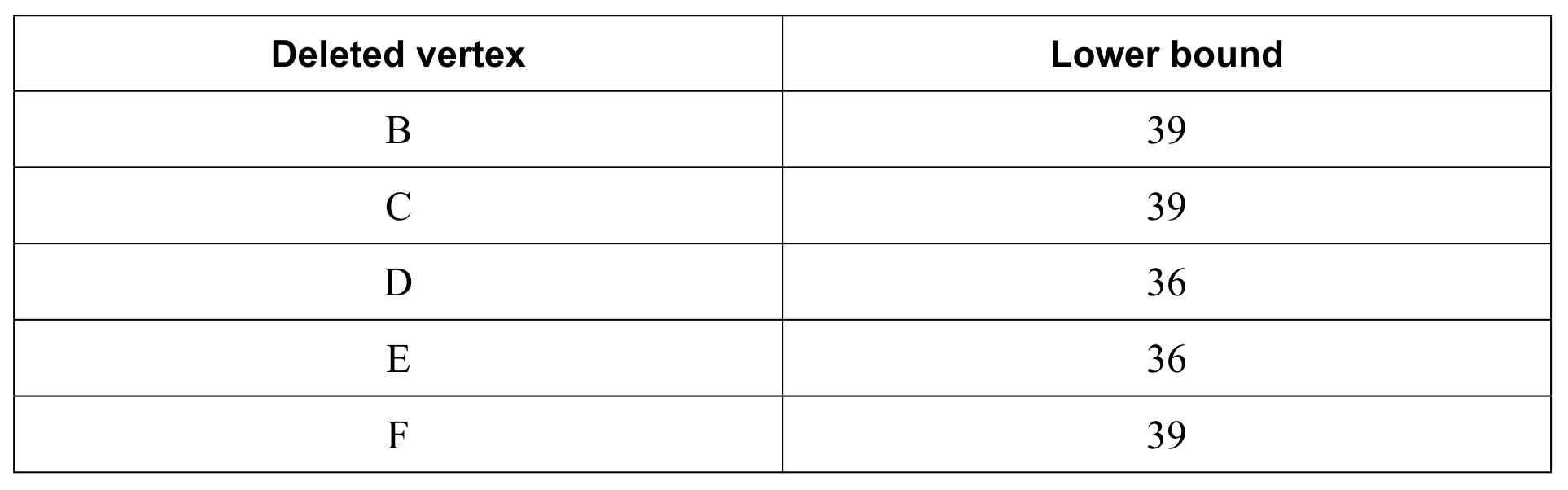
Martin finds more lower bounds for T, by deleting each vertex in turn. The results are shown in the following table.

Table

Martin finds the smallest possible interval within which T lies, based on his calculated values for upper and lower bounds. He writes his answer in the form pTqp \leq T \leq q.

[ 2 ]
(e)

Write down the value of

[ 2 ]
(i)

p;

[ 1 ]
(ii)

q.

Martin's favourite ride is Energy Pulse (E), so he decides to go there first. He plans to begin at A and visit the rides in the order E, D, C, B, F before returning to A . For the rest of the question, assume that Martin is taking this route.

[ 1 ]
(f)
(i)

Find the shortest possible time it would take to complete this route.

[ 1 ]
(ii)

State the edge which would need to be repeated.

Each of the rides takes 2 minutes to complete.
Let the time spent waiting in the queue for ride B be written as the random variable BtB_{t} and similarly for the other rides.

The following distributions model the times spent waiting in the queues. Each waiting time is independent of all other waiting times and the time of day.

Bt N(13,3),Ct N(21,15),Dt N(16,8),Et N(10,6),Ft N(20,15)B_{t} \sim \mathrm{~N}(13,3), C_{t} \sim \mathrm{~N}(21,15), D_{t} \sim \mathrm{~N}(16,8), E_{t} \sim \mathrm{~N}(10,6), F_{t} \sim \mathrm{~N}(20,15)
[ 1 ]
[Maximum number: 9]

The point A has coordinates (1,2,1) and the point B has coordinates (3,5,2).

(a)

Find AB .

Triangle ABC is right-angled with its right angle at B . The point C has coordinates (2,8, k).

[ 2 ]
(b)

Find the value of k.

[ 4 ]
(c)

Calculate the size of BAAC .

[ 3 ]
[Maximum number: 8]

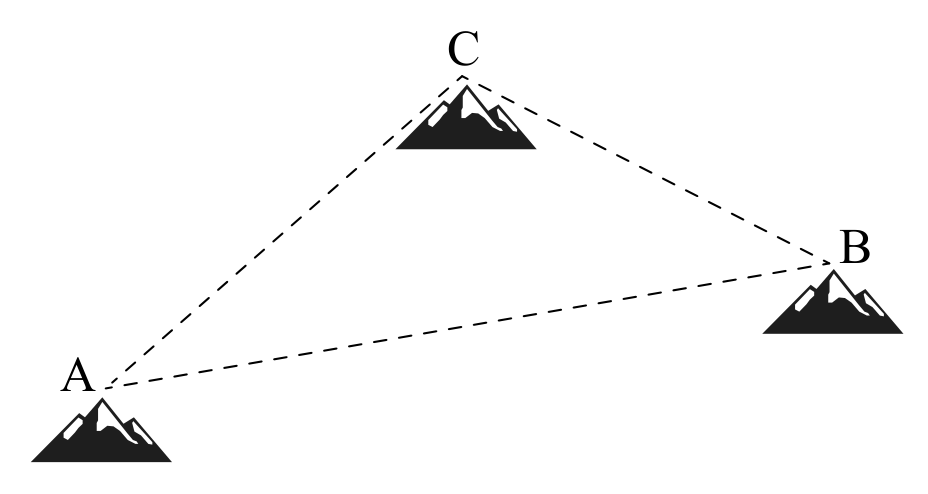
A national park contains three mountains whose summits are at points A, B and C .
According to a coordinate system, the position of A is (0,0,2.8) and the position of B is (7.2, 5.1, 2.4). All the values are in kilometres.

Question image
(a)
(i)

Find the vector AB\overrightarrow{\mathrm{AB}}.

(ii)

Hence find AB , the distance between A and B .

The vector AC\overrightarrow{\mathrm{AC}} is parallel to the vector (1.18.40.2)\left(\begin{array}{l}1.1 \\ 8.4 \\ 0.2\end{array}\right).

[ 3 ]
(b)

Find the angle between (1.18.40.2)\left(\begin{array}{l}1.1 \\ 8.4 \\ 0.2\end{array}\right) and AB\overrightarrow{\mathrm{AB}}.

The angle between BA\overrightarrow{\mathrm{BA}} and BC\overrightarrow{\mathrm{BC}} is 55.255.2^{\circ}.

[ 5 ]
[Maximum number: 7]

.
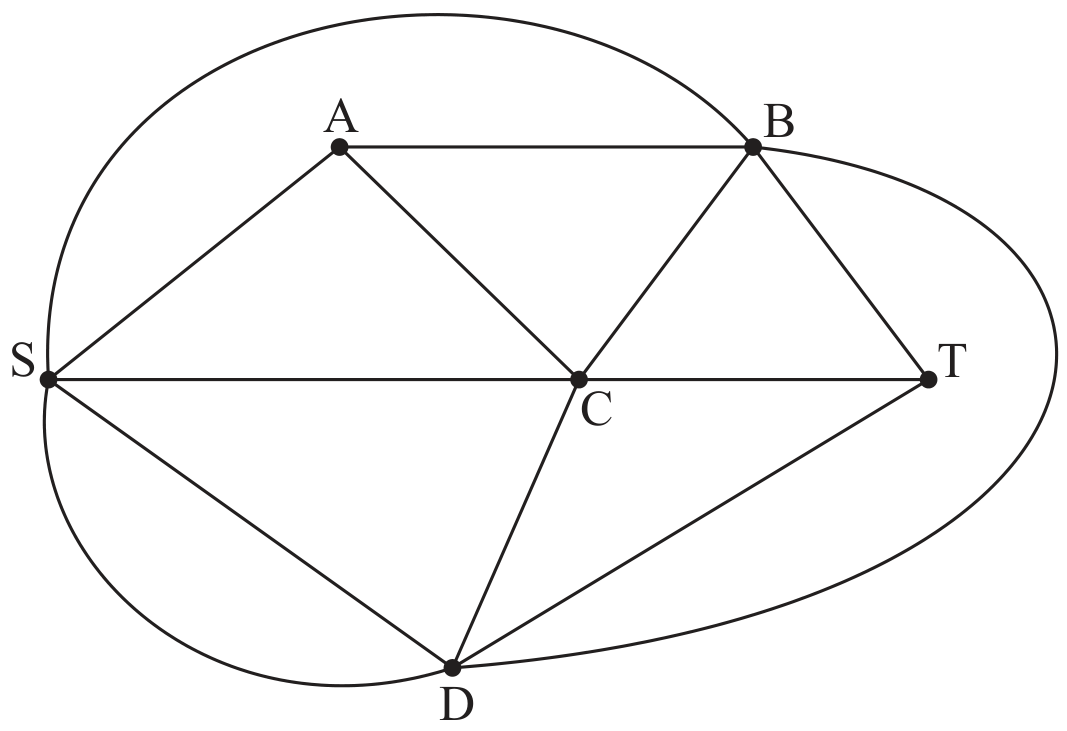
In a competition, a contestant has to move through a maze to find treasure. A graph of the maze is shown below, where each edge represents a corridor in the maze. The contestant starts at S and the treasure is located at T .

Question image
(a)

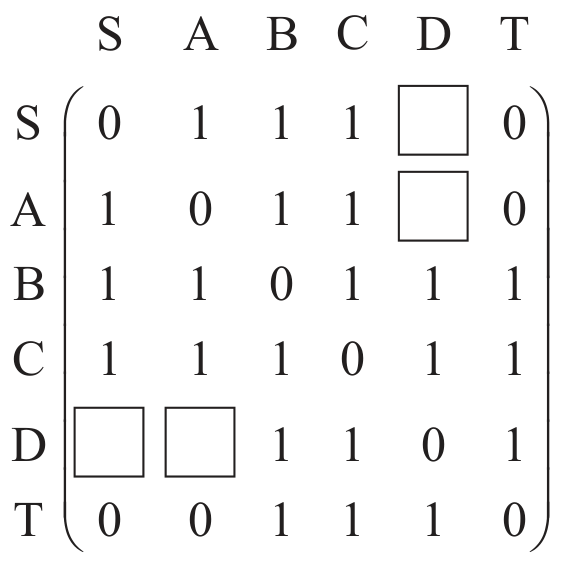
Complete the adjacency matrix, M, for the graph.

Table

The competition rules state that the contestant can walk along a maximum of four corridors.

[ 2 ]
(b)

Find the number of walks from S to T with a maximum of 4 edges.

[ 4 ]
(c)

Explain why the number of ways the contestant can reach the treasure is less than the answer to part (b).

[ 1 ]
[Maximum number: 22]

In this question you will use vector methods to determine whether aircraft are obeying air traffic regulations.
The base of an air traffic control tower at an airport is taken as the origin of a coordinate system. An aircraft's position is given by the coordinates (x, y, z), where x and y are respectively the aircraft's displacement east and north of the tower, and z is the vertical displacement of the aircraft above the base of the tower. All displacements are measured in kilometres.
At 12:00 two aircraft, A and B , are at the points P(100,-82,10.7) and Q(215,-197,10.7) respectively.

(a)

Find the distance between the two aircraft at 12:00.

The two aircraft are flying along the same straight line (flight path), with B behind A .
They both have the same constant velocity of (6406400)\left(\begin{array}{c}-640 \\ 640 \\ 0\end{array}\right) kilometres per hour.

[ 2 ]
(b)

Find the speed of both aircraft.

Air traffic regulations state that if two aircraft are on the same flight path then they must always maintain at least a 10 minute gap between them. If at any time two aircraft are too close they are said to be "in conflict".

[ 2 ]
(c)

Find the length of time it takes B to reach point P from point Q , and hence state whether the two aircraft are in conflict.

[ 3 ]
(d)

Write down, rA\boldsymbol{r}_{A}, the position vector of A, t hours after 12:00.

If two aircraft are not on the same flight path, air traffic regulations state:
When the vertical distance between the two aircraft is less than 300 m the aircraft must be more than 10 km apart.

When the vertical distance between the two aircraft is at least 300 m there are no restrictions.
The air traffic controller notices an aircraft, C , flying on a different flight path but close to A . The position of C, t hours after 12:00, is given by

rC=(400419.1)+t(1406042)\boldsymbol{r}_{C}=\left(\begin{array}{c} -400 \\ -41 \\ 9.1 \end{array}\right)+t\left(\begin{array}{c} -140 \\ 604 \\ 2 \end{array}\right)
[ 1 ]
(e)
(i)

Find the two values of t at which the distance between A and C is 10 km .

It is given that the distance between A and C is less than 10 km , only between these two values of t.

[ 5 ]
(f)

Describe the path followed by D.

Around the same time a small aircraft, E, is flying at the same height as D and along the line with vector equation

RE=(2010)+λ(11)\overrightarrow{\mathrm{RE}}=\binom{20}{10}+\lambda\binom{-1}{1}
[ 3 ]
(g)

Let b=(11)\boldsymbol{b}=\binom{-1}{1}.

[ 6 ]
(i)

Find REb\overrightarrow{\mathrm{RE}} \cdot \boldsymbol{b} in terms of λ\lambda.

[ 2 ]
(ii)

Hence find the value of λ\lambda for which the distance from R to the line is minimum.

[ 2 ]
(iii)

Find this minimum distance.

[ 2 ]
0