EduNinja
IB Maths AI HL/Question Bank/3 Geometry and trigonometry

IB Maths AI HL3 Geometry and trigonometryQuestion Bank

HL114 questions10 previewsSyllabus linked
[Maximum number: 22]

This question explores how graph algorithms can be applied to a graph with an unknown edge weight.
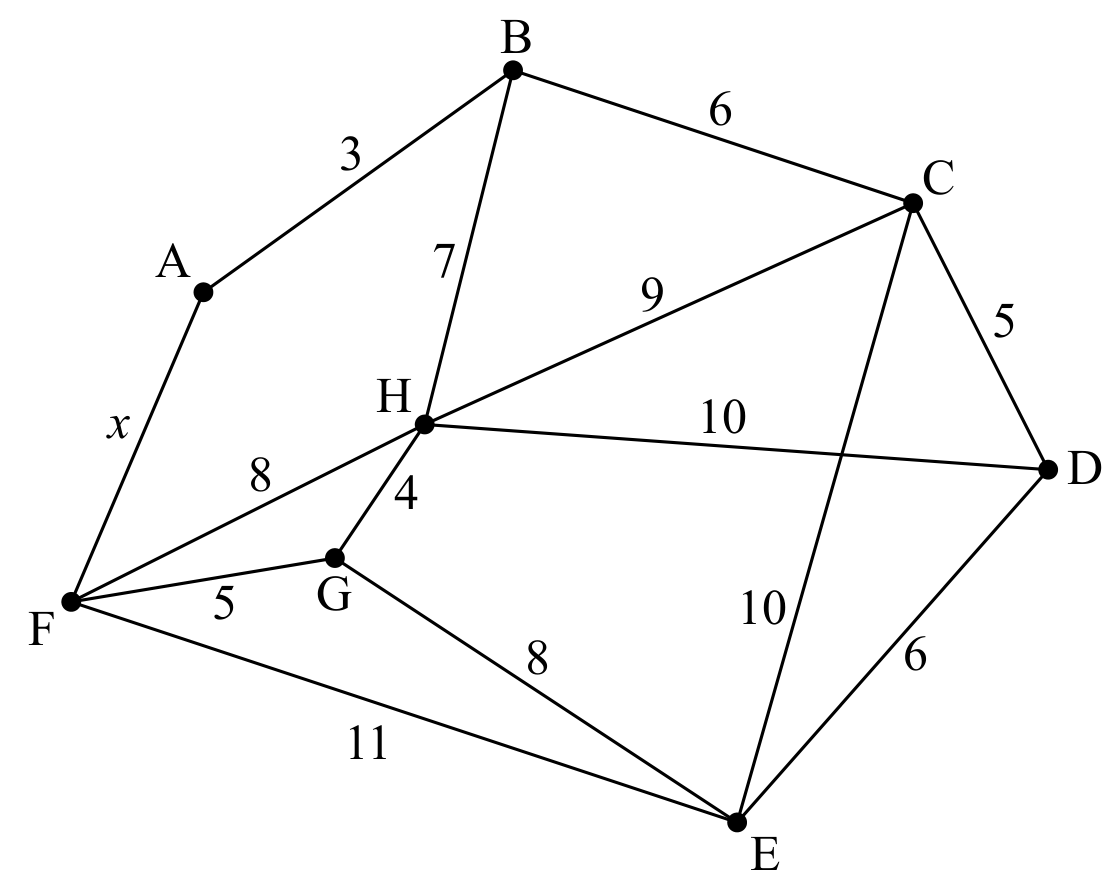
Graph W is shown in the following diagram. The vertices of W represent tourist attractions in a city. The weight of each edge represents the travel time, to the nearest minute, between two attractions. The route between A and F is currently being resurfaced and this has led to a variable travel time. For this reason, AF has an unknown travel time x minutes, where xZ+x \in \mathbb{Z}^{+}.

Question image
(a)

Write down a Hamiltonian cycle in W.

Daniel plans to visit all the attractions, starting and finishing at A. He wants to minimize his travel time.

To find a lower bound for Daniel's travel time, vertex A and its adjacent edges are first deleted.

[ 1 ]
(b)
(i)

Use Prim's algorithm, starting at vertex B, to find the weight of the minimum spanning tree of the remaining graph. You should indicate clearly the order in which the algorithm selects each edge.

[ 5 ]
(ii)

Hence, for the case where x<9, find a lower bound for Daniel's travel time, in terms of x.

Daniel makes a table to show the minimum travel time between each pair of attractions.
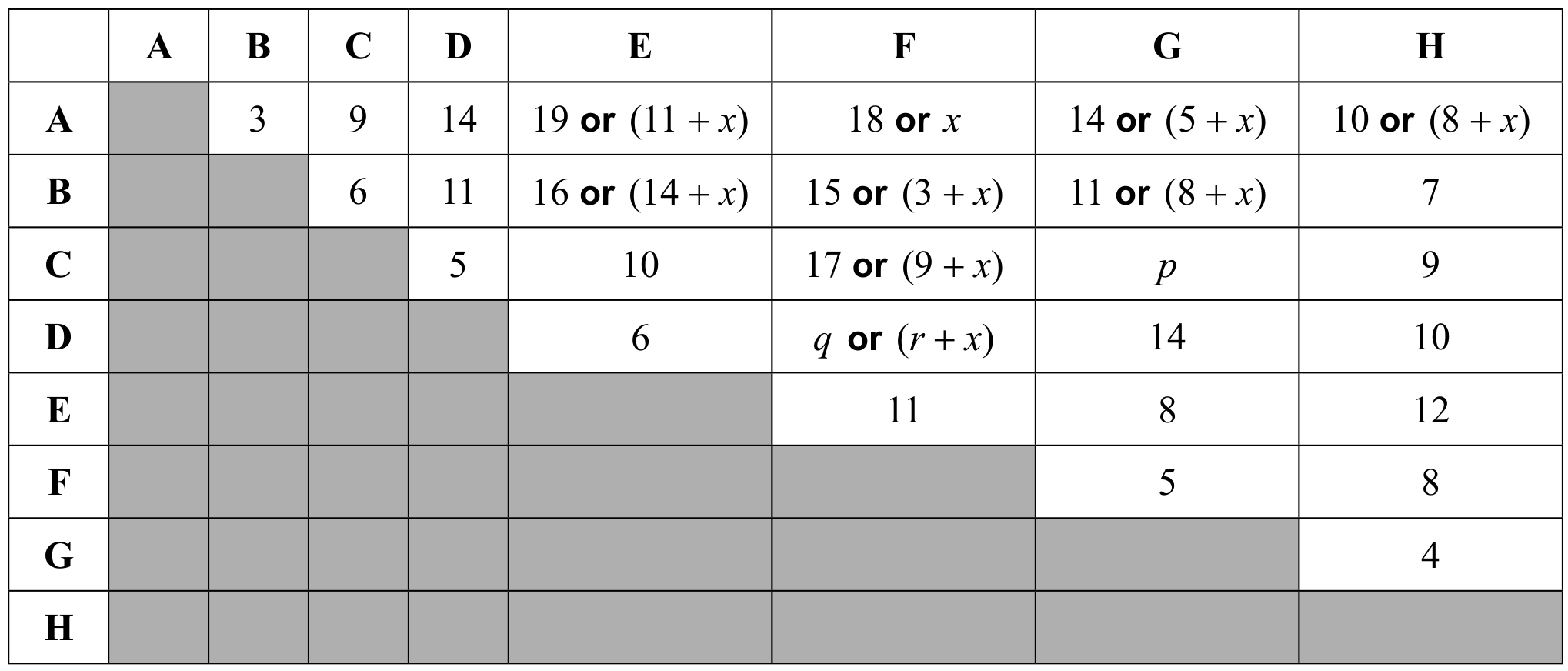
Table
[ 2 ]
(c)

Consider the case where x=3.

[ 5 ]
(i)

Use the nearest neighbour algorithm to find two possible cycles.

[ 3 ]
(ii)

Find the best upper bound for Daniel's travel time.

[ 2 ]
(d)

Consider the case where x>3.

[ 4 ]
(i)

Find the least value of x for which the edge AF will definitely not be used by Daniel.

[ 2 ]
(ii)

Hence state the value of the upper bound for Daniel's travel time for the value of x found in part (e)(i).

The tourist office in the city has received complaints about the lack of cleanliness of some routes between the attractions. Corinne, the office manager, decides to inspect all the routes between all the attractions, starting and finishing at H . The sum of the weights of all the edges in graph W is (92+x).

Corinne inspects all the routes as quickly as possible and takes 2 hours.

[ 2 ]
(e)

Find the value of x during Corinne's inspection.
[ 5 ]
[Maximum number: 12]

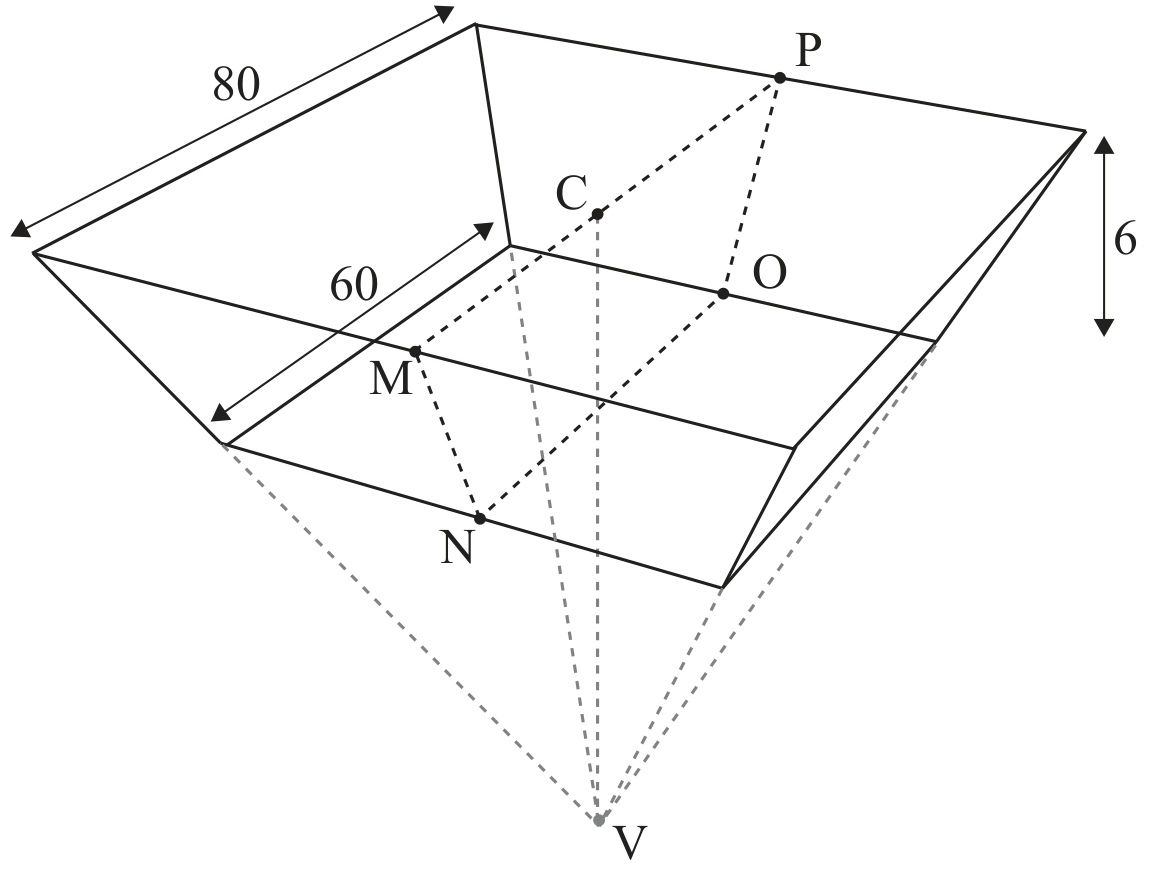
A large water reservoir is built in the form of part of an upside-down right pyramid with a horizontal square base of length 80 metres. The point C is the centre of the square base and point V is the vertex of the pyramid.

diagram not to scale

diagram not to scale

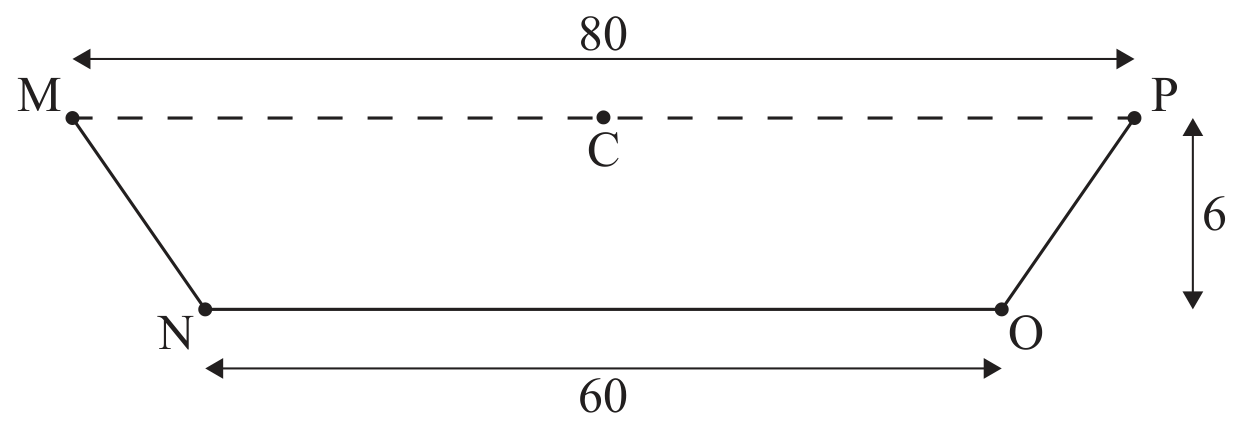
The bottom of the reservoir is a square of length 60 metres that is parallel to the base of the pyramid, such that the depth of the reservoir is 6 metres as shown in the diagram.

The second diagram shows a vertical cross section, MNOPC, of the reservoir.

Question image
(a)

Find the angle of depression from M to N .

[ 2 ]
(b)
(i)

Find CV.

(ii)

Hence or otherwise, show that the volume of the reservoir is 29600 m329600 \mathrm{~m}^{3}.

Every day 80 m380 \mathrm{~m}^{3} of water from the reservoir is used for irrigation.
Joshua states that, if no other water enters or leaves the reservoir, then when it is full there is enough irrigation water for at least one year.

[ 5 ]
(c)

Find the area that was painted.

[ 5 ]
[Maximum number: 15]

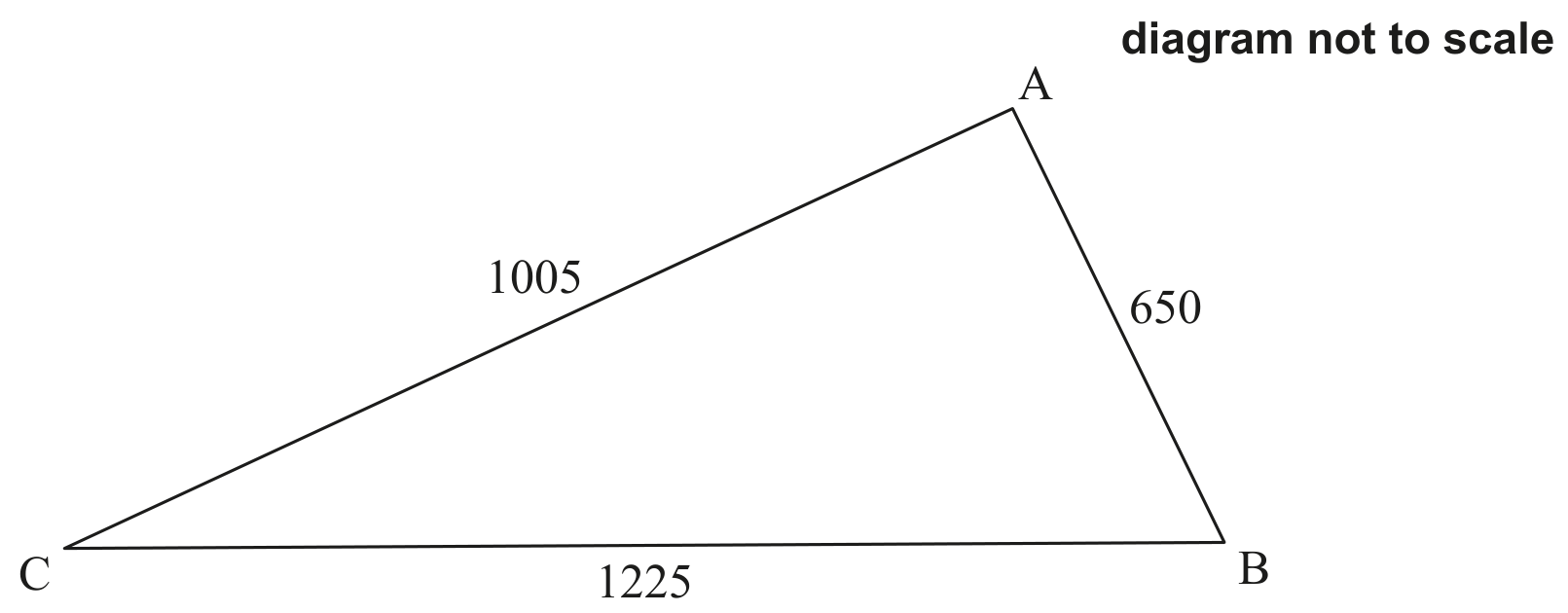
A farmer owns a field in the shape of a triangle ABC such that AB=650 m,AC=1005 m\mathrm{AB}=650 \mathrm{~m}, \mathrm{AC}=1005 \mathrm{~m} and BC=1225 m\mathrm{BC}=1225 \mathrm{~m}.

Question image
(a)

Find the size of AC^BA \hat{C} B.

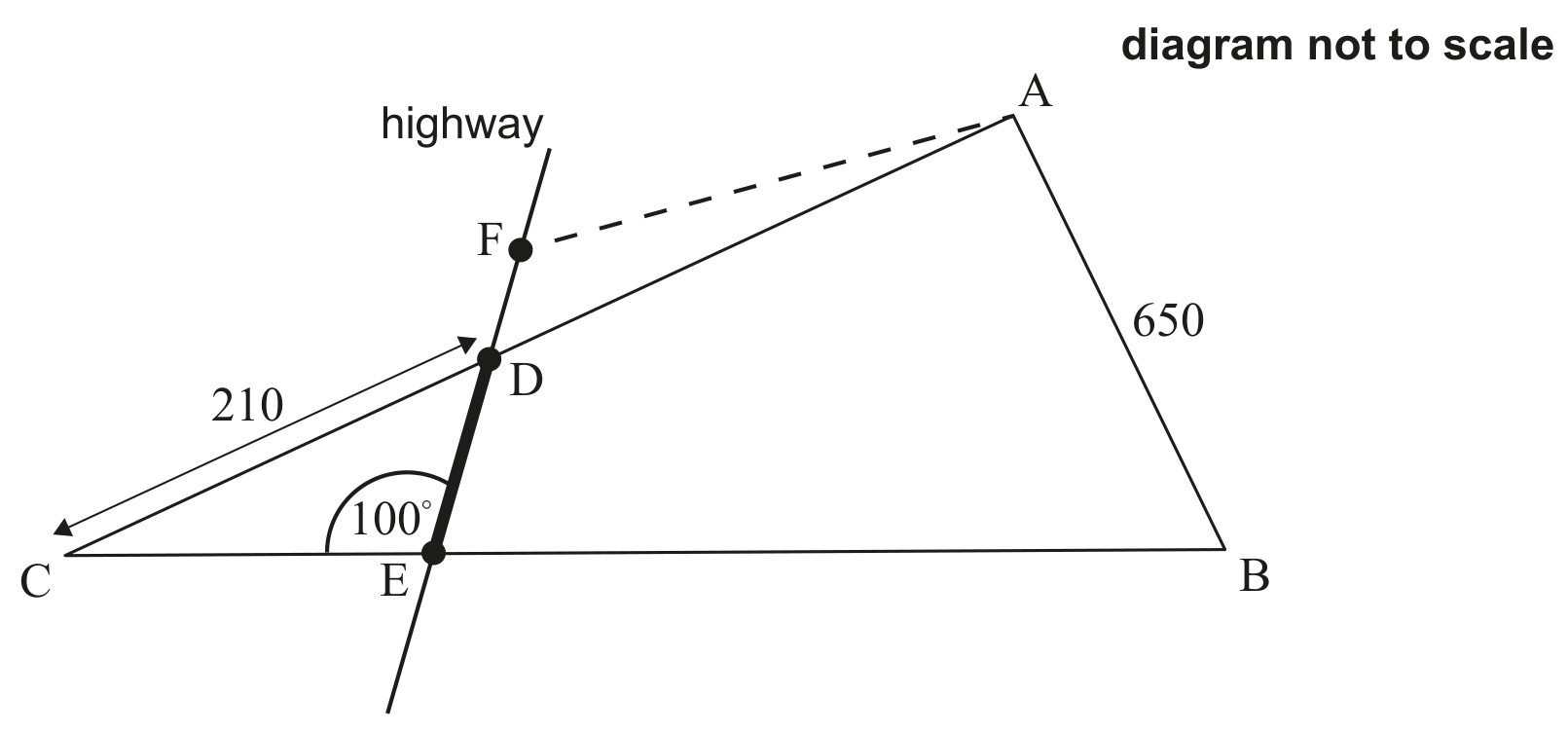
The local town is planning to build a highway that will intersect the borders of the field at points D and E , where DC=210 m\mathrm{DC}=210 \mathrm{~m} and CED=100\mathrm{CED}=100^{\circ}, as shown in the diagram below.

Question image
[ 3 ]
(b)

Find DE .

The town wishes to build a carpark here. They ask the farmer to exchange the part of the field represented by triangle DCE. In return the farmer will get a triangle of equal area ADF, where F lies on the same line as D and E, as shown in the diagram above.

[ 3 ]
(c)

Find the area of triangle DCE.

[ 5 ]
(d)

Estimate DF. You may assume the highway has a width of zero.

[ 4 ]
[Maximum number: 11]

A suitable site for the landing of a spacecraft on the planet Mars is identified at a point, A. The shortest time from sunrise to sunset at point A must be found.
Radians should be used throughout this question. All values given in the question should be treated as exact.
Mars completes a full orbit of the Sun in 669 Martian days, which is one Martian year.

Question image

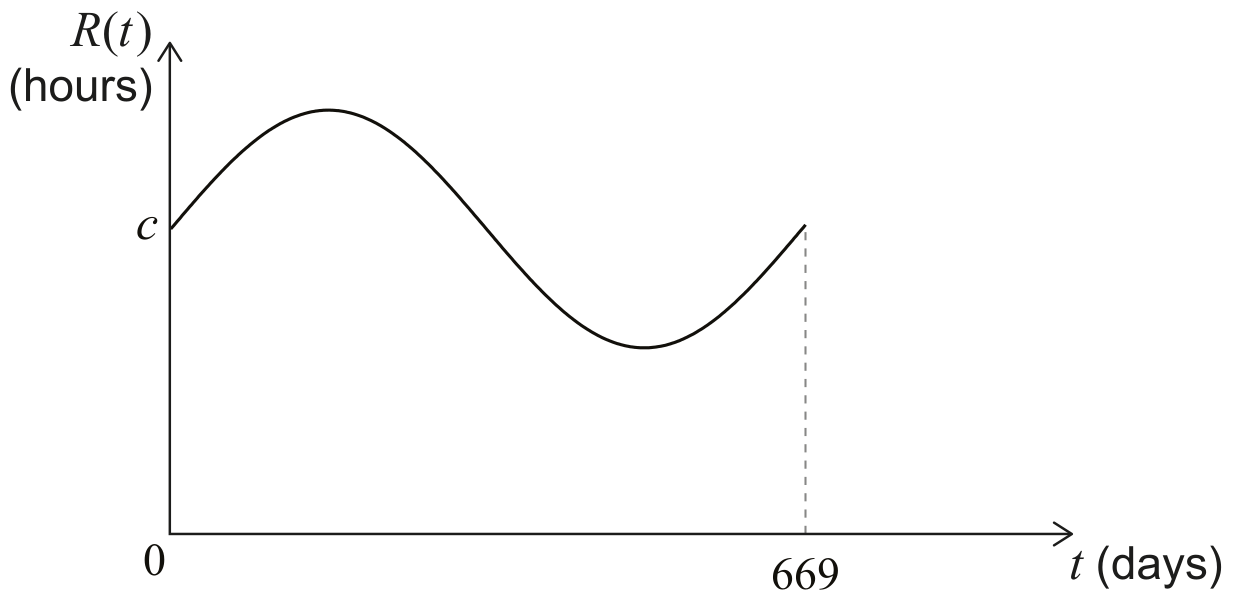
On day t, where tZt \in \mathbb{Z}, the length of time, in hours, from the start of the Martian day until sunrise at point A can be modelled by a function, R(t), where

R(t)=asin(bt)+c,tR.R(t)=a \sin (b t)+c, t \in \mathbb{R} .

The graph of R is shown for one Martian year.

Question image
(a)

Show that b0.00939b \approx 0.00939.

Mars completes a full rotation on its axis in 24 hours and 40 minutes.

[ 2 ]
(b)

Find the angle through which Mars rotates on its axis each hour.

The time of sunrise on Mars depends on the angle, δ\delta, at which it tilts towards the Sun. During a Martian year, δ\delta varies from -0.440 to 0.440 radians.

The angle, ω\omega, through which Mars rotates on its axis from the start of a Martian day to the moment of sunrise, at point A , is given by cosω=0.839tanδ,0ωπ\cos \omega=0.839 \tan \delta, 0 \leq \omega \leq \pi.

[ 3 ]
(c)
(i)

Show that the maximum value of ω=1.98\omega=1.98, correct to three significant figures.

[ 3 ]
(ii)

Find the minimum value of ω\omega.

[ 1 ]
(d)

Hence show that a=1.6, correct to two significant figures.

[ 2 ]
[Maximum number: 7]

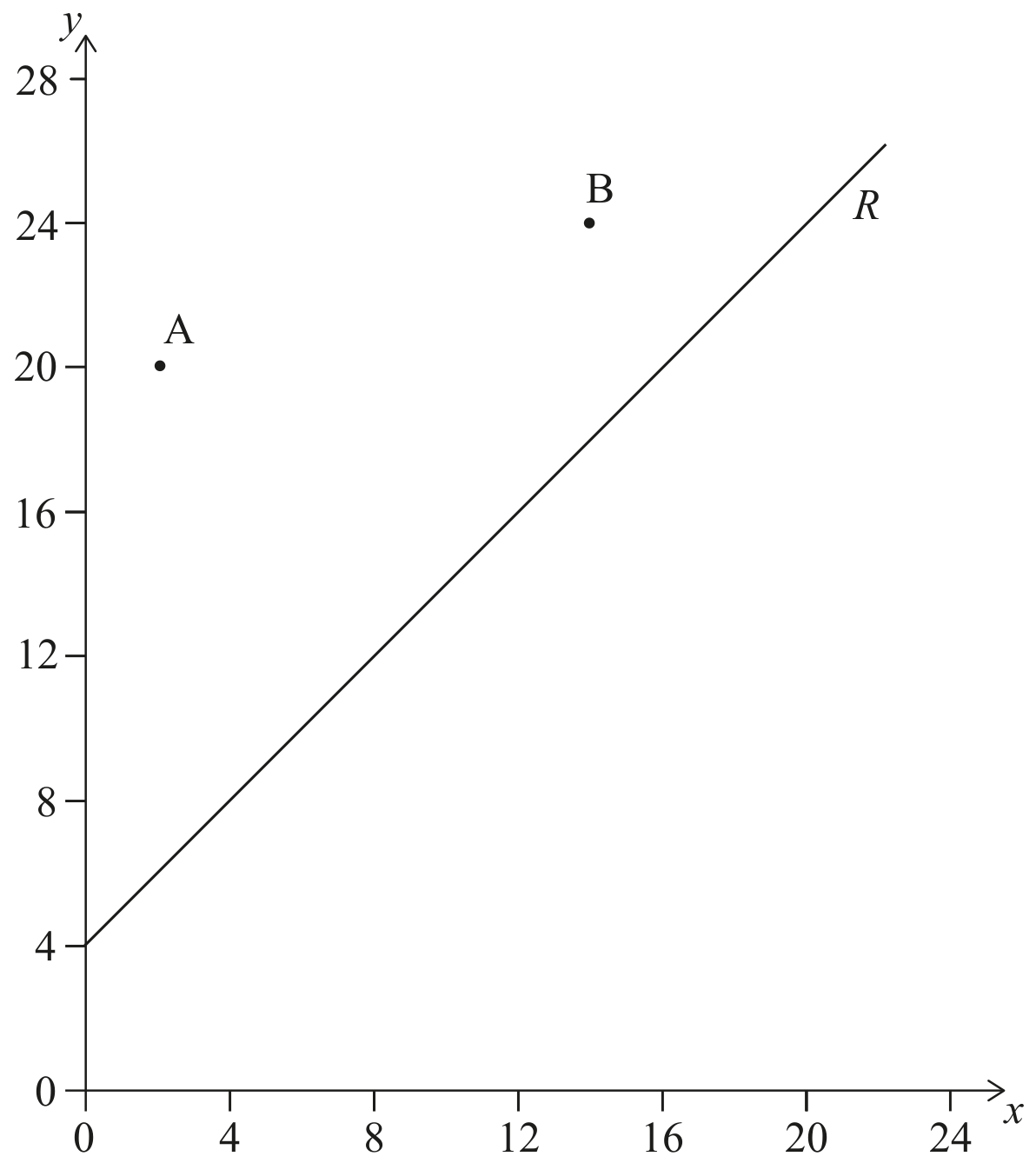
Two schools are represented by points A(2,20) and B(14,24) on the graph below. A road, represented by the line R with equation -x+y=4, passes near the schools. An architect is asked to determine the location of a new bus stop on the road such that it is the same distance from the two schools.

Question image
(a)

Find the equation of the perpendicular bisector of [AB][\mathrm{AB}]. Give your equation in the form y=m x+c.

[ 5 ]
(b)

Determine the coordinates of the point on R where the bus stop should be located.

[ 2 ]
[Maximum number: 13]

In this question, you will explore possible approaches to using historical sports results for making predictions about future sports matches.
Two friends, Peter and Helen, are discussing ways of predicting the outcomes of international football matches involving Argentina.
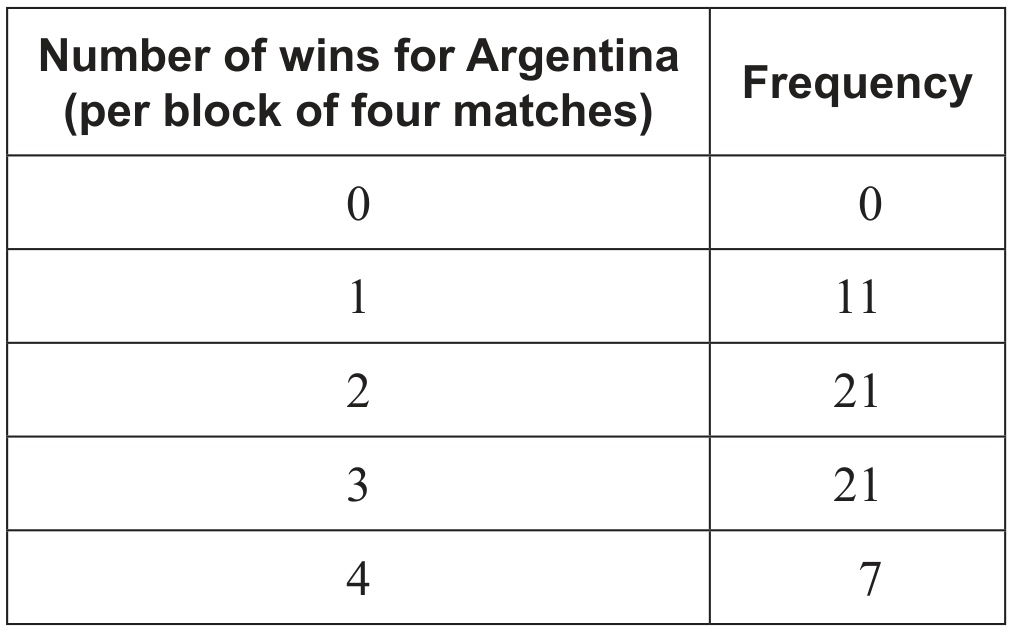
Peter suggests analysing historical data to help make predictions. He lists the results of the most recent 240 matches in which Argentina played, in chronological order, then considers blocks of four matches at a time. He counts how many times Argentina has won in each block. The following table shows his results for the 60 blocks of four matches.

Table
(a)
(i)

Write down the transition matrix, T, for Helen's model.

[ 2 ]
(b)
(i)

Show that the characteristic polynomial of T is 1363λ21263λ100=01363 \lambda^{2}-1263 \lambda-100=0.

[ 3 ]
(ii)

Hence or otherwise, find the eigenvalues of T.

[ 1 ]
(iii)

Find the corresponding eigenvectors.

[ 3 ]
(c)

In her retirement, many years from now, Helen is planning to travel to three consecutive international football matches involving Argentina. Use Helen's model to find the probability that Argentina will win all three matches.

[ 4 ]
[Maximum number: 12]

This question considers the optimal route between two points, separated by several regions where different speeds are possible.
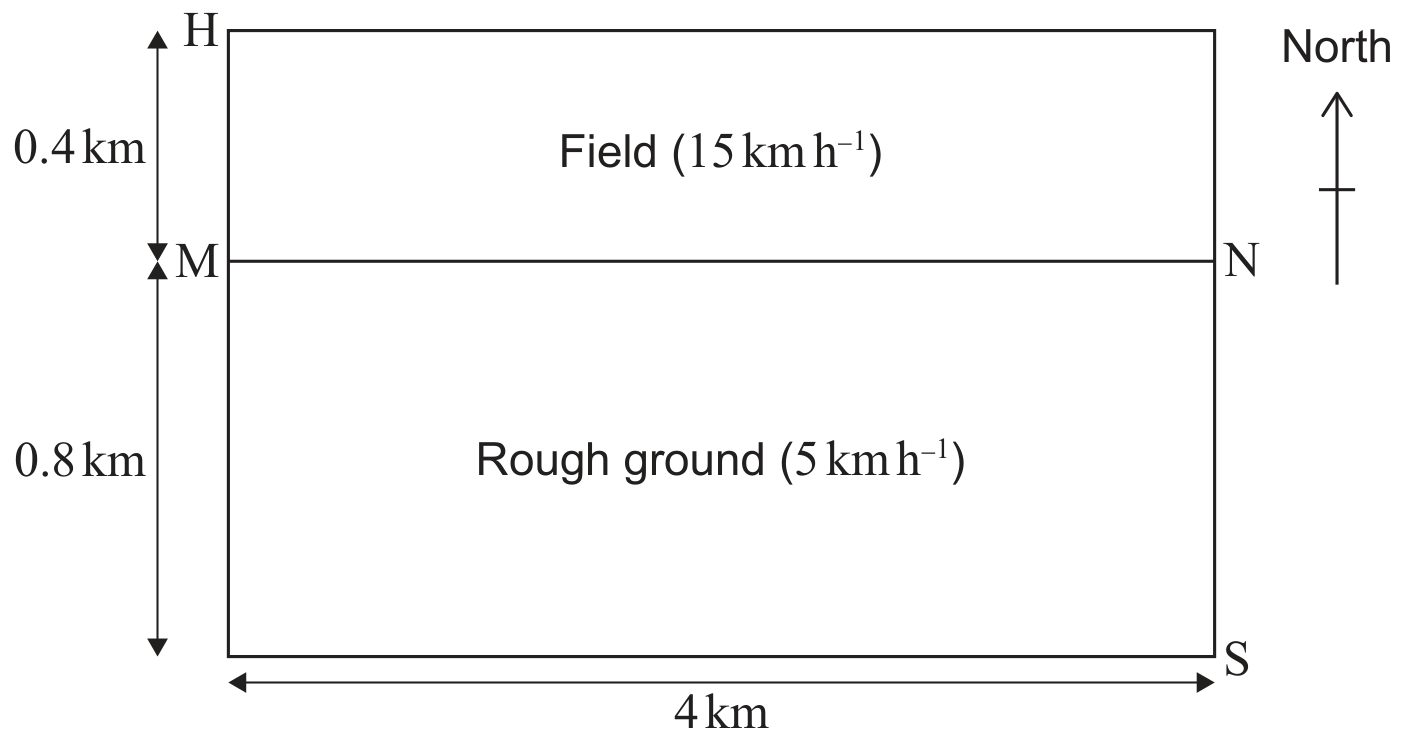
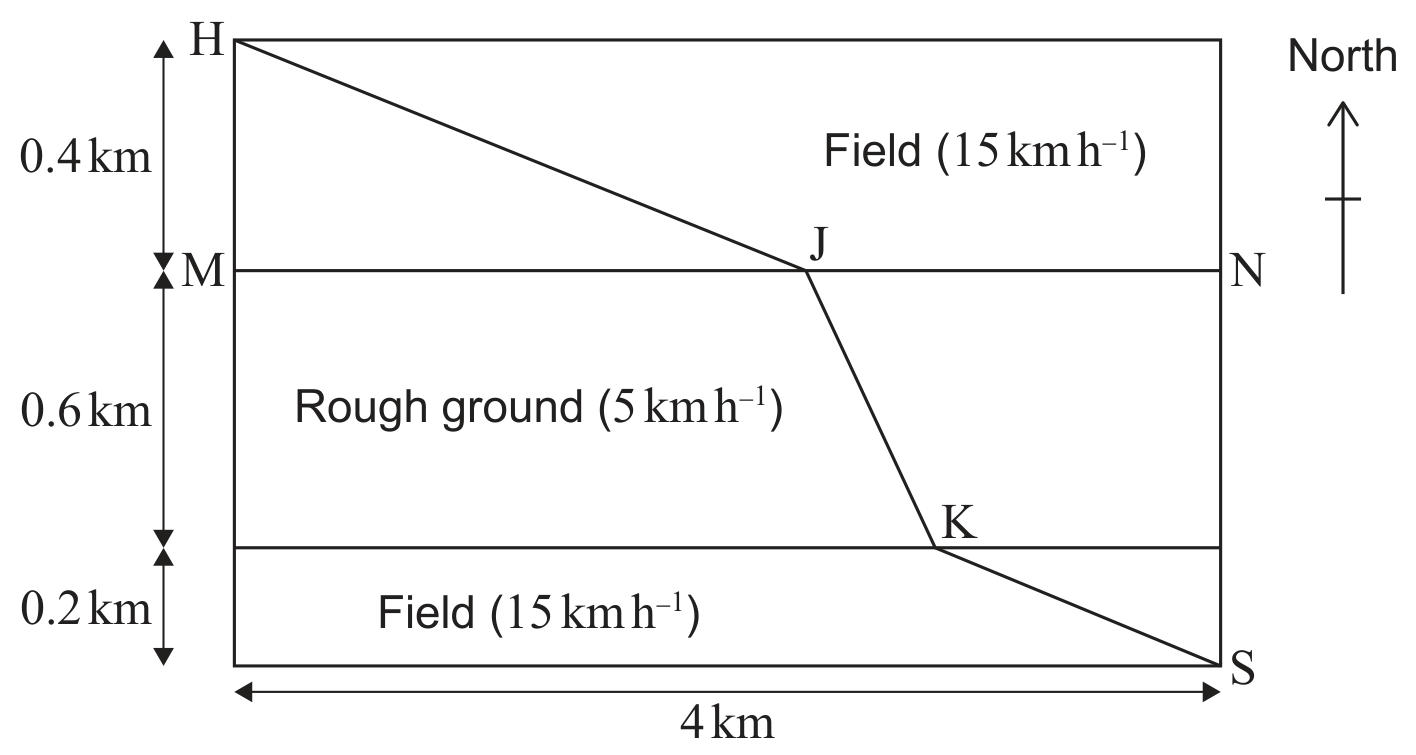
Huw lives in a house, H , and he attends a school, S , where H and S are marked on the following diagram. The school is situated 1.2 km south and 4 km east of Huw's house. There is a boundary [MN], going from west to east, 0.4 km south of his house. The land north of [MN] is a field over which Huw runs at 15 kilometres per hour (kmh1)\left(\mathrm{km} \mathrm{h}^{-1}\right). The land south of [MN] is rough ground over which Huw walks at 5 km h15 \mathrm{~km} \mathrm{~h}^{-1}. The two regions are shown in the following diagram.

diagram not to scale

diagram not to scale

(a)

Huw travels in a straight line from H to S . Calculate the time that Huw takes to complete this journey. Give your answer correct to the nearest minute.

[ 6 ]
(b)
(i)

For the optimal route, verify that the equation in part (c)(ii) satisfies the following result:

cosHPM^cos SP^ N= speed over field  speed over rough ground \frac{\cos \mathrm{H} \hat{\mathrm{P} M}}{\cos \mathrm{~S} \hat{\mathrm{P}} \mathrm{~N}}=\frac{\text { speed over field }}{\text { speed over rough ground }}
(c)

The owner of the rough ground converts the southern quarter into a field over which Huw can run at 15 km h115 \mathrm{~km} \mathrm{~h}^{-1}. The following diagram shows the optimal route, HJKS, in this new situation. You are given that [HJ] is parallel to [KS].

diagram not to scale

diagram not to scale

Using a similar result to that given in part (c)(iii), at the point J, determine MJ.

[ 6 ]
[Maximum number: 3]

In this question you will use a historic method of calculating the cost of a barrel of wine to determine which shape of barrel gives the best value for money.
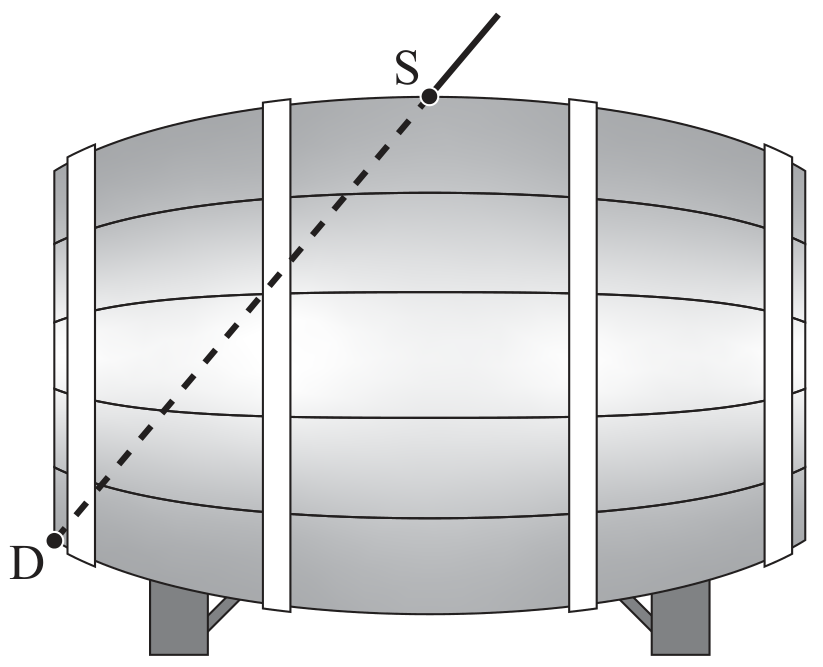
In Austria in the 17th century, one method for measuring the volume of a barrel of wine, and hence determining its cost, was by inserting a straight stick into a hole in the side, as shown in the following diagram, and measuring the length SD . The longer the length, the greater the cost to the customer.

Question image

Let SD be d metres and the cost be C gulden (the local currency at the time). When the length of SD was 0.5 metres, the cost was 0.80 gulden.

(a)

This method of determining the cost was noticed by a mathematician, Kepler, who decided to try to calculate the dimensions of a barrel which would give the maximum volume of wine for a given length SD.

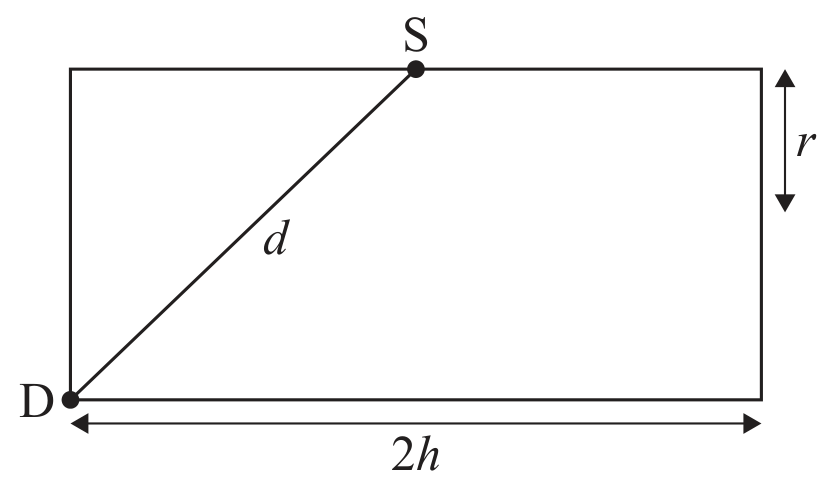
Initially he modelled the barrel as a cylinder, with S at the midpoint of one side. He took the length of the cylinder as 2 h metres and its radius as r metres, as shown in the following diagram of the cross-section.

Question image

Find an expression for r2r^{2} in terms of d and h.

Let the volume of this barrel be V m3V \mathrm{~m}^{3}.

[ 3 ]
[Maximum number: 13]

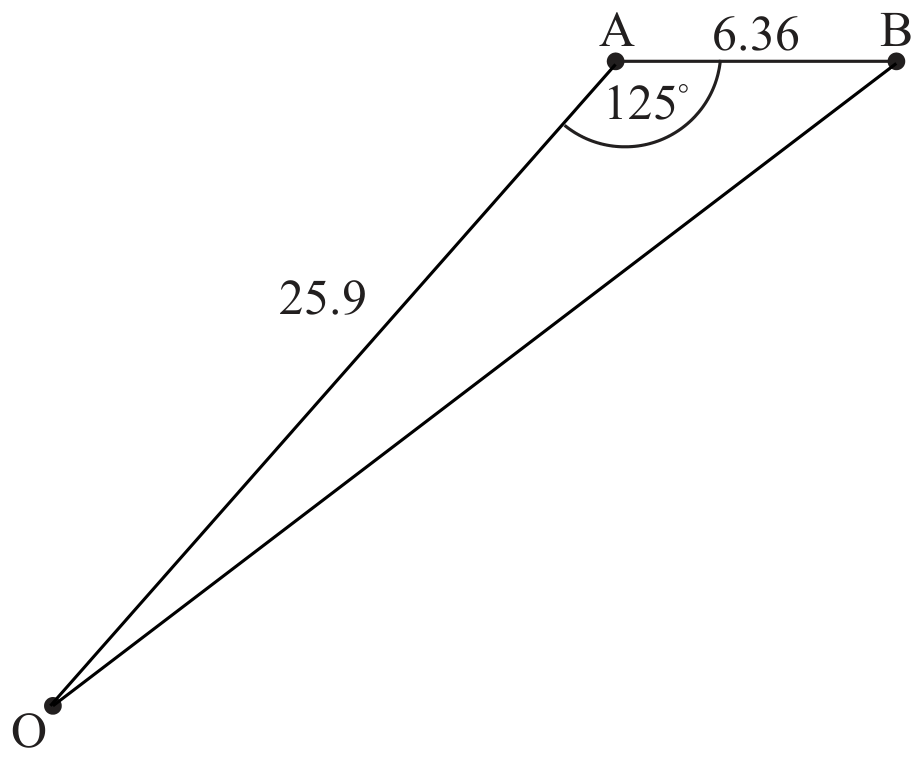
The diagram shows points in a park viewed from above, at a specific moment in time.
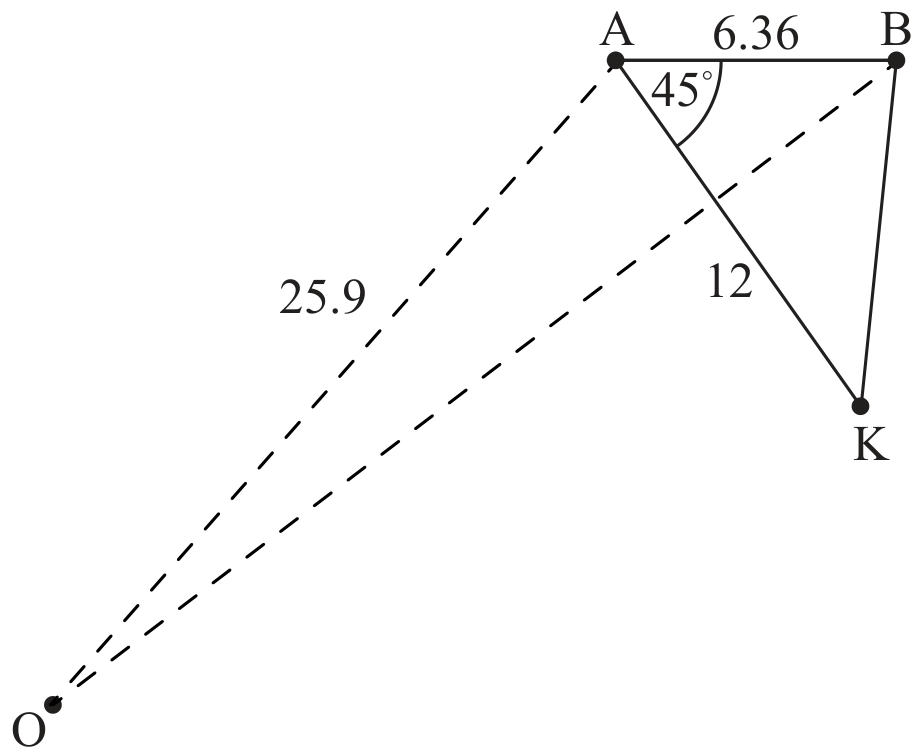
The distance between two trees, at points A and B , is 6.36 m .
Odette is playing football in the park and is standing at point O , such that OA=25.9 m\mathrm{OA}=25.9 \mathrm{~m} and OAB=125\mathrm{OAB}=125^{\circ}.

Question image
(a)

Calculate the area of triangle AOB.

Odette's friend, Khemil, is standing at point K such that he is 12 m from A and KAB =45=45^{\circ}.

Question image
[ 3 ]
(b)

Calculate Khemil's distance from B.

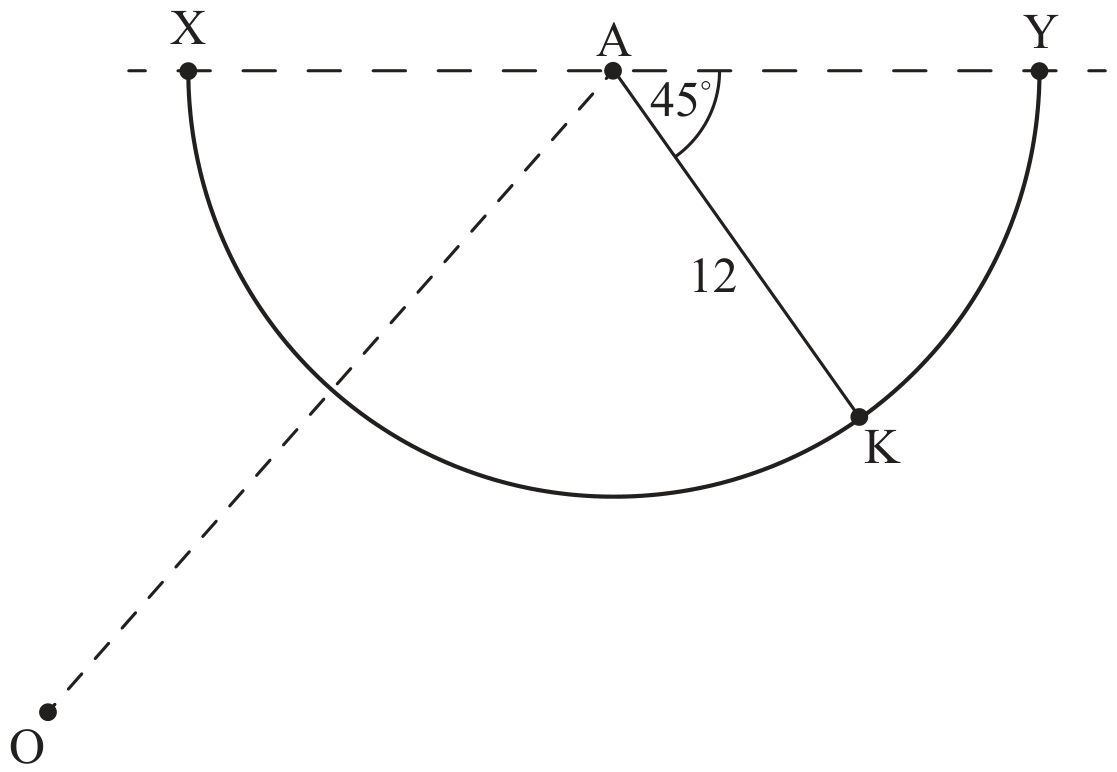
XY is a semicircular path in the park with centre A , such that KAY=45\mathrm{KA} \mathrm{Y}=45^{\circ}. Khemil is standing on the path and Odette's football is at point X . This is shown in the diagram below.

Question image

The length KX=22.2 m,KOPX=53.8\mathrm{KX}=22.2 \mathrm{~m}, \mathrm{KOPX}=53.8^{\circ} and OK^X=51.1\mathrm{O} \hat{\mathrm{K}} \mathrm{X}=51.1^{\circ}.

[ 3 ]
(c)

Find whether Odette or Khemil is closer to the football.

Khemil runs along the semicircular path to pick up the football.

[ 4 ]
(d)

Calculate the distance that Khemil runs.

[ 3 ]
[Maximum number: 18]

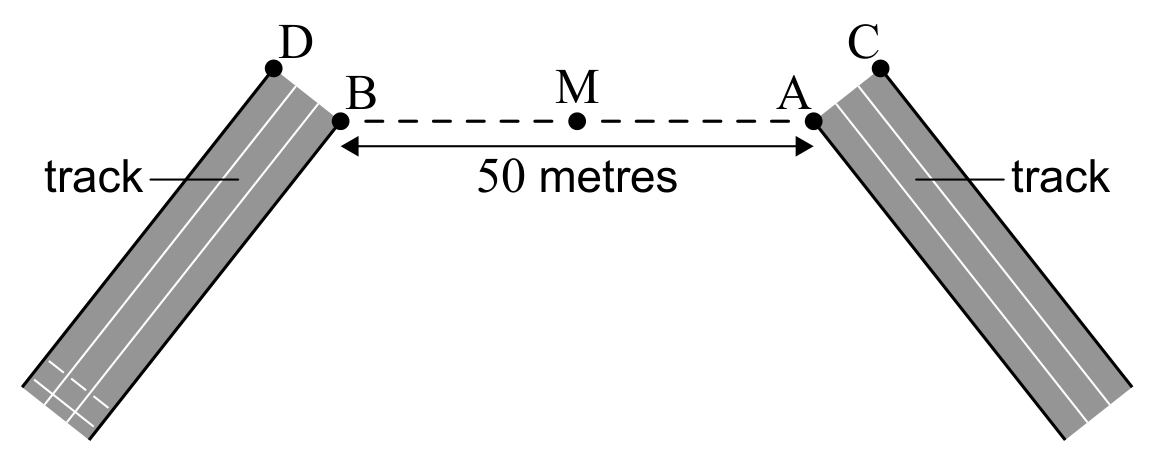
Madhu is designing a jogging track for the campus of her school. The following diagram shows an incomplete portion of the track.
Madhu wants to design the track such that the inner edge is a smooth curve from point A to point B , and the other edge is a smooth curve from point C to point D . The distance between points A and B is 50 metres.

Question image

To create a smooth curve, Madhu first walks to M , the midpoint of [AB][\mathrm{AB}].

(a)

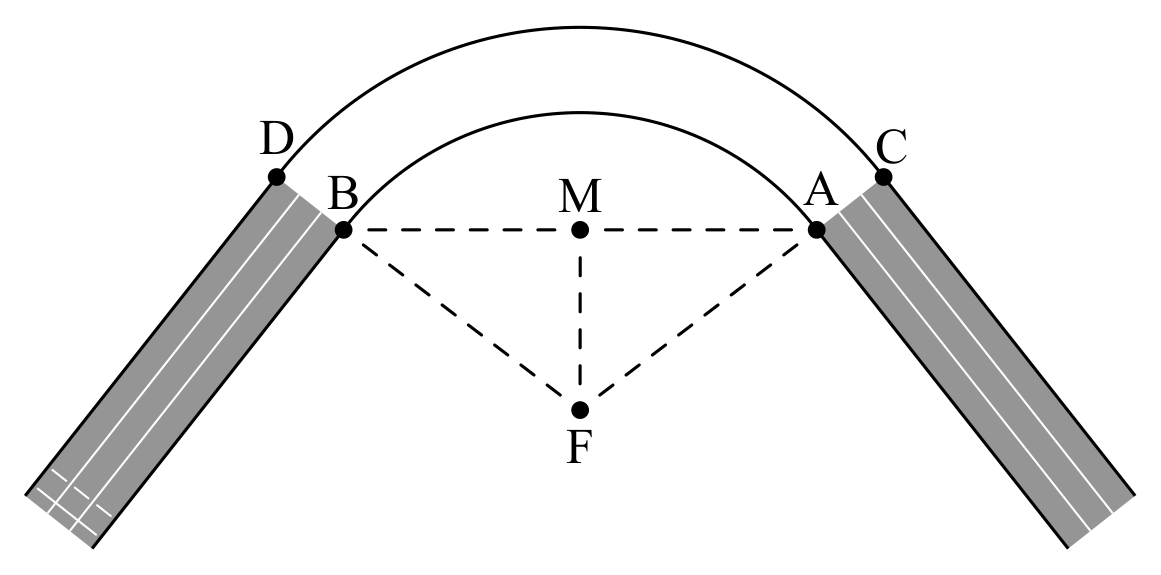
Madhu then walks 20 metres in a direction perpendicular to [A B] to get from point M to point F. Point F is the centre of a circle whose arc will form the smooth curve between points A and B on the track, as shown in the following diagram.

Question image
[ 8 ]
(i)

Find the length of [BF][\mathrm{BF}].

[ 4 ]
(ii)

Find BFA .

[ 4 ]
(b)

Hence, find the length of arc AB .

The outer edge of the track, from C to D, is also a circular arc with centre F, such that the track is 2 metres wide.

[ 3 ]
(c)

Calculate the area of the curved portion of the track, ABDC .

The base of the track will be made of concrete that is 12 cm deep.

[ 4 ]
(d)

Calculate the volume of concrete needed to create the curved portion of the track.

[ 3 ]
0