3.2.6—Structural isomers
- Syllabus
- First assessment 2025
- Objective
- 3.2.6
- Level
- SL
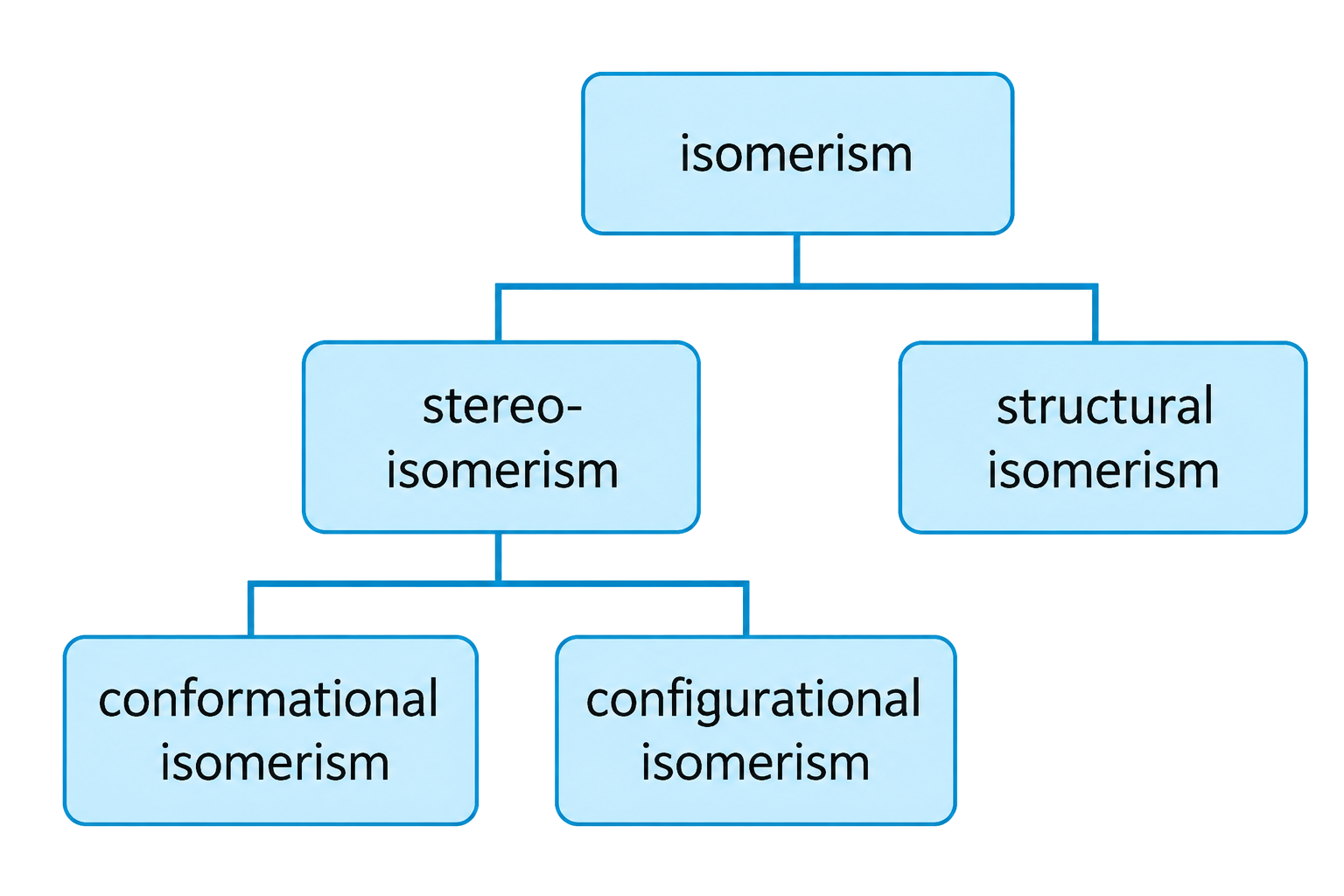
Structural isomers have the same molecular formula but different atom connectivities. Types include straight-chain/branched, position, and functional-group isomers.
Classify primary, secondary, and tertiary alcohols, halogenoalkanes, and amines by the carbon or nitrogen environment attached to the functional group.
| Family | Primary / secondary / tertiary test |
|---|---|
| Alcohol | count carbon groups attached to the carbon bearing -OH: 1 / 2 / 3 |
| Halogenoalkane | count carbon groups attached to the carbon bearing X: 1 / 2 / 3 |
| Amine | count carbon groups attached directly to N: 1 / 2 / 3 |
C₄H₁₀O can represent different carbon skeletons, different –OH positions, or an ether instead of an alcohol. Draw each connectivity once, then compare molecular formulae. Rotating or redrawing one connectivity does not create a new structural isomer.
For alcohols and halogenoalkanes, classify the carbon carrying the functional group; for amines, classify the nitrogen by how many carbon groups are bonded to it. Do not use the position number alone: butan-2-ol is secondary because its OH-bearing carbon is attached to two other carbons.