3.2.1—Organic formulas
- Syllabus
- First assessment 2025
- Objective
- 3.2.1
- Level
- SL
| Representation | What it preserves or shows |
|---|---|
| Empirical | Simplest whole-number atom ratio |
| Molecular | Actual atom counts |
| Structural/condensed | Connectivity in compact form |
| Skeletal | Carbon framework and implied hydrogen |
| Stereochemical/3D | Spatial arrangement |
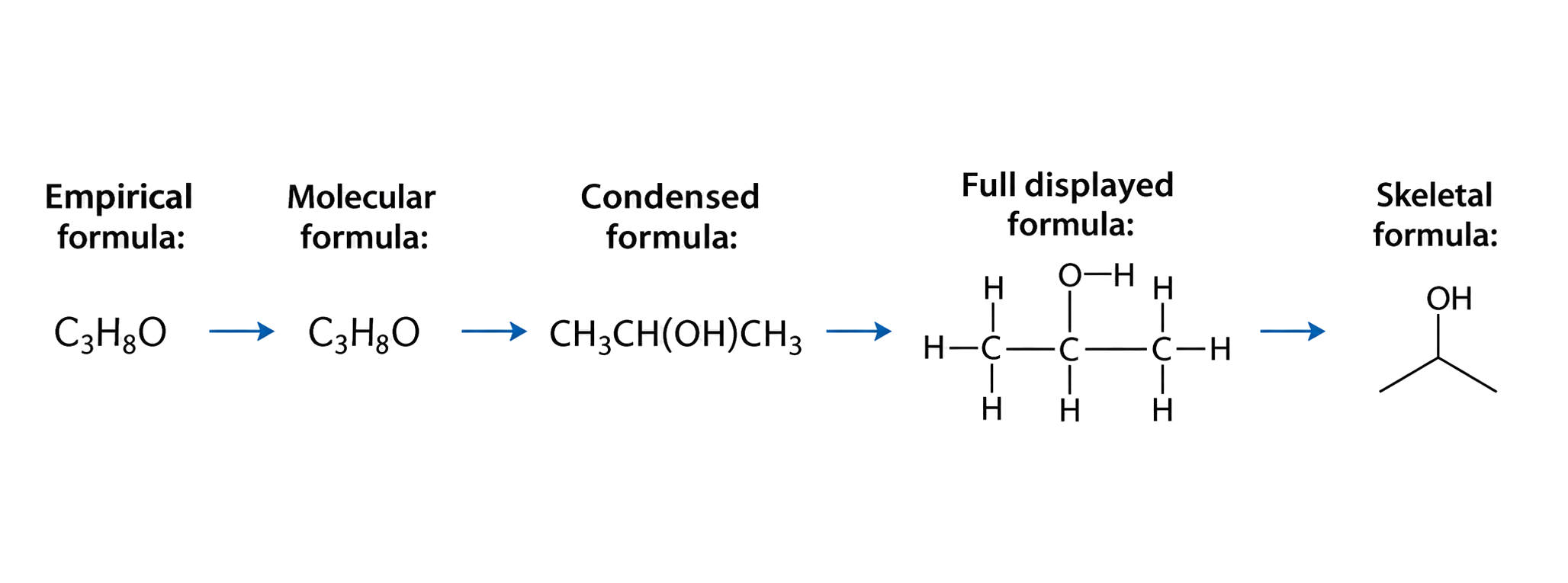
Translate representations without changing atom connectivity. For a skeletal formula, count every vertex and line end as carbon, add enough hydrogens to give carbon four bonds, and write heteroatoms explicitly. Then verify both the molecular formula and the connectivity.
An empirical formula is a ratio, not necessarily the complete molecule: hydrogen peroxide has molecular formula H₂O₂ but empirical formula HO. Reduce all subscripts by their greatest common factor; if no common factor exists, the molecular and empirical formula are identical.
Matching atom totals alone cannot prove two drawings are the same compound: connectivity and, where relevant, stereochemistry must also agree. Do not reduce a molecular formula when the subscripts already have no common factor.