3.2.2—Functional groups
- Syllabus
- First assessment 2025
- Objective
- 3.2.2
- Level
- SL
| Family | Complete recognition pattern | Bounded characteristic cue |
|---|---|---|
| Halogenoalkane | C–F/Cl/Br/I | polar C–X bond |
| Alcohol / hydroxyl | C–OH, not the –OH inside –COOH | can donate and accept hydrogen bonds |
| Aldehyde | terminal –CHO carbonyl | polar C=O; terminal carbonyl |
| Ketone | –CO– between carbons | polar C=O; internal carbonyl |
| Carboxylic acid | –COOH | acidic proton and hydrogen bonding |
| Ether / alkoxy | C–O–C | oxygen accepts hydrogen bonds but has no O–H donor |
| Amine / amino | C–N without adjacent carbonyl | basic lone-pair chemistry; N–H species may donate H bonds |
| Amide / amido | –CONH₂/–CONHR/–CONR₂ | nitrogen directly attached to carbonyl |
| Ester | –COO– between carbon groups | carbonyl and single-bond O in one group |
| Phenyl | C₆H₅– attached as a substituent | aromatic ring pattern |
Identify the whole local bonding pattern before naming the group; these cues support classification, not a complete reaction mechanism.
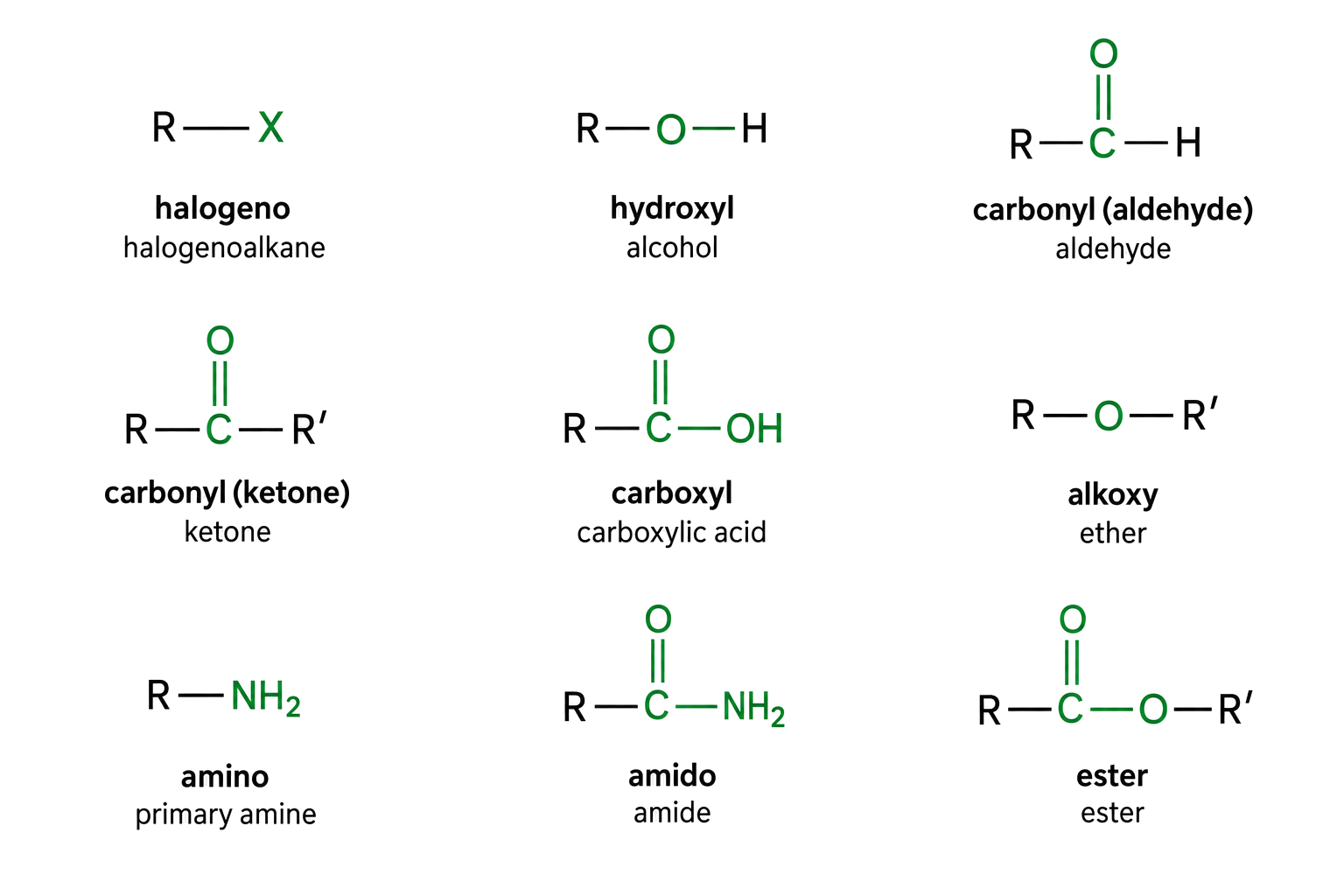
Identify the characteristic atoms and bonding pattern first, then give the functional-group name and relevant property context.
Identify the complete bonding pattern: an aldehyde has a terminal –CHO carbonyl, a ketone has C=O between carbons, and an ester contains –C(=O)–O–. Do not label every O–H as an alcohol or every C–N as an amine without checking the neighbouring carbonyl.
Saturation describes carbon-carbon bonding: a saturated compound has only C-C single bonds, while an unsaturated compound contains at least one C=C or C≡C bond. A carbonyl C=O does not by itself make the carbon skeleton unsaturated. Identify saturation separately from identifying hydroxyl, carbonyl, carboxyl or other functional groups.