3.1.3—Amphiprotic species

Syllabus
First assessment 2025
Objective
3.1.3
Level
SL

Amphiprotic Species

An amphiprotic species can donate H+ in one reaction and accept H+ in another.
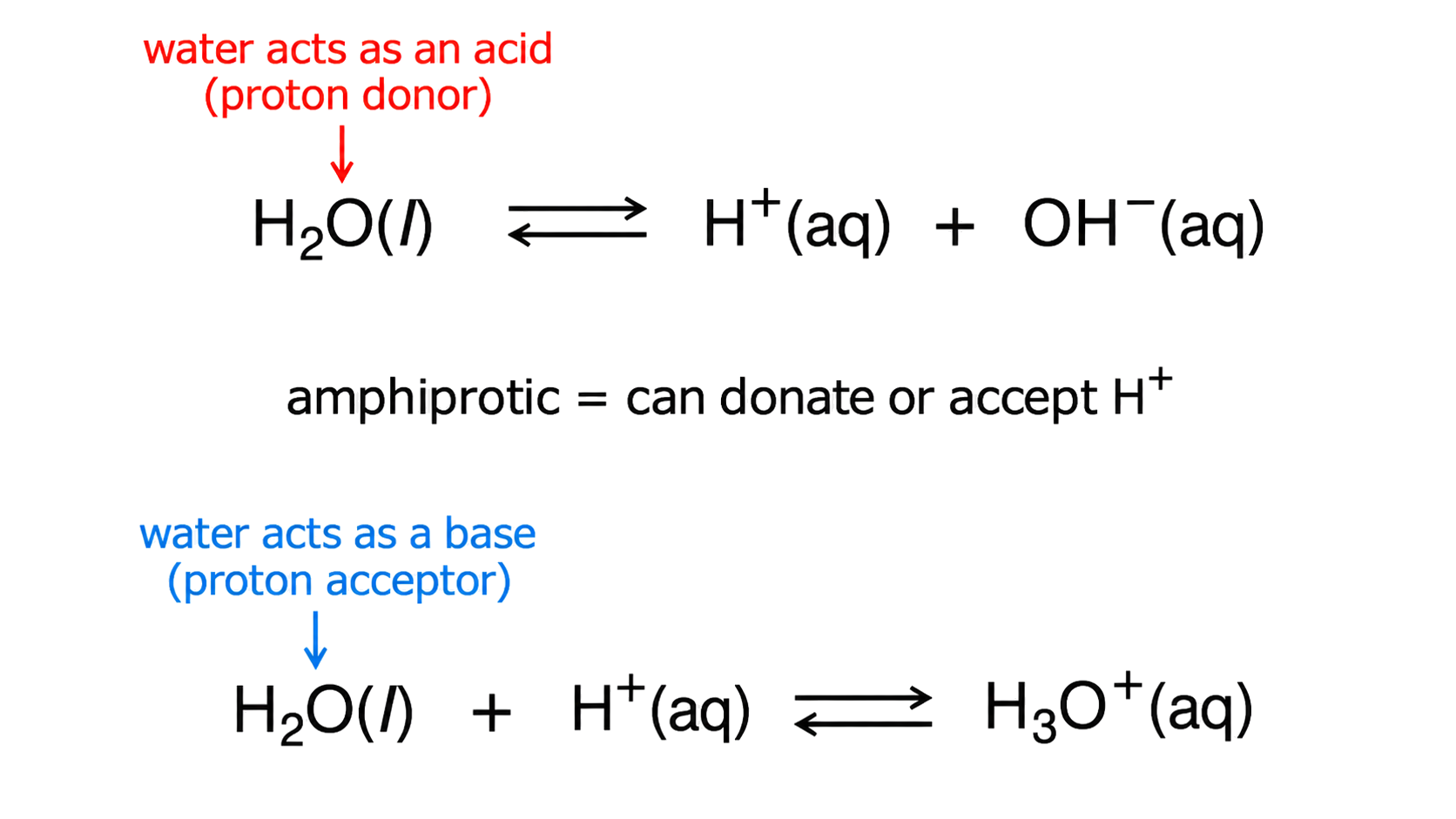
Write one equation in which the species becomes its conjugate base and another in which it becomes its conjugate acid.

For HCO₃⁻, donation gives CO₃²⁻ whereas acceptance gives H₂CO₃. Showing both reactions is the evidence for amphiprotic behaviour; one acid–base equation alone is insufficient.

Showing Amphiprotic Behaviour

Assessment in practice

Representative question

Question 1

[Maximum number: 2]

Formulate two equations to show the amphiprotic nature of H2PO4\mathrm{H}_{2} \mathrm{PO}_{4}^{-}.

Proton Transfer Reactions Summary

Retrieve the route: track proton transfer and conjugates, calculate pH and Kw, distinguish strength, balance neutralization, read titration curves, use Ka/Kb and hydrolysis, select indicators, and explain and calculate buffer behaviour.

Check donor versus acceptor, one-proton differences, logarithm direction, ion comparison, strength versus concentration, equivalence versus endpoint, pKa landmarks, conjugate equations and dilution ratios.