Reactivity 1. What drives chemical reactions?
- Syllabus
- First assessment 2025
- Section
- —
- Level
- SL
| Type | Energy direction | Surroundings temperature |
|---|---|---|
| Endothermic | Absorbed by the system | Decreases |
| Exothermic | Released by the system | Increases |
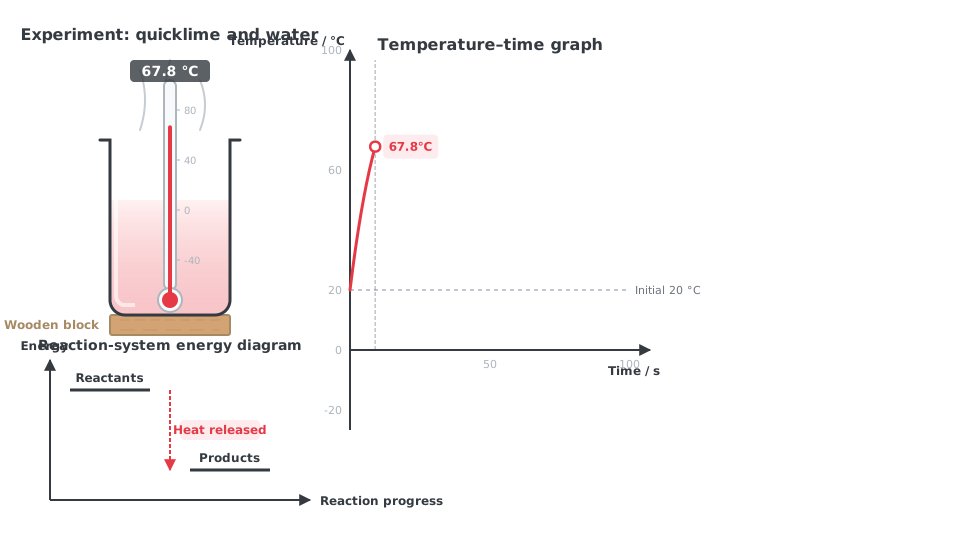
Classify from the direction of energy transfer, then check that the observed temperature change of the surroundings agrees.
Connect three representations: exothermic means energy flows out of the system, the surroundings warm, and ΔH for the system is negative; endothermic gives the opposite pattern and positive ΔH. State the observed part before inferring the reaction type.
Lower relative energy corresponds to greater relative stability. In an exothermic reaction the products are lower in energy than the reactants; in an endothermic reaction the products are higher.
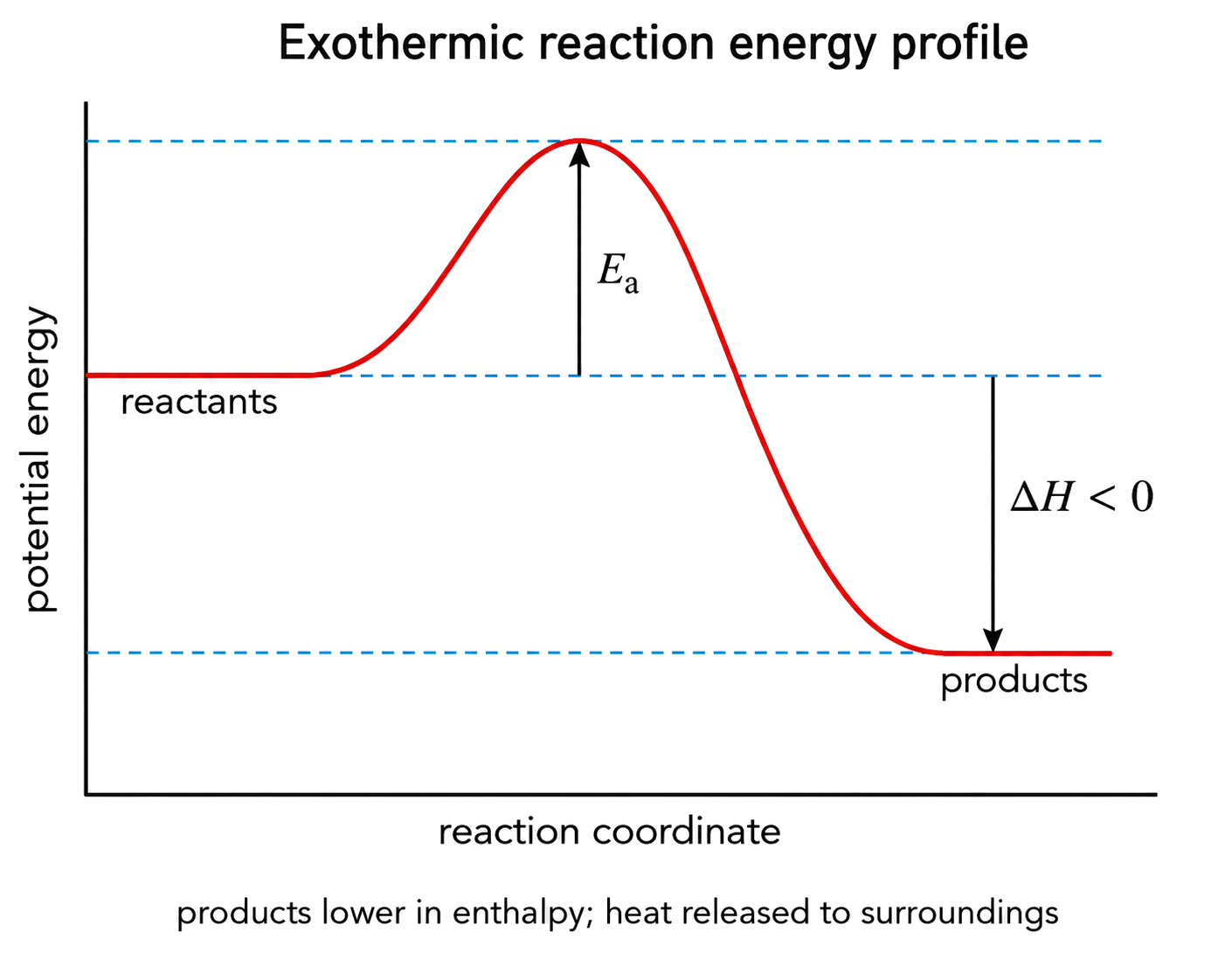
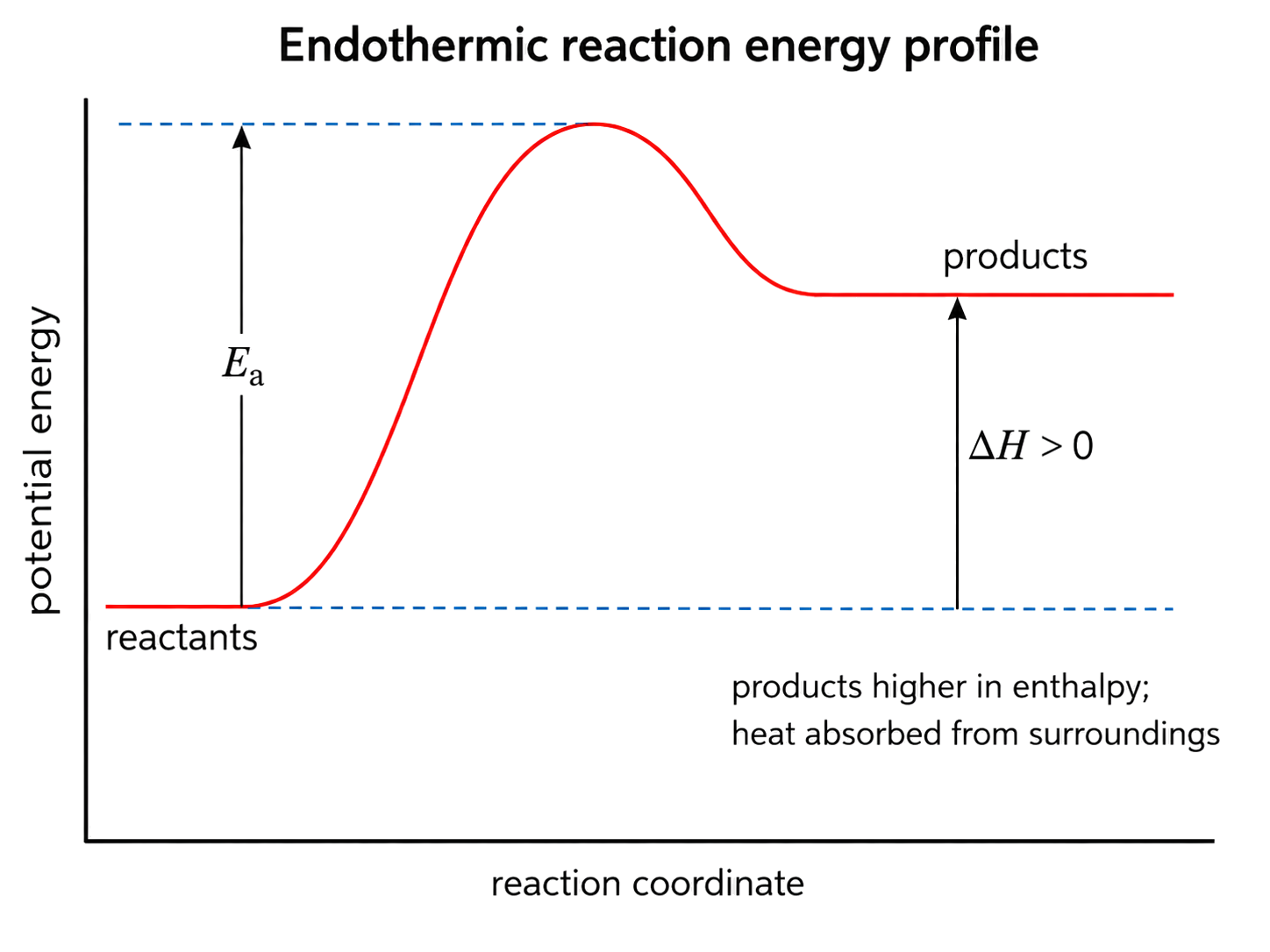
Label the horizontal axis reaction coordinate and the vertical axis potential energy. Then read reactant and product levels, identify the sign and direction of ΔH, and distinguish ΔH from activation energy.
On a profile, ΔH is the vertical difference between product and reactant levels, while activation energy rises from reactants to the peak. A catalyst lowers the peak by changing the pathway but leaves the two energy levels, ΔH and the relative stability of reactants and products unchanged.
An energy profile identifies an activation barrier but does not by itself determine an observed rate: temperature, particle concentrations/collision frequency and the available pathway also matter. Use the diagram to compare energetic barriers only when the profiles and conditions make that comparison valid.
Hess's law states that enthalpy change is independent of reaction pathway. Enthalpy values can therefore be combined through a balanced cycle.
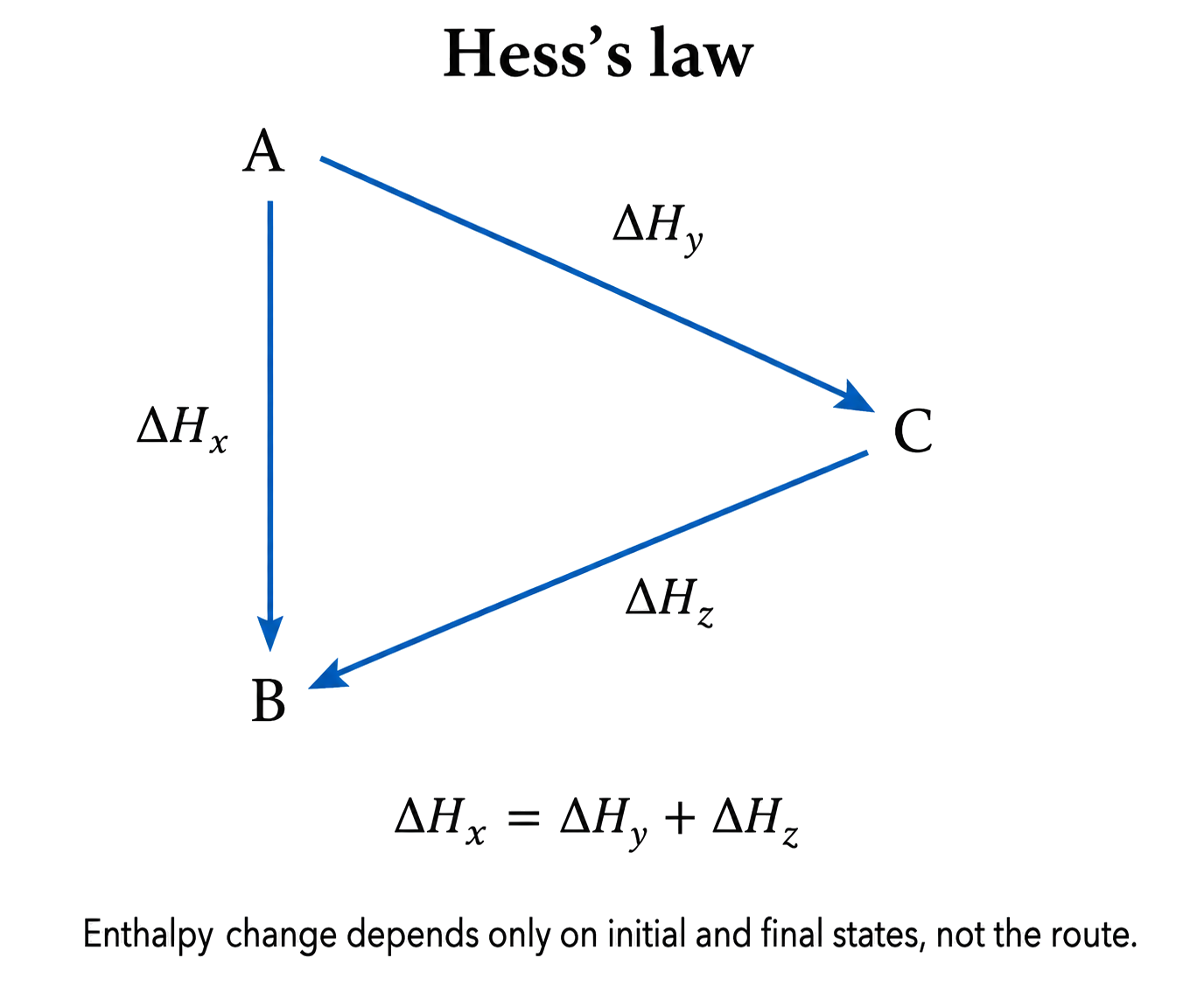
Reverse an entire balanced equation by changing the sign of ΔH; scale every coefficient and ΔH by the same factor; then add equations and cancel identical species in identical physical states. Never change a chemical subscript, formula or state symbol merely to force cancellation. The surviving equation must exactly match the target before enthalpies are summed.
Treat chemical equations like algebra: reverse a step and reverse its ΔH sign; multiply all coefficients and ΔH by the same factor; then add and cancel species. The surviving overall equation must exactly match the target before the enthalpies are summed.
Worked example — Hess's law: target . Use , ; double to give ; reverse methanol combustion to give . After cancelling and , for the target equation.
A fuel cell converts chemical energy from a spontaneous redox reaction directly into electrical energy. Oxidation occurs at the anode and reduction at the cathode.
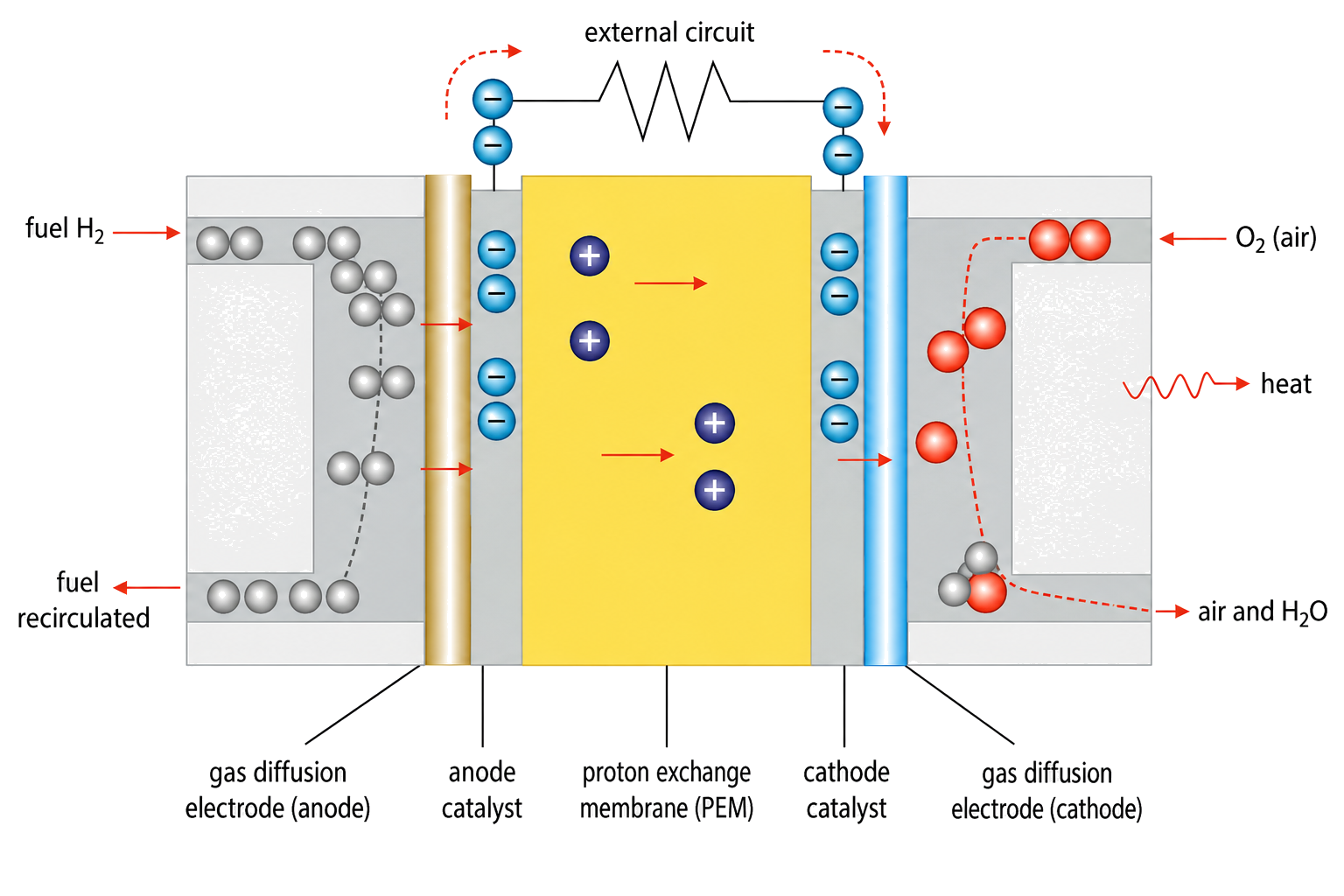
Deduce each half-equation from the fuel-cell reactants and electrolyte context, balance atoms and charge, then add the half-equations to obtain the overall reaction. Hydrogen and methanol cells require different oxidation half-equations.
For a hydrogen fuel cell, oxidation of H₂ supplies electrons at the anode and O₂ gains electrons at the cathode; the half-equations must match the acidic or alkaline electrolyte before they are added to 2H₂ + O₂ → 2H₂O. Direct electrical conversion does not remove the need to evaluate fuel production and storage.
A fuel cell operates while fuel and oxidant are supplied continuously from outside; a conventional battery stores a finite set of reactants internally. Point-of-use water from a hydrogen cell is not a complete environmental assessment—fuel manufacture, transport, storage and electricity source remain inside a lifecycle comparison.
Worked equations — acidic hydrogen cell: anode ; cathode . Double the anode equation before adding, giving . Direct-methanol cell: anode ; cathode . Adding and cancelling gives . Match each half-equation to the stated electrolyte; proton-exchange-membrane construction details are not assessed.
