1.2 Energy cycles
- Syllabus
- First assessment 2025
- Topic
- 1.2
- Level
- SL
ΔH≈Σ(bondsbroken)−Σ(bondsformed)
Breaking bonds absorbs energy; forming bonds releases energy. Count every bond with its stoichiometric multiplicity before applying the signed sum.
For H₂ + Cl₂ → 2HCl, break one H–H and one Cl–Cl bond, then form two H–Cl bonds. Average bond enthalpies give an estimate because the tabulated value averages that bond across different gaseous molecules.
Worked example — bond enthalpies: for CX2HX4(g)+HBr(g)CX2HX5Br(g), the local course book gives C−H=414, C=C=614, H−Br=366, C−C=346 and C−Br=285kJmol−1. ΔH=[4(414)+614+366]−[5(414)+346+285]=2636−2701=−65kJmol−1. The negative estimate means the bonds formed release more energy than the bonds broken absorb; it remains approximate because the values are gaseous averages.
Representative question
Calculate the enthalpy change for the reaction, ΔH. Use section 12 of the data booklet.
Alternative 1:
«bonds broken»
121O=O+4C−H+Cl−Cl/121×498+4×414+242/2645 «kJ mol −1 » «bonds formed»
C=O+2C−O+2H−O+2H−Cl/804+2×358+2×463+2×431/3308 « kJ mol−1 » ΔH= «2645-3308=»-663 «kJ mol-1» (correct calculation: reactants-products) OR
Alternative 2:
«Bonds broken» [12(414)+2(346)+242+1.5(498)] =6649 V
«Bonds formed» [8(414) + 804+2(358)+2(346)+2(431)+2(463)]=7312.
ΔH= «6649-7312=» -663 « kJmol−1 » (correct calculation: reactants-products)
Marking guidance:
Award [3] for correct final answer.
Award [2 max] for +663 « kJmol−1 ».
Accept breaking and remaking all the other bonds.
Hess's law states that enthalpy change is independent of reaction pathway. Enthalpy values can therefore be combined through a balanced cycle.
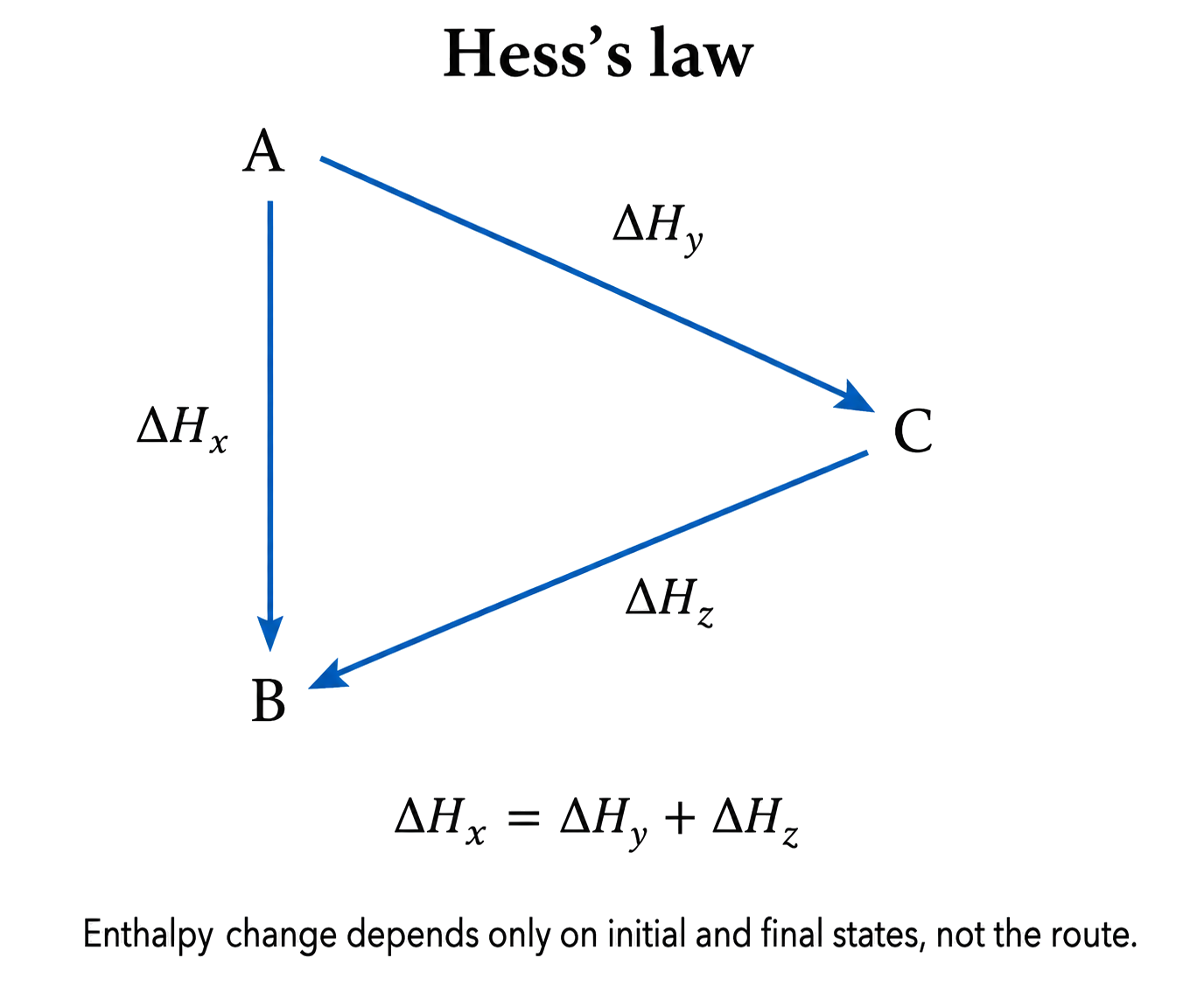
Reverse an entire balanced equation by changing the sign of ΔH; scale every coefficient and ΔH by the same factor; then add equations and cancel identical species in identical physical states. Never change a chemical subscript, formula or state symbol merely to force cancellation. The surviving equation must exactly match the target before enthalpies are summed.
Treat chemical equations like algebra: reverse a step and reverse its ΔH sign; multiply all coefficients and ΔH by the same factor; then add and cancel species. The surviving overall equation must exactly match the target before the enthalpies are summed.
Worked example — Hess's law: target C(s)X2+HX2(g)X1+/2OX2(g)CHX3OH(l). Use CX+OX2COX2, ΔH=−394kJmol−1; double HX2X+1/2OX2HX2O(l) to give −572kJmol−1; reverse methanol combustion to give +726kJmol−1. After cancelling COX2 and HX2O, ΔH=−394−572+726=−240kJmol−1 for the target equation.
Representative question
Determine the enthalpy change, ΔH, in kJmol−1, for the hydration of solid anhydrous magnesium sulfate, MgSO4.
ΔH(=ΔH1−ΔH2)=−99( kJ mol−1);
Marking guidance:
Award [1] if -86 is used giving an answer of −104( kJ mol−1).
Retrieve the route: count bond breaking/forming, manipulate Hess equations, define standard formation/combustion values, apply product–reactant sums, and track every Born–Haber energy term.
Check equation direction, coefficients, signs, standard states, lattice enthalpy convention, and one-versus-two-electron steps.