[Maximum number: 2]
Urea, , is excreted by mammals and can be used as a fertilizer.
(a)
Describe the bond formation when urea acts as a ligand in a transition metal complex ion.
[ 2 ]
 EduNinja
Urea, , is excreted by mammals and can be used as a fertilizer.
Describe the bond formation when urea acts as a ligand in a transition metal complex ion.
Ethyne, , reacts with oxygen in welding torches.
Ethyne reacts with steam.
Two possible products are:
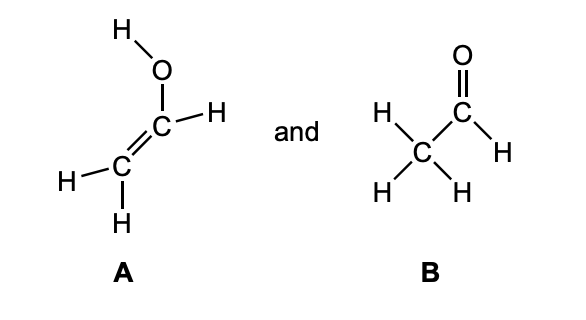
Product A contains a carbon-carbon double bond. State the type of reactions that compounds containing this bond are likely to undergo.
Chlorine undergoes many reactions.
Write the equation for the reaction of chloroethane with a dilute aqueous solution of sodium hydroxide.
Deduce the nucleophile for the reaction in d(iii).
Chlorine undergoes many reactions.
Explain the mechanism of the reaction between chloroethane and aqueous sodium hydroxide, NaOH(aq), using curly arrows to represent the movement of electron pairs.
Alkanes are commonly occurring organic compounds.
Chloroethane can be converted to ethanol. Identify the reagent and conditions necessary for this reaction to occur.
Reagent:
Conditions:
Alkanes are commonly occurring organic compounds.
Chloroethane can be converted to ethanol. Identify the reagent and conditions necessary for this reaction to occur.
Reagent:
Conditions:
Hydrogen cyanide, HCN , is a very toxic compound.
The cyanide ion reacts with iodomethane, .
Predict, giving a reason, whether this reaction will occur by an or mechanism.
Explain how you might experimentally conclude whether the mechanism of this reaction is or .
Halogenoalkanes are used as refrigerants and solvents.
Substance X undergoes nucleophilic substitution with a hydroxide nucleophile.
Describe the movement of electron pairs during the reaction using curly arrows.
Cobalt forms the complex . Which statements are correct for this complex?
I. The cobalt ion acts as a Lewis acid.
II. The cobalt ion has an oxidation number of + II.
III. There are bond angles between the cobalt ion and the ligands.
I and II only
I and III only
II and III only
I, II and III
Which species cannot act as a ligand?