EduNinja
[Maximum number: 3]

Hydrogen cyanide, HCN , is a very toxic compound.

(a)

The cyanide ion, CN\mathrm{CN}^{-}, can form complex ions, such as [Fe(CN)6]4\left[\mathrm{Fe}(\mathrm{CN})_{6}\right]^{4-}.

[ 3 ]
(i)

[Fe2+]\left[\mathrm{Fe}^{2+}\right] is 2.20×10⁷moldm32.20 \times 10^{-7} \mathrm{moldm}^{-3} in a 1.00moldm31.00 \mathrm{moldm}^{-3} solution of the complex ion.

Determine the value of the equilibrium constant, K, for the formation of [Fe(CN)6]4\left[\mathrm{Fe}(\mathrm{CN})_{6}\right]^{4-} from its constituent ions.

[ 3 ]
[Maximum number: 10]

Nitrogen dioxide, NO2\mathrm{NO}_{2}, is a brown, toxic and corrosive gas. It can be made in a school laboratory by heating a group II metal nitrate or by the reaction of copper, Cu , with concentrated nitric acid, HNO3\mathrm{HNO}_{3}.

(a)

The NO2\mathrm{NO}_{2} made was sealed in a glass vessel where the following equilibrium reaction occurred:

2NO2( g)N2O4( g)ΔH=55.3 kJ mol12 \mathrm{NO}_{2}(\mathrm{~g}) \rightleftharpoons \mathrm{N}_{2} \mathrm{O}_{4}(\mathrm{~g}) \quad \Delta H^{\ominus}=-55.3 \mathrm{~kJ} \mathrm{~mol}^{-1}

Suggest two measurements, other than colour change, that could be used to monitor the progress of this reaction over time and the expected results.

Measurement 1:
Expected result:

Measurement 2:
Expected result:

[ 4 ]
(b)

A sample of 0.0100 moles of NO2\mathrm{NO}_{2} was placed in a 1dm31 \mathrm{dm}^{3} sealed container and maintained at a constant temperature of 40C40^{\circ} \mathrm{C}.

[ 2 ]
(i)

The equilibrium concentration of NO2\mathrm{NO}_{2} was monitored using colorimetry. A student started the experiment and recorded the absorbance value immediately.

Suggest why this may not give a reliable result.

[ 1 ]
(ii)

Suggest how the problem identified in part (c)(ii) could be overcome.

[ 1 ]
(c)

The equilibrium was investigated at 0C0^{\circ} \mathrm{C} and it was found that 0.00732 moles of NO2\mathrm{NO}_{2}, remained in the container from the original 0.0100 moles.

Determine the value of the equilibrium constant, K for this equilibrium at 0C0^{\circ} \mathrm{C}.

K=[N2O4][NO2]2K=\frac{\left[\mathrm{N}_{2} \mathrm{O}_{4}\right]}{\left[\mathrm{NO}_{2}\right]^{2}}
[ 2 ]
(d)

The initial amount of NO2\mathrm{NO}_{2} was determined by titration. The oxide was first dissolved in water according to the following equation:

2NO2( g)+H2O(l)HNO3(aq)+HNO2(aq)2 \mathrm{NO}_{2}(\mathrm{~g})+\mathrm{H}_{2} \mathrm{O}(\mathrm{l}) \rightarrow \mathrm{HNO}_{3}(\mathrm{aq})+\mathrm{HNO}_{2}(\mathrm{aq})

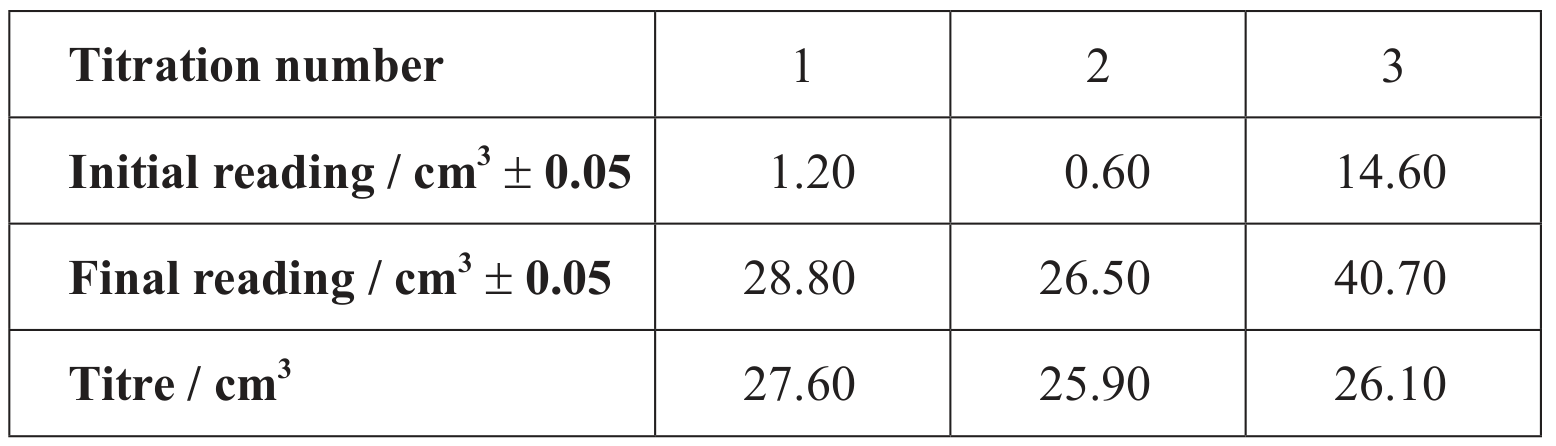
The solution was made up to 250.0 cm3250.0 \mathrm{~cm}^{3} and 25.0 cm325.0 \mathrm{~cm}^{3} portions of this solution were then titrated against a 0.0500 moldm30.0500 \mathrm{~mol} \mathrm{dm}^{-3} standard solution of sodium hydroxide, NaOH .

[ 2 ]
(i)

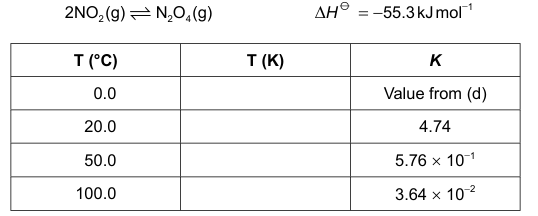
The experiment described in part (b) was repeated three more times at different temperatures. The following values for the equilibrium constant, K, were determined:

Question image

Calculate the values for temperature, T , in degrees kelvin, K , and complete the table.

[ 1 ]
(ii)

Deduce if the results in part (e)(iii) are consistent with the enthalpy of reaction data given in part (b).

[ 1 ]
[Maximum number: 1]

Hydrogen peroxide, H2O2(aq)\mathrm{H}_{2} \mathrm{O}_{2}(\mathrm{aq}), releases oxygen gas, O2( g)\mathrm{O}_{2}(\mathrm{~g}), as it decomposes according to the equation below.

2H2O2(aq)2H2O(l)+O2( g)2 \mathrm{H}_{2} \mathrm{O}_{2}(\mathrm{aq}) \rightarrow 2 \mathrm{H}_{2} \mathrm{O}(\mathrm{l})+\mathrm{O}_{2}(\mathrm{~g})

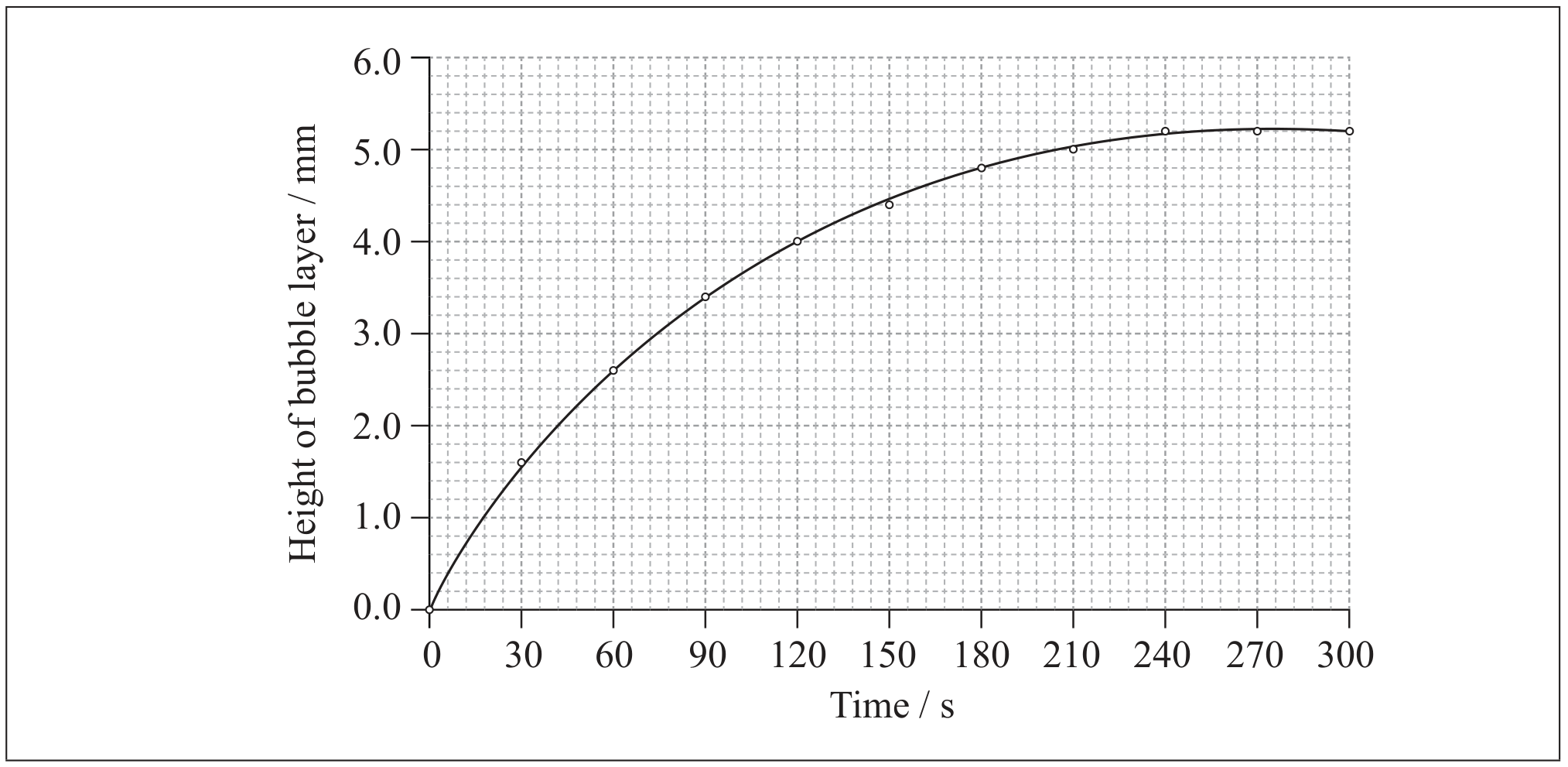
50.0 cm350.0 \mathrm{~cm}^{3} of hydrogen peroxide solution was placed in a boiling tube, and a drop of liquid detergent was added to create a layer of bubbles on the top of the hydrogen peroxide solution as oxygen gas was released. The tube was placed in a water bath at 75C75^{\circ} \mathrm{C} and the height of the bubble layer was measured every thirty seconds. A graph was plotted of the height of the bubble layer against time.

Question image
(a)

Explain why the curve reaches a maximum.

[ 1 ]
[Maximum number: 6]

A class studied the equilibrium established when ethanoic acid and ethanol react together in the presence of a strong acid, using propanone as an inert solvent. The equation is given below.

CH3COOH+C2H5OHCH3COOC2H5+H2O\mathrm{CH}_{3} \mathrm{COOH}+\mathrm{C}_{2} \mathrm{H}_{5} \mathrm{OH} \rightleftharpoons \mathrm{CH}_{3} \mathrm{COOC}_{2} \mathrm{H}_{5}+\mathrm{H}_{2} \mathrm{O}

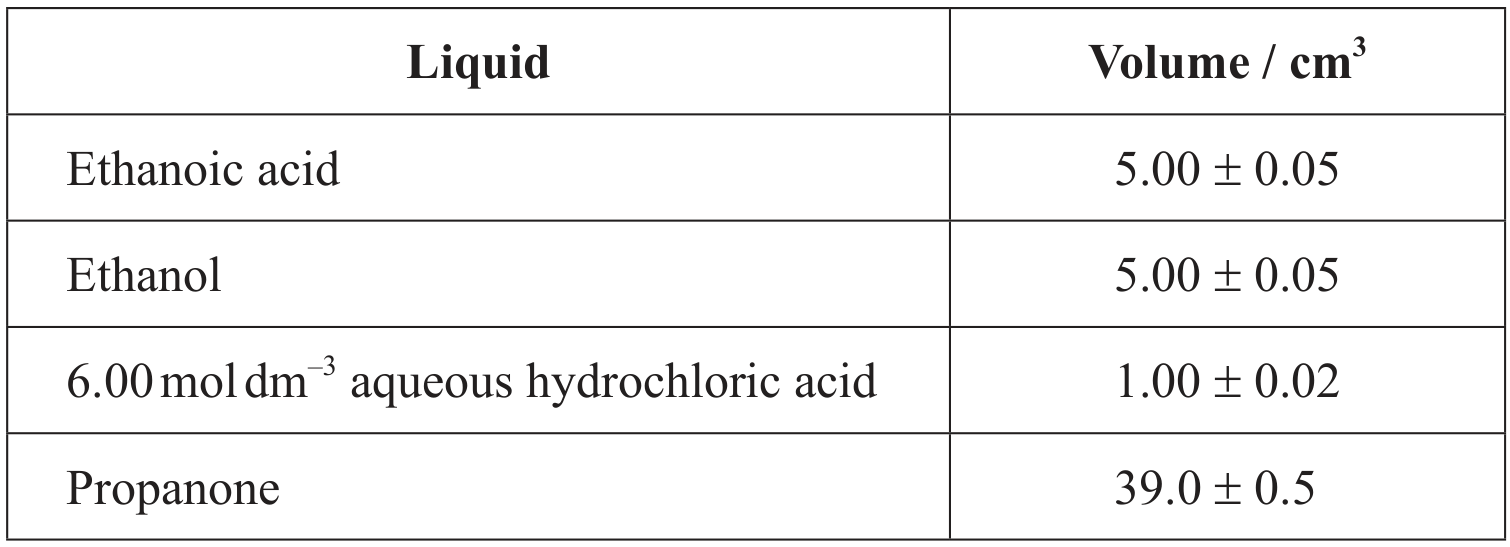
One group made the following initial mixture:

Table
(a)

Deduce the equilibrium constant expression for the reaction.

[ 1 ]
(b)

Outline how you could establish that the system had reached equilibrium at the end of one week.

[ 1 ]
(c)

Outline why changing the temperature has only a very small effect on the value of the equilibrium constant for this equilibrium.

[ 1 ]
(d)

Outline how adding some ethyl ethanoate to the initial mixture would affect the amount of ethanoic acid converted to product.

[ 2 ]
(e)

Suggest one other reason why using water as a solvent would make the experiment less successful.

[ 1 ]
[Maximum number: 7]

A class studied the equilibrium established when ethanoic acid and ethanol react together in the presence of a strong acid, using propanone as an inert solvent. The equation is given below.

CH3COOH+C2H5OHCH3COOC2H5+H2O\mathrm{CH}_{3} \mathrm{COOH}+\mathrm{C}_{2} \mathrm{H}_{5} \mathrm{OH} \rightleftharpoons \mathrm{CH}_{3} \mathrm{COOC}_{2} \mathrm{H}_{5}+\mathrm{H}_{2} \mathrm{O}

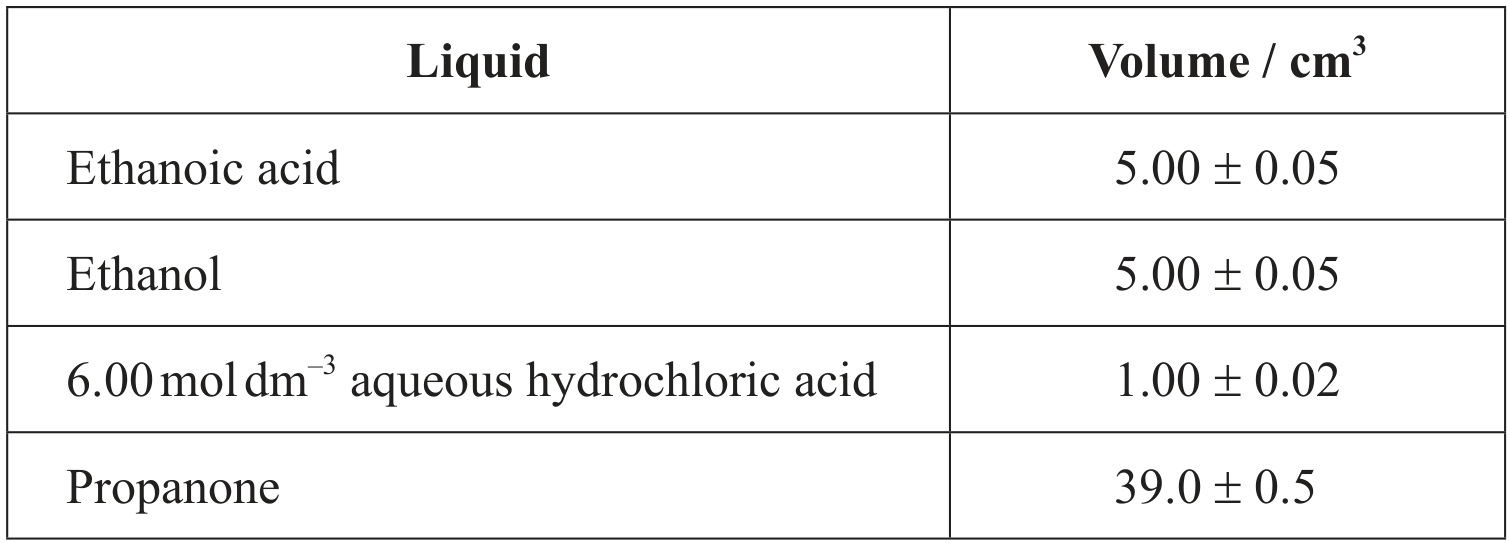
One group made the following initial mixture:

Table
(a)

After one week, a 5.00±0.05 cm35.00 \pm 0.05 \mathrm{~cm}^{3} sample of the final equilibrium mixture was pipetted out and titrated with 0.200 moldm30.200 \mathrm{~mol} \mathrm{dm}^{-3} aqueous sodium hydroxide to determine the amount of ethanoic acid remaining. The following titration results were obtained:

Table
[ 2 ]
(i)

Deduce the equilibrium constant expression for the reaction.

[ 1 ]
(ii)

The other concentrations in the equilibrium mixture were calculated as follows:

Table

Use these data, along with your answer to part (iii), to determine the value of the equilibrium constant. (If you did not obtain an answer to part (iii), assume the concentrations of ethanol and ethanoic acid are equal, although this is not the case.)

[ 1 ]
(b)

Outline how you could establish that the system had reached equilibrium at the end of one week.

[ 1 ]
(c)

Outline why changing the temperature has only a very small effect on the value of the equilibrium constant for this equilibrium.

[ 1 ]
(d)

Outline how adding some ethyl ethanoate to the initial mixture would affect the amount of ethanoic acid converted to product.

[ 2 ]
(e)

Suggest one other reason why using water as a solvent would make the experiment less successful.

[ 1 ]
[Maximum number: 3]

Ethane-1,2-diol, HOCH2CH2OH\mathrm{HOCH}_{2} \mathrm{CH}_{2} \mathrm{OH}, has a wide variety of uses including the removal of ice from aircraft and heat transfer in a solar cell.

(a)

Ethane-1,2-diol can be formed according to the following reaction.

2CO( g)+3H2( g)HOCH2CH2OH( g)2 \mathrm{CO}(\mathrm{~g})+3 \mathrm{H}_{2}(\mathrm{~g}) \rightleftharpoons \mathrm{HOCH}_{2} \mathrm{CH}_{2} \mathrm{OH}(\mathrm{~g})
[ 3 ]
(i)

Deduce the equilibrium constant expression, KcK_{\mathrm{c}}, for this reaction.

[ 1 ]
(ii)

State how increasing the pressure of the reaction mixture at constant temperature will affect the position of equilibrium and the value of KcK_{\mathrm{c}}.

Position of equilibrium:
Kc:K_{\mathrm{c}}:

[ 2 ]
[Maximum number: 3]

Ethane-1,2-diol, HOCH2CH2OH\mathrm{HOCH}_{2} \mathrm{CH}_{2} \mathrm{OH}, has a wide variety of uses including the removal of ice from aircraft and heat transfer in a solar cell.

(a)

Ethane-1,2-diol can be formed according to the following reaction.

2CO( g)+3H2( g)HOCH2CH2OH( g)2 \mathrm{CO}(\mathrm{~g})+3 \mathrm{H}_{2}(\mathrm{~g}) \rightleftharpoons \mathrm{HOCH}_{2} \mathrm{CH}_{2} \mathrm{OH}(\mathrm{~g})
[ 3 ]
(i)

Deduce the equilibrium constant expression, KcK_{\mathrm{c}}, for this reaction.

[ 1 ]
(ii)

State how increasing the pressure of the reaction mixture at constant temperature will affect the position of equilibrium and the value of KcK_{\mathrm{c}}.

Position of equilibrium:
Kc:K_{\mathrm{c}}:

[ 2 ]
[Maximum number: 1]

There is a link between world energy consumption and carbon dioxide production.

(a)

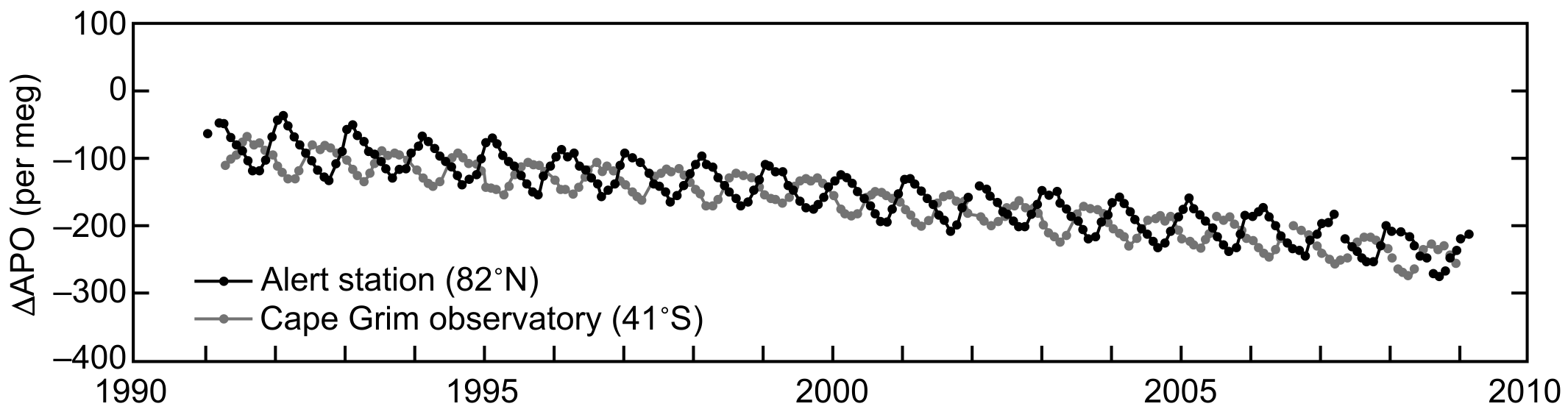
Climate induced changes in the ocean can be studied using measurements such as the Atmospheric Potential Oxygen (APO). Trends in APO concentration from two stations, one in each hemisphere, are shown below.

Question image
[ 1 ]
(i)

The equilibrium expression for O2\mathrm{O}_{2} exchange between the atmosphere and ocean is O2( g)O2(aq)\mathrm{O}_{2}(\mathrm{~g}) \rightleftharpoons \mathrm{O}_{2}(\mathrm{aq}). Identify one factor which shifts the equilibrium to the right.

[ 1 ]
[Maximum number: 1]

There is a link between world energy consumption and carbon dioxide production.

(a)

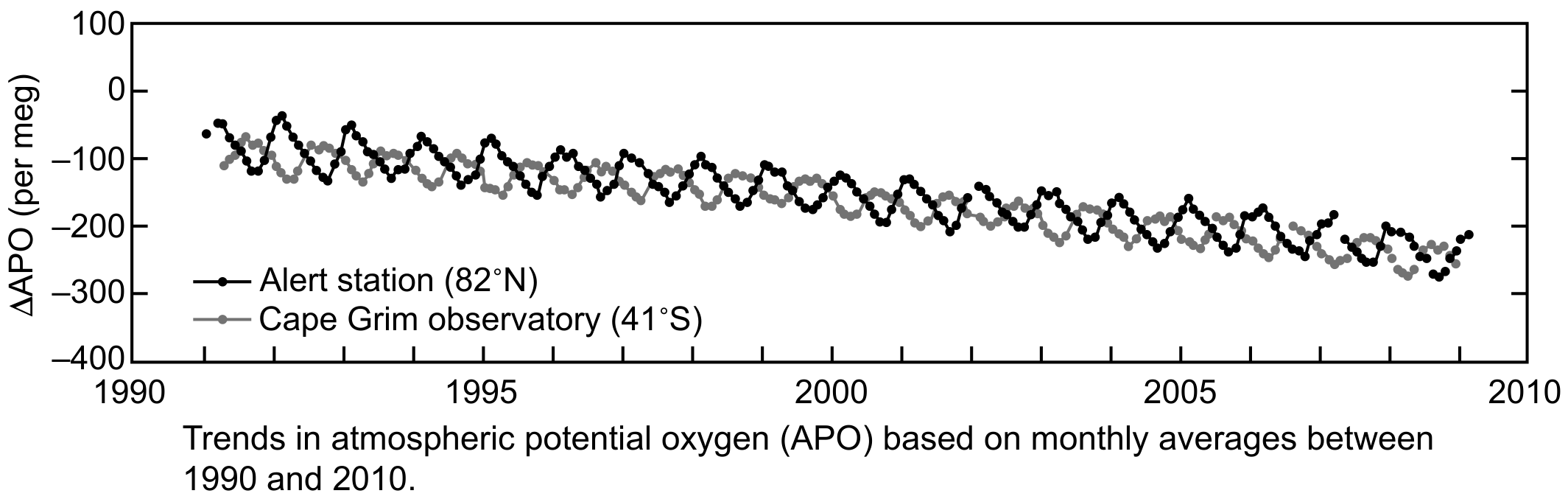
Climate induced changes in the ocean can be studied using measurements such as the Atmospheric Potential Oxygen (APO). Trends in APO concentration from two stations, one in each hemisphere, are shown below.

Question image

Trends in atmospheric potential oxygen (APO) based on monthly averages between 1990 and 2010

[ 1 ]
(i)

The equilibrium expression for O2\mathrm{O}_{2} exchange between the atmosphere and ocean is O2( g)O2(aq)\mathrm{O}_{2}(\mathrm{~g}) \rightleftharpoons \mathrm{O}_{2}(\mathrm{aq}). Identify one factor which shifts the equilibrium to the right.

[ 1 ]
[Maximum number: 1]

Urea, (H2 N)2CO\left(\mathrm{H}_{2} \mathrm{~N}\right)_{2} \mathrm{CO}, is excreted by mammals and can be used as a fertilizer.

(a)

Urea can also be made by the direct combination of ammonia and carbon dioxide gases.

2NH3( g)+CO2( g)(H2 N)2CO( g)+H2O( g)ΔH<02 \mathrm{NH}_{3}(\mathrm{~g})+\mathrm{CO}_{2}(\mathrm{~g}) \rightleftharpoons\left(\mathrm{H}_{2} \mathrm{~N}\right)_{2} \mathrm{CO}(\mathrm{~g})+\mathrm{H}_{2} \mathrm{O}(\mathrm{~g}) \quad \Delta H<0

Predict, with a reason, the effect on the equilibrium constant, KcK_{\mathrm{c}}, when the temperature is increased.

[ 1 ]
0