EduNinja
[Maximum number: 5]

Alkanes are commonly occurring organic compounds.

(a)

Ethane can be converted to chloroethane by reacting with chlorine gas, Cl2( g)\mathrm{Cl}_{2}(\mathrm{~g}), in the presence of UV light.

[ 5 ]
(i)

State the type of reaction and the name of the mechanism by which it occurs.

[ 1 ]
(ii)

Explain the reaction mechanism by writing equations for each step.

One initiation step:
Two propagation steps:

One termination step:

[ 4 ]
[Maximum number: 1]

Chlorine undergoes many reactions.

(a)
(i)

State the type of reaction occurring when ethane reacts with chlorine to produce chloroethane.

[ 1 ]
[Maximum number: 1]

Alkanes are commonly occurring organic compounds.

(a)

Ethane can be converted to chloroethane by reacting with chlorine gas, Cl2( g)\mathrm{Cl}_{2}(\mathrm{~g}), in the presence of UV light.

State the type of reaction and the name of the mechanism by which it occurs.

[ 1 ]
[Maximum number: 1]

Chlorine undergoes many reactions.

(a)
(i)

State the type of reaction occurring when ethane reacts with chlorine to produce chloroethane.

[ 1 ]
[Maximum number: 1]

In the stratosphere, ozone is decomposed by ultraviolet radiation.

O3( g)O2( g)+O( g)\mathrm{O}_{3}(\mathrm{~g}) \rightarrow \mathrm{O}_{2}(\mathrm{~g})+\mathrm{O}(\mathrm{~g})
(a)

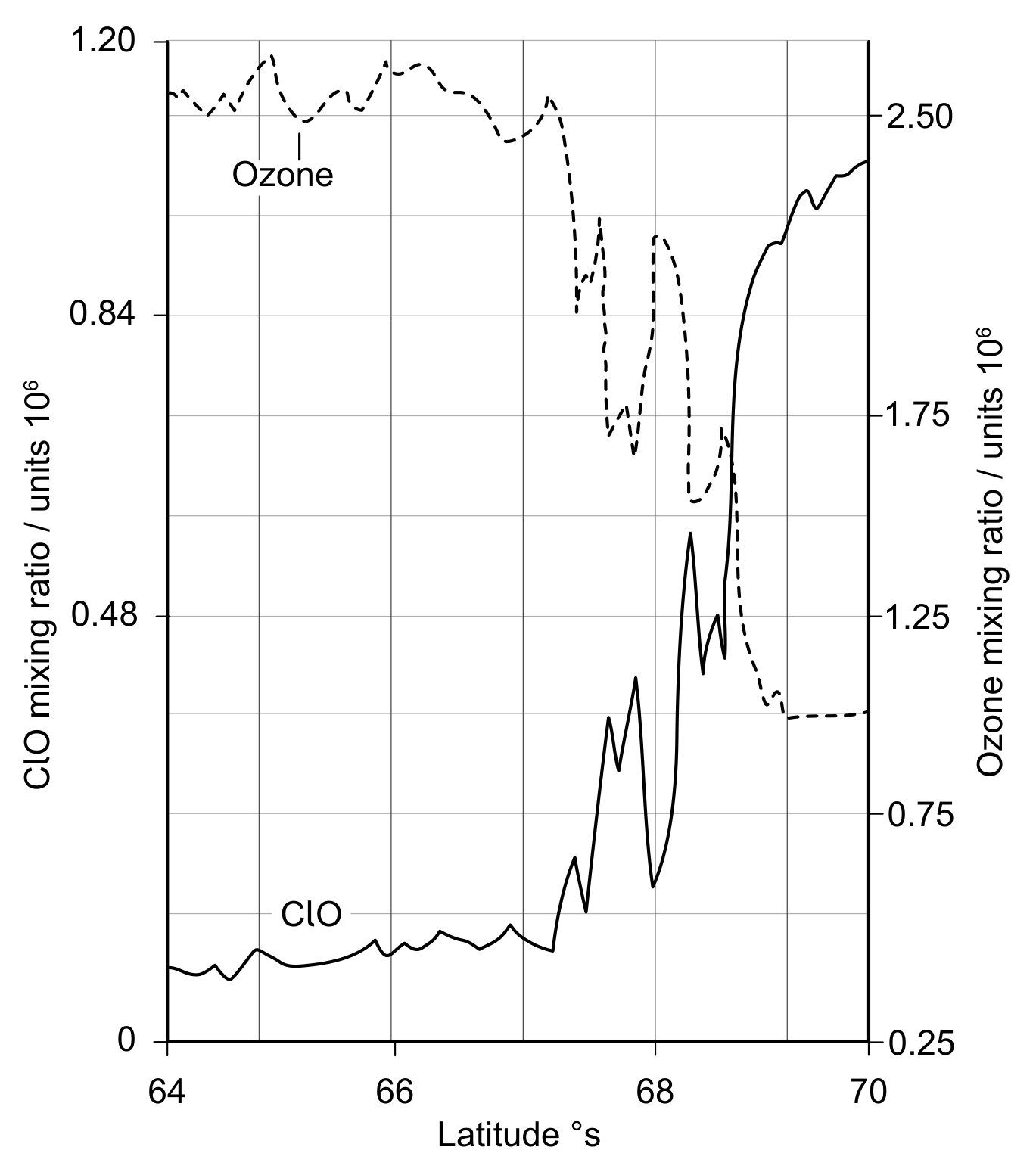
The concentrations of ozone molecules and chlorine monoxide, ClO , free radicals were measured.

Question image
[ 1 ]
(i)

Outline the relationship between the concentrations of ozone and ClO , free radicals.

[ 1 ]
[Maximum number: 1]

In the stratosphere, ozone is decomposed by ultraviolet radiation.

O3( g)O2( g)+O( g)\mathrm{O}_{3}(\mathrm{~g}) \rightarrow \mathrm{O}_{2}(\mathrm{~g})+\mathrm{O}(\mathrm{~g})
(a)

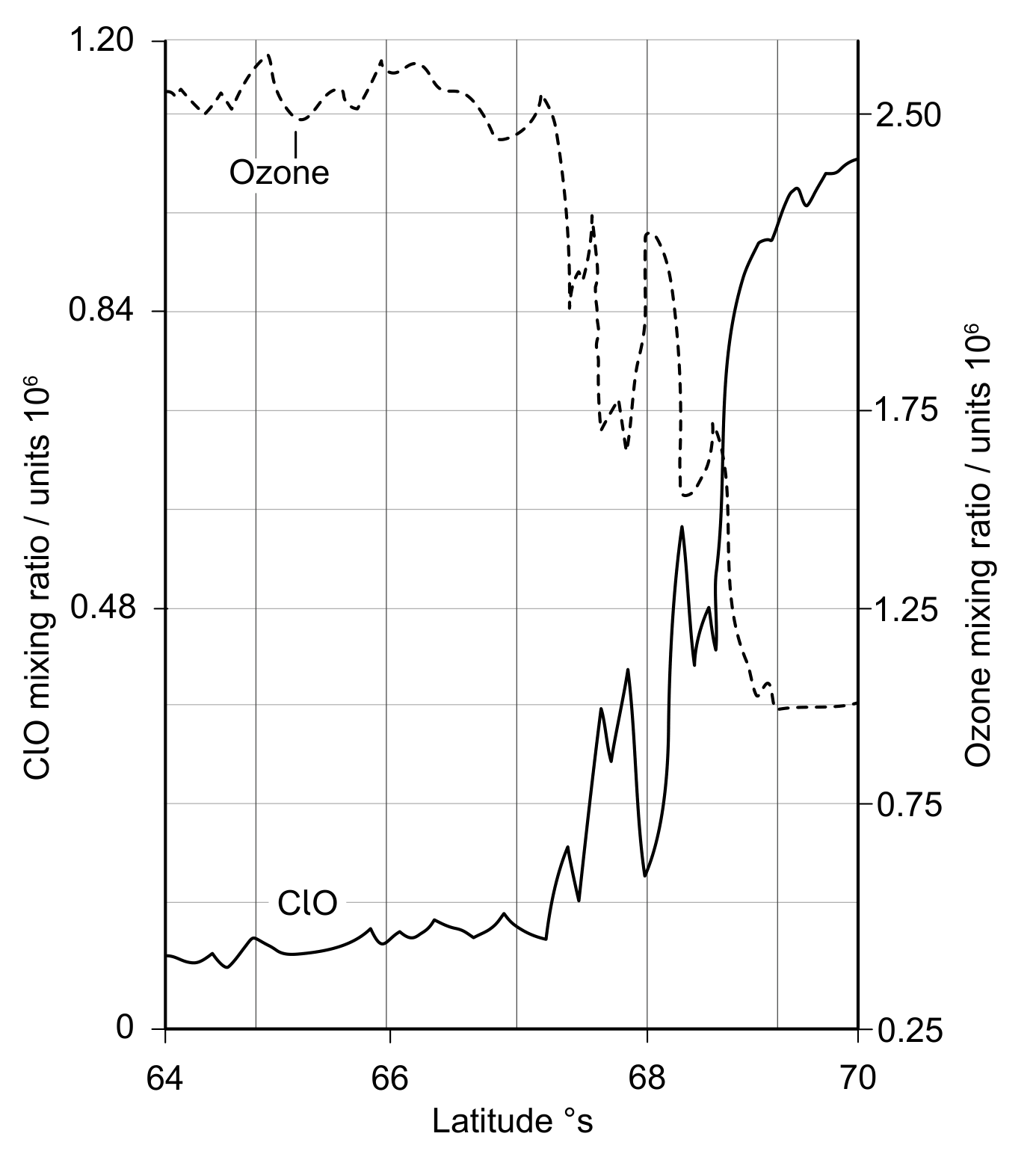
The concentrations of ozone molecules and chlorine monoxide, ClO , free radicals were measured.

Question image
[ 1 ]
(i)

Outline the relationship between the concentrations of ozone and ClO , free radicals.

[ 1 ]
[Maximum number: 2]

Halogenoalkanes are used as refrigerants and solvents.

(a)

Substance X undergoes nucleophilic substitution with a hydroxide nucleophile.

[ 2 ]
(i)

Contrast homolytic and heterolytic fission.

Homolytic fission:

Heterolytic fission:

[ 2 ]
[Maximum number: 5]

Bromomethane was used as a pesticide until it was found to be ozone-depleting.

(a)

State the equation for the reaction between methane and bromine to form bromomethane.

[ 1 ]
(b)

Explain, using equations, the complete free-radical mechanism for the reaction of methane with bromine, including necessary reaction conditions.

[ 4 ]
[Maximum number: 4]

Ethane reacts with chlorine in the presence of sunlight.

(a)

Complete the overall equation for this reaction by stating the products.

C2H6+Cl2\mathrm{C}_{2} \mathrm{H}_{6}+\mathrm{Cl}_{2} \rightarrow
[ 1 ]
(b)

State the type of mechanism by which this reaction occurs.

[ 1 ]
(c)

Traces of butane, C4H10\mathrm{C}_{4} \mathrm{H}_{10}, are also found amongst the products of this reaction. Explain how this product arises.

[ 2 ]
[Maximum number: 4]

Nitrous acid, HNO2(aq)\mathrm{HNO}_{2}(\mathrm{aq}) and hydrochloric acid, HCl(aq) are both inorganic acids.

(a)

Picric acid, carbolic acid and aspirin are trivial names of chemical substances.

They can cause misunderstanding when communicating information internationally.

[ 4 ]
(i)

Ethyl ethanoate can be produced by the reaction of ethanol with ethanoic acid. Both reactants can be synthesized from ethane through a series of reactions, the first of which is shown.

C2H6( g)+Cl2( g)C2H5Cl( g)+HCl( g)\mathrm{C}_{2} \mathrm{H}_{6}(\mathrm{~g})+\mathrm{Cl}_{2}(\mathrm{~g}) \rightarrow \mathrm{C}_{2} \mathrm{H}_{5} \mathrm{Cl}(\mathrm{~g})+\mathrm{HCl}(\mathrm{~g})

The first step in this reaction, initiation, is given by the following equation.

Cl22Cl\mathrm{Cl}_{2} \rightarrow 2 \mathrm{Cl} \cdot

State an essential condition for this reaction.

[ 1 ]
(ii)

Deduce two propagation steps and one termination step for this reaction.

[ 3 ]
0