Ammonium nitrate, , is used as a high nitrogen fertilizer.
State, with a reason, whether the ammonium ion is a Brønsted-Lowry acid or base.
Calculate the pH of an ammonium nitrate solution with
. Use section 1 of the data booklet.
EduNinjaAmmonium nitrate, NH4NO3, is used as a high nitrogen fertilizer.
State, with a reason, whether the ammonium ion is a Brønsted-Lowry acid or base.
Calculate the pH of an ammonium nitrate solution with
[H3O+]=1.07×10⁻⁵ moldm−3. Use section 1 of the data booklet.
When heated in air, magnesium ribbon reacts with oxygen to form magnesium oxide.
The presence of magnesium nitride can be demonstrated by adding water to the product. It is hydrolysed to form magnesium hydroxide and ammonia.
Deduce, giving reasons, whether the reaction of magnesium nitride with water is an acid-base reaction, a redox reaction, neither or both.
Acid-base: Yes No
Reason:
Redox: Yes No
Reason:
Ammonium nitrate, NH4NO3, is used as a high nitrogen fertilizer.
State, with a reason, whether the ammonium ion is a Brønsted-Lowry acid or base.
A 0.20 moldm−3 solution of ammonium nitrate is prepared.
Calculate the pH of an ammonium nitrate solution with
[H3O+]=1.07×10⁻⁵ moldm−3. Use section 1 of the data booklet.
Ammonium nitrate is neutralized with sodium hydroxide. Write the equation for the reaction.
A 20.00 cm3 sample of the 0.20 moldm−3 solution of ammonium nitrate is titrated with a 0.20 moldm−3 solution of sodium hydroxide. Determine the pH at the equivalence point, to two decimal places using section 1 and 21 of the data booklet.
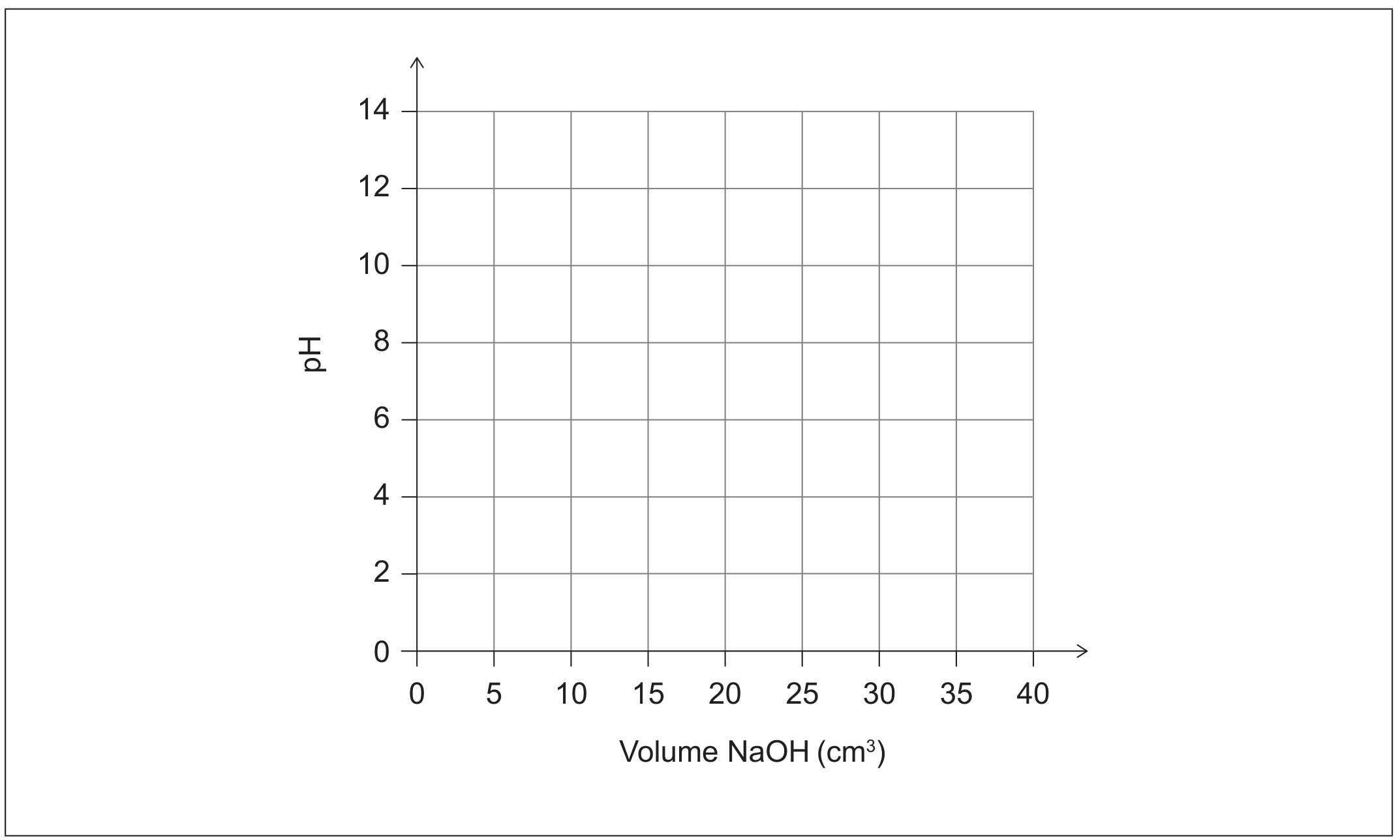
Sketch the pH curve that would result from the titration of a 0.20 moldm−3 solution of ammonium nitrate with sodium hydroxide.

State, with a reason, if bromothymol blue is an appropriate indicator for this titration. Use section 22 of the data booklet.
This question is about acid-base properties.
Deduce the ionic equation, including state symbols, for the reaction of hydrogen chloride gas with water.
Calculate the pH of 0.50 moldm−3 hydrochloric acid.
Explain why a solution of ethanoic acid has a higher pH than hydrochloric acid of the same concentration.
A pH probe can be used to distinguish between the acids in part (c). Identify another simple instrumental method that could be used in a school laboratory to distinguish between the two acids.
Outline how the instrumental method identified in part (d) distinguishes between the acids in part (c).
This question is about acid-base properties.
Deduce the ionic equation, including state symbols, for the reaction of hydrogen chloride gas with water.
Calculate the pH of 0.50 moldm−3 hydrochloric acid.
Explain why a solution of ethanoic acid has a higher pH than hydrochloric acid of the same concentration.
A pH probe can be used to distinguish between the acids in part (a)(iii). Identify another simple instrumental method that could be used in a school laboratory to distinguish between the two acids.
Outline how the instrumental method identified in part (a)(iv) distinguishes between the acids in part (a)(iii).
Outline one chemical test, other than an indicator, that can distinguish between the two acids in part (a)(iii), and the expected result.
Chemical test:
Expected result:
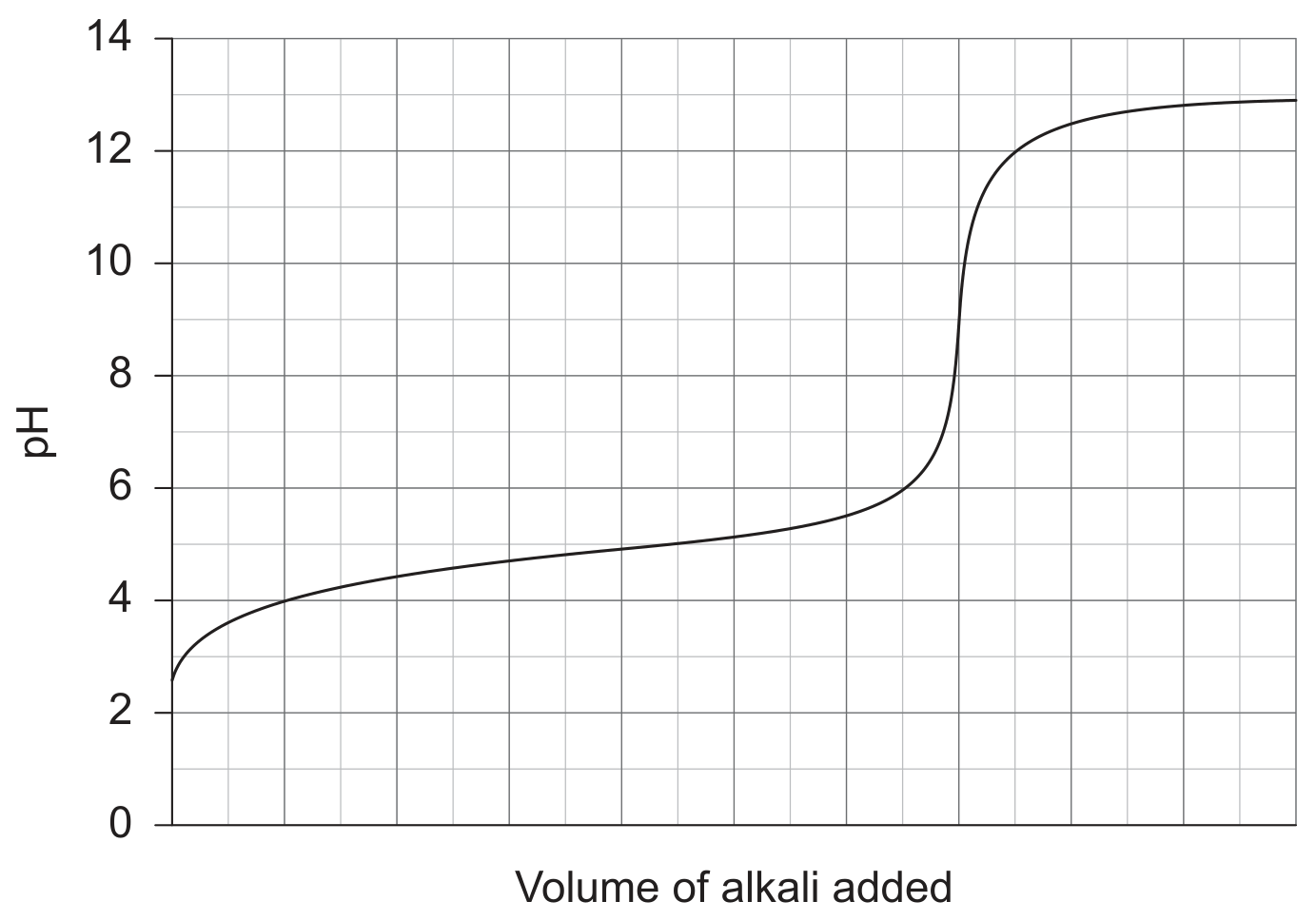
A neutralization curve for a weak acid, HA, and a strong base is given.

Estimate the pKa of HA .
Explain, using an equation, why adding a strong base to the weak acid, HA , leads to very little change in pH in the buffer zone of the graph.
In a separate experiment, 80 cm3 of 0.1 moldm−3 ammonia, NH3(aq), was added to 40 cm3 of 0.1 moldm−3 hydrochloric acid, HCl(aq).
Determine the final pH of the solution. Use section 21 of the data booklet.
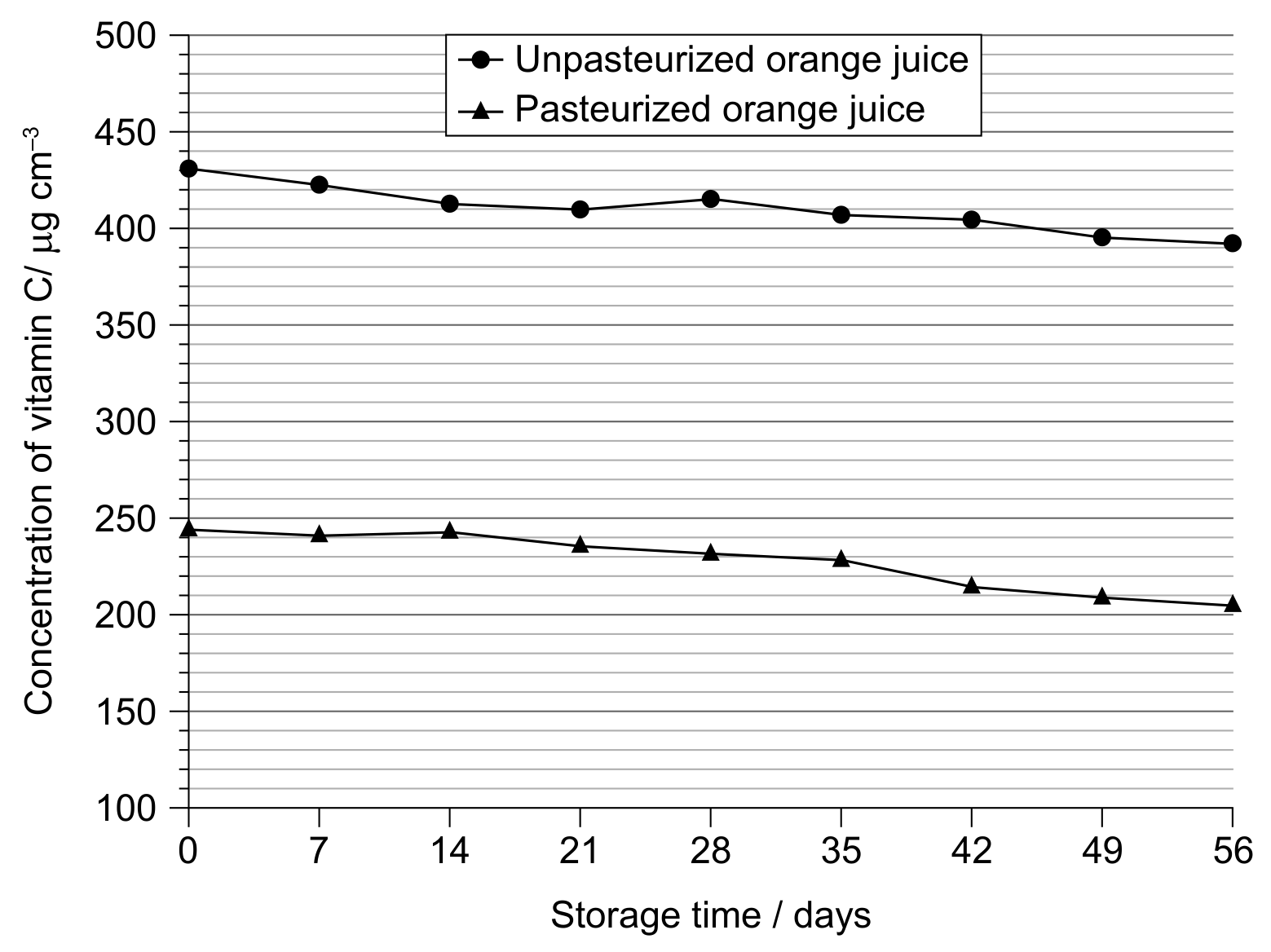
Pasteurization is used to eliminate pathogenic bacteria. The concentration of vitamin C was monitored over a period of time in pasteurized and unpasteurized orange juice.

The concentration of vitamin C (ascorbic acid) can be measured by performing a redox titration using acidified iodate, IO3−, and iodide ions. Starch reacts with excess iodine once the vitamin C is consumed to produce a dark-blue complex.
Reaction 1: IO3−(aq)+5I−(aq)+6H+(aq)→3I2(aq)+3H2O(l)
Reaction 2: ascorbic acid (aq) +I2(aq)→2I−(aq)+ dehydroascorbic acid (aq)
The student recorded the end point and then noticed the blue colour in the conical flask disappeared. Suggest why this occurred.
State the effect the recorded end point has on the value of the calculated concentration of vitamin C.
Suggest why this method cannot be used to measure the concentration of vitamin C in blueberry juice. provided.
Methanoic acid (HCOOH) is the first member of the homologous series of carboxylic acids.
Methanoic acid and ethanal (CH3CHO) both contain a carbonyl group and have similar molar masses.
Predict, giving an explanation, the relative electrical conductivity of solutions of methanoic acid, ethanal and hydrochloric acid of the same concentration.
Relative electrical conductivity: < <
Explanation:
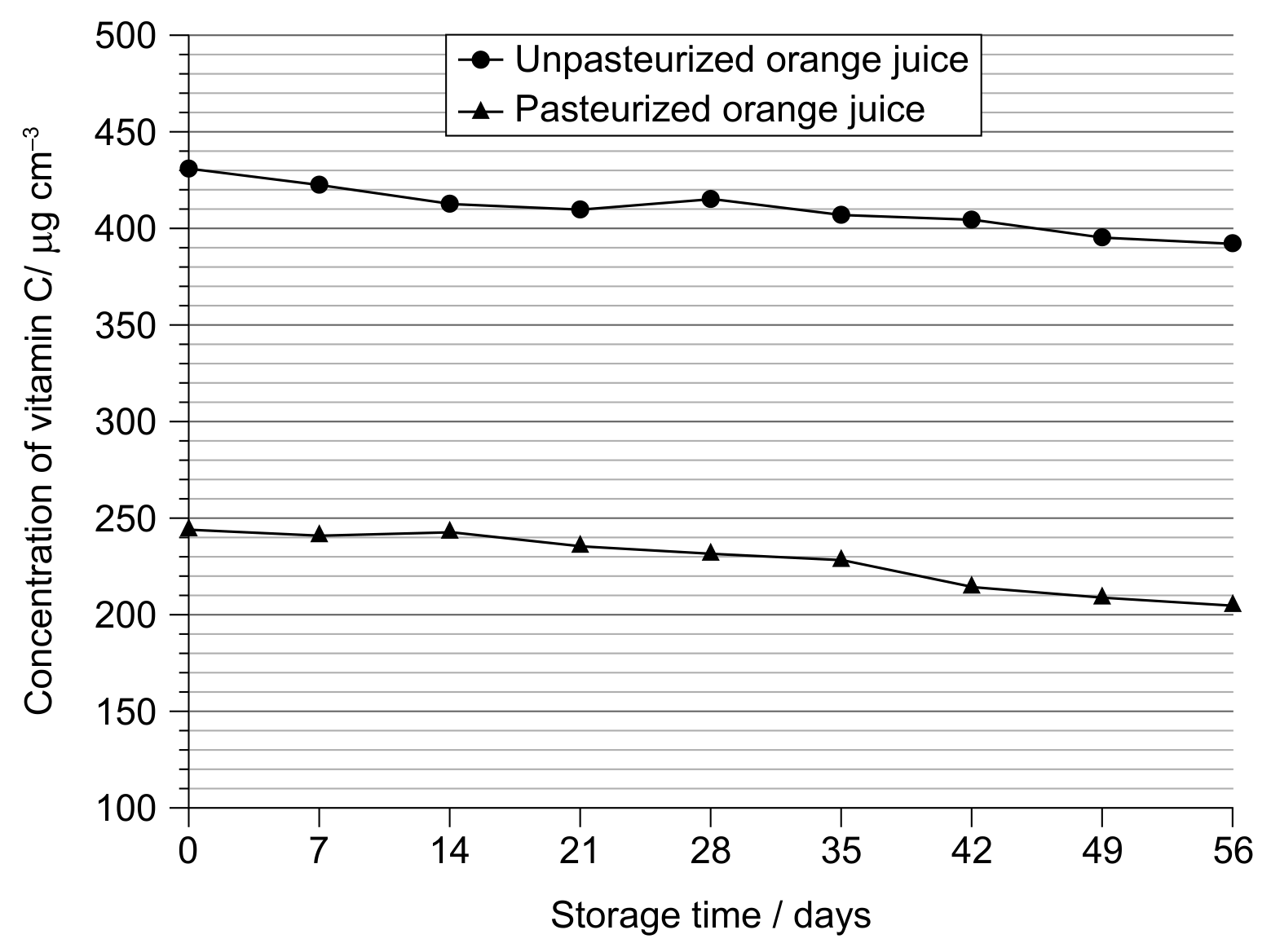
Pasteurization is used to eliminate pathogenic bacteria. The concentration of vitamin C was monitored over a period of time in pasteurized and unpasteurized orange juice.

The concentration of vitamin C (ascorbic acid) can be measured by performing a redox titration using acidified iodate, IO3−, and iodide ions. Starch reacts with excess iodine once the vitamin C is consumed to produce a dark-blue complex.
Reaction 1: IO3−(aq)+5I−(aq)+6H+(aq)→3I2(aq)+3H2O(l)
Reaction 2: ascorbic acid (aq) +I2(aq)→2I−(aq)+ dehydroascorbic acid (aq)
The student recorded the end point and then noticed the blue colour in the conical flask disappeared. Suggest why this occurred.
State the effect the recorded end point has on the value of the calculated concentration of vitamin C.
Suggest why this method cannot be used to measure the concentration of vitamin C in blueberry juice. provided.
Methanoic acid (HCOOH) is the first member of the homologous series of carboxylic acids.
Methanoic acid and ethanal (CH3CHO) both contain a carbonyl group and have similar molar masses.
Predict, giving an explanation, the relative electrical conductivity of solutions of methanoic acid, ethanal and hydrochloric acid of the same concentration.
Relative electrical conductivity: < <
Explanation:
Methanoic acid acts as a weak monobasic acid in aqueous solution.
Determine the pH of the methanoic acid solution. Use section 21 of the data booklet.
Predict, using an equation, whether the pH of the solution of sodium methanoate formed would be greater than, less than or equal to 7 .
A powder has the following percentage composition by mass:
30.0 % sucrose, C12H22O11
45.0 % citric acid, C6H8O7
25.0 \% sodium hydrogencarbonate, NaHCO3
In the presence of water, the powder effervesces as the citric acid reacts with the sodium hydrogencarbonate:
3NaHCO3( s)+C6H8O7(aq)→Na3(C6H5O7)(aq)+3CO2( g)+3H2O(l)
Deduce the structural formula of the conjugate base of citric acid.
Predict, giving a reason, the strength of citric acid.
Calculate the pH of a solution with a hydrogen ion concentration,
[H+]=0.0025 moldm−3.