EduNinja
[Maximum number: 6]

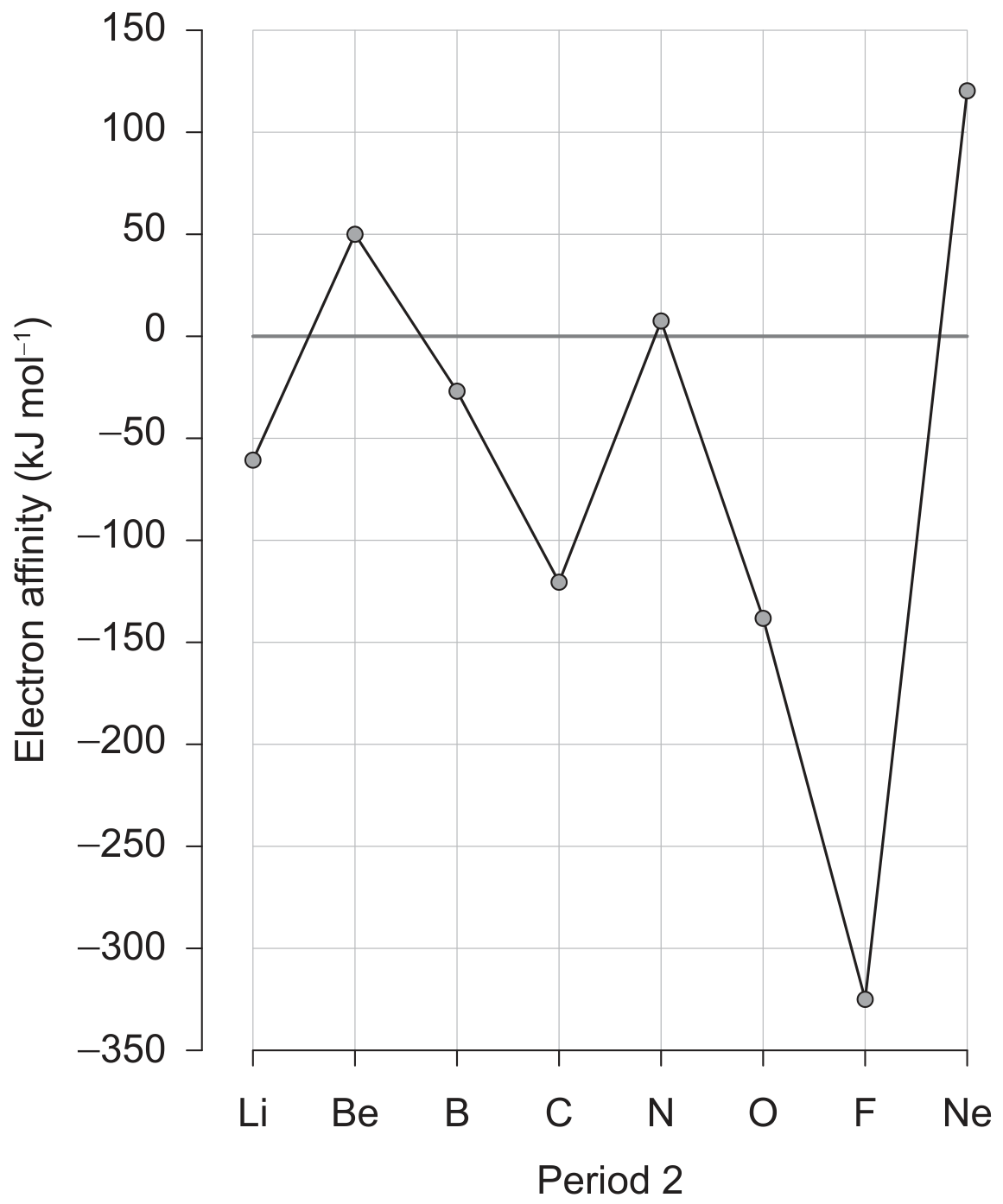
Graphs showing the first ionization energy and first electron affinity of the elements in period 2 of the periodic table are shown.
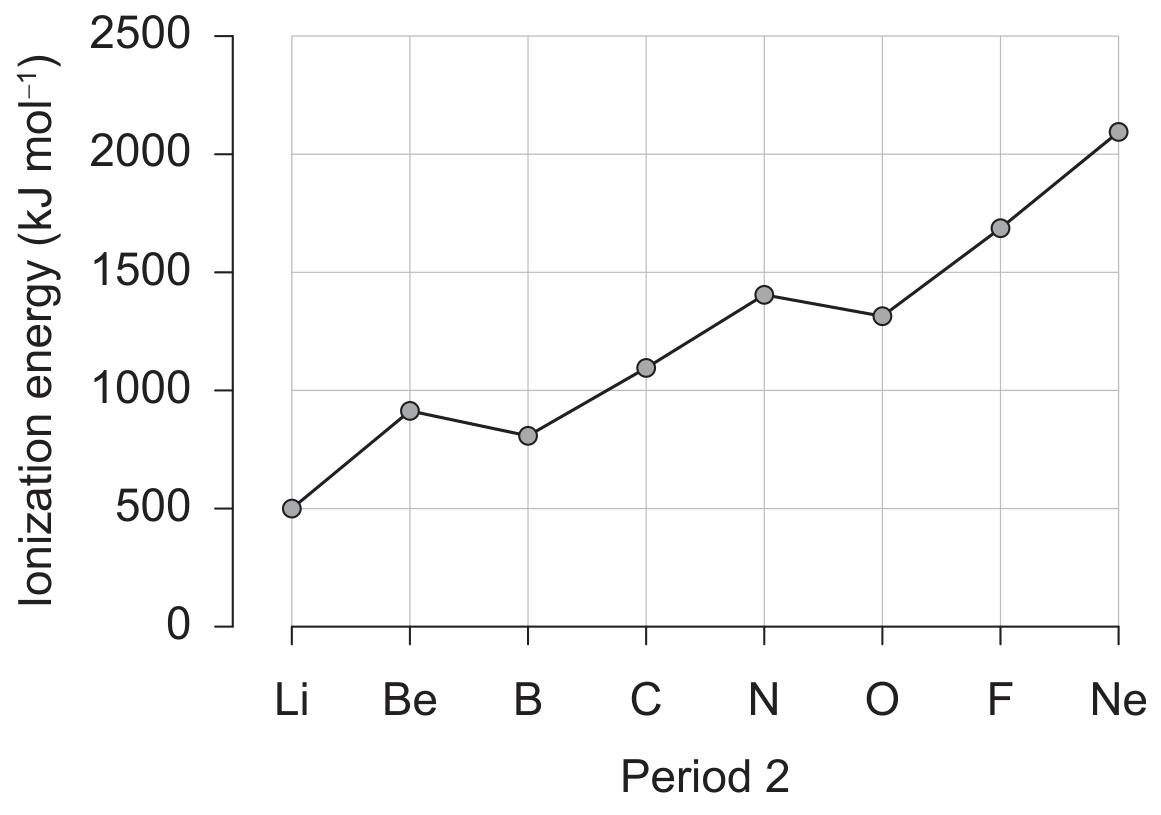
First ionization energy
First ionization energy

First electron affinity

First electron affinity

(a)

First ionization energy tends to increase across the period. Explain the decrease in first ionization energy from beryllium to boron.

[ 2 ]
(b)

Suggest one reason for a positive value for the first electron affinity for nitrogen.

[ 1 ]
(c)

Suggest reasons why noble gases have the largest first ionization energy and largest positive first electron affinity in their period.

Largest first ionization energy:

Largest positive first electron affinity:

[ 2 ]
(d)

Suggest, giving one reason, how the first electron affinity of xenon compares with that of neon.

[ 1 ]
[Maximum number: 1]

A powder has the following percentage composition by mass:
30.0 % sucrose, C12H22O11\mathrm{C}_{12} \mathrm{H}_{22} \mathrm{O}_{11}
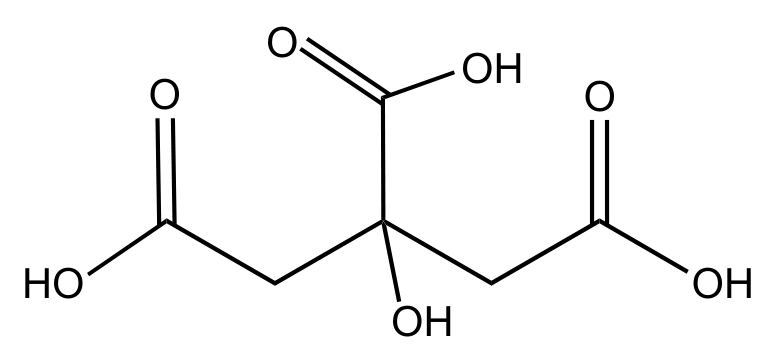
45.0 % citric acid, C6H8O7\mathrm{C}_{6} \mathrm{H}_{8} \mathrm{O}_{7}
25.0 \% sodium hydrogencarbonate, NaHCO3\mathrm{NaHCO}_{3}

In the presence of water, the powder effervesces as the citric acid reacts with the sodium hydrogencarbonate:

3NaHCO3( s)+C6H8O7(aq)Na3(C6H5O7)(aq)+3CO2( g)+3H2O(l)3 \mathrm{NaHCO}_{3}(\mathrm{~s})+\mathrm{C}_{6} \mathrm{H}_{8} \mathrm{O}_{7}(\mathrm{aq}) \rightarrow \mathrm{Na}_{3}\left(\mathrm{C}_{6} \mathrm{H}_{5} \mathrm{O}_{7}\right)(\mathrm{aq})+3 \mathrm{CO}_{2}(\mathrm{~g})+3 \mathrm{H}_{2} \mathrm{O}(\mathrm{l})

(a)
(i)

State the number of acidic hydrogens in the citric acid molecule shown.

Question image
[ 1 ]
[Maximum number: 1]

Nitrogen monoxide, NO(g), is produced in internal combustion and jet engines.

(a)

In an exhaust pipe catalytic converter, NO reacts with carbon monoxide, CO .

NO( g)+CO( g)CO2( g)+12 N2( g)\mathrm{NO}(\mathrm{~g})+\mathrm{CO}(\mathrm{~g}) \rightarrow \mathrm{CO}_{2}(\mathrm{~g})+\frac{1}{2} \mathrm{~N}_{2}(\mathrm{~g})

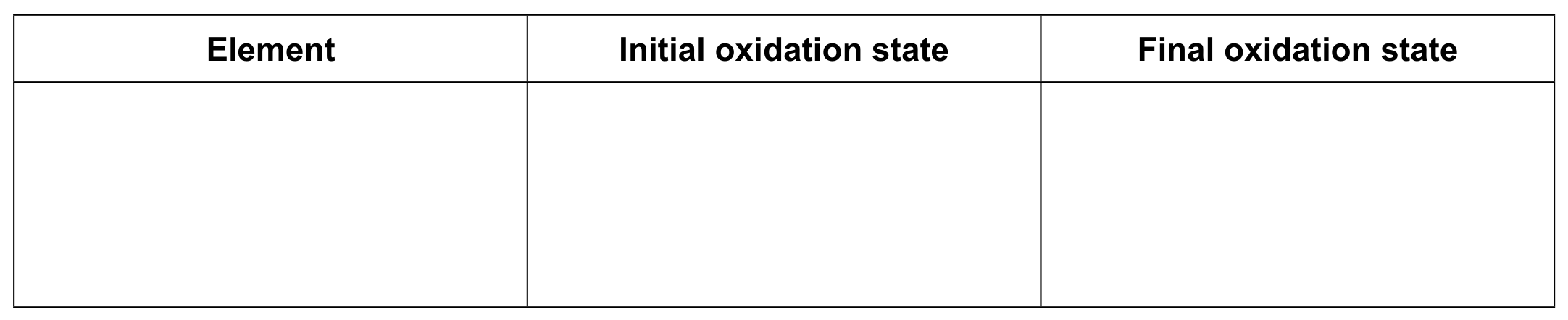
Deduce which element is reduced in this process, indicating the initial and final oxidation states.

Table
[ 1 ]
[Maximum number: 2]

Phosphorus is an element that is an essential part of the biological molecules involved in both respiration and photosynthesis.

(a)
(i)

Explain why the first ionization energy decreases as you descend group 15 from nitrogen to bismuth.

[ 2 ]
[Maximum number: 5]

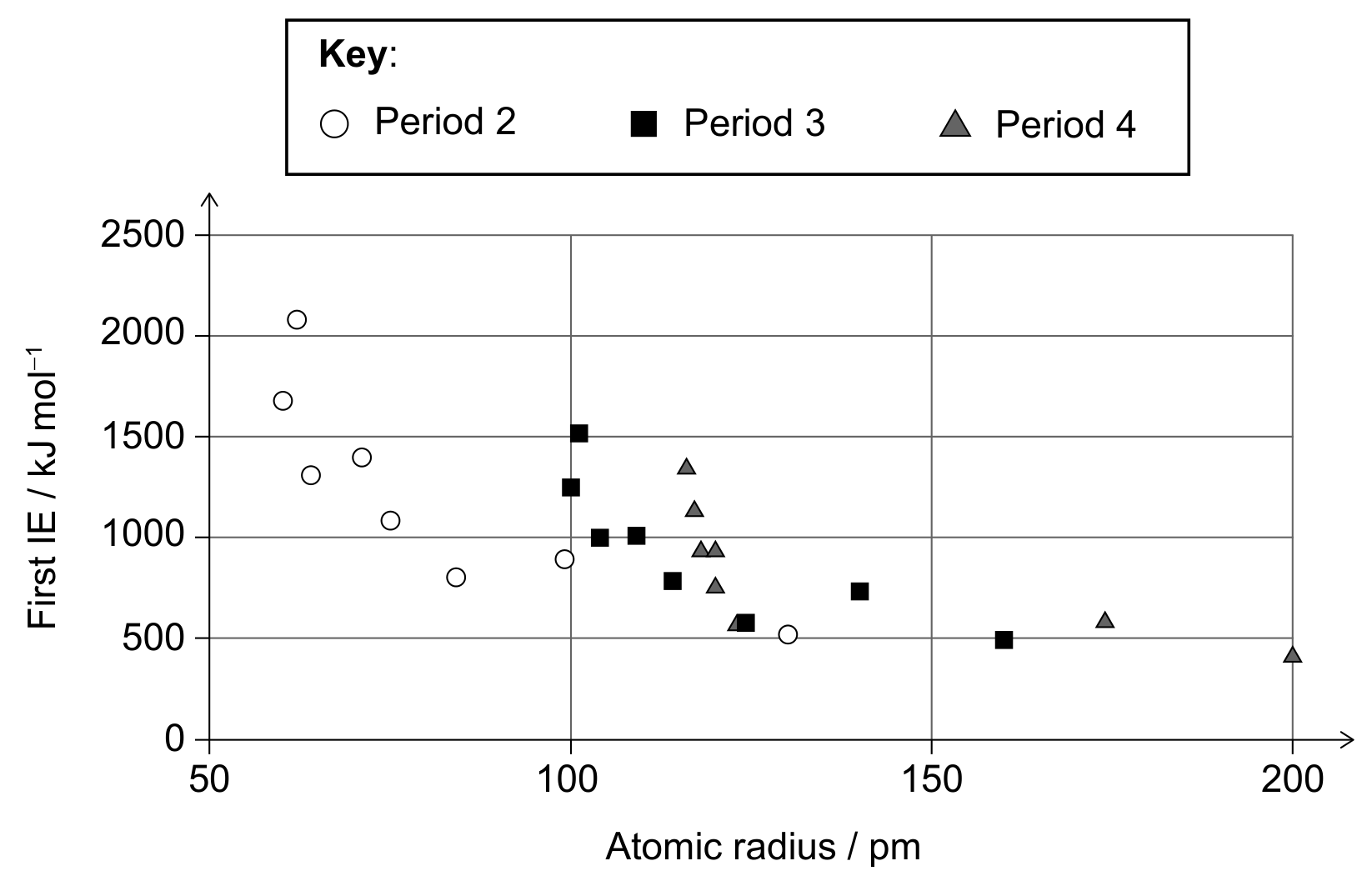
The graph shows the variation of the first ionization energy with atomic radius for periods 2, 3 and 4 of the periodic table, with the d-block elements omitted.

Question image
(a)

Annotate the graph with an additional data point, marked with a cross ( X ), for scandium. Use sections 9 and 10 of the data booklet.

[ 1 ]
(b)

Suggest why there might be a link between the two variables in the graph.

[ 1 ]
(c)

The graph shows a relationship between first ionization energy and atomic radius.

[ 3 ]
(i)

State the type of relationship between the variables.

[ 1 ]
(ii)

Compare and contrast the trends shown by the different periods.

[ 2 ]
[Maximum number: 1]

Hydrogen cyanide, HCN , is a very toxic compound.

(a)

Hydrogen cyanide reacts with hydrogen according to the equilibrium:

HCN( g)+2H2( g)CH3NH2( g)\mathrm{HCN}(\mathrm{~g})+2 \mathrm{H}_{2}(\mathrm{~g}) \rightleftharpoons \mathrm{CH}_{3} \mathrm{NH}_{2}(\mathrm{~g})
[ 1 ]
(i)

Determine the oxidation states that indicate that carbon is reduced in this reaction.

Initial oxidation state:
Final oxidation state:

[ 1 ]
[Maximum number: 1]

Nitrogen monoxide, NO(g), is produced in internal combustion and jet engines.

(a)

In an exhaust pipe catalytic converter, NO reacts with carbon monoxide, CO , to form N2\mathrm{N}_{2}.

[ 1 ]
(i)

State the initial and final oxidation states of nitrogen.

Initial:
Final:

[ 1 ]
[Maximum number: 2]

Phosphorus is an element that is an essential part of the biological molecules involved in both respiration and photosynthesis.

(a)
(i)

Explain why the first ionization energy decreases as you descend group 15 from nitrogen to bismuth.

[ 2 ]
[Maximum number: 4]

Hydrogen cyanide, HCN , is a very toxic compound.

(a)

The cyanide ion, CN\mathrm{CN}^{-}, can form complex ions, such as [Fe(CN)6]4\left[\mathrm{Fe}(\mathrm{CN})_{6}\right]^{4-}.

[ 4 ]
(i)

Deduce the oxidation state of iron in the complex ion.

[ 1 ]
(ii)

Explain why transition element ions, such as [Fe(CN)6]4\left[\mathrm{Fe}(\mathrm{CN})_{6}\right]^{4-}, are usually coloured.

[ 3 ]
[Maximum number: 2]

The concentration of calcium ions, Ca2+\mathrm{Ca}^{2+}, in aqueous solution can be determined by titration with ethylenediaminetetraacetic acid (EDTA), or by atomic absorption spectrophotometry.

(a)

A sample of tap water was titrated against the standardized EDTA solution, using Eriochrome Black T as an indicator.

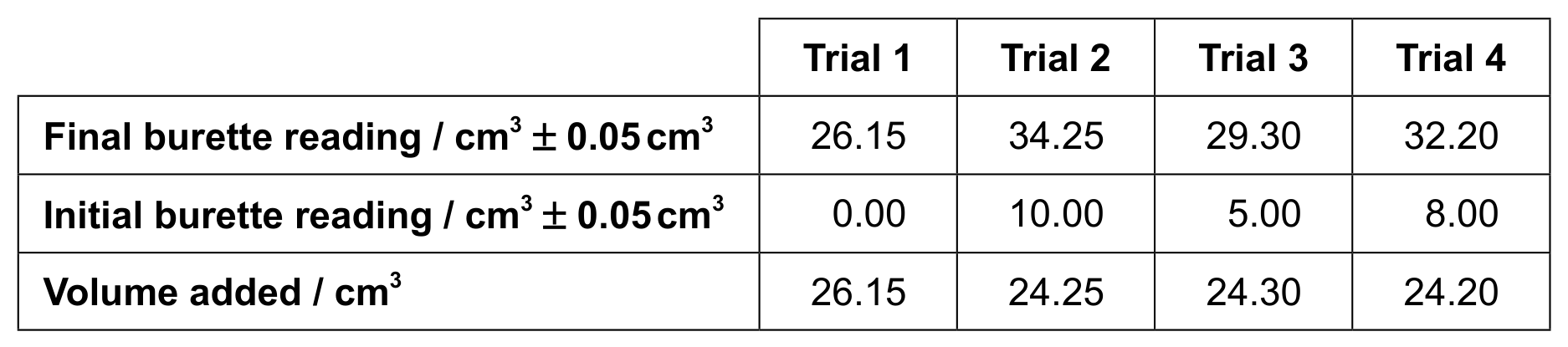
The following titration data were obtained.

Table
[ 2 ]
(i)

The end point of the titration is determined when a red complex, X, changes to a blue ion, Y. Explain how this shows that X absorbs radiation with higher energy than Y.

[ 2 ]
0