1.2 The nuclear atom
- Syllabus
- First assessment 2025
- Topic
- 1.2
- Level
- HL
An atom has a dense, positively charged nucleus containing protons and neutrons. Negatively charged electrons occupy the space outside the nucleus. Protons and neutrons are nucleons.
| Quantity | Meaning | Rule |
|---|---|---|
| Atomic number, Z | Number of protons | p = Z |
| Mass number, A | Protons plus neutrons | n = A − Z |
| Ion charge | Proton charge compared with electron charge | charge = p − e |
For a neutral atom, electrons equal protons. For an ion, use the stated charge to determine the electron count.
Read Z first to obtain protons, subtract Z from A to obtain neutrons, then use the ion charge to check or calculate electrons.
Apply the symbols in a fixed order. For ³⁵₁₇Cl⁻, Z = 17 gives 17 protons, A − Z gives 18 neutrons, and the 1− charge means one more electron than protons, so there are 18 electrons. The ion charge changes electron count, never the element identity.
| Particle | Location | Relative charge | Approximate relative mass |
|---|---|---|---|
| Proton | nucleus | +1 | 1 |
| Neutron | nucleus | 0 | 1 |
| Electron | outside nucleus | −1 | about 1/1836 |
Most atomic mass is concentrated in the nucleus. Atomic number identifies the element through proton count; ion formation changes electron count, not proton count.
2 marks
Calculate the number of protons, neutrons and electrons in the 26Mg+ion.
Protons:
Neutrons:
Electrons:
Isotopes are atoms of the same element with the same number of protons but different numbers of neutrons. They have the same electron arrangement and therefore the same chemical properties, while their different masses can give different physical properties.
Ar=∑(isotopemass×fractionalabundance)
Convert percentage abundances to fractions, multiply each isotope mass by its fractional abundance, then add the contributions. The result is a weighted mean, not an unweighted average.
For a two-isotope sample containing 75% mass 35 and 25% mass 37, the weighted mean is (35 × 0.75) + (37 × 0.25) = 35.5. An answer between the isotope masses is a useful check; simply averaging 35 and 37 would ignore abundance.
Read isotope identity from the pair of nuclear symbols: ³⁵₁₇Cl and ³⁷₁₇Cl are both chlorine because Z = 17 in each, but they contain 18 and 20 neutrons respectively because A differs. Mass number belongs to one nuclide; relative atomic mass is the abundance-weighted mean for a sample.
2 marks
Calculate the relative atomic mass of bromine from the sample, giving your answer to two decimal places.
In a mass spectrum, peak position identifies an isotope's mass-to-charge value and relative peak height represents its abundance in the sample. Use those two pieces of evidence together to identify isotopes and determine relative atomic mass.
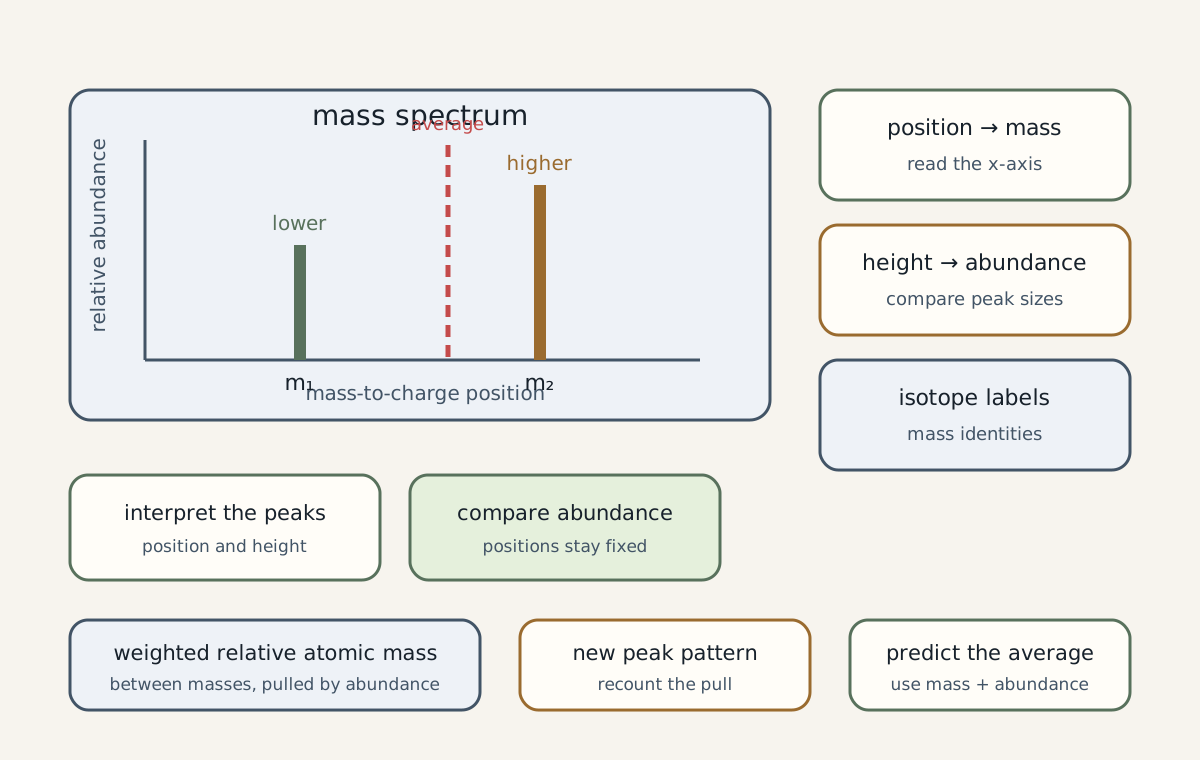
| Read | Infer | Use |
|---|---|---|
| Peak position | Isotope mass | Label the isotope |
| Relative peak height | Relative abundance | Weight that isotope's contribution |
| All peaks together | Isotopic composition | Calculate the weighted relative atomic mass |
The syllabus assesses interpretation of mass spectra, not operational details of how the spectrometer works.
Ar=(m1×f1)+(m2×f2)+…
If singly charged isotope peaks occur at m/z 35 and 37 in a 3:1 height ratio, use fractional abundances 0.75 and 0.25 to obtain Aᵣ = 35.5. First confirm the charge state: m/z is a ratio, so a multiply charged ion cannot be read as mass alone.
Retrieve the sequence: use nuclear notation to count particles, distinguish isotopes by neutron number, then read mass-spectrum positions and heights as isotope mass and abundance evidence.
When checking an answer, ask: Did I separate A, Z, and charge? Did I explain isotope properties through electron arrangement? Did I weight each isotope by its abundance?