B3.2.5—Vein adaptations
Veins return low-pressure blood to the heart using valves, wide lumens and flexible walls that can be compressed by surrounding muscles.
- Syllabus
- First assessment 2025
- Objective
- B3.2.5
- Level
- SL
Veins return low-pressure blood to the heart using valves, wide lumens and flexible walls that can be compressed by surrounding muscles.

Coverage 2011–2025 · Updated 15 Jul 2026
Veins use large lumens, valves and skeletal-muscle contractions to return blood to the heart despite low pressure.
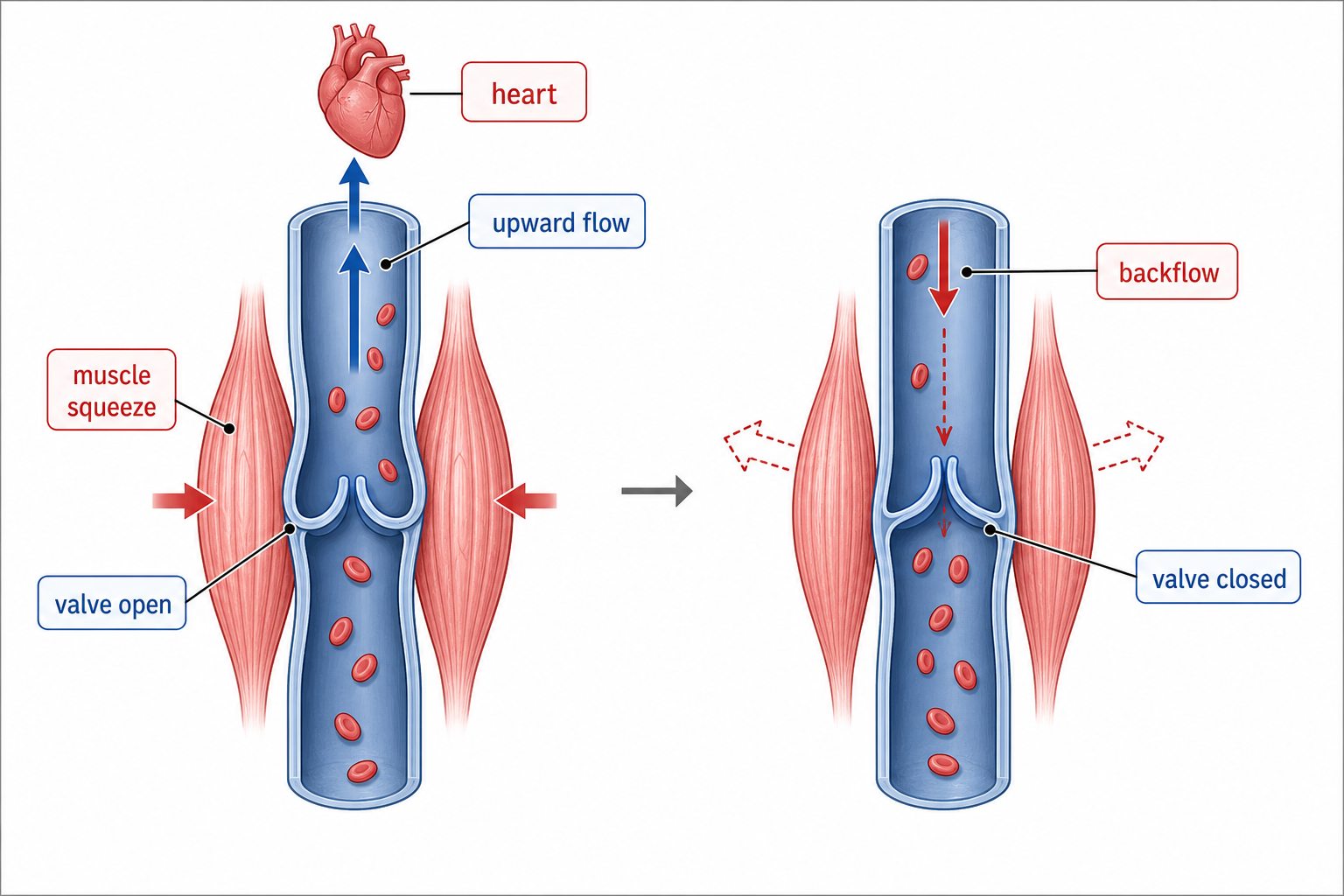
A wide lumen reduces resistance, valves stop reverse flow and muscle compression raises local pressure. Breathing movements can also help draw venous blood toward the chest.
Follow one bolus of venous blood upward and identify how valves and muscle compression prevent reversal.
When calf muscles contract, a valve below the compressed region closes while the valve above opens, pushing blood upward.
Valves do not create the original pressure; they make one-way assistance effective.
This objective is assessed through structured response, commonly using Identify / State / Explain.
Identify / State / Explain / Deduce
Build the answer around this relationship: Vein valves keep blood moving toward the heart.
Explaining venous flow without mentioning valves that prevent backflow.
Representative question
Deduce what the experiment demonstrated about the circulation of blood.
| a | blood flows towards the heart |
| b | valves prevent backflow |
| c | blood flow is unidirectional |
Animal and plant transport answers should link structure to function. In animals, capillaries exchange, arteries maintain high-pressure flow, veins return low-pressure blood, pulse measures arterial pressure waves, and coronary occlusion blocks oxygen delivery to heart muscle. In plants, xylem transports water by transpiration tension and cohesion, while stem and root tissue plans show where xylem and phloem are arranged.