B1.1.12—Phospholipid bilayers

Phospholipids are amphipathic molecules whose hydrophilic phosphate heads and hydrophobic fatty-acid tails self-arrange into stable membrane bilayers in water-rich environments.

Syllabus
First assessment 2025
Objective
B1.1.12
Level
SL

Exam analysis

Chance of appearing1%of analysed past papers
Latest appearanceNovember 2022
Most common paperPaper2
Typical marks1–2

Common command terms

  • Outline
  • Annotate

Scoring notes

Common mistake
Reversing the hydrophilic phosphate head and hydrophobic fatty-acid tails.

Recent exam appearances

November 2022Paper2 ["SL"] · TZ02(a)[ 2 ]B1.1.12—Phospholipid bilayers
November 2012Paper2 ["SL"] · TZ01(d)[ 1 ]B1.1.12—Phospholipid bilayers

Coverage 2012–2022 · Updated 15 Jul 2026

Phospholipids hide their tails to make a barrier

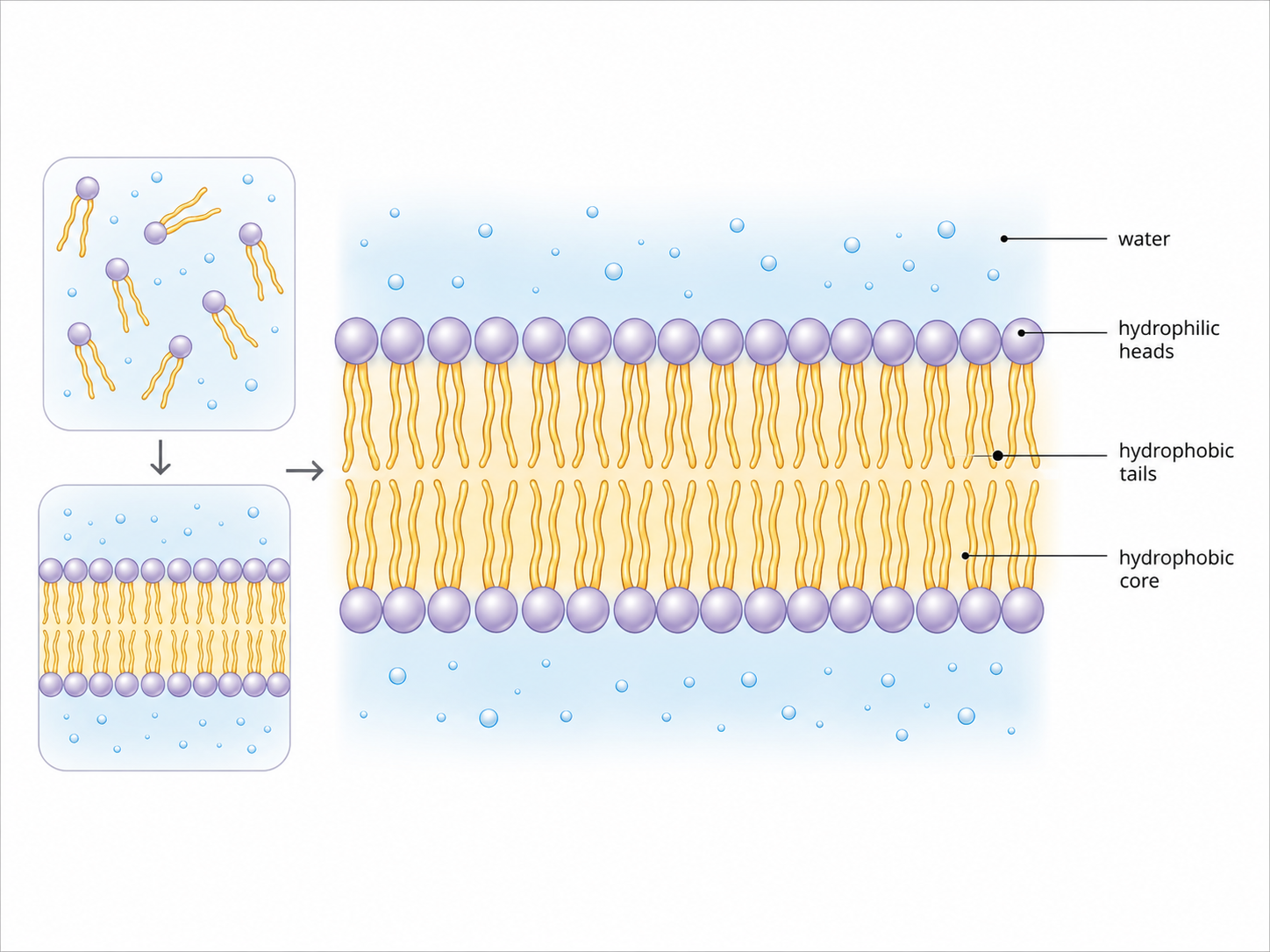
A phospholipid is amphipathic: its ionised phosphate head is hydrophilic, while its two hydrocarbon tails are hydrophobic.

In water, phospholipids arrange so that:

  • heads remain in contact with water
  • tails turn away from water
  • a surface favours a monolayer
  • water on both sides favours a bilayer with tails enclosed inside
A labelled phospholipid and its arrangement as a monolayer at a water surface and a bilayer when surrounded by water.

Self-assembly lowers the exposure of non-polar tails to water. The resulting stable bilayer has a hydrophobic core that restricts many ions and polar solutes, forming the basic boundary of a cell.

Lipid summary: predict behaviour from molecular regions

Structure seen Property predicted Main biological outcome
3 fatty-acid tails on glycerol hydrophobic, highly reduced dense long-term energy store
more cis C=C bonds in tails poorer packing, lower melting point greater fluidity at a given temperature
phosphate head + 2 tails amphipathic self-assembled bilayer barrier
4 fused carbon rings, mostly non-polar lipid-soluble diffusion through bilayer core

Ester condensation joins fatty acids to glycerol. The components retained in the product determine whether it behaves as a hydrophobic store or an amphipathic membrane molecule.

Across carbohydrates and lipids, use the same reasoning chain:

atoms and functional groups → bonds → molecular shape and polarity → interactions with water and other molecules → biological function

Phospholipid bilayers

[ 2 ]

Annotate the diagram to illustrate the amphipathic nature of phospholipids.

Concept essentials

  • Phospholipid heads are hydrophilic and phosphate-containing.
  • Fatty-acid tails are hydrophobic and avoid water.
  • In water, phospholipids self-arrange so tails are shielded from water.
  • Phospholipid bilayers form the basic barrier structure of cell membranes.