B1.2.5—Effect of pH and temperature

Protein function depends on shape, so high temperature or unsuitable pH can denature proteins by disrupting stabilizing bonds and active sites.

Syllabus
First assessment 2025
Objective
B1.2.5
Level
HL

Exam analysis

Chance of appearing2%of analysed past papers
Latest appearanceNovember 2021
Most common paperPaper1
Typical marks1–4

Common command terms

  • Outline
  • Explain
  • Identify

Scoring notes

Common mistake
Claiming denaturation changes the amino-acid sequence.

Recent exam appearances

November 2021Paper2 ["HL"] · TZ08(a)[ 4 ]B1.2.5—Effect of pH and temperature
May 2017Paper1 ["HL"] · TZ29[ 1 ]B1.2.5—Effect of pH and temperature

Coverage 2017–2021 · Updated 15 Jul 2026
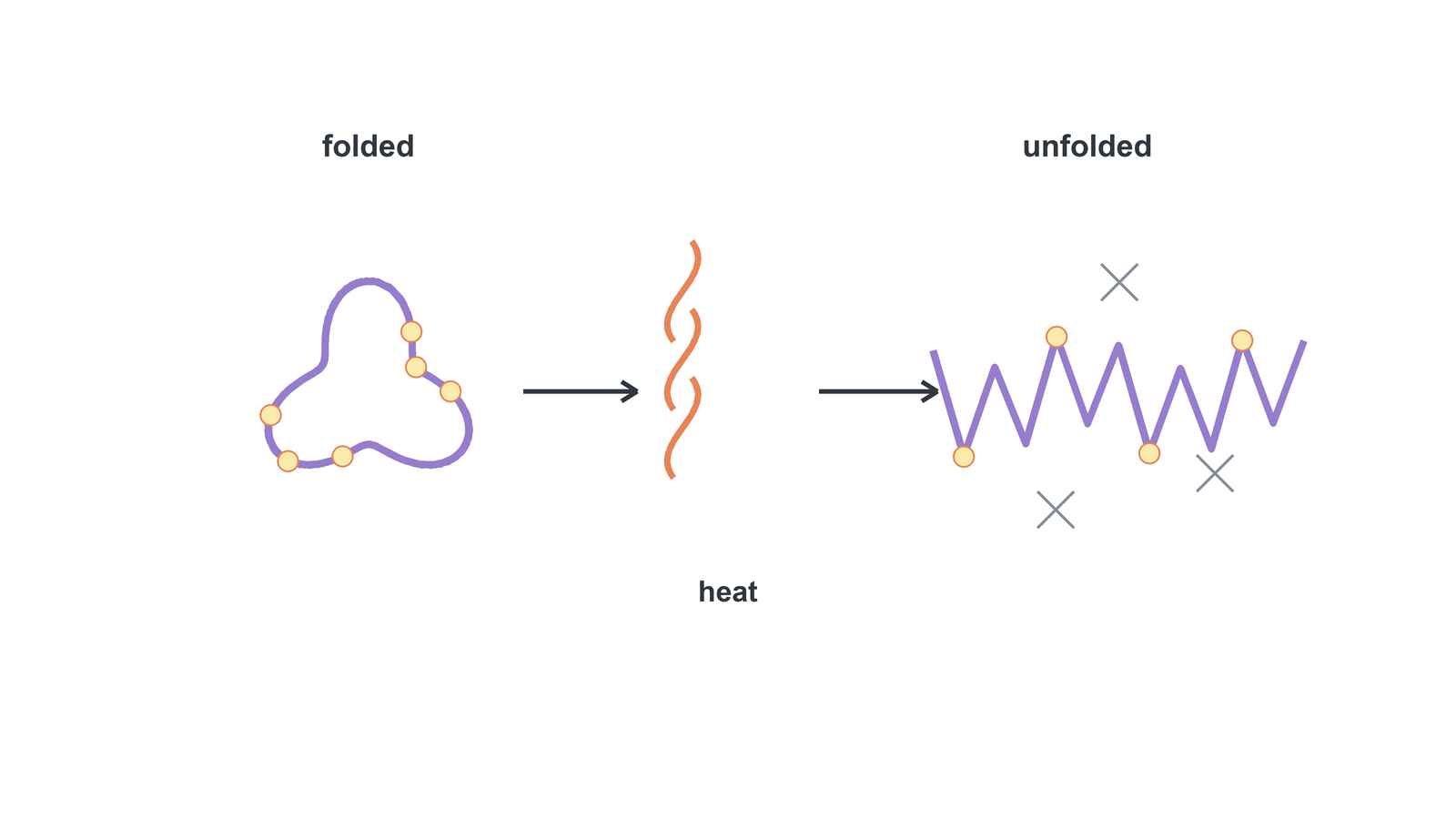
Heat and pH can denature a protein

A folded protein loses its precise shape when heat or extreme pH disrupts stabilizing interactions.
Change Molecular effect Consequence
High temperature weak interactions break fold and binding surfaces, including active sites, change
Extreme pH R-group charges change ionic attractions and H-bonds break

Denaturation changes conformation and function but usually leaves the amino-acid sequence intact. Refolding requires the original interactions to reform before aggregation.

Checkpoint: build a protein, then identify what can limit it

Shared amino-acid groups condense → peptide bonds build a directional backbone → genetic information specifies residue order → positioned R-groups create folding possibilities.

Limiting change Mechanism Consequence
Essential amino acid unavailable a required monomer is missing synthesis of affected proteins slows
High temperature stabilizing interactions are disrupted conformation and function may be lost
pH away from optimum R-group charges change ionic attractions and H-bond patterns can be disrupted

Effect of pH and temperature

[ 4 ]

Outline the process of protein denaturation.

Concept essentials

  • Denaturation changes protein conformation and can remove biological function.
  • High temperature and unsuitable pH can disrupt bonds within proteins.
  • Enzyme denaturation changes the active site and reduces substrate binding.
  • Denaturation usually leaves the primary amino-acid sequence unchanged.