IGCSE Maths Trigonometry: SOHCAHTOA and Bearings
Practise IGCSE Maths trigonometry with SOHCAHTOA, bearings, right-angled triangles, angle choice, and common diagram mistakes. Includes examples and targeted FAQ.
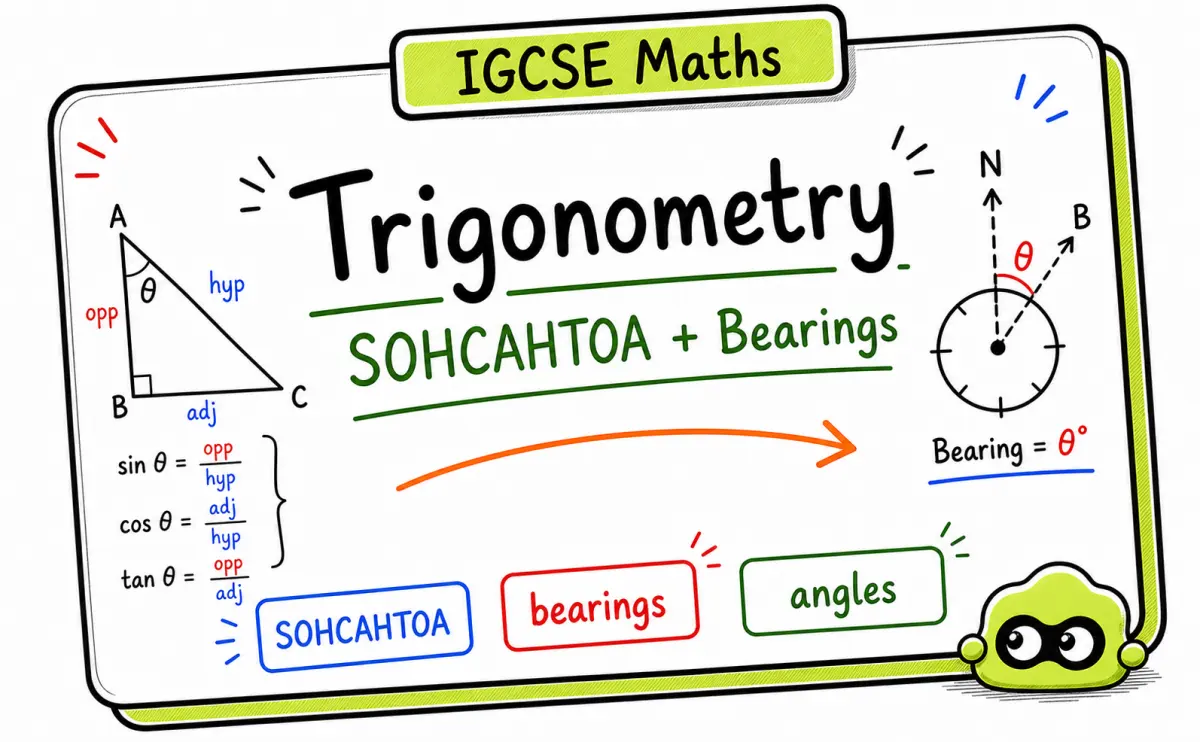
IGCSE Maths trigonometry marks are often lost before the calculator appears. If the angle, side label, or bearing direction is wrong, the final answer can look tidy and still be wrong.
If you only remember one thing: label the triangle from the angle you are using. Opposite and adjacent change when the angle changes. The hypotenuse does not. For bearings, draw north first and measure clockwise.
Useful starting points:
- C6.2 Right-angled triangles
- E6.2 Right-angled triangles
- IGCSE Mathematics Question Bank
- C6.2.1 Know and use the sine, cosine and tangent ratios for acute angles
- 0580 Maths Examiners Tips
- IGCSE Maths Past Examination Papers Classified by Topic
Use the question bank after you rebuild the method. Trigonometry improves fastest when you mark the setup, not only the final number.
Quick answer
- SOHCAHTOA works for right-angled triangles.
- Sine uses opposite and hypotenuse.
- Cosine uses adjacent and hypotenuse.
- Tangent uses opposite and adjacent.
- Use inverse sine, inverse cosine, or inverse tangent when the question asks for an angle.
- Bearings are measured clockwise from north.
- Bearings are often written with three digits, such as 035 degrees or 270 degrees.
- For angle of elevation or depression, draw a horizontal line first.
- If finding an angle, use inverse trig: sin^-1, cos^-1, or tan^-1.
- For a bearing of B from A, draw north at A, not at B.
- Reverse bearings differ by 180 degrees.
- Check calculator degree mode before using sine, cosine, tangent, or inverse trig.
The SOHCAHTOA table
| Ratio | Formula | Use when you know or need |
|---|---|---|
| Sine | sin(theta) = opposite / hypotenuse | Opposite and hypotenuse |
| Cosine | cos(theta) = adjacent / hypotenuse | Adjacent and hypotenuse |
| Tangent | tan(theta) = opposite / adjacent | Opposite and adjacent |
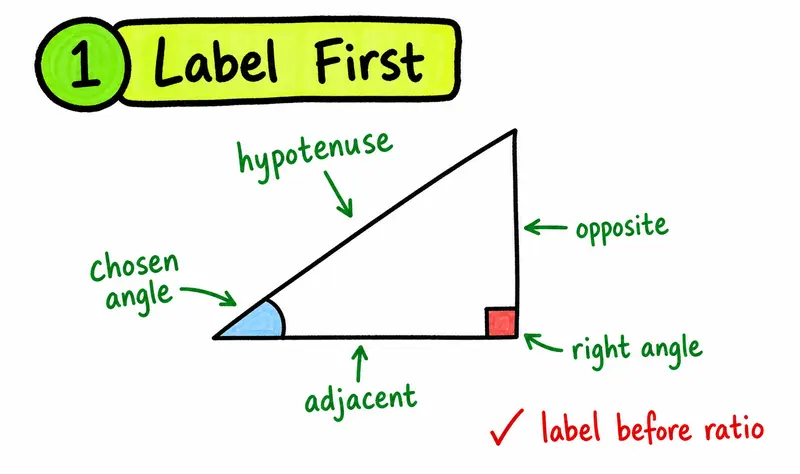
The side names depend on the chosen angle. The side opposite the right angle is always the hypotenuse. The other two labels must be set from the angle in the question.
Step 1: label the triangle
Before choosing a ratio, mark three things:
- The right angle.
- The angle you are using.
- The side you need to find.
Then label the sides:
- Hypotenuse: opposite the right angle.
- Opposite: opposite the chosen angle.
- Adjacent: next to the chosen angle, but not the hypotenuse.
Many wrong answers come from using the other acute angle by accident. If the question gives angle A, label opposite and adjacent from angle A.
Step 2: choose the ratio
Use the two sides involved in the question. Ignore the third side unless you need it later.
| Known side | Unknown side | Ratio to try |
|---|---|---|
| Opposite | Hypotenuse | Sine |
| Adjacent | Hypotenuse | Cosine |
| Opposite | Adjacent | Tangent |
| Hypotenuse | Adjacent | Cosine |
| Hypotenuse | Opposite | Sine |
| Adjacent | Opposite | Tangent |
The ratio is not chosen because it feels familiar. It is chosen because it contains the two sides in your diagram.
When to use inverse trig
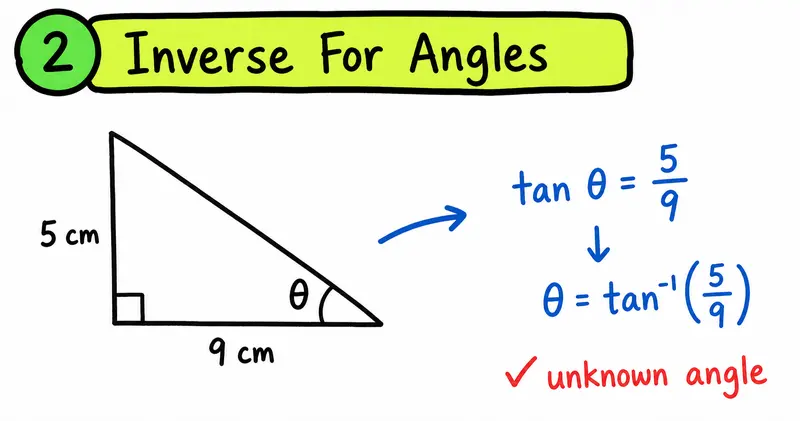
Use inverse trigonometry when the unknown is an angle.
| Known sides | Ratio | Angle step |
|---|---|---|
| Opposite and hypotenuse | Sine | theta = sin^-1(opposite / hypotenuse) |
| Adjacent and hypotenuse | Cosine | theta = cos^-1(adjacent / hypotenuse) |
| Opposite and adjacent | Tangent | theta = tan^-1(opposite / adjacent) |
If the question asks for a side, use sin, cos, or tan. If the question asks for an angle, use inverse trig.
Worked example 1: find a side
Question: A right-angled triangle has an angle of 35 degrees. The hypotenuse is 12 cm. Find the side opposite the 35 degree angle.
Label:
- Opposite is the unknown side.
- Hypotenuse is 12 cm.
- Use sine.
sin(35) = opposite / 12 opposite = 12 x sin(35) opposite = 6.88 cm
Answer: 6.88 cm to 3 significant figures.
Why this scores: The ratio matches the labelled sides, and the answer includes units and sensible rounding.
Worked example 2: find an angle
Question: A right-angled triangle has opposite side 5 cm and adjacent side 9 cm. Find the angle.
Use tangent because the known sides are opposite and adjacent.
tan(theta) = 5 / 9 theta = tan^-1(5 / 9) theta = 29.1 degrees
Answer: 29.1 degrees to 3 significant figures.
Why this scores: The inverse trig step is shown. If you only write tan = 5 / 9, the angle has not been found yet.
Bearings: draw north first
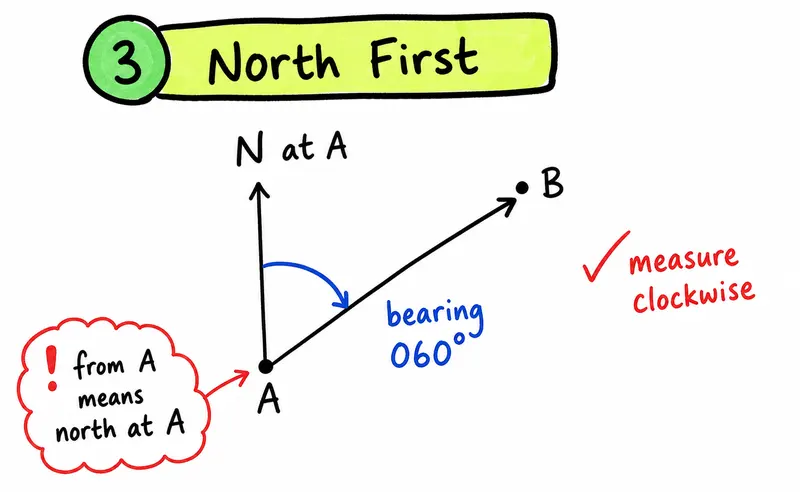
A bearing is an angle measured clockwise from north. It is usually written as a three-digit angle.
| Bearing | Meaning |
|---|---|
| 000 degrees or 360 degrees | North |
| 090 degrees | East |
| 180 degrees | South |
| 270 degrees | West |
| 035 degrees | 35 degrees clockwise from north |
For bearings questions:
- Draw a north line at the starting point.
- Measure clockwise from north.
- Add the direction line.
- If needed, form a right-angled triangle.
- Use SOHCAHTOA on the triangle.
The most common mistake is measuring the small angle from the wrong north line. In a journey question, each point can have its own north line.
Bearings from A to B and from B to A
The bearing of B from A means you stand at A, draw north at A, and measure clockwise to B.
The bearing of A from B means you stand at B, draw north at B, and measure clockwise to A.
Reverse bearings differ by 180 degrees.
If the bearing of B from A is 060 degrees, the bearing of A from B is 240 degrees.
If adding 180 gives more than 360, subtract 360.
Worked example 3: bearing with a right triangle
Question: A ship travels 8 km east and then 6 km north. Find the bearing of the ship from its starting point.
Draw the displacement from the starting point to the final point. The right triangle has east distance 8 km and north distance 6 km.
The bearing is measured clockwise from north, so use the angle between north and the displacement line.
tan(theta) = east / north tan(theta) = 8 / 6 theta = tan^-1(8 / 6) theta = 53.1 degrees
Bearing: 053 degrees to the nearest degree.
Why this scores: The ratio uses east over north because the angle is measured from north, not from east.
Angle of elevation and depression
Angle of elevation is measured upward from a horizontal line. Angle of depression is measured downward from a horizontal line.
For these questions, draw the horizontal line first. Then draw the line of sight.
| Phrase in question | What to draw |
|---|---|
| Angle of elevation | Horizontal line, then line upward to the object |
| Angle of depression | Horizontal line, then line downward to the object |
| Height of a building | Vertical side |
| Distance from a building | Horizontal side |
| Line of sight | Hypotenuse if it connects observer to object |
Angles of elevation and depression are equal when the horizontal lines are parallel and the same line of sight cuts across them. This can help you move the angle into the triangle.
Worked example 4: angle of elevation
Question: A person stands 20 m from a tower. The angle of elevation to the top is 32 degrees. Find the height of the tower.
The height is opposite the angle. The ground distance is adjacent.
tan(32) = height / 20 height = 20 x tan(32) height = 12.5 m
Answer: 12.5 m to 3 significant figures.
Why this scores: The horizontal distance is adjacent, the vertical height is opposite, and tangent matches the two sides.
Calculator mode and rounding
Most IGCSE trigonometry questions use degrees. Check that the calculator is in degree mode before starting.
Keep extra digits during working and round at the end. If the question asks for 3 significant figures, do not round each intermediate step to 3 significant figures.
Write units where needed:
- lengths: cm, m, km
- angles: degrees
- bearings: three digits if the question expects bearings
Weak answer vs mark-worthy answer
| Prompt | Weak answer | Why it loses marks | Mark-worthy answer |
|---|---|---|---|
| Find a side using trig | Use sine because it is trig. | The side relationship is missing. | The known side is the hypotenuse and the unknown side is opposite the angle, so use sine. |
| Find an angle | tan = 5 / 9 | The inverse step is missing. | theta = tan^-1(5 / 9), so theta = 29.1 degrees. |
| Give a bearing | The angle is 53 degrees. | Bearings need direction from north and often three digits. | The bearing is 053 degrees because it is measured clockwise from north. |
| Use angle of elevation | The angle is at the top. | The horizontal reference line is unclear. | Draw the horizontal line from the observer, then measure the angle upward to the object. |
The stronger answer explains why the ratio or bearing direction fits the diagram. That is usually where the method mark comes from.
Common mistakes that cost marks
- Labelling opposite and adjacent from the wrong angle.
- Using sine, cosine, or tangent before checking the two sides involved.
- Forgetting inverse trig when finding an angle.
- Measuring bearings anticlockwise.
- Writing 35 degrees instead of 035 degrees when a three-digit bearing is expected.
- Using the north line at the wrong point.
- Rounding too early.
- Forgetting units.
Fix the setup first. If the diagram is wrong, repeating calculator practice will not repair the mark loss.
Diagram mistakes that change the answer
| Mistake | Why it is wrong | Fix |
|---|---|---|
| Labelling opposite from the wrong angle | Opposite and adjacent depend on the chosen angle | Circle the angle used in the formula |
| Treating the hypotenuse as adjacent | Hypotenuse is always opposite the right angle | Mark the right angle first |
| Measuring a bearing anticlockwise | Bearings are clockwise from north | Draw north and add a clockwise arrow |
| Using north at the wrong point | Bearings are measured from the starting point | For "B from A", draw north at A |
| Forgetting degree mode | Calculator gives the wrong trig value | Check DEG before calculating |
Exam-ready checklist
- Did I mark the right angle?
- Did I label the target angle?
- Did I label opposite, adjacent, and hypotenuse from that angle?
- Did I choose the ratio from the two sides involved?
- Did I use inverse trig when finding an angle?
- Did I check degree mode?
- Did I draw north before measuring a bearing?
- Did I write the bearing with three digits if required?
- Did I round only at the end?
How EduNinja helps
Use this page as the setup guide for IGCSE Maths trigonometry. Then use the linked right-angled triangle question bank to practise the same sequence: label, choose ratio, calculate, check units.
For bearings, spend extra time on the diagram. A bearing question is often a trigonometry question hidden inside a direction diagram.
FAQ
When do I use sine, cosine, or tangent?
Use the ratio that contains the two sides in the question. Sine uses opposite and hypotenuse, cosine uses adjacent and hypotenuse, and tangent uses opposite and adjacent.
When do I use inverse trigonometry?
Use inverse trigonometry when the question asks for an angle and you know two sides. For example, use tan^-1(opposite / adjacent) when the known sides are opposite and adjacent.
Why do bearings need three digits?
Bearings are measured clockwise from north and are often written with three digits so the direction is clear. For example, 35 degrees is written as 035 degrees.
How do I know which north line to use?
Use the north line at the point the bearing is measured from. If the question asks for the bearing of B from A, draw north at A.
What is the difference between angle of elevation and angle of depression?
Angle of elevation is measured upward from a horizontal line. Angle of depression is measured downward from a horizontal line.
What is the difference between trig and inverse trig?
Use trig when finding a side. Use inverse trig when finding an angle from two known sides.
How do I find a reverse bearing?
Add 180 degrees to the bearing. If the answer is more than 360 degrees, subtract 360 degrees. For example, the reverse bearing of 070 degrees is 250 degrees.
Why is my trigonometry answer wrong even though the calculator step is right?
The diagram may be wrong. Check the chosen angle, opposite and adjacent labels, hypotenuse, degree mode, units, and whether the bearing was measured clockwise from the correct north line.
Related study links
- C6.2 Right-angled triangles
- E6.2 Right-angled triangles
- IGCSE Mathematics Question Bank
- C6.2.1 Know and use the sine, cosine and tangent ratios for acute angles
- 0580 Maths Examiners Tips
- IGCSE Maths Past Examination Papers Classified by Topic
Use the links as a practice route: do one right-angled triangle question, one angle question, and one bearings question before moving to another topic.
Closing
IGCSE Maths trigonometry becomes much easier when the diagram controls the calculation. Label from the chosen angle, pick the ratio from the two sides involved, and treat bearings as clockwise angles from north.
Choose a course and continue studying.
Pick your curriculum and subject, then continue into the right question bank or notes.
Related articles
More course notes, updates and study resources from the EduNinja blog.
Piecewise Functions Explained | IB Maths AA
Revise IB Maths AA piecewise functions with interval rules, endpoint notation, graphs, evaluation steps, common mistakes and practice.
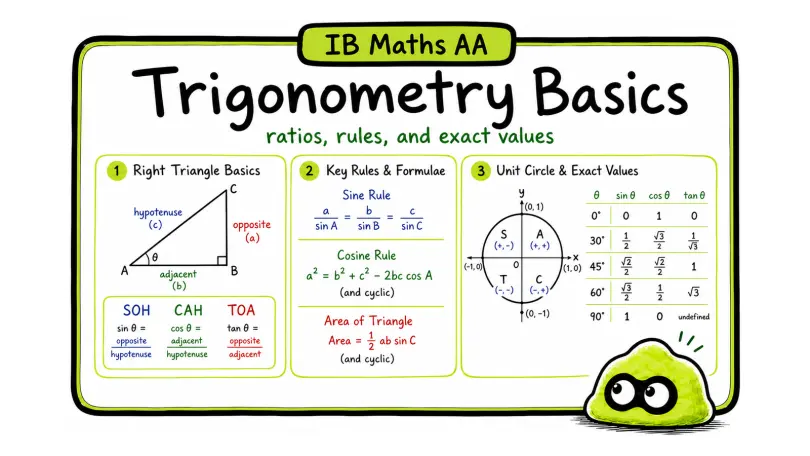
Trigonometry Basics for Exams | IB Maths AA
Learn IB Maths AA trigonometry basics with SOH CAH TOA, sine and cosine rules, area, unit-circle signs, exact values and exam practice.
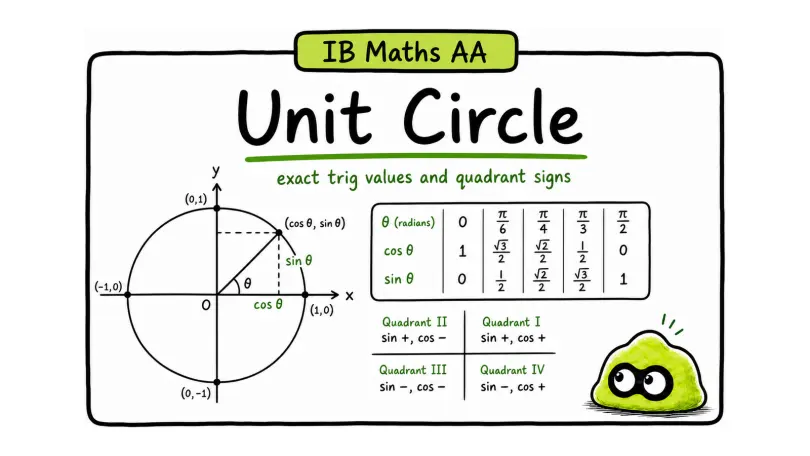
Unit Circle Explained | IB Maths AA
Learn the unit circle for IB Maths AA with exact trigonometric values, radians, quadrants, signs and exam methods.