IB ESS SL Human Systems and Resource Use: Revision Guide
Revise IB ESS SL human systems and resource use with sustainability, carrying capacity, ecological footprints, energy choices, and evaluation.
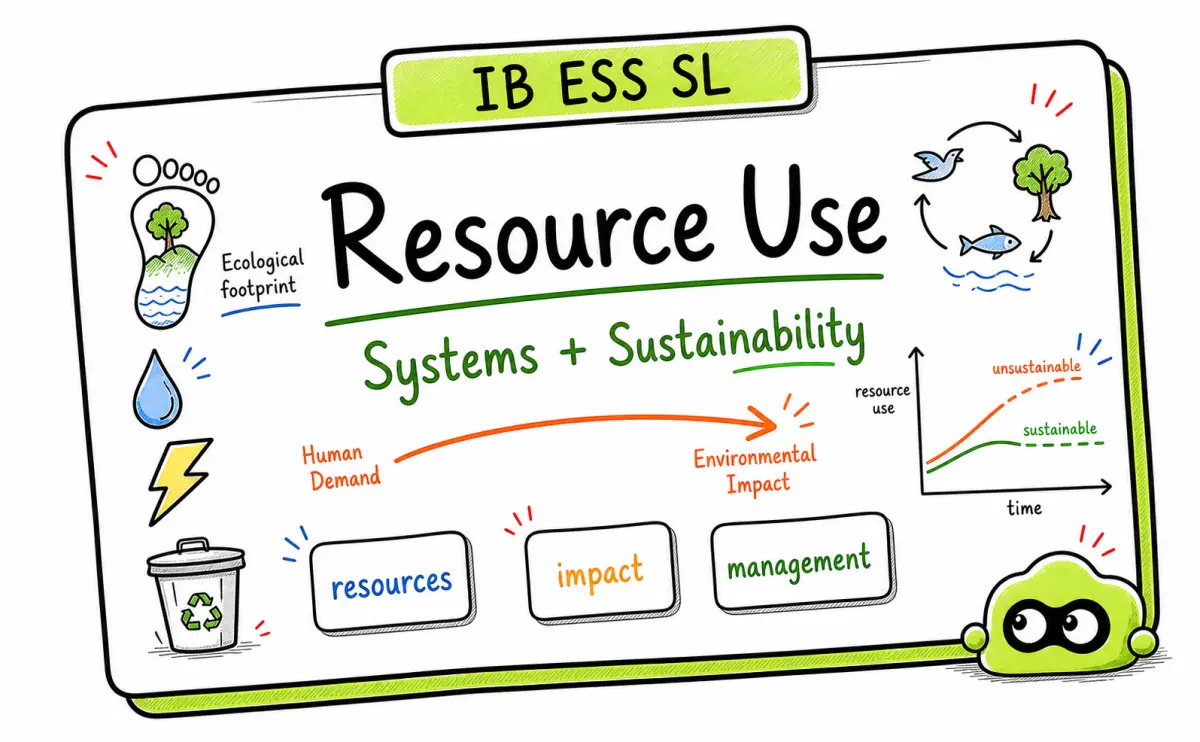
IB ESS human systems and resource use is about pressure. Human population grows, standards of living change, resources are extracted, waste is produced, and societies try to manage the effects without depleting natural capital.
If you only remember one thing: this topic is not only about "too many people". ESS expects you to connect population dynamics, resource demand, natural capital, sustainability, ecological footprints, and waste management in the same answer.
Useful starting points:
- IB Environmental Systems and Societies Notes
- IB Environmental Systems and Societies Question Bank
- IB Environmental Systems and Societies Study Library
This guide follows the local ESS Topic 8 notes. Topic 4 and Topic 5 are used only where resource use connects clearly to water, food, fisheries, soil degradation, and sustainable yield.
Quick answer
- Human population affects the environment because more people need more resources and produce more waste.
- Resource demand also depends on wealth, standards of living, urban or rural setting, geography, and patterns of consumption.
- Malthus argued that population growth could outstrip food supply. Boserup argued that population pressure can stimulate technological innovation.
- Natural capital is the source of resources and services obtained from nature.
- Renewable, replenishable, and non-renewable natural capital must be managed differently.
- Sustainable yield is the rate at which natural capital can be used without depleting the original stock.
- Ecological footprint compares human demand on productive land and water with what is available.
- Solid domestic waste can be managed by reduction, reuse, recycling, composting, landfills, incineration, and energy recovery.
Human population dynamics
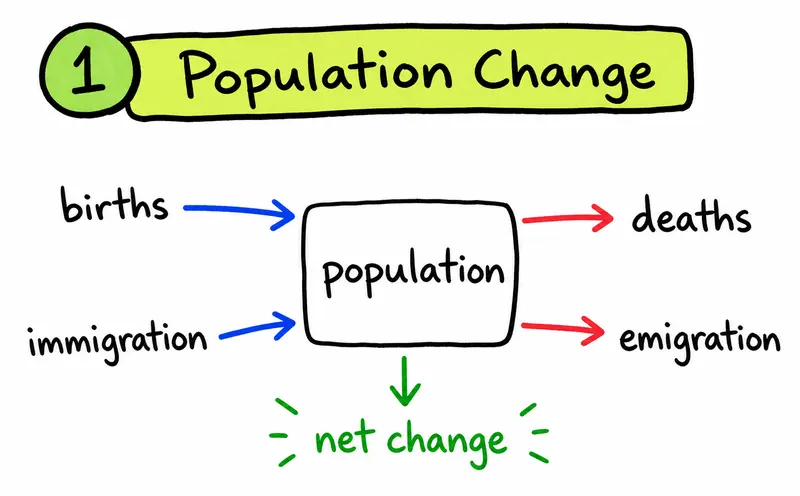
The Topic 8 notes begin with human population dynamics. Human population has been relatively small for most of human history, but technological advances have increased population size and the carrying capacity of many areas.
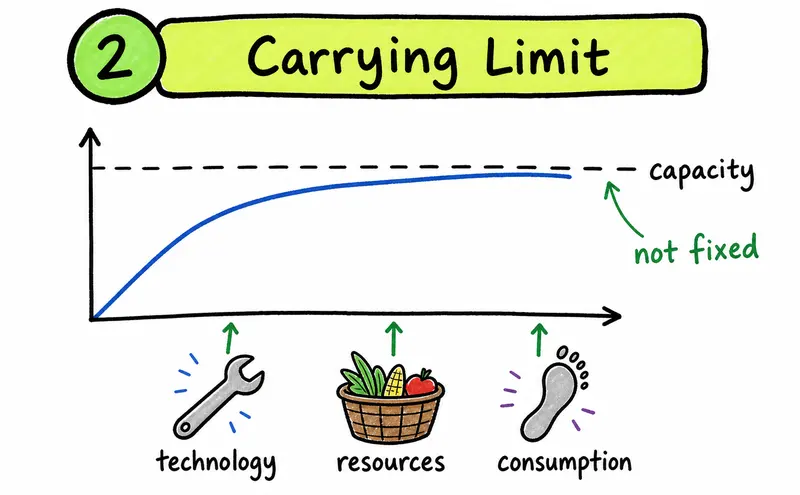
Carrying capacity means the maximum population an environment can support sustainably with available resources and environmental conditions. In human systems, carrying capacity is not fixed. Technology, agriculture, trade, medicine, sanitation, and energy use can all change it.
That is why ESS answers should avoid a simple sentence like "population growth damages the environment". A better answer explains the pathway:
Population growth can increase demand for food, water, land, energy, and materials. This can increase resource scarcity, waste production, pollution, and ecological footprint, especially when rising population is combined with rising affluence.
Why human carrying capacity is difficult to measure
Human carrying capacity is harder to measure than the carrying capacity of many non-human populations. Humans use many different resource types, substitute one resource for another, import resources from other places, and change resource efficiency through technology.
Resource use also varies between societies. Lifestyle, culture, income, urban or rural living, diet, transport, housing, and economic development all change the amount of natural capital a population uses.
That means the same population size can have very different environmental impacts. An ESS answer should therefore discuss both population size and consumption pattern.
Ecocentric and technocentric ways to affect carrying capacity
| View | How it may affect carrying capacity | Evaluation |
|---|---|---|
| Ecocentric | Reduce non-renewable resource use, minimize renewable resource use, grow food locally, recycle water, use rainwater harvesting, reduce waste | Lowers demand on natural capital, but may require lifestyle change |
| Technocentric | Use technology, trade, efficiency improvements, higher-yield systems, and innovation to increase available resources or reduce pressure | Can increase apparent carrying capacity, but efficiency gains do not mean carrying capacity can be exceeded sustainably |
This is a useful Malthus and Boserup link. Malthus is closer to the idea of limits, while Boserup is closer to the idea that pressure can stimulate technological responses.
Measuring population change
The PDF lists several key population measures.
| Term | Meaning |
|---|---|
| Crude birth rate, CBR | Number of births per 1000 individuals per year |
| Crude death rate, CDR | Number of deaths per 1000 individuals per year |
| Rate of natural change | Difference between birth rate and death rate |
| Natural increase rate, NIR | Human population growth expressed as percentage change per year |
| Fertility rate | Number of live births per 1000 women aged 15 to 54 in a given year |
| Total fertility rate | Average number of children each woman has in her reproductive lifetime |
| Replacement-level fertility | Fertility level at which each generation replaces itself |
| Doubling time | Time in years for a population to double |
The notes give the natural increase rate relationship:
The notes also use this doubling time estimate:
These formulas are useful only if you interpret them. A high NIR means faster growth and a shorter doubling time, which can increase pressure on resources and infrastructure.
HDI and resource pressure
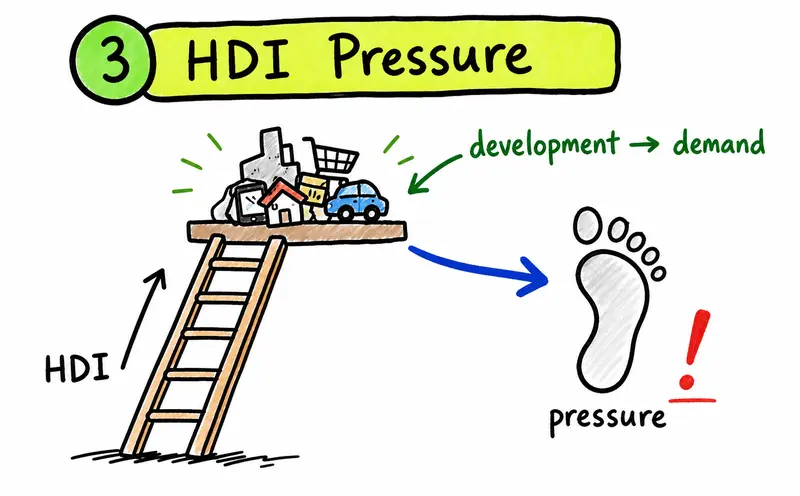
The notes define the Human Development Index as a measure of well-being and development. It combines health, wealth, and education into one value.
In ESS, HDI helps you avoid assuming that every population has the same environmental impact. A smaller, wealthier population may use more resources per person than a larger, poorer population.
Human population impacts the environment because:
- more people need more resources
- more people produce more waste
- people often want improved standards of living
Other factors include wealth, resource demand, resource use, urban or rural setting, and geography.
Malthusian theory
Thomas Malthus argued that food supply was the main limit to population growth. The notes describe his view as population increasing geometrically while food supply grows arithmetically.
In this view, population may eventually outstrip food supply until a catastrophe such as famine, disease, or war reduces population pressure.
The notes also give limitations:
- hunger does not affect everyone equally
- food distribution is not always fair or even
- food is not the only factor controlling population growth
- technological advances are not fully accounted for
- migration is ignored because the theory assumes a closed population
Use Malthus when a question asks about limits, carrying capacity, food supply, or pessimistic views of population growth.
Boserup's theory
Esther Boserup gives a more optimistic and technocentric view. The notes state that population growth increases demand for food and can act as an incentive to improve technology.
In simple terms: necessity can drive invention.
The notes also give limitations:
- the theory may assume a closed population
- not all areas have money, skills, or conditions for technological development
- technological development is not guaranteed
Use Boserup when discussing innovation, agricultural technology, or the idea that human systems can adapt to pressure.
Birth rates, death rates and family size
The Topic 8 notes list several factors influencing birth rates:
- education, especially education of women
- pro-natalist or anti-natalist policies
- economic prosperity
- need for children in agrarian economies
- cultural and religious beliefs
- access to family planning and contraception
Reasons for large families include high infant or child mortality, old-age security, children as economic assets, low status of women, and lack of contraception or family planning education.
Death rates can be affected by healthcare, sanitation, infant mortality, political conditions, natural disasters, and ageing populations.
This is a strong ESS exam move: do not only describe the pattern. Explain why birth rate or death rate changes.
Population pyramids and demographic transition
Population pyramids show the age and gender structure of a population at a particular time. They help identify whether a population is expanding, stationary, or contracting.
The demographic transition model describes a historical shift from high birth and death rates to low birth and death rates.
| Stage | General pattern |
|---|---|
| Stage 1 | High birth rate and high death rate, stable or slow increase |
| Stage 2 | High birth rate and rapidly falling death rate, very rapid increase |
| Stage 3 | Falling birth rate and slowly falling death rate, slower increase |
| Stage 4 | Low birth rate and low death rate, stable or slow increase |
| Stage 5 | Very low birth rate and low death rate, slow increase or decrease |
The notes link early stages to farming needs, high infant mortality, lack of family planning, disease, famine, and poor medical facilities. Later stages connect to healthcare, diet, family planning, education, improved status of women, later marriage, and ageing populations.
Limitations matter. The model can be Eurocentric, assumes industrialization, and may ignore barriers such as religious beliefs against contraception or gender bias against women.
Reducing birth rates and family size
The notes give several strategies:
- provide education to children, women, and adults
- improve healthcare to reduce infant deaths
- provide contraceptives and family planning
- use micro-finance schemes to support incomes
- educate and employ women
- introduce pension schemes to reduce dependency on children in old age
The key ESS point is that population management is not only a medical issue. It is linked to gender equality, poverty, education, family security, and social policy.
Resource use in society
Topic 8 defines natural capital as the source of supply of resources and services obtained from nature. Natural income is the yield from sources of natural capital.
| Type of natural capital | Meaning | Example from notes |
|---|---|---|
| Renewable natural capital | Living resources that can be replaced as fast as they are used by natural productivity | food crops |
| Replenishable natural capital | Non-living resources replaced by natural processes | water |
| Non-renewable natural capital | Resources replaced only over a very long timescale, slower than use | fossil fuels |
The value of natural capital can change over time. Uranium became more valuable with nuclear power technology, while salt became less economically exceptional over time.
That dynamic value is important. ESS resource value depends on technology, demand, scarcity, and social choices.
Sustainability and natural capital
The notes state that societies depleting natural capital live unsustainably. The rate of use should be lower than the rate of renewal, or natural capital will be depleted.
Problems in protecting natural capital include:
- difficulty assigning value to market and non-market environmental resources
- unwillingness to pay for resources that have long seemed free
- lack of knowledge about renewal times
- lack of knowledge about interactions between resources
- poor management of resources shared by more than one country
- inequalities between LEDCs and MEDCs
This gives you a strong evaluation structure. Sustainable management is not only about knowing the science. It also depends on economics, knowledge, governance, equity, and international cooperation.
Total Economic Value
The Topic 8 notes use Total Economic Value to show why natural capital is often undervalued. Some values are easy to price because humans use the resource directly. Other values are harder to price because they are indirect, future-focused, cultural, or intrinsic.
| Value type | Meaning |
|---|---|
| Use value | Value from using the resource or service |
| Direct value | Direct human use, such as harvesting food, timber, water, or fuel |
| Indirect value | Ecosystem services that support life and systems, such as flood control, climate regulation, soil formation, or water purification |
| Option value | Potential future use of a resource that may become valuable later |
| Bequest value | Value of leaving natural capital for future generations |
| Existence or intrinsic value | Value of nature existing, even if humans do not directly use it |
This matters because market prices often ignore non-market values. If a forest is valued only for timber, its indirect value for biodiversity, water regulation, soil protection, carbon storage, and future generations may be underestimated.
Sustainable yield and maximum sustainable yield
Sustainable yield is the rate at which natural capital can be exploited without depleting the original stock or reducing its ability to replenish.
Maximum sustainable yield is the largest amount that can be extracted without permanently depleting the stock.
Topic 4 uses fisheries to show why this is difficult. Estimates are based on models, past patterns, and assumptions about populations. Disease, age structure, sex ratio, juvenile harvest, or targeting reproductive females can make the model inaccurate.
That is why maximum sustainable yield is risky if used too aggressively. A safer management approach may harvest below the maximum to protect long-term stock stability.
Sustainable development principles
The Topic 8 notes describe sustainable development through several principles.
| Principle | Meaning in an ESS answer |
|---|---|
| Eco-friendly | Development should reduce environmental damage and protect natural capital |
| Public participation | Local people should be involved before and during projects, so management is more realistic and accepted |
| Social justice and equity | Strategies should consider poorer people and unequal access to resources |
| Futurity | Decisions should protect the ability of future generations to meet their needs |
Use these principles when evaluating a policy. A project may be environmentally useful but weak on equity, or economically attractive but poor on futurity.
Ecological footprint
The ecological footprint estimates the area of land and water required to support a population's resource consumption and waste assimilation.
If ecological footprint is greater than the area available to the population, it indicates unsustainability.
Use ecological footprint carefully:
- It helps compare demand between populations.
- It links consumption to productive land and water.
- It can show inequality between high-consuming and low-consuming societies.
- It is an estimate, so it should be used as an indicator rather than a perfect measurement.
A strong answer explains both what footprint measures and what it suggests about sustainability.
Solid domestic waste
The notes discuss waste as a major part of human resource use. Solid domestic waste includes household waste such as packaging, food waste, paper, plastics, glass, metals, textiles, and discarded products.
Waste increases when population grows, affluence rises, products become more disposable, packaging increases, and consumption habits change.
The ESS link is direct:
Human system: consumption and disposal.
Environmental system: land use, pollution, greenhouse gases, contamination, resource depletion, and habitat impacts.
Circular economy in ESS
The Topic 8 notes contrast a linear economic model with a circular economy. A linear model uses natural capital, produces goods, and then discards waste. This increases extraction and disposal pressure.
A circular economy aims to be restorative. It uses renewable energy where possible, reduces toxic waste, designs out waste, and keeps materials in use for longer.
Manufacturers and producers have responsibility in this model. Products should be designed for repair, reuse, recycling, and safer disposal, rather than leaving all waste management to consumers or local authorities.
Waste management options
| Strategy | How it works | Limitation or trade-off |
|---|---|---|
| Reduce | Avoid producing waste in the first place | Requires behaviour change and product redesign |
| Reuse | Use items again before disposal | Depends on durability and consumer habits |
| Recycle | Process materials into new products | Requires sorting, infrastructure, energy, and markets |
| Compost | Convert organic waste into useful material | Only works for suitable organic waste |
| Anaerobic digestion | Microorganisms break down organic waste without oxygen; methane can be used as fuel and remaining material can be used as fertiliser or soil conditioner | If methane is not used as biogas, it is a greenhouse gas; fertiliser use must be managed to avoid eutrophication |
| Landfill | Bury waste in managed sites | Uses land and can produce leachate and methane |
| Incineration | Burn waste to reduce volume | Can cause air pollution if poorly managed |
| Energy recovery | Use waste to produce energy | May still produce emissions and requires technology |
When evaluating waste management, avoid saying one method is always best. The best option depends on waste type, cost, technology, public behaviour, and environmental impact.
Water and food resource links
Topic 4 supports this article because water and food are major resource systems.
Water scarcity is not only about how much water exists. It is also about how much is used and whether water is accessible, clean, and managed. The notes distinguish physical water scarcity from economic water scarcity.
Growing water demand can be caused by:
- population growth
- increasing affluence
- increasing demand for food
- industrial demand
- energy production
Solutions include reservoirs, redistribution, desalination, rainwater harvesting, artificial recharge of aquifers, domestic water reduction, grey water reuse, drip irrigation, and wastewater treatment.
Food systems link to resource use through water, soil, energy, fertilisers, pesticides, land, waste, and transport.
Soil systems and resource use
Topic 5 supports resource-use revision because soil is natural capital. Soil degradation reduces the ability of land to provide food and ecosystem services.
The notes identify processes leading to soil degradation:
- overgrazing
- over-cropping or overcultivation
- deforestation
- unsustainable agricultural practices
- salinization from irrigation
- monoculture
Conservation strategies include soil conditioners, wind reduction, shelter belts, strip cultivation, cover crops, terracing, contour farming, improved irrigation, stopping ploughing on marginal land, and crop rotation.
This is a useful Paper 2 link: resource use is sustainable only if the natural capital that supports production is maintained.
How to write an ESS answer on this topic
Use this chain:
- Name the human pressure.
- Identify the resource or natural capital affected.
- Explain the environmental impact.
- Add a social or economic factor.
- Evaluate the management strategy.
Example:
Population growth can increase demand for food and water. This raises pressure on natural capital such as soil and freshwater. If agriculture expands through overcultivation or inefficient irrigation, soil fertility may decline and salinization may increase. A management response such as drip irrigation can reduce water loss, but it may require investment and technical support.
Common mistakes
| Mistake | Better habit |
|---|---|
| Saying population growth is the only cause of resource pressure | Include affluence, technology, consumption, and waste |
| Treating renewable resources as automatically sustainable | Explain rate of use compared with rate of renewal |
| Forgetting natural capital | Identify the stock or service being used |
| Using ecological footprint as a perfect measure | Treat it as an estimate and comparison tool |
| Ignoring LEDC and MEDC differences | Mention capacity, equity, consumption, and access |
| Listing waste strategies without evaluation | Add costs, infrastructure, emissions, or behaviour change |
| Describing soil or water without linking to human systems | Connect to population, agriculture, industry, and management |
Related Study Links
FAQ
What is human systems and resource use in IB ESS?
It is the study of how human population, consumption, development, natural capital, waste, and management choices interact with environmental systems.
What is natural capital?
Natural capital is the source of resources and services obtained from nature. It can be renewable, replenishable, or non-renewable.
What is sustainable yield?
Sustainable yield is the rate at which a resource can be used without depleting the original stock or reducing its ability to replenish.
What is ecological footprint?
Ecological footprint estimates the productive land and water area needed to supply a population's resources and absorb its waste. If demand exceeds available area, it indicates unsustainability.
What is the difference between Malthus and Boserup?
Malthus argued that population could outstrip food supply and lead to catastrophe. Boserup argued that population pressure can stimulate technological innovation and increased production.
How do I evaluate waste management in ESS?
Match the strategy to the waste type and context. Then discuss cost, technology, public behaviour, emissions, land use, pollution risk, and long-term sustainability.
Related study links
- IB Environmental Systems and Societies Notes
- IB Environmental Systems and Societies Question Bank
- IB Environmental Systems and Societies Study Library
Continue your full IB ESS SL study plan.
Return to the complete course overview, or move directly into the most relevant study tool.