
EduNinja

IGCSE Biology5.15 GM plants in food productionTopic Practice

5.15 GM plants in food production

Understand how genetically modified plants can be used to improve food production.

Question 2(c)(ii)

[Maximum number: 6]

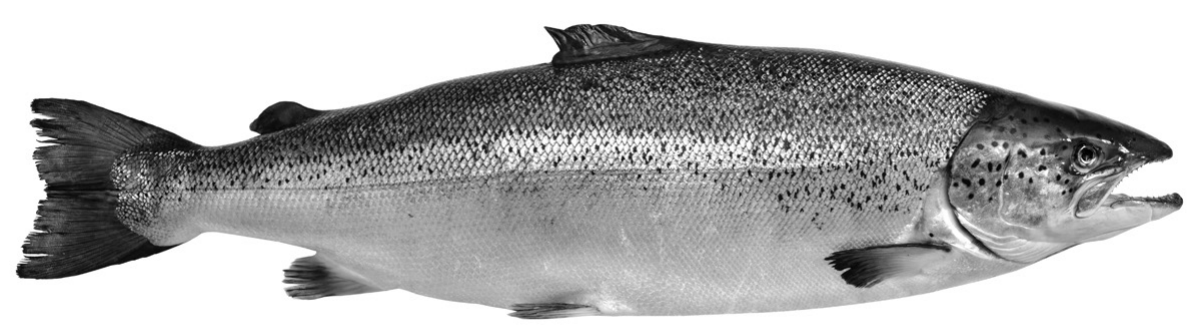
The photograph shows a type of fish called a salmon.
Question image

Some humans eat salmon as a source of protein.
Protein is a component of a balanced diet.

A student investigates the effect of genetic modification on the growth of salmon.

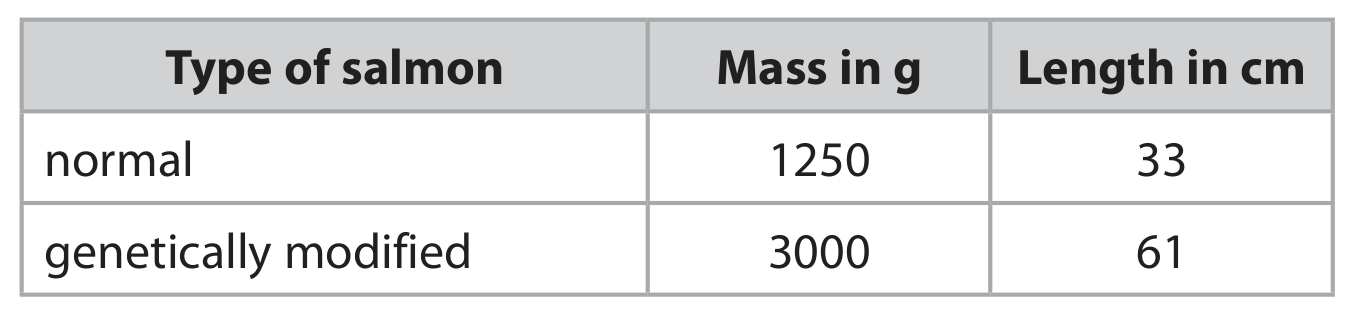
The student measures the mass and length of one normal salmon and one genetically modified salmon when both salmon are 18 months old.

The table shows the student's results.
Table

The student concludes that his results show that genetically modified (GM) salmon are useful in providing a balanced diet.

Discuss the student's conclusion.
Question 5(b)

[Maximum number: 6]

Plants can be genetically modified (GM) to produce insect poison.
They are modified using a bacterium called Agrobacterium.
This bacterium has a plasmid that contains recombinant DNA.

A farmer can use either of these methods to improve his crop yield.
- grow GM plants that produce the insect poison
- grow non-GM plants and use pesticides

The farmer decides to grow the GM plants rather than using pesticides.
Discuss the decision made by the farmer.

Question 6(b)

[Maximum number: 4]

Scientists have developed genetically modified (GM) crops in order to increase food production by increasing crop yields.

Some GM crops that are available to farmers are resistant to herbicides (weedkillers).

Other GM crops are resistant to diseases caused by viruses and to damage by insects. Some people are for the use of GM crops because they may be beneficial to ecosystems. Some people are against the use of GM crops because they could harm ecosystems. Discuss these opinions for and against the use of GM crops.

Question 6

[Maximum number: 4]

The photograph shows a fish called tilapia. This type of fish is often grown in fish farms.

Question 6(b)

(a)

Scientists have produced genetically modified (GM) tilapia that grow faster.

Scientists investigate the growth of these GM tilapia compared with non-genetically modified (non-GM) tilapia.

This is the scientists' method.
- set up two equally sized tanks containing water
- put non-GM tilapia into one tank
- put an equal mass of GM tilapia into the second tank
- feed the fish in each tank the same mass of protein pellets

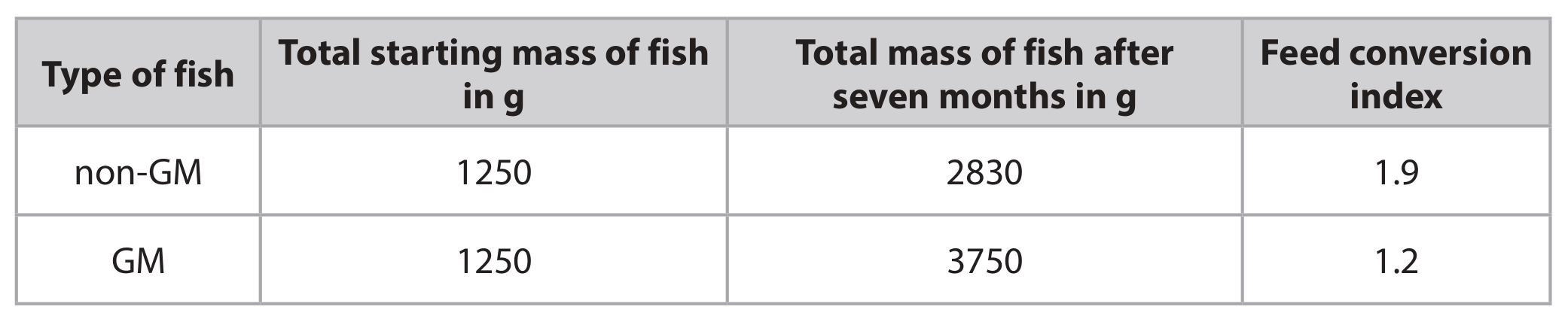
The mass of each type of fish was measured at the start of the investigation and after seven months.

A measure called the feed conversion index was also calculated for each type of fish.

The table shows the scientists' results.

Table
[ 4 ]

Question 6(b)(i)

(i)

The mean rate of increase in mass of the non-GM tilapia during the seven months is 226 g per month.

Calculate the mean rate of increase in mass, in g per month, of the GM tilapia.
Give your answer to three significant figures.
mean rate of increase = g per month

[ 2 ]

Question 6(b)(iii)

(ii)

Suggest why the GM tilapia have a lower feed conversion index than the non-GM tilapia.

[ 2 ]

Question 8(b)(ii)

[Maximum number: 2]

Golden rice is an example of a genetically modified plant.

Golden rice has been given a gene to make a substance called carotene.
This gene was taken from daffodil plants.

Carotene is converted into vitamin A after being consumed by humans. Non-genetically modified rice does not usually contain carotene.

Suggest why some people may not agree with growing genetically modified crops such as golden rice.

0 selected