
Question 1(f)
Read the passage below. Use the information in the passage and your own knowledge to answer the questions that follow.
Plants to the rescue
Since the early 20th century, the concentration of carbon dioxide in the atmosphere has increased rapidly. This has further increased in recent years due to more cars and the increased demand for electricity for homes and industry.
Scientists have found that plants play a critical part in removing this excess carbon dioxide from the atmosphere. Using computer models, the scientists concluded that photosynthesis has increased by 30 per cent.
The scientists measured carbonyl sulfide found in ice cores and air samples. In addition to carbon dioxide, plants take in carbonyl sulfide gas during their natural carbon cycle, and this is frequently used as a measure of photosynthesis on a global scale. Terrestrial plants are removing about 29 per cent of carbon dioxide emissions that would otherwise contribute to an increase in the atmospheric carbon dioxide concentration.
A carbon sink is an ecosystem, such as a forest, that absorbs more carbon dioxide than it releases. The size of the carbon sink depends on the rate of photosynthesis but also on the levels of deforestation and respiration. The model the scientists used showed that the role of photosynthesis in producing a carbon sink in land plants is larger than estimated in most other models.
Other scientists are less confident about using carbonyl sulfide as a measure of photosynthesis. Plant absorption of carbonyl sulfide can vary depending upon the amount of light the plants receive. Therefore, the measure of global photosynthesis could be overestimated.
Regardless of the rate at which photosynthesis has increased, scientists agree that excess carbon dioxide is boosting the growth of plants. Trees are becoming leafier, and there is more wood. The wood is where most of the carbon is stored in the plant.
In experimental research, scientists exposed plants to double the normal concentration of carbon dioxide found in the atmosphere. Under these increased carbon dioxide conditions, the composition of the leaf tissues changed. This made the leaves tougher for herbivores to eat and made it harder for insect larvae to grow.
Scientists have also observed that when plants are exposed to increasing levels of carbon dioxide, the size of the stomatal pores on a leaf increases.
The photograph shows stomata on a small square of the lower surface of a leaf.
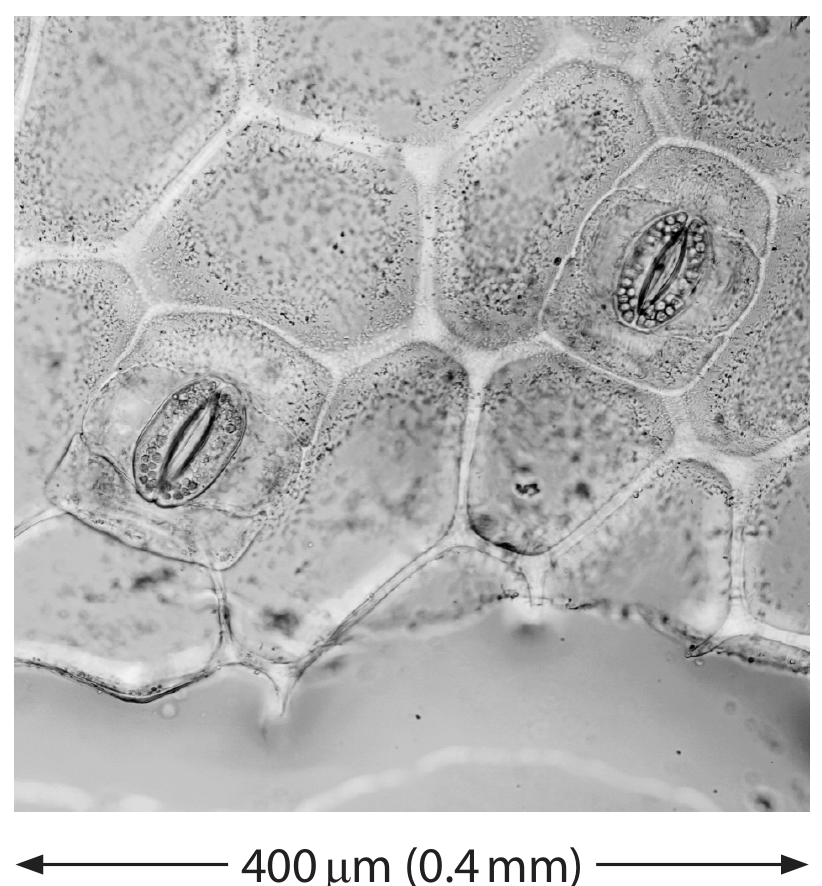
The total area of the lower surface of the leaf is .
Using the photograph and the total lower surface area of the leaf, estimate the number of stomata on the lower surface of the leaf.
number of stomata =