EduNinja

IB Chemistry SL3.2 Functional groups: Organic compoundsQuestion Bank

Question 1

[Maximum number: 2]

The mass spectrum and infrared (IR) spectrum of a compound are shown below.

Question image
Question image

Question 1(b)

Question 1(b)(iii)

(a)
(i)

Deduce the structures of two possible isomers of propanoic acid consistent with the IR spectrum.

[ 2 ]

Question 1

[Maximum number: 1]

Ethyne, C2H2\mathrm{C}_{2} \mathrm{H}_{2}, reacts with oxygen in welding torches.

Question 1(c)

(a)

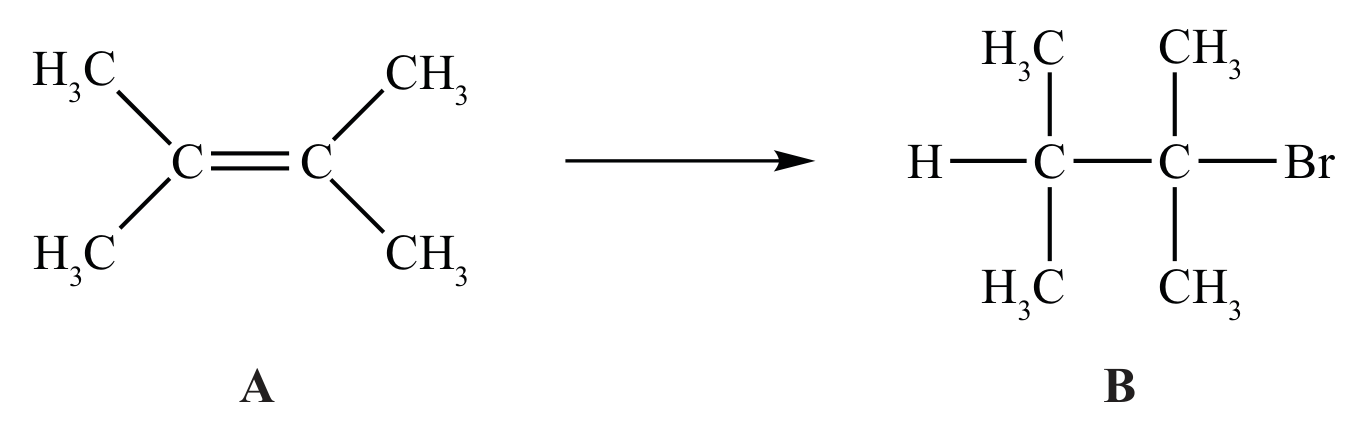
Ethyne reacts with steam.

Two possible products are:

Question image
[ 1 ]

Question 1(c)(ii)

(i)

State the name of product B, applying IUPAC rules.

[ 1 ]

Question 1

[Maximum number: 1]

An organic compound, A, has the following composition by mass when its only combustion products, carbon dioxide and water, are analysed.

Table

Question 1(a)

(a)

Outline why this compound is not a hydrocarbon.

[ 1 ]

Question 1

[Maximum number: 1]

Chlorine undergoes many reactions.

Question 1(d)

Question 1(d)(v)

(a)
(i)

Ethoxyethane (diethyl ether) can be used as a solvent for this conversion.

Draw the structural formula of ethoxyethane.

[ 1 ]

Question 1

[Maximum number: 1]

Methanoic acid (HCOOH) is the first member of the homologous series of carboxylic acids.

Question 1(a)

(a)

Outline what is meant by the term "homologous series".

[ 1 ]

Question 1

[Maximum number: 1]

A powder has the following percentage composition by mass:
30.0 % sucrose, C12H22O11\mathrm{C}_{12} \mathrm{H}_{22} \mathrm{O}_{11}
45.0 % citric acid, C6H8O7\mathrm{C}_{6} \mathrm{H}_{8} \mathrm{O}_{7}
25.0 \% sodium hydrogencarbonate, NaHCO3\mathrm{NaHCO}_{3}

In the presence of water, the powder effervesces as the citric acid reacts with the sodium hydrogencarbonate:

3NaHCO3( s)+C6H8O7(aq)Na3(C6H5O7)(aq)+3CO2( g)+3H2O(l)3 \mathrm{NaHCO}_{3}(\mathrm{~s})+\mathrm{C}_{6} \mathrm{H}_{8} \mathrm{O}_{7}(\mathrm{aq}) \rightarrow \mathrm{Na}_{3}\left(\mathrm{C}_{6} \mathrm{H}_{5} \mathrm{O}_{7}\right)(\mathrm{aq})+3 \mathrm{CO}_{2}(\mathrm{~g})+3 \mathrm{H}_{2} \mathrm{O}(\mathrm{l})

Question 1(b)

Question 1(b)(i)

(a)
(i)

State the number of acidic hydrogens in the citric acid molecule shown.

Question image
[ 1 ]

Question A1

[Maximum number: 1]

A1. Compound P contains a carbonyl group (C=O) and has the molecular formula C3H6O\mathrm{C}_{3} \mathrm{H}_{6} \mathrm{O}.

Question A1(a)

(a)

Draw the two possible structures of compound P.

[ 1 ]

Question 2

[Maximum number: 1]

The structure of an unknown compound A with empirical formula CH2\mathrm{CH}_{2} can be determined using information from a variety of analytical techniques.

Question 2(b)

(a)

The infrared (IR) spectrum of A is shown below.

Question image
[ 1 ]

Question 2(b)(iii)

(i)

Deduce a structural formula consistent with the data.

[ 1 ]

Question 4

[Maximum number: 2]

Halogenoalkanes are used as refrigerants and solvents.

Question 4(a)

(a)

State the International Union of Pure and Applied Chemistry (IUPAC) name of substance X,CH3CHBrC(CH3)3\mathbf{X}, \mathrm{CH}_{3} \mathrm{CHBrC}\left(\mathrm{CH}_{3}\right)_{3}.

[ 1 ]

Question 4(c)

(b)

Draw a structural isomer of molecule X.

[ 1 ]

Question 2

[Maximum number: 2]

A student investigated the use of hand sanitising gel containing propan-1-ol as a camping fuel.

Question image
Question image
Table

Question 2(c)

(a)

Ethanol and propan-1-ol are members of a homologous series.

[ 2 ]

Question 2(c)(i)

(i)

State the names of the class of compound and the functional group of this series.

Class:
Functional group:

[ 2 ]
0 selected