EduNinja

IB Biology HLD4.3 Climate changeQuestion Bank

Question 1

[Maximum number: 11]

Global warming has changed both the thickness and surface area of sea ice of the Arctic Ocean as well as the Southern Ocean that surrounds Antarctica. Sea ice is highly sensitive to changes in temperature.

Scientists have calculated a long-term mean for the surface area of sea ice in the Arctic and in the Southern Ocean around Antarctica. This mean value is used as a reference to examine changes in ice extent. The graph shows the variations from this mean (zero line) over a period of time.
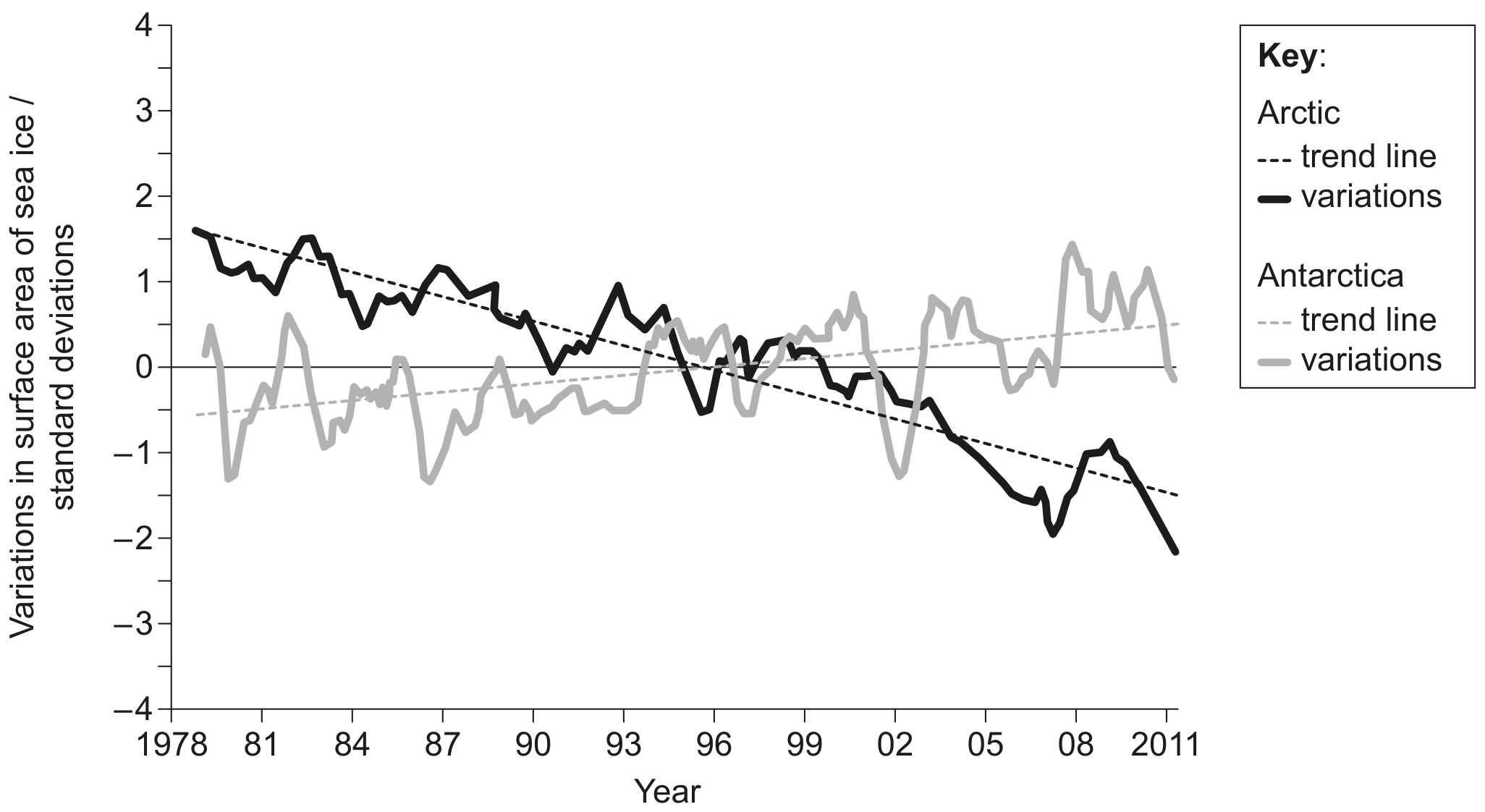
Question image

Question 1(a)

(a)

State the trend in the surface area of sea ice in the Southern Ocean around Antarctica.

[ 1 ]

Question 1(b)

(b)

Distinguish between changes in the surface area of sea ice in the Arctic and Antarctica.

[ 2 ]

Question 1(d)

(c)

Describe the trends in the length of the sea ice season around the Antarctic Peninsula and in the Ross Sea.

[ 2 ]

Question 1(e)

(d)

The graphs show the changes in penguin population in three of the colonies shown on the map.
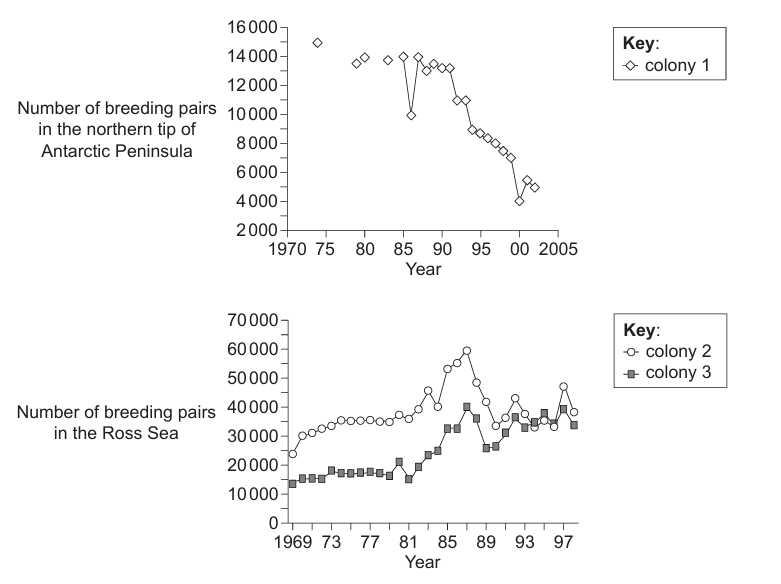
Question image

Analyse the trends in colony size of the Adélie penguins in relation to the changes in the sea ice.

[ 3 ]

Question 1(f)

(e)

Discuss the use of Adélie penguins in studying the effects of global warming.
[ 3 ]

Question 1

[Maximum number: 8]

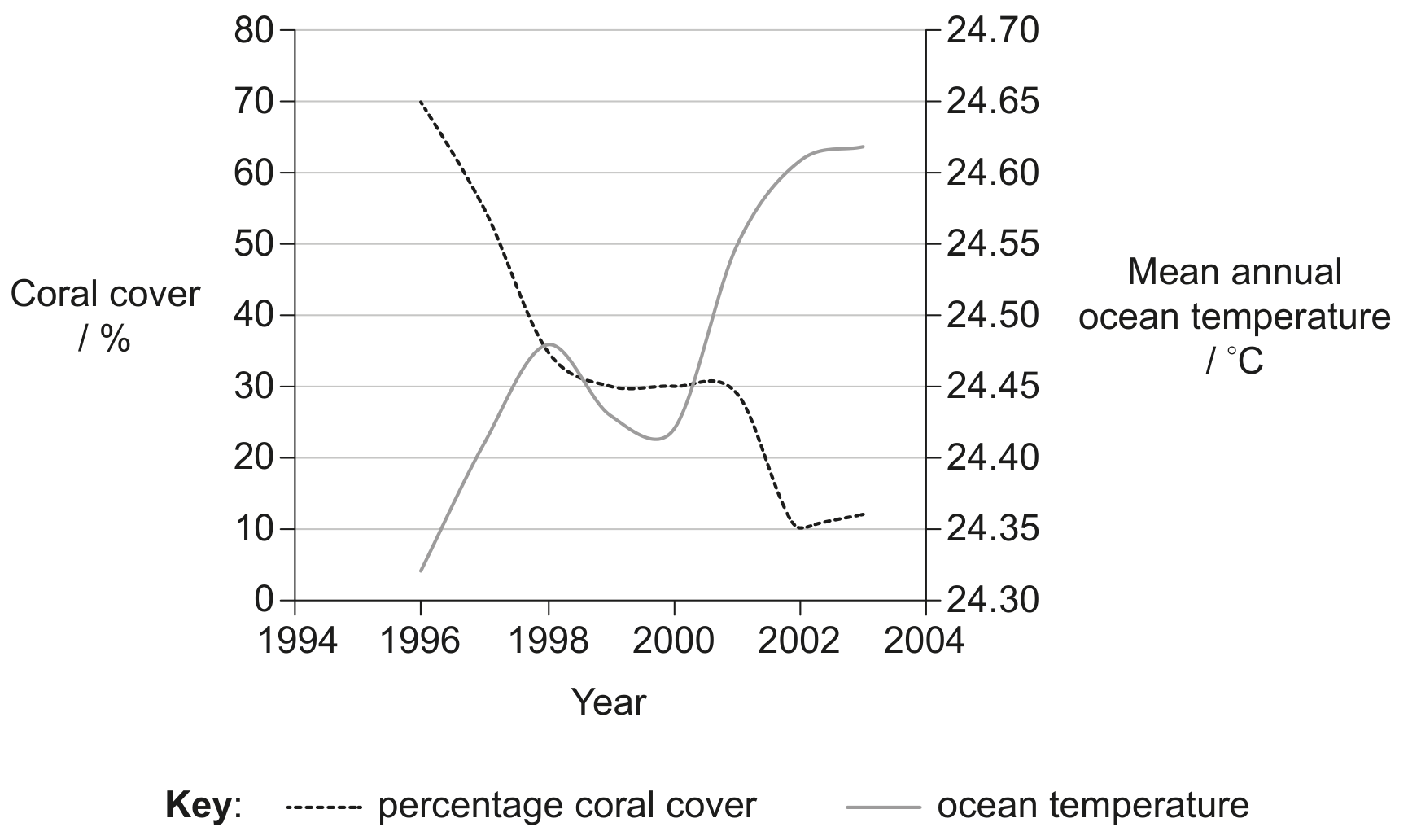
Coral reefs are among the most spectacular ecosystems on Earth. They support a rich diversity of life and provide economic benefits to the people who use them. In Papua New Guinea in the Pacific Ocean north of Australia the following data were collected. Coral cover is the percentage of the reef surface covered by live hard coral.

Question image

Question 1(f)

(a)

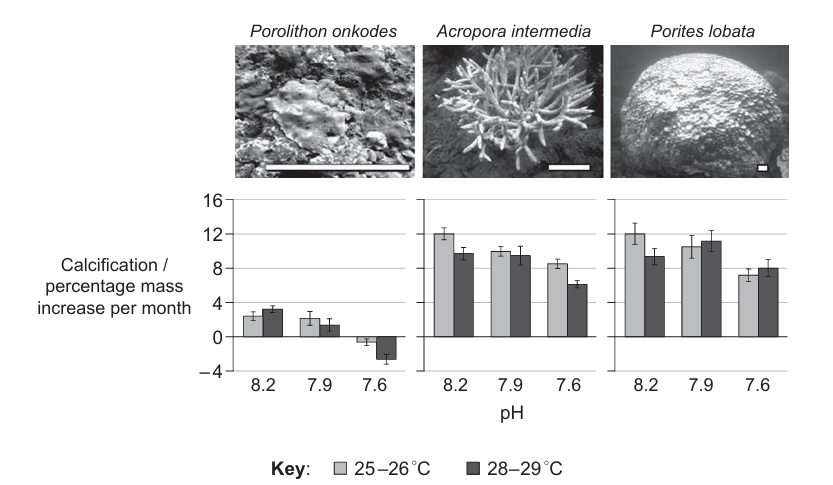
Acidification of the world's oceans is an increasing threat to the health of oceanic life including coral reefs. Corals perform calcification to create their calcium carbonate exteriors. An experiment was conducted on Heron Island, Southern Great Barrier Reef, Australia. For the experiment the pH was altered by dissolving carbon dioxide in the water. Three different coral species were used, with each test group at two different temperature ranges and three different pH values. The white line in each photograph represents 5 cm .

Porolithon onkodes

Porolithon onkodes

[ 2 ]

Question 1(f)(i)

(i)

Describe the trend in calcification when the pH is decreased at 2526C25-26^{\circ} \mathrm{C}.

[ 1 ]

Question 1(f)(iii)

(ii)

Using all of the data, comment on the hypothesis that ocean acidification in warming seas will have the same effect on all species of coral.

[ 1 ]

Question 1(g)

(b)

Suggest another marine animal that has parts made of calcium carbonate and may therefore be damaged due to ocean acidification.

[ 1 ]

Question 1(h)

(c)

Outline causes of ocean acidification.

[ 2 ]

Question 1(i)

(d)

Discuss the need for international cooperation to solve the problems of declining coral populations.

[ 3 ]

Question 1

[Maximum number: 3]

The black-legged tick (lxodes scapularis) is an arthropod which sucks blood from humans and other mammals. It is encountered mainly in wooded and semi-wooded areas.

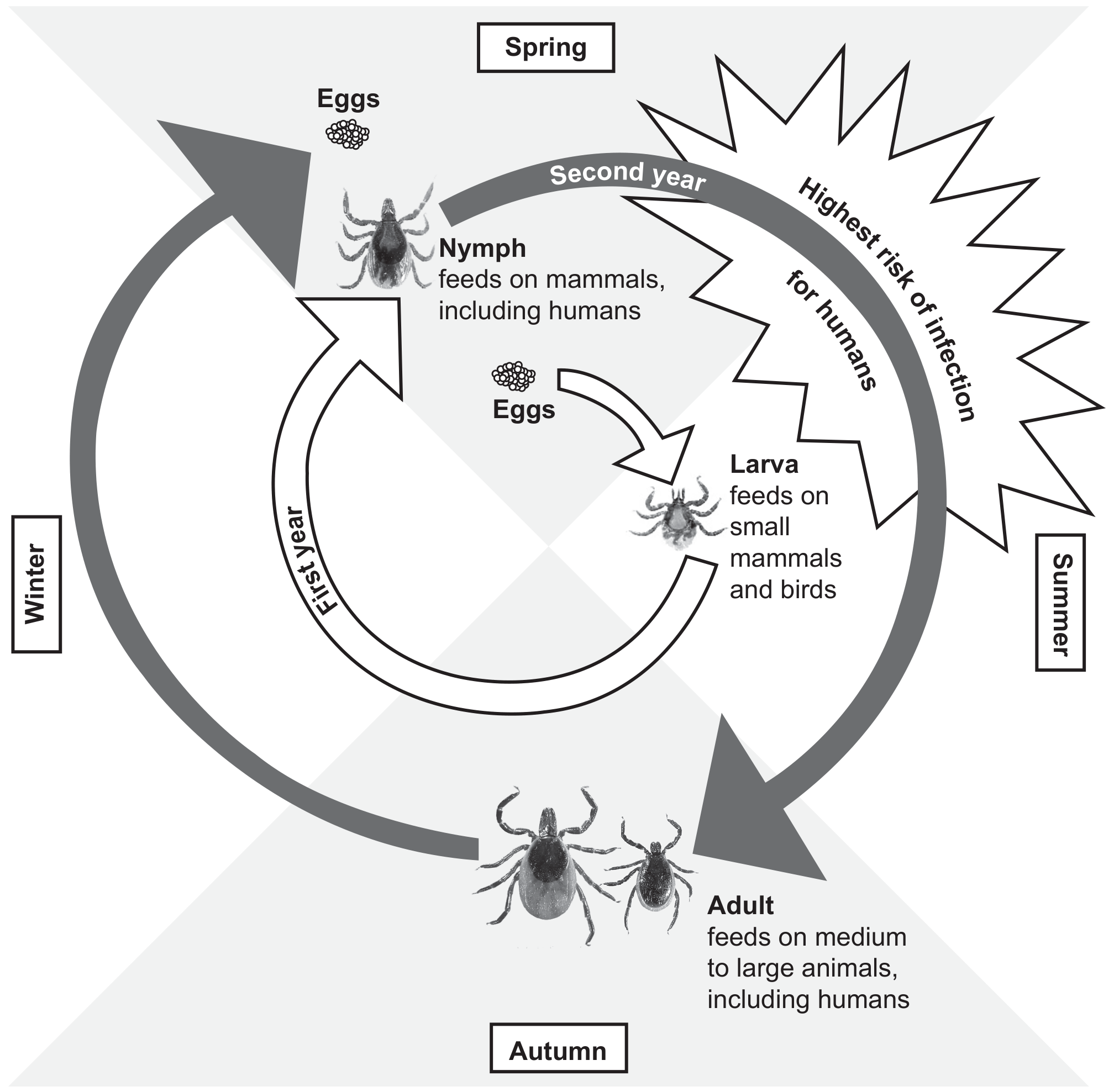
Some ticks can be infected by the bacterium Borrelia burgdorferi. When a tick bites a human, the bacterium is often introduced, causing Lyme disease. Lyme disease is a public health problem in North America and, if left untreated, can cause important neurological impairment. The diagram represents the two-year life cycle of a tick.

Question image

Question 1(c)

(a)

Scientists fear that global warming will change the distribution range of ticks.
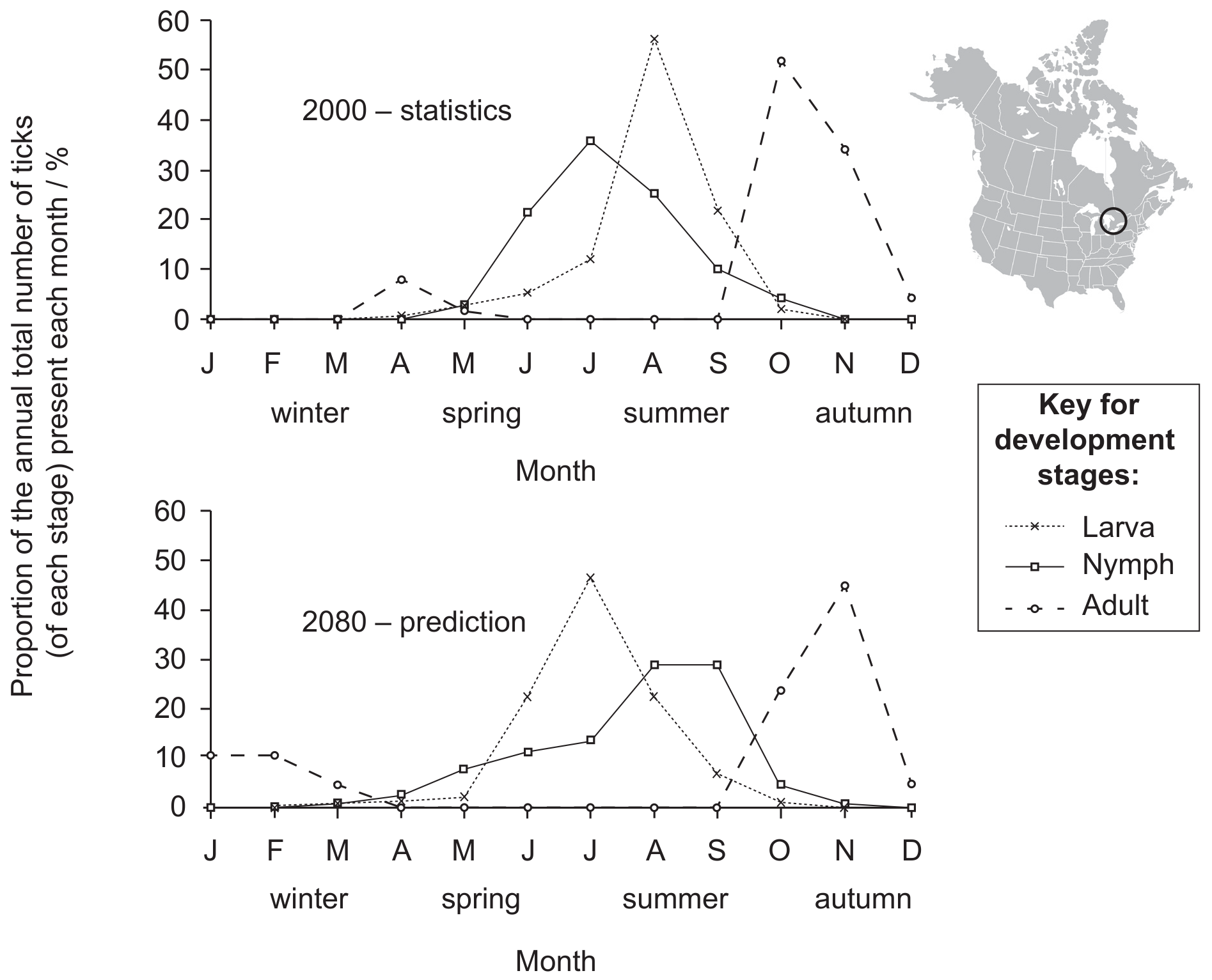
The graphs show the developmental stages of ticks throughout seasons in a densely human-populated area of south-eastern Canada, surrounded by woods (circled on the map). Values are already established for 2000 and are predicted for 2080.

Question image

Identify the month when small birds had the greatest chance of being infected by B. burgdorferi bacteria in the year 2000 and the month when they would be most likely to become infected according to the 2080 predictions.

2000:
2080:

[ 1 ]

Question 1(d)

(b)

Using the life cycle diagram and the graph for the year 2000, analyse the distribution of adult ticks throughout the different seasons.

[ 2 ]

Question 2

[Maximum number: 3]

Average human internal (core) body temperature is 36.4C36.4^{\circ} \mathrm{C}, with slight variations between day and night. The average surface temperature of the Earth in the 20th century was 13.9C13.9^{\circ} \mathrm{C}. It has now risen to 14.8C14.8^{\circ} \mathrm{C}.

Question 2(b)

(a)

Explain how the burning of fossil fuels has contributed to the increase in the Earth's temperature.

[ 2 ]

Question 2(c)

(b)

Melting polar ice due to global warming is reducing reflection of sunlight from the Earth. Identify with a reason whether this will result in positive or negative feedback.

[ 1 ]

Question 2

[Maximum number: 3]

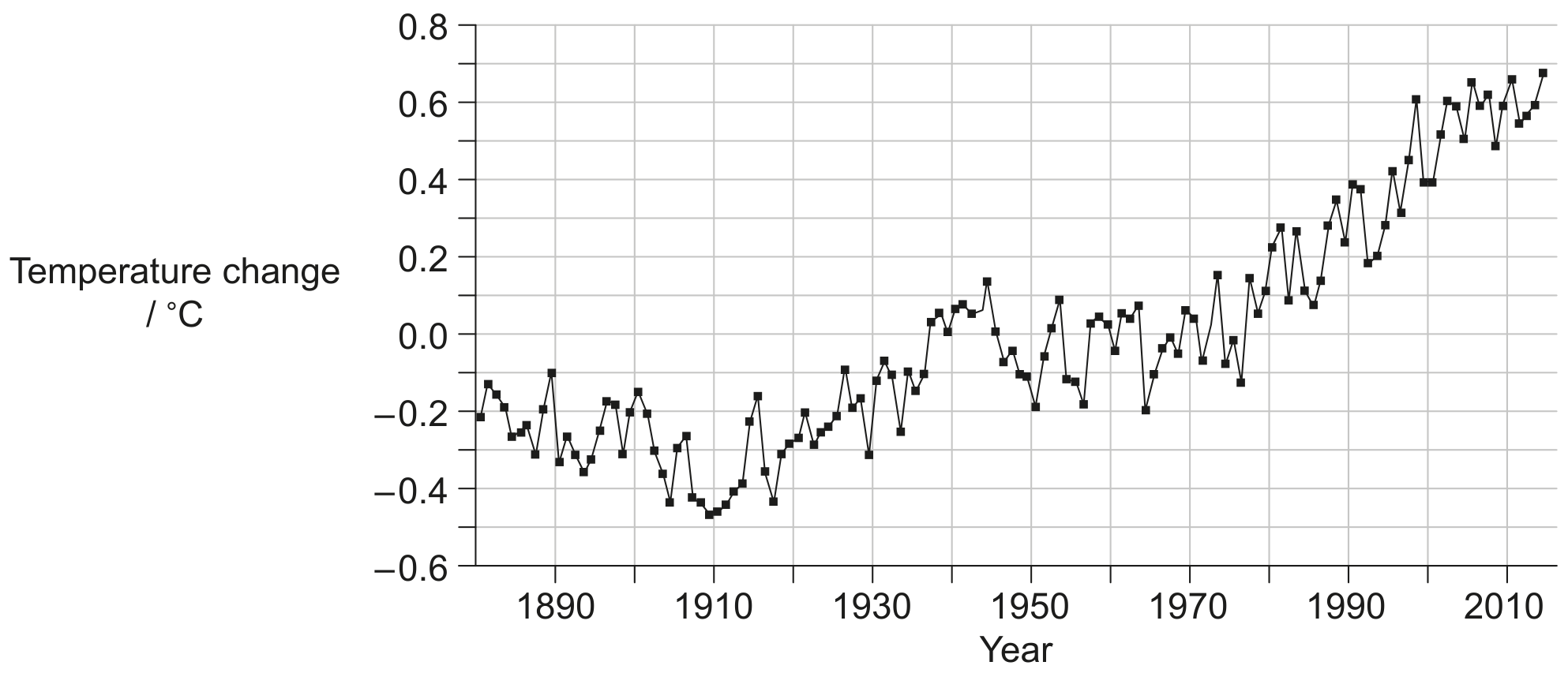
The graph shows the mean annual changes in global temperatures between 1880 and 2014. The mean temperature from 1951 to 1980 was used as the value of zero change in temperature.

Question image

Question 2(c)

(a)

Explain how increased carbon dioxide in the air leads to the greenhouse effect.

[ 3 ]

Question 15

[Maximum number: 1]

How do greenhouse gases contribute to global warming?

A

They destroy the ozone layer, allowing radiation to reach the Earth's surface.

B

They prevent radiation from the Earth escaping into space.

C

They trap short wavelength radiation in the atmosphere.

D

They are a product of combustion, which generates heat.

Question 15

[Maximum number: 1]

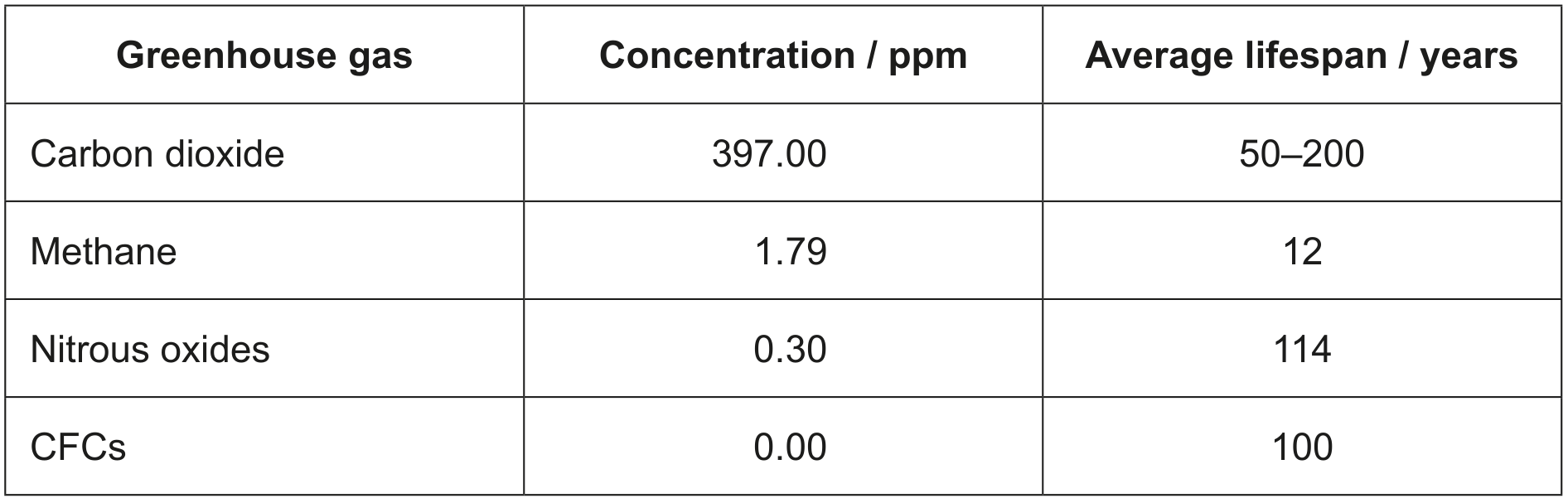
The table shows features of greenhouse gases in the atmosphere.

Table

According to the data in the table, which greenhouse gas contributes the most to climate change?

A

Carbon dioxide because it is the most abundant greenhouse gas

B

Methane because it has the shortest lifespan

C

Nitrous oxides because they absorb the greatest amount of shortwave radiation

D

CFCs because they destroy the ozone layer

Question 16

[Maximum number: 1]

What is a potential consequence of the rise in global temperatures?

A

Increased exposure to UV light due to ozone depletion

B

Increase in ocean pH threatening the survival of marine organisms that require calcium carbonate

C

Decrease in the number and severity of storms due to the increased evaporation

D

Changes to circulating ocean currents

Question 16

[Maximum number: 1]

What contributes to rising atmospheric concentrations of carbon dioxide and increases in average global temperature?

A

An increase in the shorter wavelength radiation emitted by Earth

B

An increase in longer wavelength radiation emitted by Earth

C

An increase in the combustion of fossilized organic matter

D

The depletion of ozone in the stratosphere

Question 16

[Maximum number: 1]

Which expected effect of temperature increase on arctic ecosystems will increase carbon dioxide in the atmosphere?

A

Greater production of plants due to warmer temperatures and changing vegetation

B

Greater decomposition of organic matter currently stored in permafrost

C

Less ice and snow will cause incoming radiation to be absorbed more readily

D

Melting ice from glaciers and icebergs will cause sea levels to rise

0 selected