
EduNinja

IB Biology HLD4.1 Natural selectionQuestion Bank

Question 1

[Maximum number: 2]

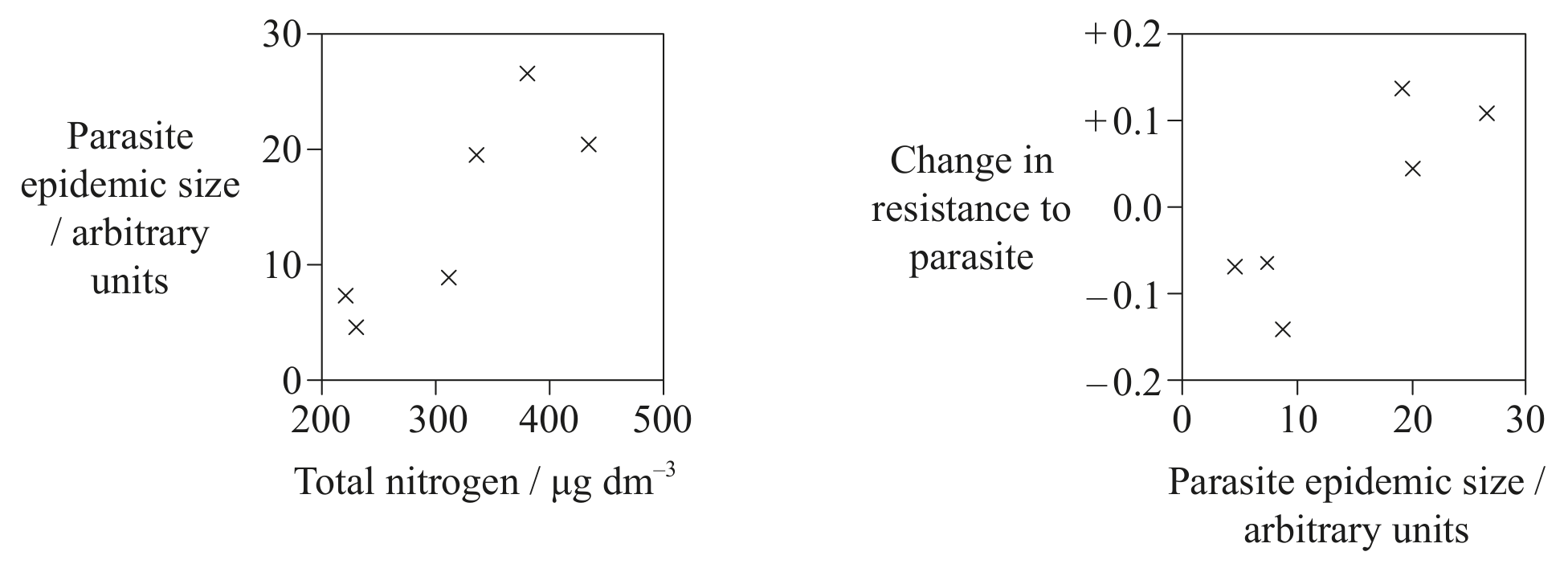
The yeast Metschnikowia bicuspidata is a parasite of a species of zooplankton, Daphnia dentifera. Biologists monitored the infections of D. dentifera populations in a series of lakes in Indiana (USA). An increase in nitrogen compounds dissolved in the lakes causes the phytoplankton populations to increase. D. dentifera feed on phytoplankton.

The graphs show the
- relationship between nitrogen levels dissolved in the water and the size of the parasite epidemic in the D. dentifera population.
- relationship between the size of the parasite epidemic in the D. dentifera population and the change in the resistance (established by comparing the infection of the D. dentifera populations before and after the epidemic).
Question image

Question 1(c)

(a)

Outline, according to the theory of natural selection, how increased size of the parasite epidemic in the D. dentifera will result in the evolution of increased resistance to the parasite.
Predatory fish tend to eat infected D. dentifera more than uninfected D. dentifera.
[ 2 ]

Question 1

[Maximum number: 4]

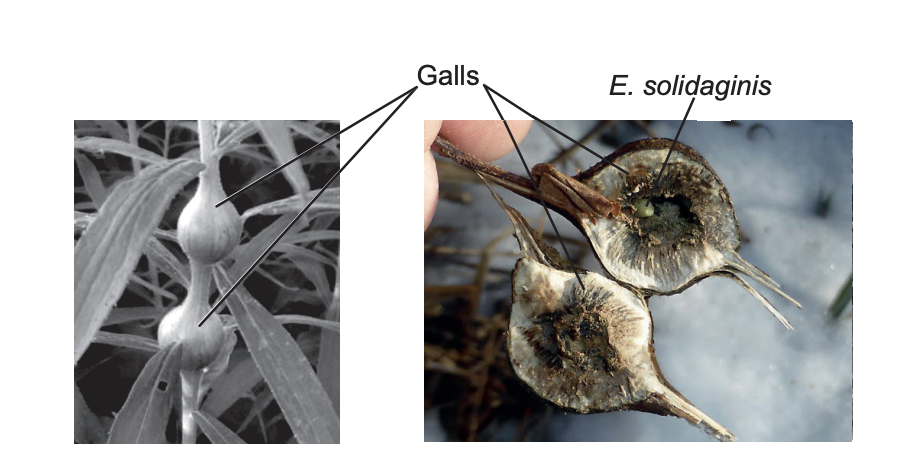
The larval stage of the fly Eurosta solidaginis develops in the plant Solidago altissima.

The larva secretes a chemical which causes plant tissue to grow around it forming a swelling called a gall. The gall provides the developing insect with protection from predators.

Question image

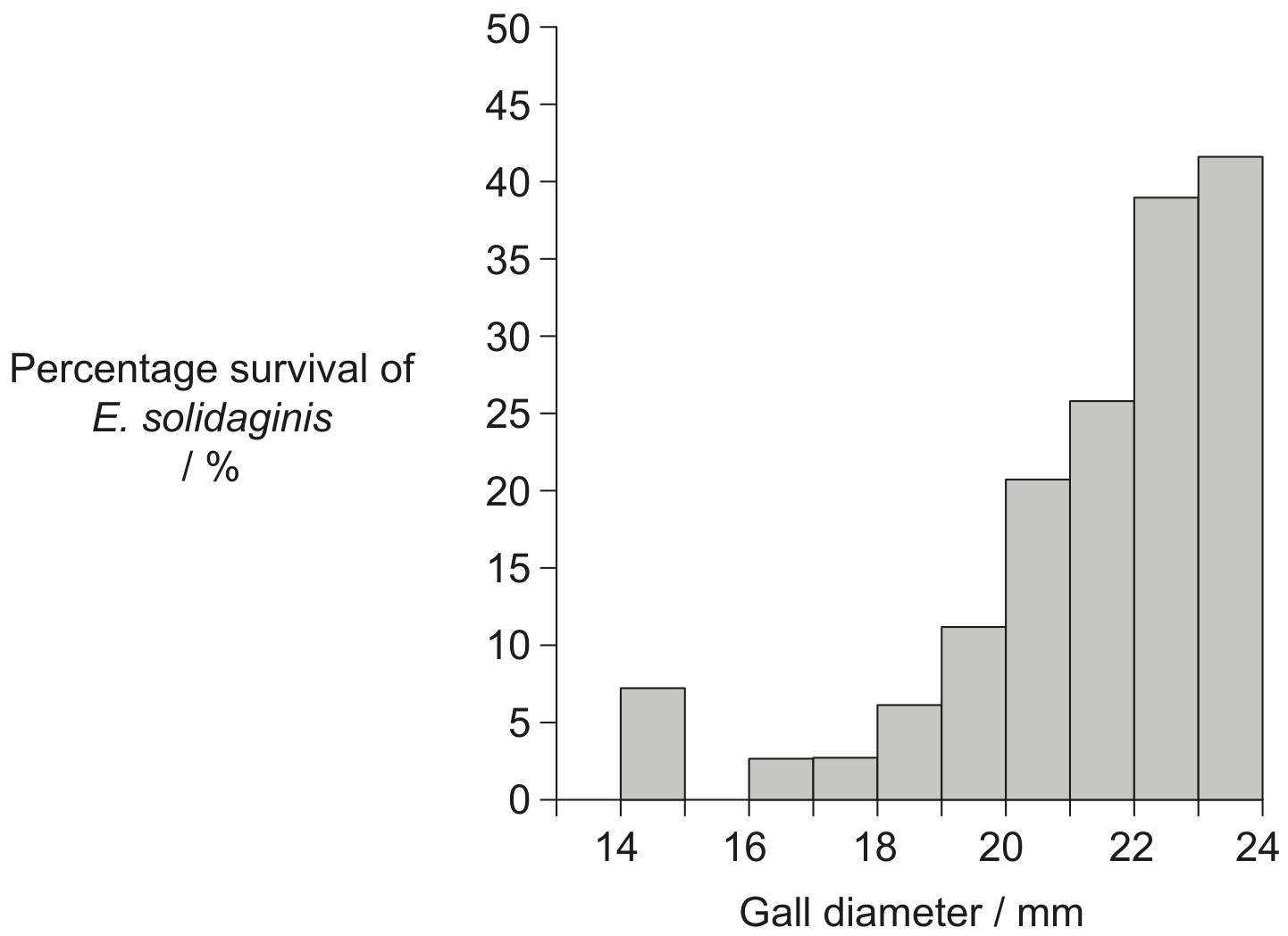
The E. solidaginis fly is preyed upon by the parasitic wasp Eurytoma gigantea. The graph shows the relationship between gall diameter and the percentage of flies that avoid predation by E. gigantea.

Question image

Question 1(b)

(a)

Describe the relationship between gall diameter and percentage survival of E. solidaginis.

[ 2 ]

Question 1(c)

(b)

Explain the concept of directional selection with respect to this example.

[ 2 ]

Question 2

Question 2(b)

Question 2(b)(i)

(a)
(i)

In fruit flies (Drosophila melanogaster) the allele for long wings is dominant to the allele for short (vestigial) wings. In a laboratory population of 200 flies there were 168 with long wings. Using the Hardy-Weinberg equation, calculate the percentage of flies that would be heterozygous for this characteristic. Show your working.

[ 2 ]

Question 2(b)(ii)

(ii)

State two assumptions made when using the Hardy-Weinberg equation to calculate allele frequencies.

[ 1 ]

Question D2

Question D2(a)

(a)

State two assumptions that are made when the Hardy-Weinberg equation is used.

[ 2 ]

Question D2

Question D2(a)

Question D2(a)(i)

(a)
(i)

Define the term gene pool.

[ 1 ]

Question D2(c)

(b)

During a screening campaign of 281884 babies in Sao Paulo, Brazil, it was found that the frequency of the sickle-cell anemia allele was 0.02 . Calculate the expected number of babies not carrying the allele.

[ 2 ]

Question 2

Question 2(c)

Question 2(c)(i)

(a)
(i)

In a non-evolving population, state two frequencies that remain constant.

[ 2 ]

Question 2(c)(ii)

(ii)

Define gene pool.

[ 1 ]

Question 2

Question 2(a)

(a)

Define gene pool.

[ 1 ]

Question 2(b)

(b)

State two assumptions made when using the Hardy-Weinberg equation.
1.

[ 2 ]

Question D2

Question D2(b)

Question D2(b)(i)

(a)
(i)

In a human population allele A is dominant to allele a. Calculate the frequency of the resulting phenotypes if the frequency of allele A is 0.9 .

[ 3 ]

Question D2(b)(ii)

(ii)

State one condition required for the use of the Hardy-Weinberg equation to be valid.

[ 1 ]

Question 2

[Maximum number: 5]

Cystic fibrosis (CF) is caused by a mutation of a human gene which codes for a chloride channel. The frequency of the CF allele is much higher in Europe than expected for an allele that causes a harmful condition. It has been suggested that individuals who are heterozygous for this allele may be protected against an infectious disease such as cholera or typhoid. This could cause both the CF allele and the normal allele of the chloride channel gene to persist in the population.

Question 2(b)

(a)

CF\quad \mathrm{CF} is a recessive condition that affects approximately 1 in 2500 births in Australia. Calculate the percentage of heterozygous individuals in the population. Show your calculation.

[ 2 ]

Question 2(c)

(b)

Using CF as an example, distinguish between allele frequency and gene pool.

[ 2 ]

Question 2(d)

(c)

State one condition that must be fulfilled if the allele frequency for CF is to remain constant.

[ 1 ]

Question 3

[Maximum number: 6]

Outline how the Hardy-Weinberg equation is derived, including the assumptions for its use.

0 selected