Question 3
Question 3(c)
(a)
The radiant flux intensity of the radiation from the star in (b) is when observed at a distance of from the star.
[ 2 ]
Question 3(c)(ii)
(i)
Determine the radius of the star.
radius = m
[ 2 ]
 EduNinja
The radiant flux intensity of the radiation from the star in (b) is when observed at a distance of from the star.
Determine the radius of the star.
radius = m
The star in (b) has a radius of and a luminosity of . All the energy released from the formation of is radiated away from the star.
All the energy that is radiated from the star has been released in the formation of .
Determine:
the surface temperature of the star.
temperature = K
A star in the constellation Canis Major is a distance of from the Earth and has a luminosity of . The surface temperature of the star is 9830 K .
Determine the radius of the star.
radius = m
Explain how the surface temperature of a distant star may be determined from the wavelength spectrum of the light from the star.
The Sun has a surface temperature of 5780 K . The luminosity of the Sun is .
Calculate the radius of the Sun.
radius = m
The variation with wavelength of the intensity of radiation emitted from the Sun is shown in Fig. 10.1.
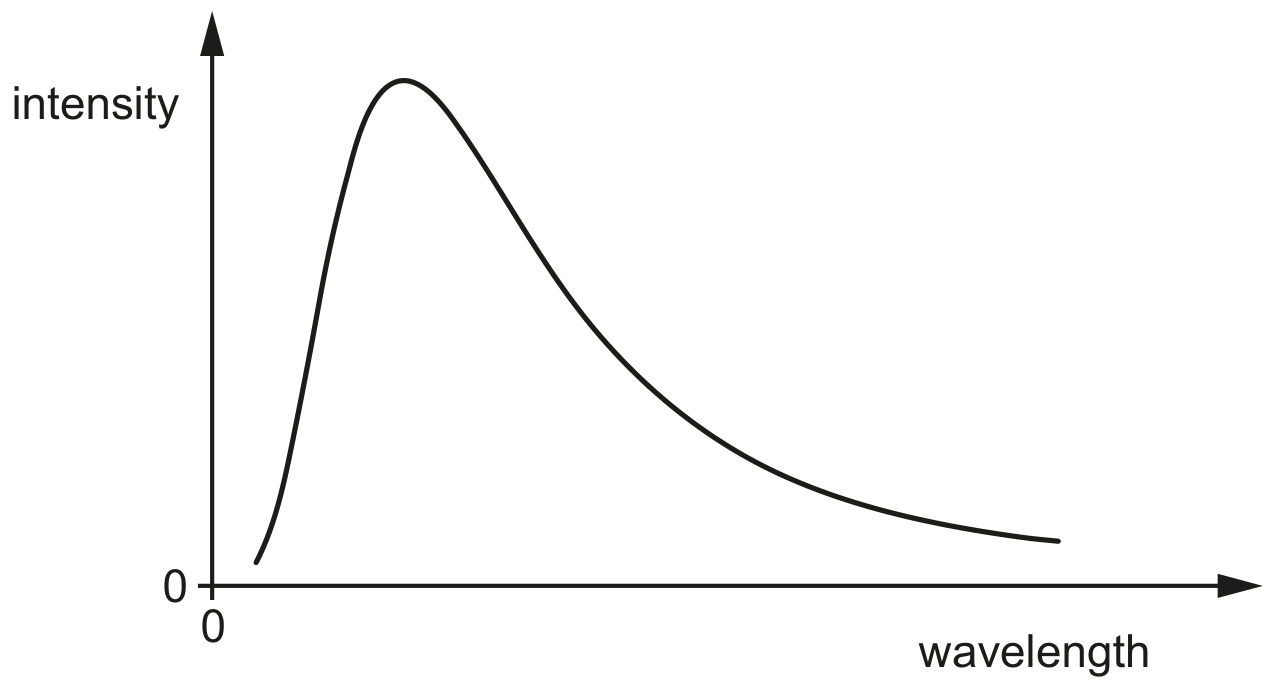
Fig. 10.1
Another star has the same radius as the Sun but has a lower surface temperature.
On Fig. 10.1, sketch a line to show the variation with wavelength of the intensity of the radiation emitted for this star.
State Wien's displacement law.
Fig. 10.1 shows the wavelength distributions of electromagnetic radiation emitted by two stars A and B .
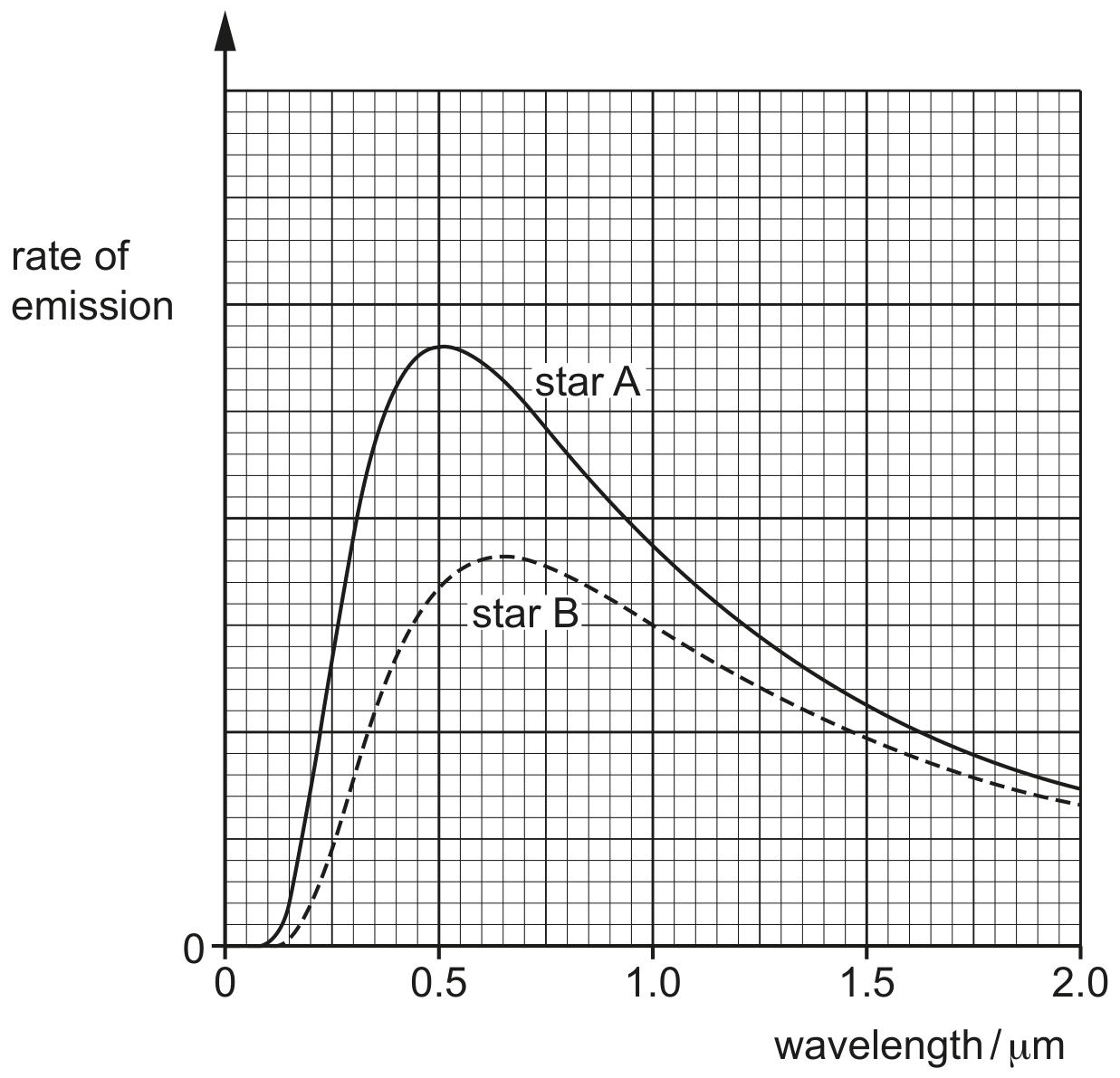
Fig. 10.1
The surface temperature of star A is known to be 5800 K .
Determine the surface temperature of star B .
surface temperature = K
Star B appears less bright than star A when viewed from the Earth.
Use Fig. 10.1 to suggest, with a reason, how else the physical appearance of star B compares with that of star A.
The Sun has a radius of and a surface temperature of 5780 K . Light from the Sun is observed to have a peak intensity at a wavelength of 501 nm .
Another star emits radiation that has a peak intensity at a wavelength of 624 nm .
Determine the surface temperature of this star.
surface temperature =
The Sun has a surface temperature of 5800 K . The wavelength of light for which the maximum rate of emission occurs from the Sun is 500 nm .
The scientist observing the star in (a) finds that the wavelength for which the maximum rate of emission occurs from the star is 430 nm .
Show that the surface temperature of the star in (a) is approximately 6700 K . Explain your reasoning.
Use the information in (a) and (b)(i) to determine the radius of the star.
radius = m
State Wien's displacement law. Identify any symbols that you use.
The radius of the Sun is .
Show that the temperature T of the surface of the Sun is 5770 K .
The wavelength of light for which the maximum rate of emission occurs from the Sun is .
The temperature of the surface of the star Sirius is 9940 K .
Use information from (d) to determine the wavelength of light for which the maximum rate of emission occurs from Sirius.
wavelength =
m