EduNinja

A-Level CAIE Physics A224.2 Production and use of X-raysQuestion Bank

Question 7

Question 7(b)

(a)

Four electron energy levels in an atom are shown in Fig. 7.1.
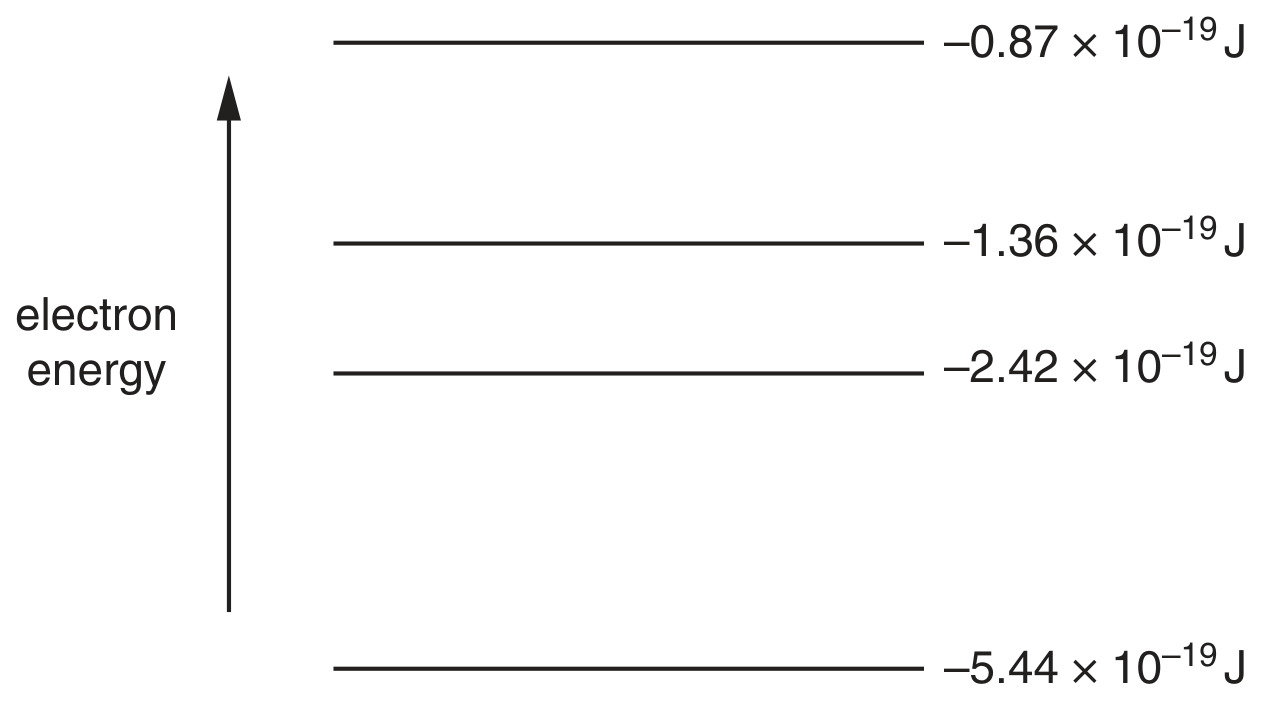
Fig. 7.1 (not to scale)

Fig. 7.1 (not to scale)

An emission spectrum is associated with the electron transitions between these energy levels.
For this spectrum,

[ 2 ]

Question 7(b)(ii)

(i)

calculate the minimum wavelength.
wavelength = m

[ 2 ]
Question 9

Question 9(a)

Question 9(a)(i)

(a)
(i)

State, with reference to X -ray images, what is meant by sharpness.

[ 1 ]

Question 9(a)(ii)

(ii)

Describe briefly two factors that affect the sharpness of an X-ray image.

1
2.

[ 3 ]

Question 9(b)

(b)

An X-ray image is taken of the skull of a patient. Another patient has a CT scan of his head.
By reference to the formation of the image in each case, suggest why the exposure to radiation differs between the two imaging techniques.

[ 4 ]

Question 10

Question 10(a)

(a)

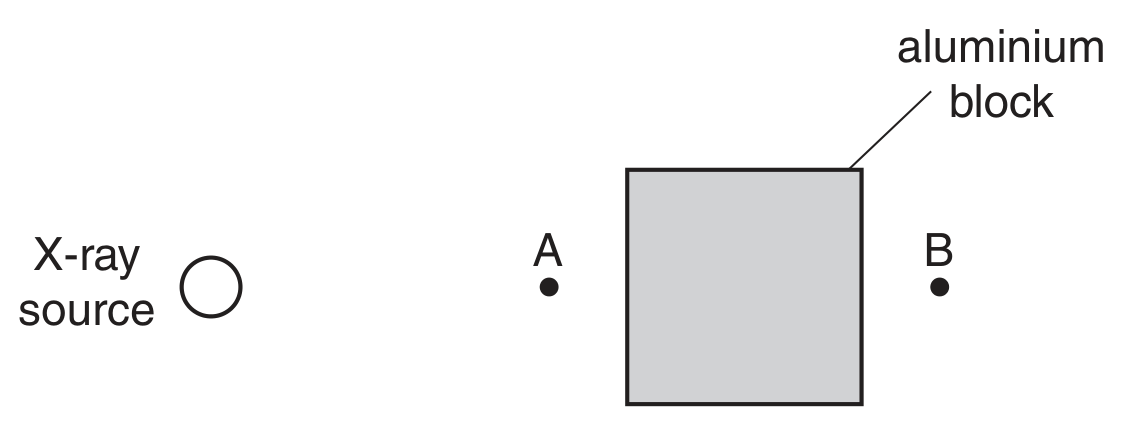
An aluminium block is placed near to a small source of X-ray radiation, as shown in Fig. 10.1.

Fig. 10.1

Fig. 10.1

X-rays from the source are detected at point A and at point B .
State two reasons why the intensity of the X-ray beam at point B is not as great as the intensity at point A .
1.
2.

[ 2 ]

Question 10(b)

(b)

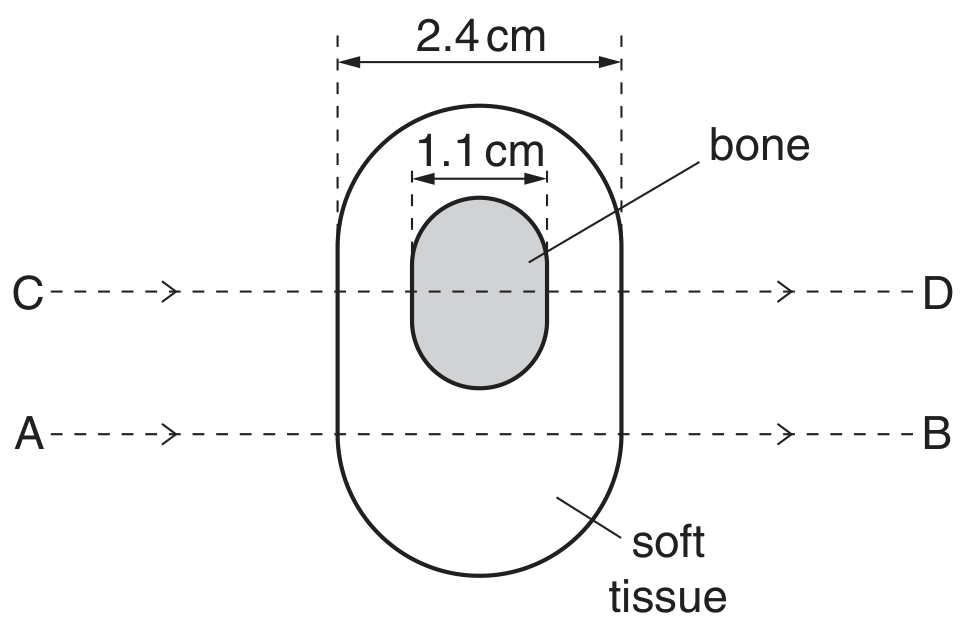
A cross-section through a model of a finger is shown in Fig. 10.2.

Fig. 10.2

Fig. 10.2

The thickness of the model is 2.4 cm and that of the bone in the model is 1.1 cm .
Parallel beams of X-rays are incident on the model in the directions A B and C D, as shown in Fig. 10.2.

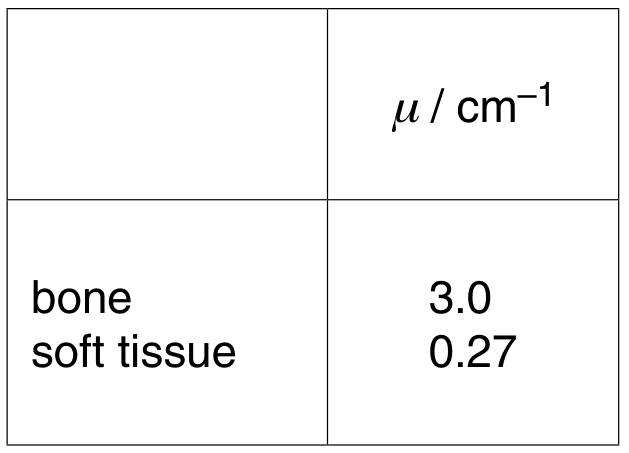
Data for the linear attenuation (absorption) coefficient μ\mu for the bone and the soft tissue in the model are given in Fig. 10.3.

Fig. 10.3

Fig. 10.3

Calculate the ratio
>  intensity of X-ray beam incident on the model  intensity of X-ray beam emergent from the model \frac{\text { intensity of X-ray beam incident on the model }}{\text { intensity of X-ray beam emergent from the model }}

for

Question 10(b)(i)

(i)

the beam AB ,

ratio =

Question 10(b)(ii)

(ii)

the beam CD .

ratio =

Question 10(c)

(c)

Use your answers in (b) to suggest why, for this model, an X-ray image with good contrast may be obtained.

Question 10

Outline the principles of CT scanning.

Question 11

Question 11(a)

(a)

Distinguish between an X-ray image of a body structure and a CT scan.
X-ray image:
CT scan:

[ 5 ]

Question 11(b)

(b)

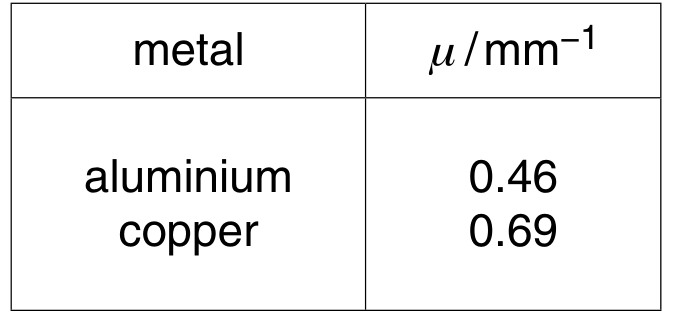
Data for the linear absorption (attenuation) coefficient μ\mu of X-ray radiation of energy 80 keV are given in Fig. 11.1.

Fig. 11.1

Fig. 11.1

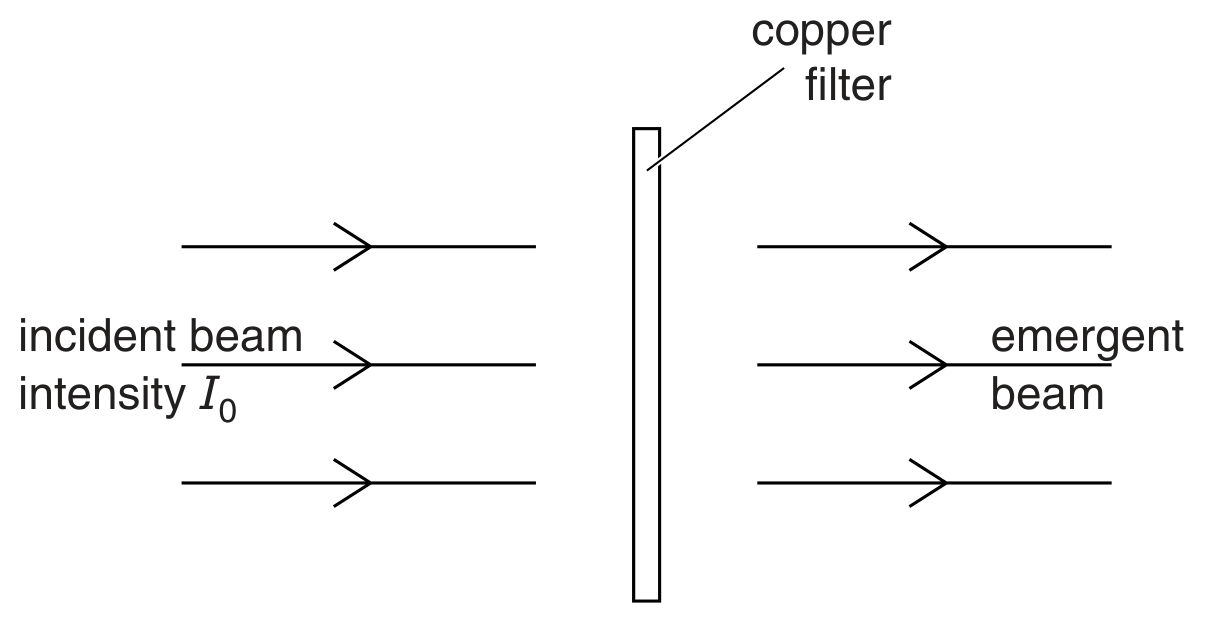
A parallel X-ray beam is incident on a copper filter, as shown in Fig.11.2.

Fig. 11.2

Fig. 11.2

The intensity of the incident beam is I0I_{0}.

[ 2 ]

Question 11(b)(i)

(i)

Calculate the thickness of copper required to reduce the intensity of the emergent beam to 0.25I00.25 I_{0}.
thickness = mm

[ 2 ]

Question 11(b)(ii)

(ii)

An aluminium filter of thickness 2.4 mm is now placed in the X-ray beam, together with the copper filter in (i).

Calculate the fraction of the incident intensity that emerges after passing through the two filters.
fraction =

Question 12

Question 12(a)

(a)

Outline briefly the principles of CT scanning.

[ 5 ]

Question 12(b)

(b)

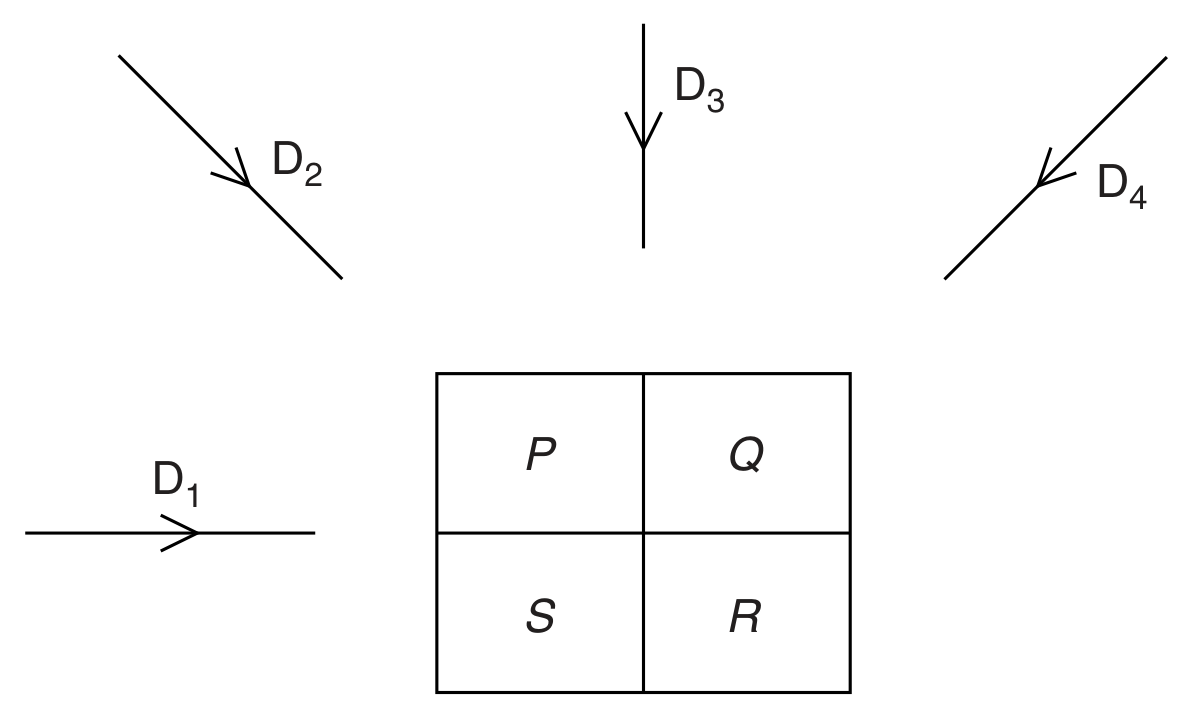
In a model for CT scanning, a section is divided into four voxels. The pixel numbers P, Q, R and S of the voxels are shown in Fig. 12.1.

Fig. 12.1

Fig. 12.1

The section is viewed from the four directions D1,D2,D3\mathrm{D}_{1}, \mathrm{D}_{2}, \mathrm{D}_{3} and D4\mathrm{D}_{4}.
The detector readings for each direction are noted.
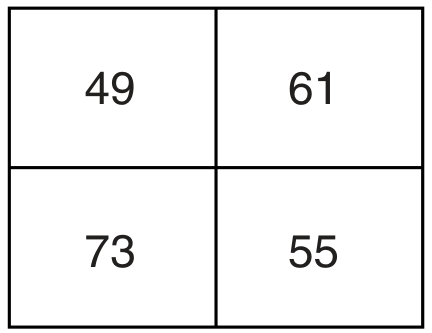
The detector readings are summed as shown in Fig.12.2.

Fig. 12.2

Fig. 12.2

The background reading is 34 .
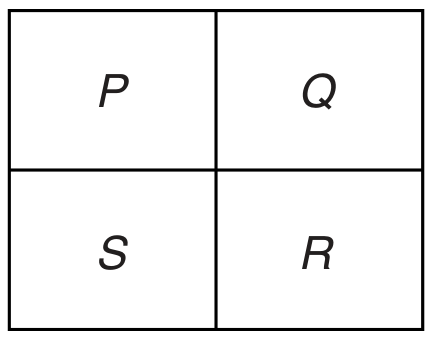
Determine the pixel numbers P, Q, R and S as shown in Fig. 12.3.

Fig. 12.3

Fig. 12.3

P=
S=
Q=
R=

Question 8

Question 8(b)

(a)

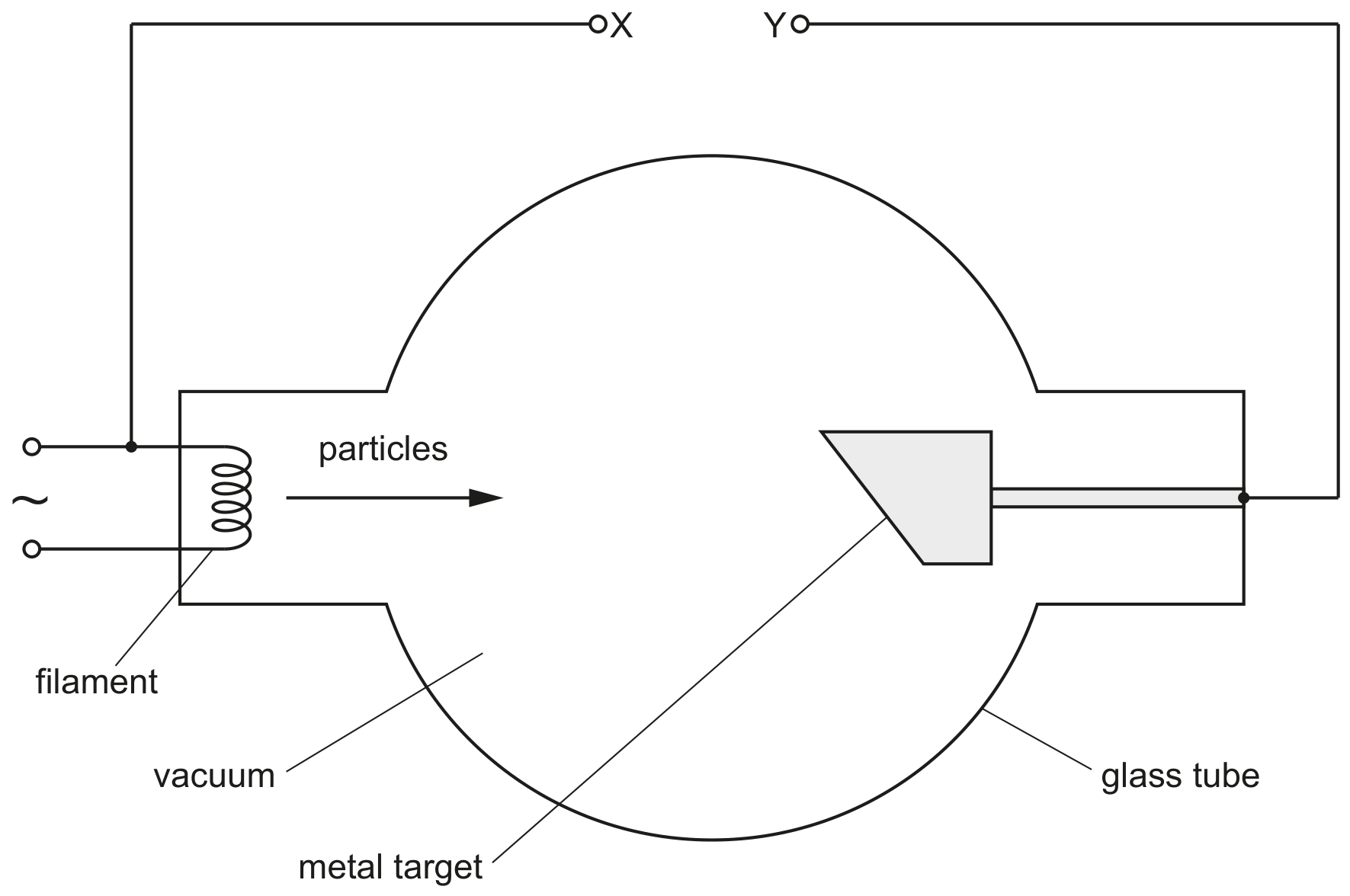
Fig. 8.1 shows a tube in which X-rays are produced at a metal target.

Fig. 8.1

Fig. 8.1

Particles are accelerated from the filament to the target by a constant high voltage applied across the terminals X and Y .

[ 2 ]

Question 8(b)(i)

(i)

State the name of the particles.

[ 1 ]

Question 8(b)(ii)

(ii)

On Fig. 8.1, use + and - signs to label terminals X and Y to indicate the polarity of the high voltage.

[ 1 ]

Question 8(d)

(b)

Explain why X-rays can be used to produce images of internal body structures that have good contrast.

[ 3 ]

Question 11

[Maximum number: 10]

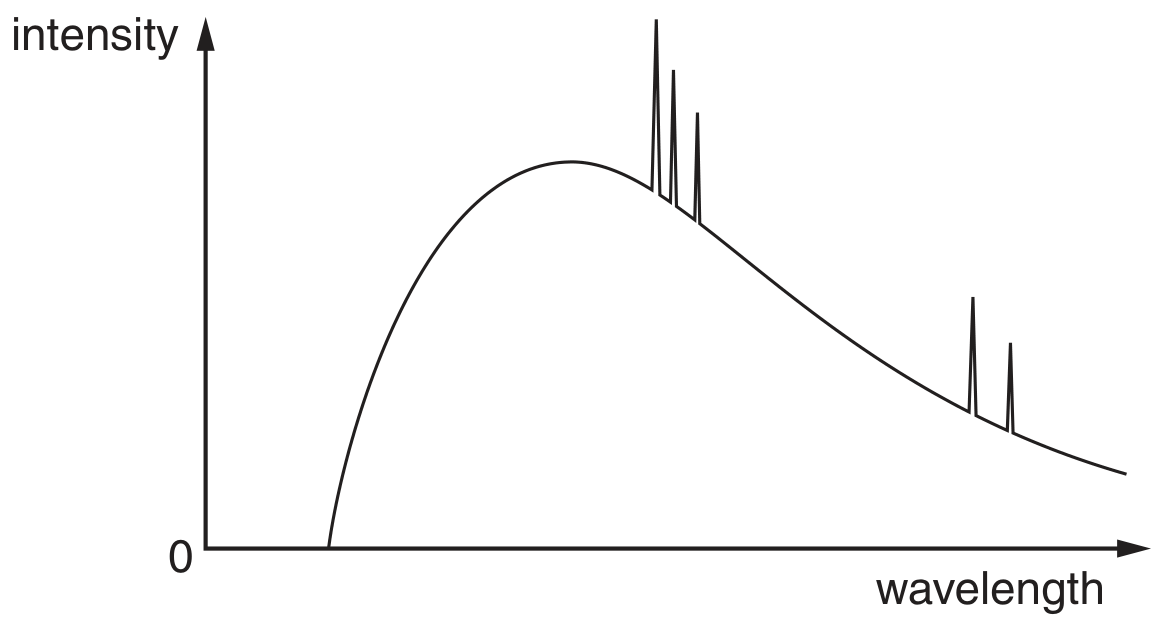
High-speed electrons are incident on a metal target. The spectrum of the emitted X-ray radiation is shown in Fig. 11.1.

Fig. 11.1

Fig. 11.1

Question 11(a)

(a)

Explain why

[ 4 ]

Question 11(a)(i)

(i)

there is a continuous distribution of wavelengths,

[ 2 ]

Question 11(a)(ii)

(ii)

there is a sharp cut-off at short wavelength.

[ 2 ]

Question 11(b)

(b)

State

[ 4 ]

Question 11(b)(i)

(i)

what is meant by the hardness of an X-ray beam,

[ 2 ]

Question 11(b)(ii)

(ii)

how hardness is controlled.

[ 2 ]

Question 11(c)

Question 11(c)(i)

(c)
(i)

Suggest why, when producing an X-ray image, long-wavelength X-ray radiation poses a greater hazard to health than short-wavelength radiation.

[ 1 ]

Question 11(c)(ii)

(ii)

Suggest how this hazard is minimised.

[ 1 ]

Question 11

[Maximum number: 7]

The use of X-rays in medical diagnosis gives rise to an increased exposure of the patient to radiation.

Explain why

Question 11(a)

(a)

an aluminium filter may be placed in the X-ray beam when producing an X-ray image of a patient,

[ 3 ]

Question 11(b)

(b)

the radiation dose received by a patient is different for a CT scan from that for a simple X-ray image.

[ 4 ]

Question 11

[Maximum number: 10]

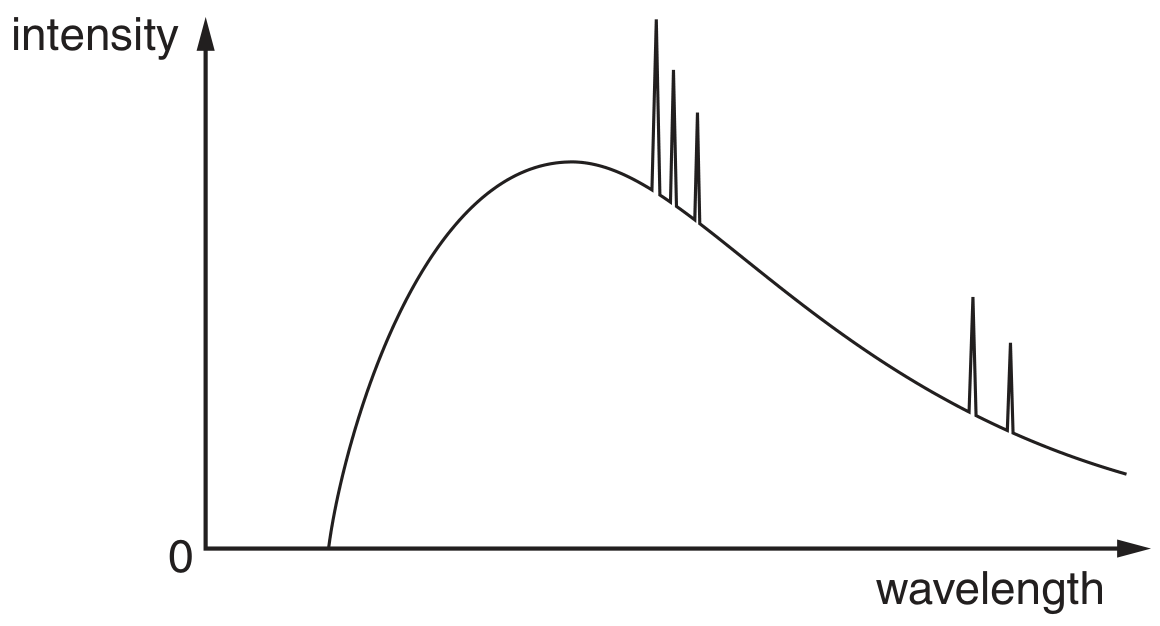
High-speed electrons are incident on a metal target. The spectrum of the emitted X-ray radiation is shown in Fig. 11.1.

Fig. 11.1

Fig. 11.1

Question 11(a)

(a)

Explain why

[ 4 ]

Question 11(a)(i)

(i)

there is a continuous distribution of wavelengths,

[ 2 ]

Question 11(a)(ii)

(ii)

there is a sharp cut-off at short wavelength.

[ 2 ]

Question 11(b)

(b)

State

[ 4 ]

Question 11(b)(i)

(i)

what is meant by the hardness of an X-ray beam,

[ 2 ]

Question 11(b)(ii)

(ii)

how hardness is controlled.

[ 2 ]

Question 11(c)

Question 11(c)(i)

(c)
(i)

Suggest why, when producing an X-ray image, long-wavelength X-ray radiation poses a greater hazard to health than short-wavelength radiation.

[ 1 ]

Question 11(c)(ii)

(ii)

Suggest how this hazard is minimised.

[ 1 ]
0 selected