EduNinja

A-Level CAIE Physics A224.1 Production and use of ultrasoundQuestion Bank

Question 7

Question 7(b)

(a)

The alternating voltage in (a) is now applied to a piezoelectric crystal in air.

[ 4 ]

Question 7(b)(i)

(i)

Explain what happens to the air surrounding the crystal.

[ 3 ]

Question 7(b)(ii)

(ii)

A second piezoelectric crystal is placed in the air near to the first crystal.

Explain the effect of the surrounding air in (b)(i) on the second crystal.

[ 1 ]
Question 9

Question 9(a)

(a)

Suggest electrical sensing devices, one in each case, that may be used to monitor changes in

[ 1 ]

Question 9(a)(iii)

(i)

the intensity of an ultrasound beam.

[ 1 ]

Question 10

Question 10(a)

(a)

State what is meant by the specific acoustic impedance of a medium.

[ 2 ]

Question 10(b)

(b)

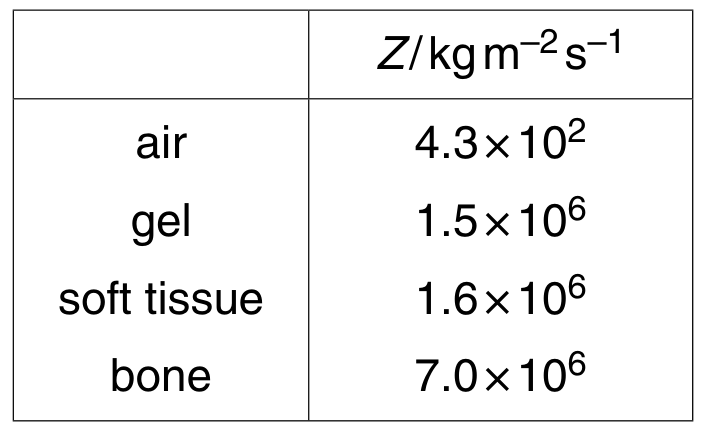
The specific acoustic impedances Z of some media are given in Fig. 10.1.

Fig. 10.1

Fig. 10.1

[ 7 ]

Question 10(b)(i)

(i)

The density of a sample of bone is 1.7×10³ kg m31.7 \times 10^{3} \mathrm{~kg} \mathrm{~m}^{-3}.

Determine the wavelength, in mm , of ultrasound of frequency 9.0×10⁵ Hz9.0 \times 10^{5} \mathrm{~Hz} in the bone.
wavelength = mm

[ 3 ]

Question 10(b)(ii)

(ii)

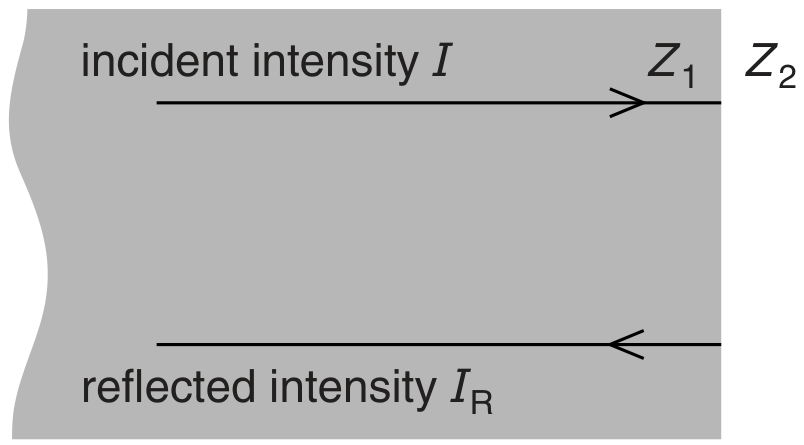
Ultrasound of intensity I is incident normally on the boundary between two media of specific acoustic impedances Z1Z_{1} and Z2Z_{2}, as shown in Fig. 10.2.

Fig. 10.2

Fig. 10.2

The intensity of the ultrasound reflected from the boundary is IRI_{\mathrm{R}}.
The ratio IRI\frac{I_{\mathrm{R}}}{I} is given by the expression

IRI=(Z1Z2)2(Z1+Z2)2.\frac{I_{\mathrm{R}}}{I}=\frac{\left(Z_{1}-Z_{2}\right)^{2}}{\left(Z_{1}+Z_{2}\right)^{2}} .

By making reference to the data for air, gel and soft tissue, explain quantitatively why, during medical diagnosis using ultrasound, a gel is usually put on the skin.

[ 4 ]

Question 10

Question 10(a)

(a)

By reference to ultrasound waves, state what is meant by acoustic impedance.

[ 2 ]

Question 10(b)

(b)

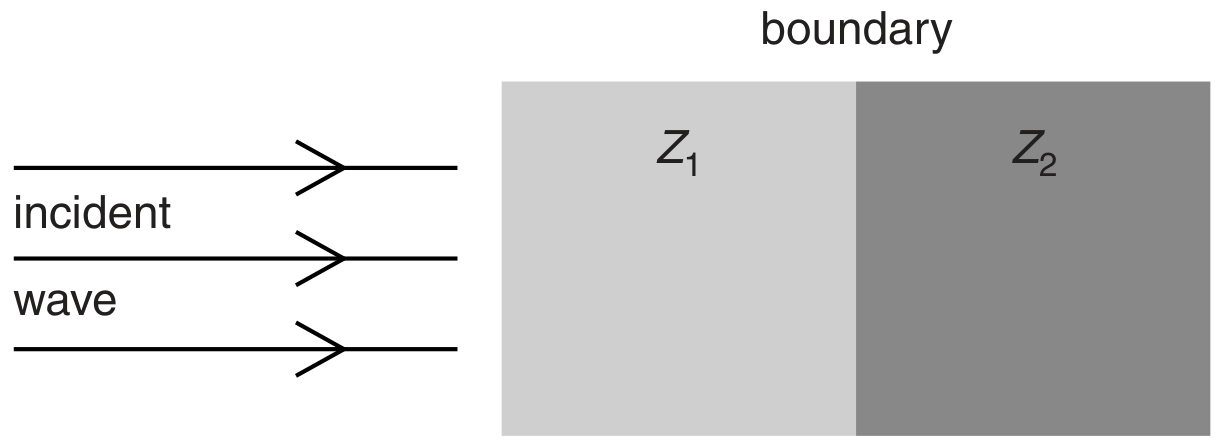
An ultrasound wave is incident on the boundary between two media. The acoustic impedances of the two media are Z1Z_{1} and Z2Z_{2}, as illustrated in Fig. 10.1.

Fig. 10.1

Fig. 10.1

Explain the importance of the difference between Z1Z_{1} and Z2Z_{2} for the transmission of ultrasound across the boundary.

[ 3 ]

Question 10(c)

(c)

Ultrasound frequencies as high as 10 MHz are used in medical diagnosis. State and explain one advantage of the use of high-frequency ultrasound compared with lower-frequency ultrasound.

[ 2 ]

Question 9

[Maximum number: 7]

Ultrasound is used to produce diagnostic information about internal body structures.

Question 9(a)

(a)

Explain how ultrasound waves are detected.

[ 3 ]

Question 9(c)

(b)

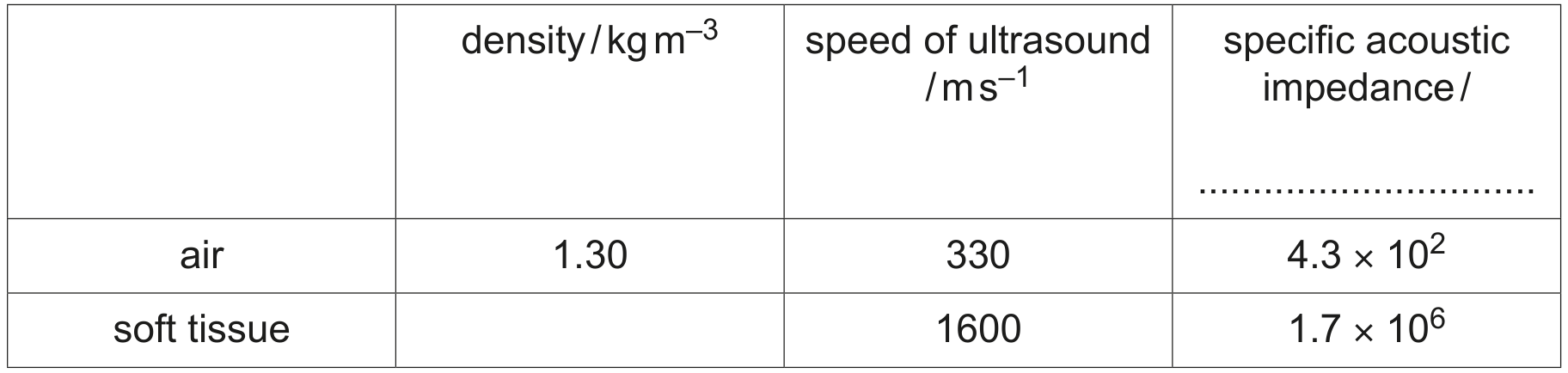
Table 9.1 contains information about air and soft tissue.

Table 9.1

Table 9.1

[ 4 ]

Question 9(c)(i)

(i)

Determine the unit for the specific acoustic impedance values shown in Table 9.1.

[ 1 ]

Question 9(c)(ii)

(ii)

Calculate the density of soft tissue.
density = kgm3\mathrm{kg} \mathrm{m}^{-3}

[ 1 ]

Question 9(c)(iii)

(iii)

Use data from Table 9.1 to explain why ultrasound cannot be used to produce an image inside an air-filled cavity such as the lungs.

[ 2 ]

Question 10

Question 10(a)

(a)

Explain the main principles behind the use of ultrasound to obtain diagnostic information about internal body structures.

[ 6 ]

Question 10(b)

(b)

State and explain one advantage of the use of high frequency ultrasound as compared with low frequency ultrasound for medical diagnosis.

[ 2 ]

Question 10(c)

(c)

The absorption (attenuation) coefficient for ultrasound in muscle is 23 m123 \mathrm{~m}^{-1}. A parallel beam of ultrasound is passed through a muscle of thickness 6.4 cm .

[ 5 ]

Question 10(c)(i)

(i)

Calculate the ratio
 intensity of transmitted beam  intensity of incident beam \frac{\text { intensity of transmitted beam }}{\text { intensity of incident beam }}. intensity of incident beam
ratio =

[ 3 ]

Question 10(c)(ii)

(ii)

An ultrasound transmitter emits a pulse. Suggest why, when the signal from the pulse is processed, any signal received later at the detector is usually amplified more than that received at an earlier time.

[ 2 ]

Question 11

Question 11(a)

(a)

By reference to ultrasound waves, state what is meant by the specific acoustic impedance of a medium.

[ 2 ]

Question 11(b)

(b)

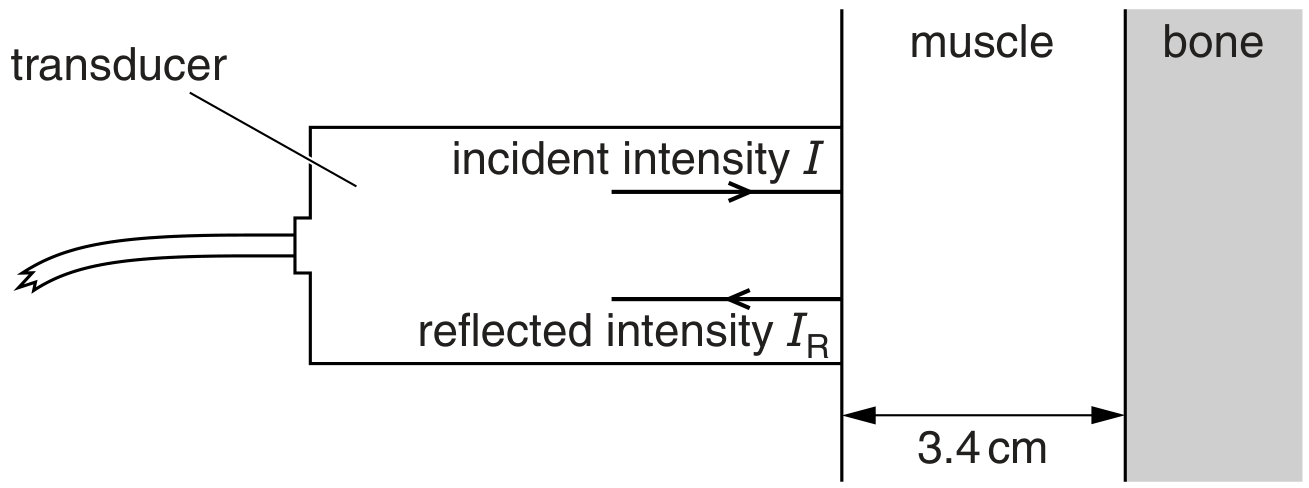
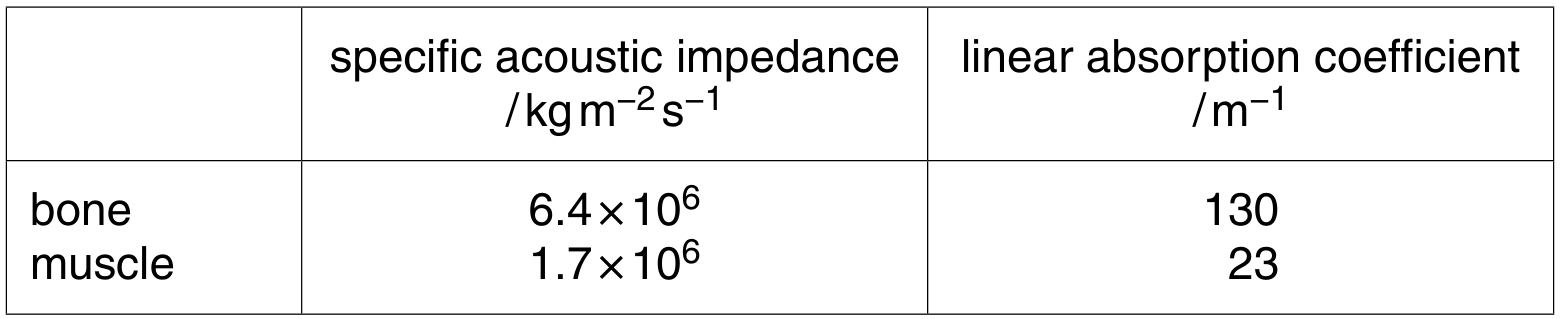
A parallel beam of ultrasound of intensity I is incident normally on a muscle of thickness 3.4 cm , as shown in Fig. 11.1.

Fig. 11.1

Fig. 11.1

The ultrasound wave is reflected at a muscle-bone boundary. The intensity of the ultrasound received back at the transducer is IRI_{\mathrm{R}}.

Some data for bone and muscle are given in Fig. 11.2.

Fig. 11.2

Fig. 11.2

[ 2 ]

Question 11(b)(i)

(i)

The intensity reflection coefficient α\alpha for two media having specific acoustic impedances Z1Z_{1} and Z2Z_{2} is given by

α=(Z1Z2)2(Z1+Z2)2\alpha=\frac{\left(Z_{1}-Z_{2}\right)^{2}}{\left(Z_{1}+Z_{2}\right)^{2}}

Calculate the fraction of the ultrasound intensity that is reflected at the muscle-bone boundary.
fraction =

[ 2 ]

Question 11(b)(ii)

(ii)

Calculate the fraction of the ultrasound intensity that is transmitted through a thickness of 3.4 cm of muscle.
fraction =

Question 11(b)(iii)

(iii)

Use your answers in (i) and (ii) to determine the ratio IRI\frac{I_{\mathrm{R}}}{I}.
ratio =

Question 9

Question 9(c)

Question 9(c)(i)

(a)
(i)

Define the specific acoustic impedance of a medium.

[ 2 ]

Question 9(c)(ii)

(ii)

Use data from Table 9.2 to calculate the percentage of the intensity of ultrasound that is transmitted at a boundary between soft tissue and bone. \%

[ 2 ]

Question 9(c)(iii)

(iii)

The ultrasound is now incident on the sample of soft tissue and bone shown in Fig. 9.1.

Suggest two reasons why the transmitted intensity through the sample is less than the answer in (c)(ii).

1

2

[ 2 ]

Question 10

Question 10(b)

Question 10(b)(i)

(a)
(i)

Explain how ultrasound pulses are used to obtain diagnostic information about internal body structures in medical diagnosis.

[ 3 ]

Question 10(b)(ii)

(ii)

Define specific acoustic impedance.

[ 2 ]

Question 10(b)(iii)

(iii)

Two media have specific acoustic impedances Z1Z_{1} and Z2Z_{2}.

State the approximate value of the intensity reflection coefficient at the boundary between the two media when:
- Z1\quad Z_{1} is almost equal to Z2Z_{2}

intensity reflection coefficient =

- Z1\quad Z_{1} is very different from Z2Z_{2}.
intensity reflection coefficient =

[ 2 ]

Question 10

Question 10(a)

(a)

Describe how reflected ultrasound pulses may be used to obtain diagnostic information about internal structures.

[ 2 ]

Question 10(b)

Question 10(b)(i)

(b)
(i)

Define specific acoustic impedance of a medium.

[ 2 ]

Question 10(b)(ii)

(ii)

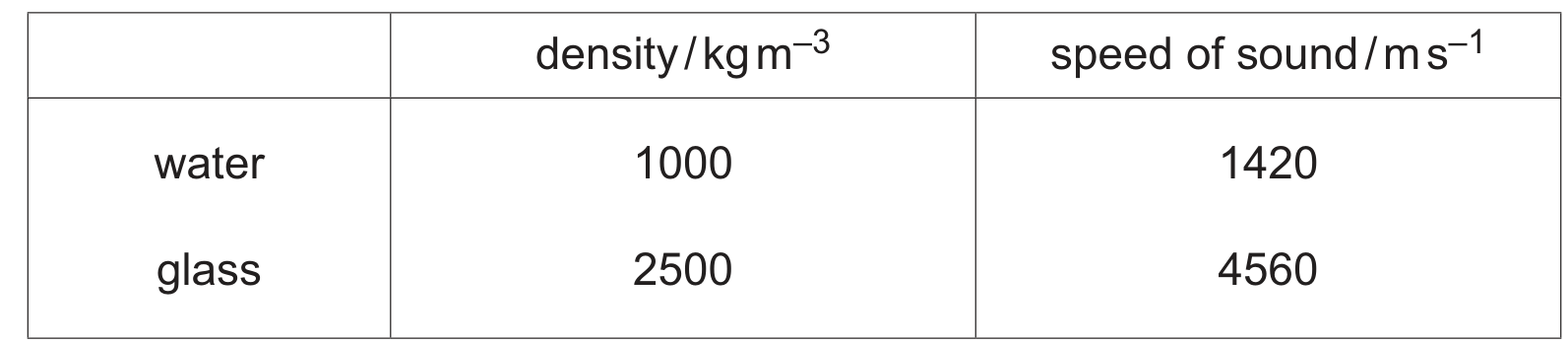
Table 10.1 shows some data for water and for glass.

Table 10.1

Table 10.1

Determine the intensity reflection coefficient for ultrasound that is incident on a water-glass boundary.
intensity reflection coefficient =

[ 3 ]
0 selected