EduNinja

A-Level CAIE Physics A213.2 Gravitational force between point massesQuestion Bank

Question 1

[Maximum number: 4]

the mass of Mars,
mass = kg

Question 1(a)

(a)

A moon is in a circular orbit of radius r about a planet. The angular speed of the moon in its orbit is ω\omega. The planet and its moon may be considered to be point masses that are isolated in space.

Show that r and ω\omega are related by the expression

r3ω2= constant. r^{3} \omega^{2}=\text { constant. }

Explain your working.

[ 3 ]

Question 1(b)

(b)

Phobos and Deimos are moons that are in circular orbits about the planet Mars.

Data for Phobos and Deimos are shown in Fig. 1.1.
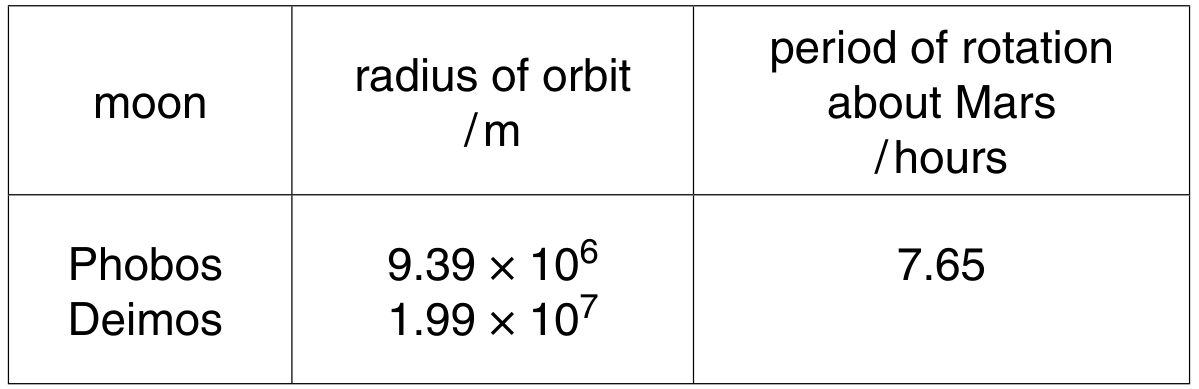
Fig. 1.1

Fig. 1.1

[ 1 ]

Question 1(b)(i)

(i)

Use data from Fig. 1.1 to determine

Question 1(b)(ii)

(ii)

The period of rotation of Mars about its axis is 24.6 hours.

Deimos is in an equatorial orbit, orbiting in the same direction as the spin of Mars about its axis.

Use your answer in (i) to comment on the orbit of Deimos.

[ 1 ]
Question 1

[Maximum number: 4]

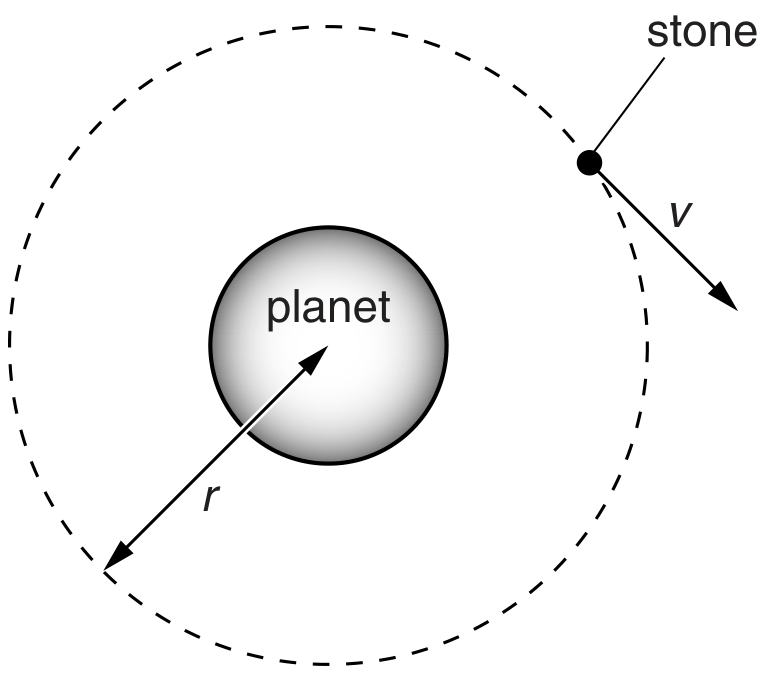
The mass M of a spherical planet may be assumed to be a point mass at the centre of the planet.

Question 1(a)

(a)

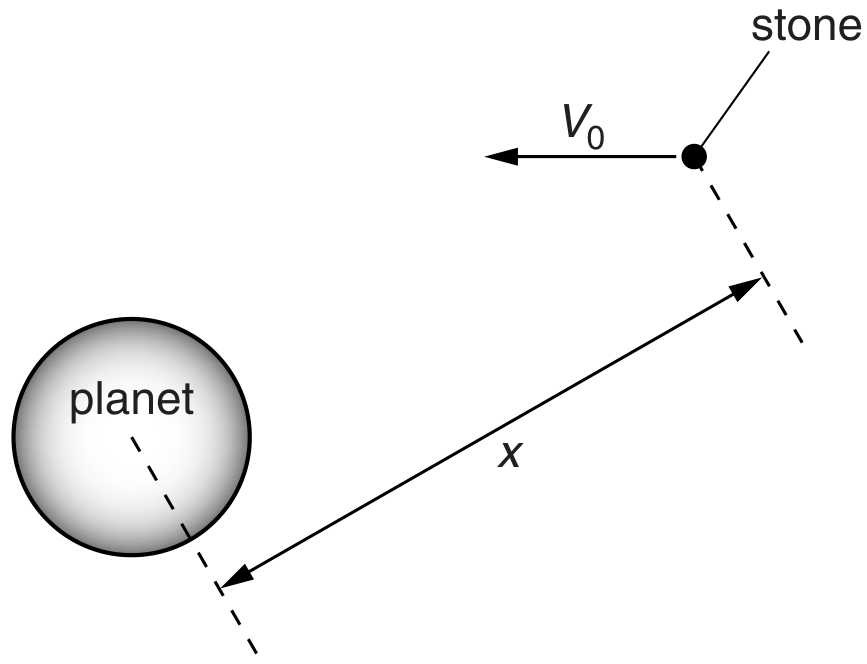
A stone, travelling at speed v, is in a circular orbit of radius r about the planet, as illustrated in Fig.1.1.

Fig. 1.1

Fig. 1.1

Show that the speed v is given by the expression

v=(GMr)v=\sqrt{\left(\frac{G M}{r}\right)}

where G is the gravitational constant.
Explain your working.

[ 2 ]

Question 1(b)

(b)

A second stone, initially at rest at infinity, travels towards the planet, as illustrated in Fig.1.2.

Fig.1.2 (not to scale)

Fig.1.2 (not to scale)

The stone does not hit the surface of the planet.

[ 2 ]

Question 1(b)(ii)

(i)

Use your answer in (i) and the expression in (a) to explain whether this stone could enter a circular orbit about the planet.

[ 2 ]

Question 1

Question 1(a)

(a)

State Newton's law of gravitation.

[ 2 ]

Question 1(b)

(b)

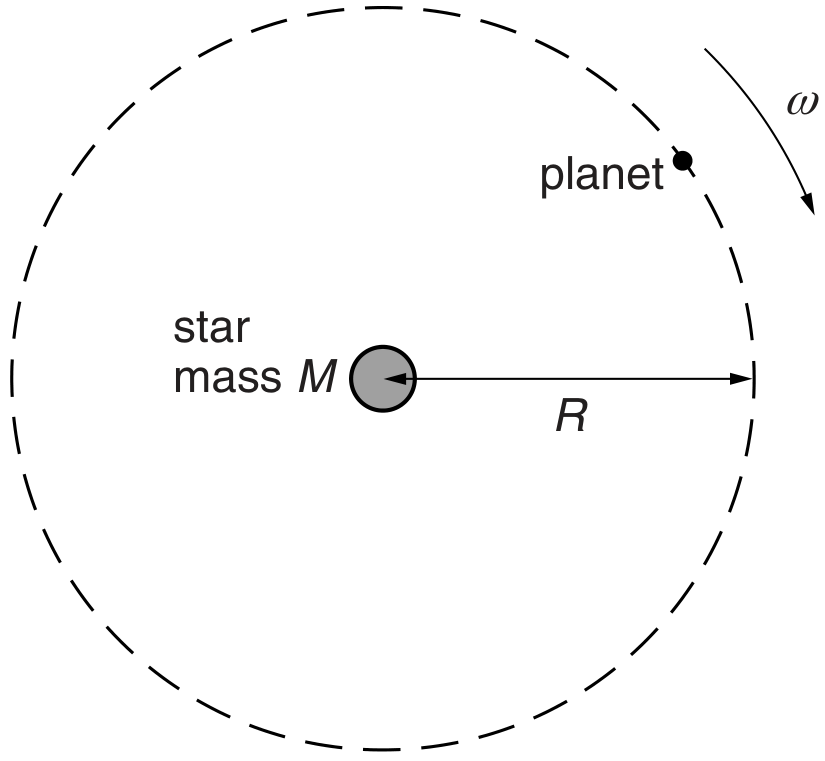
A star and a planet are isolated in space. The planet orbits the star in a circular orbit of radius R, as illustrated in Fig. 1.1.

Fig. 1.1

Fig. 1.1

The angular speed of the planet about the star is ω\omega.
By considering the circular motion of the planet about the star of mass M, show that ω\omega and R are related by the expression

R3ω2=GMR^{3} \omega^{2}=G M

where G is the gravitational constant. Explain your working.

[ 3 ]

Question 1(c)

(c)

The Earth orbits the Sun in a circular orbit of radius 1.5×10⁸ km1.5 \times 10^{8} \mathrm{~km}. The mass of the Sun is 2.0×1030 kg2.0 \times 10^{30} \mathrm{~kg}.

A distant star is found to have a planet that has a circular orbit about the star. The radius of the orbit is 6.0×10⁸ km6.0 \times 10^{8} \mathrm{~km} and the period of the orbit is 2.0 years.

Use the expression in (b) to calculate the mass of the star.
mass = kg

[ 3 ]

Question 1

[Maximum number: 11]

the amplitude,
amplitude = cm

Question 1(b)

(a)

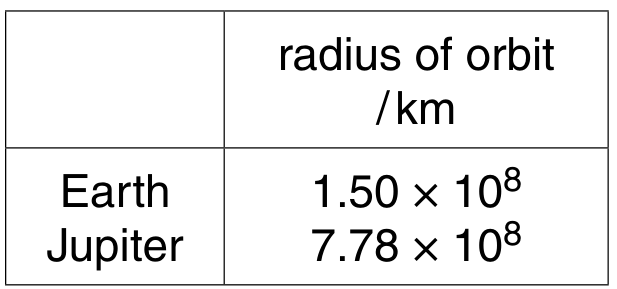
In the Solar System, the planets may be assumed to be in circular orbits about the Sun. Data for the radii of the orbits of the Earth and Jupiter about the Sun are given in Fig. 1.1.

Fig. 1.1

Fig. 1.1

[ 6 ]

Question 1(b)(i)

(i)

State Newton's law of gravitation.

[ 3 ]

Question 1(b)(ii)

(ii)

Use Newton's law to determine the ratio
gravitational field strength due to the Sun at orbit of Earth gravitational field strength due to the Sun at orbit of Jupiter
ratio =

[ 3 ]

Question 1(c)

(b)

The orbital period of the Earth about the Sun is T.

[ 5 ]

Question 1(c)(i)

(i)

Use ideas about circular motion to show that the mass M of the Sun is given by

M=4π2R3GT2M=\frac{4 \pi^{2} R^{3}}{G T^{2}}

where R is the radius of the Earth's orbit about the Sun and G is the gravitational constant.
Explain your working.

[ 3 ]

Question 1(c)(ii)

(ii)

The orbital period T of the Earth about the Sun is 3.16×10⁷ s3.16 \times 10^{7} \mathrm{~s}.

The radius of the Earth's orbit is given in Fig. 1.1.
Use the expression in (i) to determine the mass of the Sun.
mass = kg

[ 2 ]

Question 1

[Maximum number: 10]

the amount of gas, in mol, in the cylinder,
amount = mol

Question 1(a)

(a)

Explain what is meant by a geostationary orbit.

[ 3 ]

Question 1(b)

(b)

A satellite of mass m is in a circular orbit about a planet.

The mass M of the planet may be considered to be concentrated at its centre. Show that the radius R of the orbit of the satellite is given by the expression

R3=(GMT24π2)R^{3}=\left(\frac{G M T^{2}}{4 \pi^{2}}\right)

where T is the period of the orbit of the satellite and G is the gravitational constant. Explain your working.

[ 4 ]

Question 1(c)

(c)

The Earth has mass 6.0×1024 kg6.0 \times 10^{24} \mathrm{~kg}. Use the expression given in (b) to determine the radius of the geostationary orbit about the Earth.
radius = m

[ 3 ]

Question 1

[Maximum number: 6]

kinetic energy,
change in kinetic energy = J
2. gravitational potential energy.
change in potential energy = J

Question 1(a)

(a)

State Newton's law of gravitation.

[ 2 ]

Question 1(b)

(b)

A satellite of mass m is in a circular orbit of radius r about a planet of mass M. For this planet, the product G M is 4.00×10¹⁴Nm2 kg14.00 \times 10^{14} \mathrm{Nm}^{2} \mathrm{~kg}^{-1}, where G is the gravitational constant.
The planet may be assumed to be isolated in space.

[ 4 ]

Question 1(b)(i)

(i)

By considering the gravitational force on the satellite and the centripetal force, show that the kinetic energy EKE_{\mathrm{K}} of the satellite is given by the expression

EK=GMm2r.E_{\mathrm{K}}=\frac{G M m}{2 r} .
[ 2 ]

Question 1(b)(ii)

(ii)

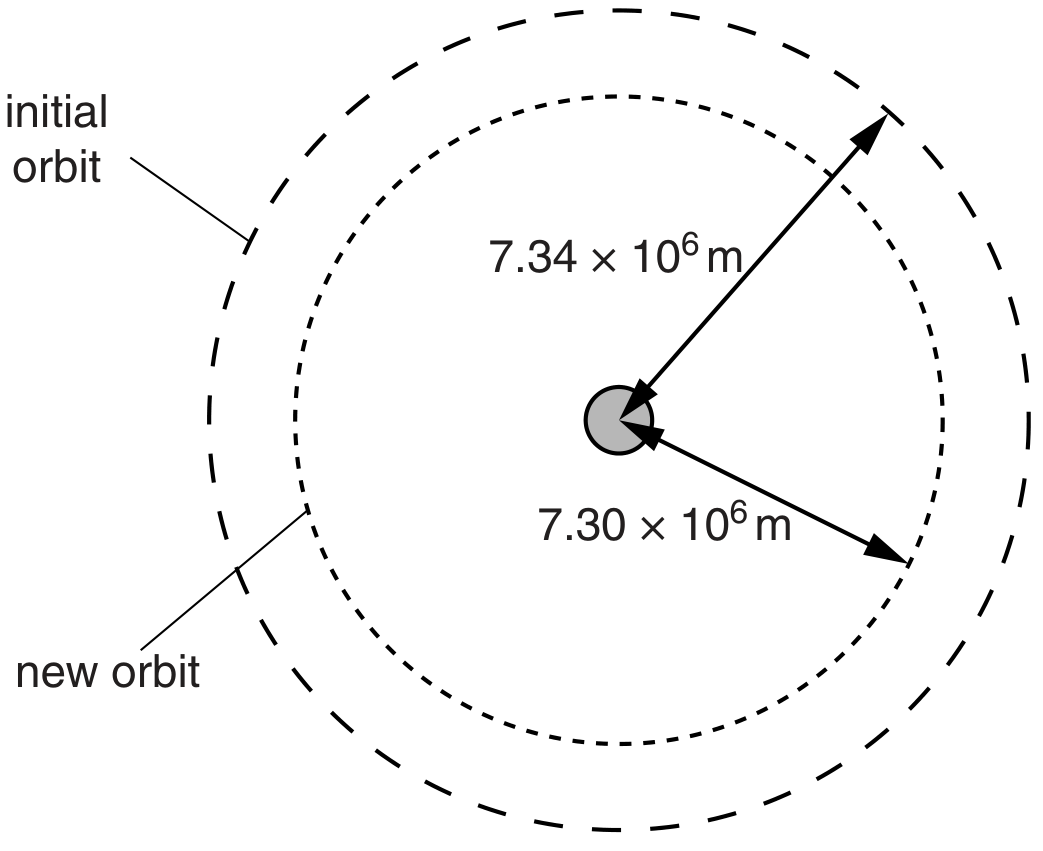
The satellite has mass 620 kg and is initially in a circular orbit of radius 7.34×10⁶ m7.34 \times 10^{6} \mathrm{~m}, as illustrated in Fig. 1.1.

Fig. 1.1 (not to scale)

Fig. 1.1 (not to scale)

Resistive forces cause the satellite to move into a new orbit of radius 7.30×10⁶ m7.30 \times 10^{6} \mathrm{~m}.

Determine, for the satellite, the change in

Question 1(b)(iii)

(iii)

Use your answers in (ii) to explain whether the linear speed of the satellite increases, decreases or remains unchanged when the radius of the orbit decreases.

[ 2 ]

Question 1

Question 1(a)

(a)

State Newton's law of gravitation.

[ 2 ]

Question 1(b)

(b)

The Earth and the Moon may be considered to be isolated in space with their masses concentrated at their centres.
The orbit of the Moon around the Earth is circular with a radius of 3.84×10⁵ km3.84 \times 10^{5} \mathrm{~km}. The period of the orbit is 27.3 days.

Show that

[ 2 ]

Question 1(b)(ii)

(i)

the mass of the Earth is 6.0×1024 kg6.0 \times 10^{24} \mathrm{~kg}.

[ 2 ]

Question 1(c)

(c)

The mass of the Moon is 7.4×10²² kg7.4 \times 10^{22} \mathrm{~kg}.

Question 1(c)(i)

(i)

Using data from (b), determine the gravitational force between the Earth and the Moon.

force =

Question 1

[Maximum number: 2]


2.

Question 1(b)

(a)

The Earth may be considered to be an isolated sphere of radius R with its mass concentrated at its centre.
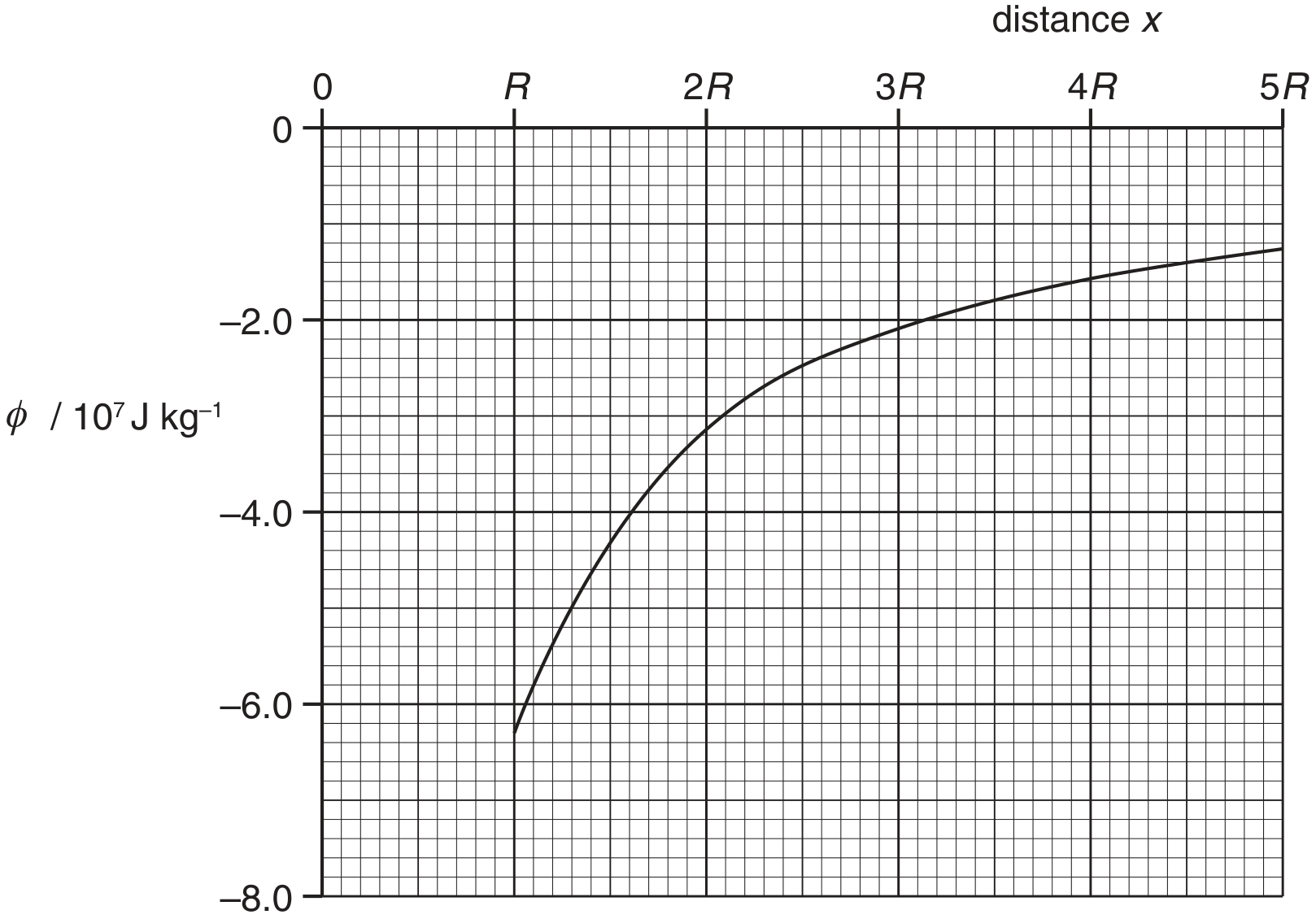
The variation of the gravitational potential ϕ\phi with distance x from the centre of the Earth is shown in Fig. 1.1.

Fig. 1.1

Fig. 1.1

The radius R of the Earth is 6.4×10⁶ m6.4 \times 10^{6} \mathrm{~m}.

[ 2 ]

Question 1(b)(iii)

(i)

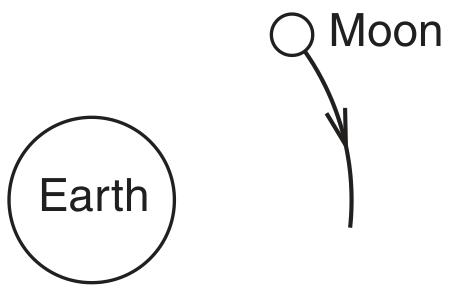
In practice, the Earth is not an isolated sphere because it is orbited by the Moon, as illustrated in Fig. 1.2.
initial path
of meteorite

Fig. 1.2 (not to scale)

Fig. 1.2 (not to scale)

The initial path of the meteorite is also shown.
Suggest two changes to the motion of the meteorite caused by the Moon.

[ 2 ]

Question 1

[Maximum number: 8]

gel and soft tissue,

α=\alpha=

Question 1(c)

(a)

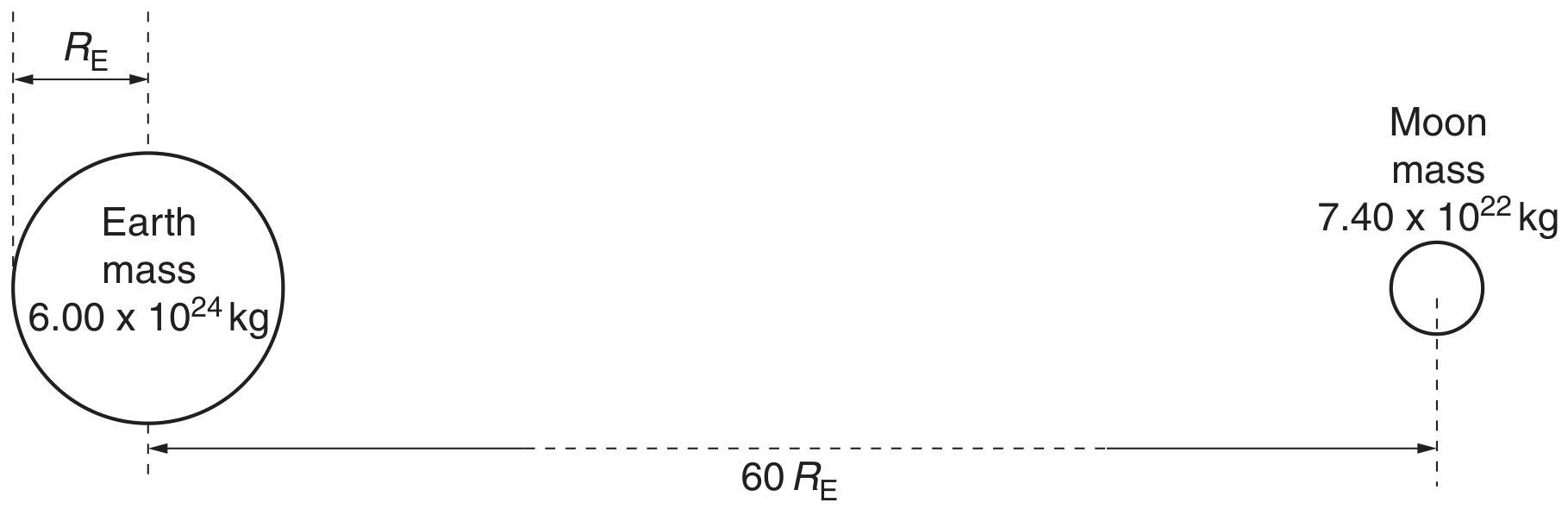
The Earth and the Moon may be considered to be spheres that are isolated in space with their masses concentrated at their centres.
The masses of the Earth and the Moon are 6.00×1024 kg6.00 \times 10^{24} \mathrm{~kg} and 7.40×10²² kg7.40 \times 10^{22} \mathrm{~kg} respectively.
The radius of the Earth is RER_{\mathrm{E}} and the separation of the centres of the Earth and the Moon is 60RE60 R_{\mathrm{E}}, as illustrated in Fig. 1.2.

Fig. 1.2 (not to scale)

Fig. 1.2 (not to scale)

[ 8 ]

Question 1(c)(i)

(i)

Explain why there is a point between the Earth and the Moon at which the gravitational field strength is zero.

[ 2 ]

Question 1(c)(ii)

(ii)

Determine the distance, in terms of RER_{\mathrm{E}}, from the centre of the Earth at which the gravitational field strength is zero.

distance =
[ 3 ]

Question 1(c)(iii)

(iii)

On the axes of Fig. 1.3, sketch a graph to show the variation of the gravitational field strength with position between the surface of the Earth and the surface of the Moon.

[ 3 ]

Question 1

[Maximum number: 2]

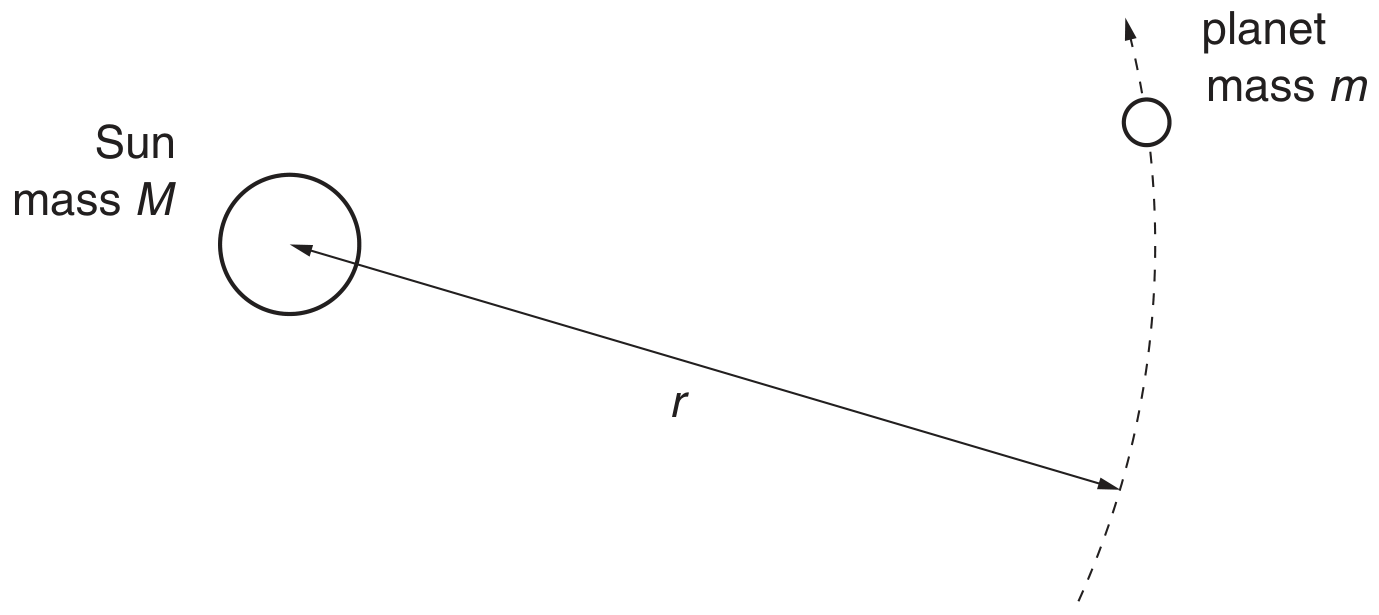
A planet of mass m is in a circular orbit of radius r about the Sun of mass M, as illustrated in Fig. 1.1.

Fig. 1.1

Fig. 1.1

The magnitude of the angular velocity and the period of revolution of the planet about the Sun are ω\omega and T respectively.

Question 1(c)

(a)

Data for the planets Venus and Neptune are given in Fig. 1.2.

Fig. 1.2

Fig. 1.2

Assume that the orbits of both planets are circular.

[ 2 ]

Question 1(c)(i)

(i)

Use the expression in (b) to calculate the value of T for Neptune.
T= years

[ 2 ]
0 selected