EduNinja

A-Level CAIE Physics A213.3 Gravitational field of a point massQuestion Bank

Question 1

Question 1(a)

Question 1(a)(ii)

(a)
(i)

Explain, with reference to gravitational field lines, why the gravitational field near the surface of the Earth is approximately constant for small changes in height.

[ 2 ]

Question 1(b)

(b)

A large isolated uniform sphere has mass M and radius R.

Point P lies on a straight line passing through the centre of the sphere, at a variable displacement x from the centre, as shown in Fig. 1.1.
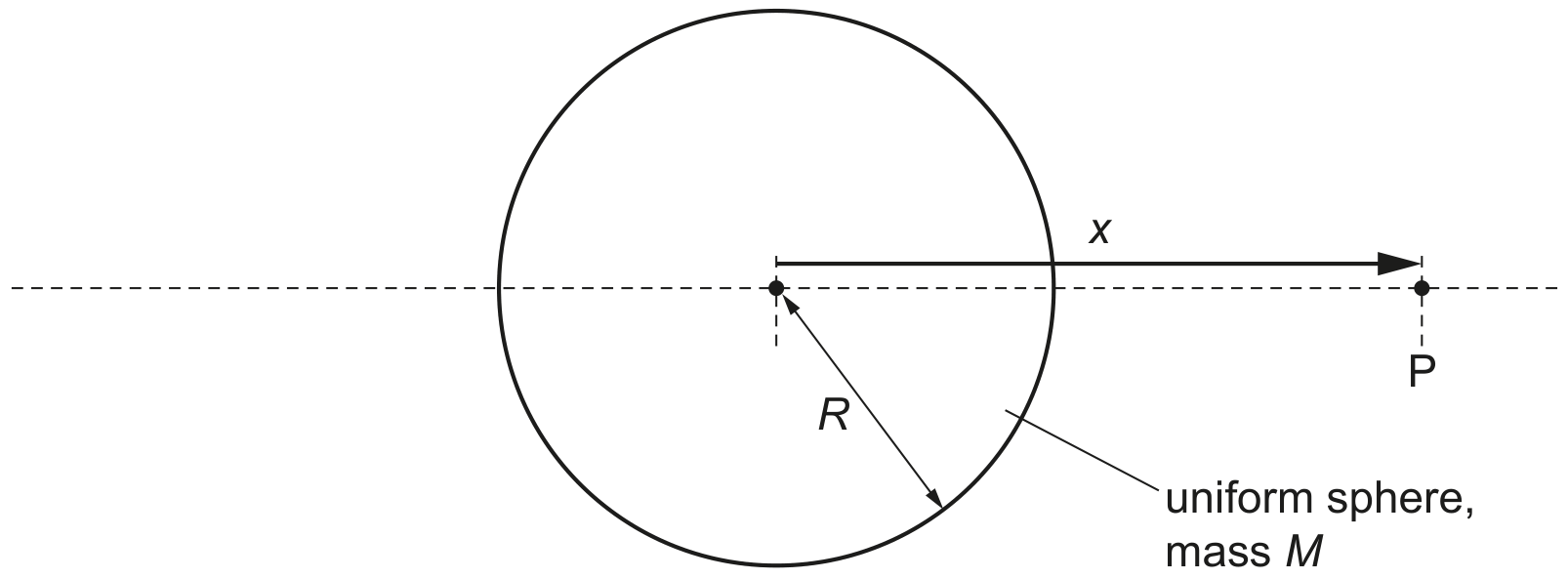
Fig. 1.1

Fig. 1.1

Fig. 1.2 shows the variation with x of the gravitational field g at point P due to the sphere for the values of x for which P is inside the sphere.
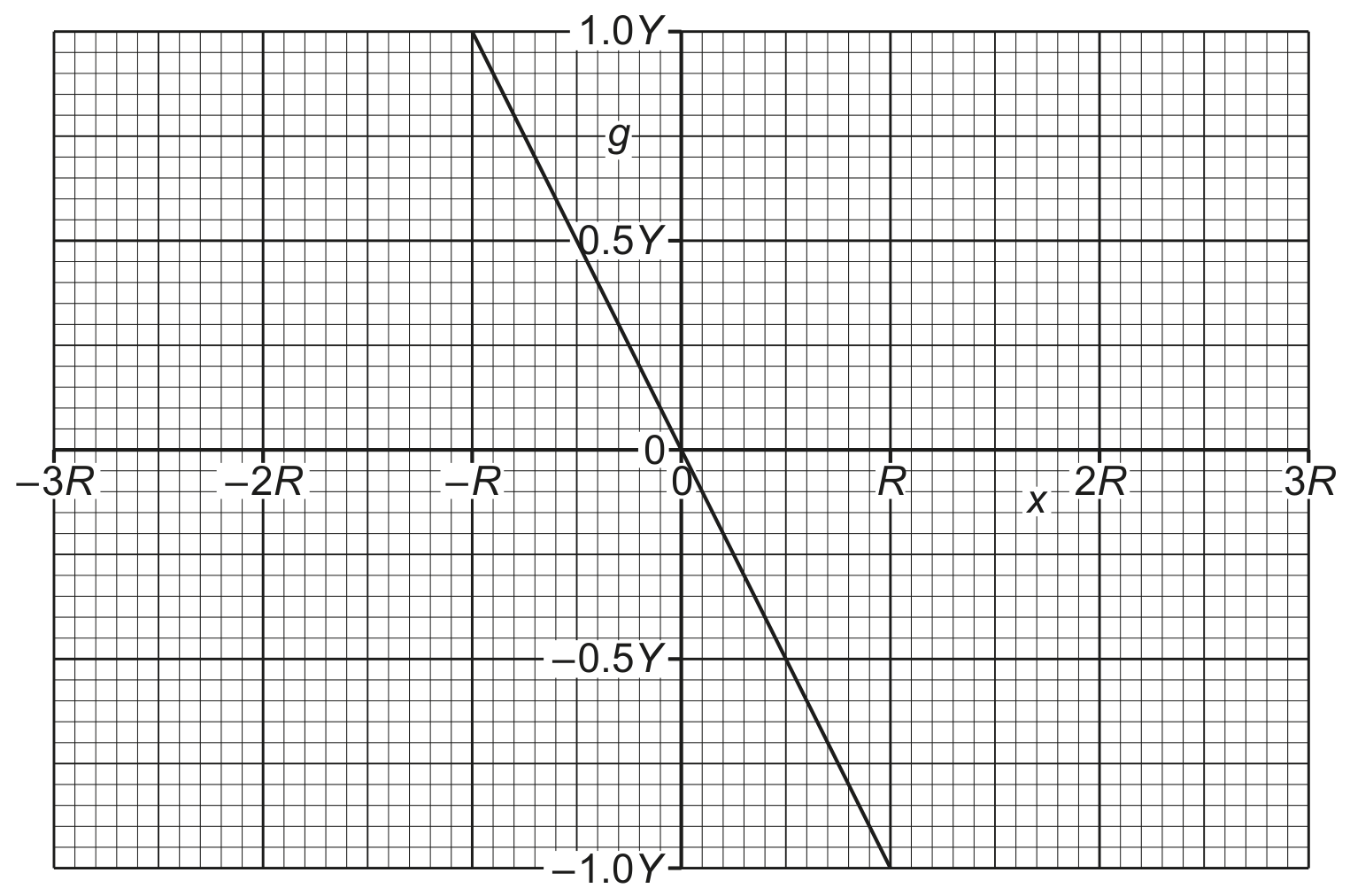
Fig. 1.2

Fig. 1.2

The magnitude of the gravitational field at the surface of the sphere is Y.

[ 7 ]

Question 1(b)(i)

(i)

Determine an expression for Y in terms of M and R. Identify any other symbols that you use.

[ 2 ]

Question 1(b)(ii)

(ii)

Explain why, at the surface of the sphere, g always has the opposite sign to x.

[ 2 ]

Question 1(b)(iii)

(iii)

Complete Fig. 1.2 to show the variation of g with x for values of x, up to ±3R\pm 3 R, for which point P is outside the sphere.
[ 3 ]

Question 1

Question 1(b)

(a)

An isolated uniform conducting sphere has mass M and charge Q.

The gravitational field strength at the surface of the sphere is g.
The electric field strength at the surface of the sphere is E.

[ 3 ]

Question 1(b)(i)

(i)

Show that

MQ=αgE\frac{M}{Q}=\alpha \frac{g}{E}

where α\alpha is a constant.

[ 3 ]

Question 1

Question 1(b)

(a)

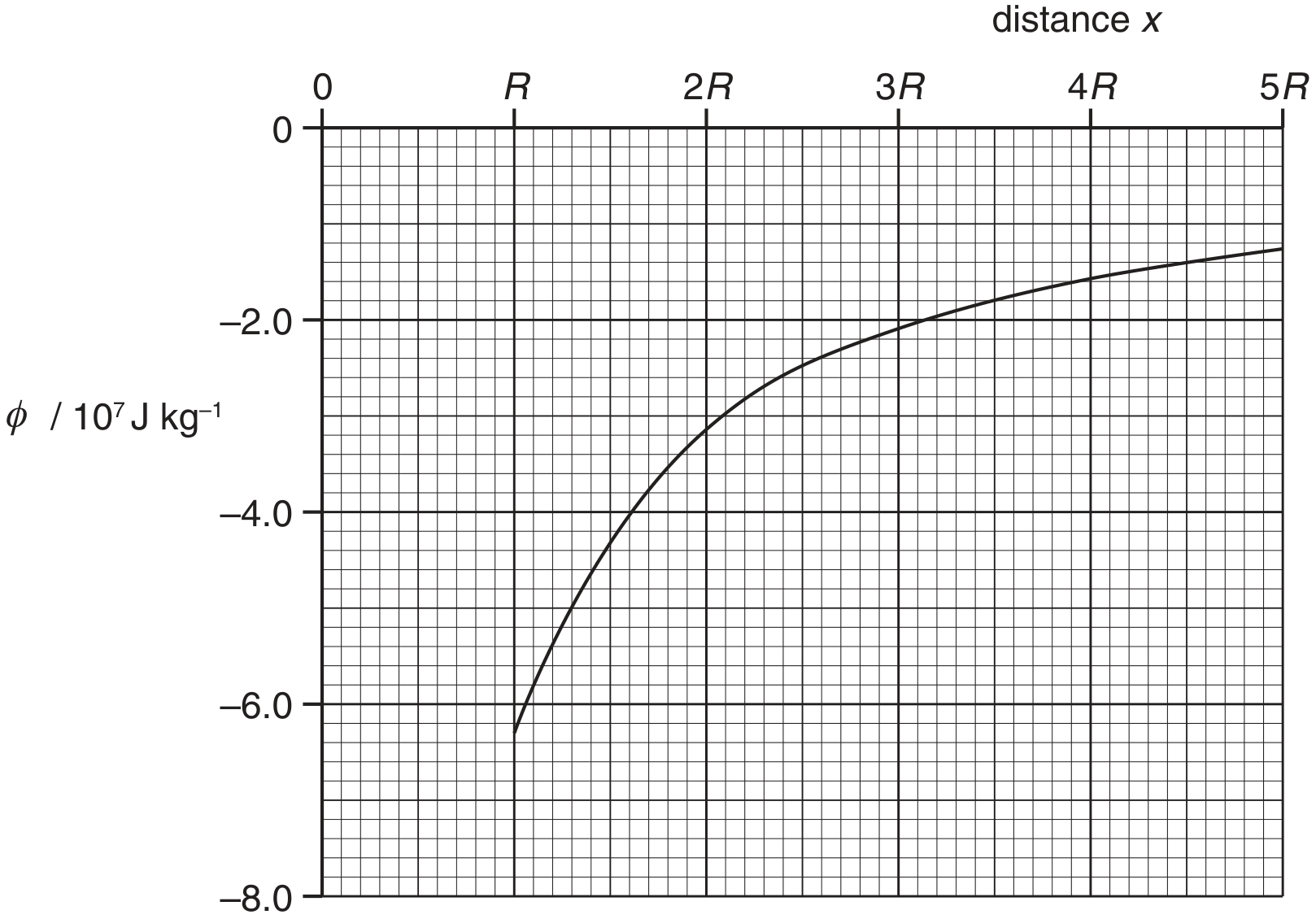
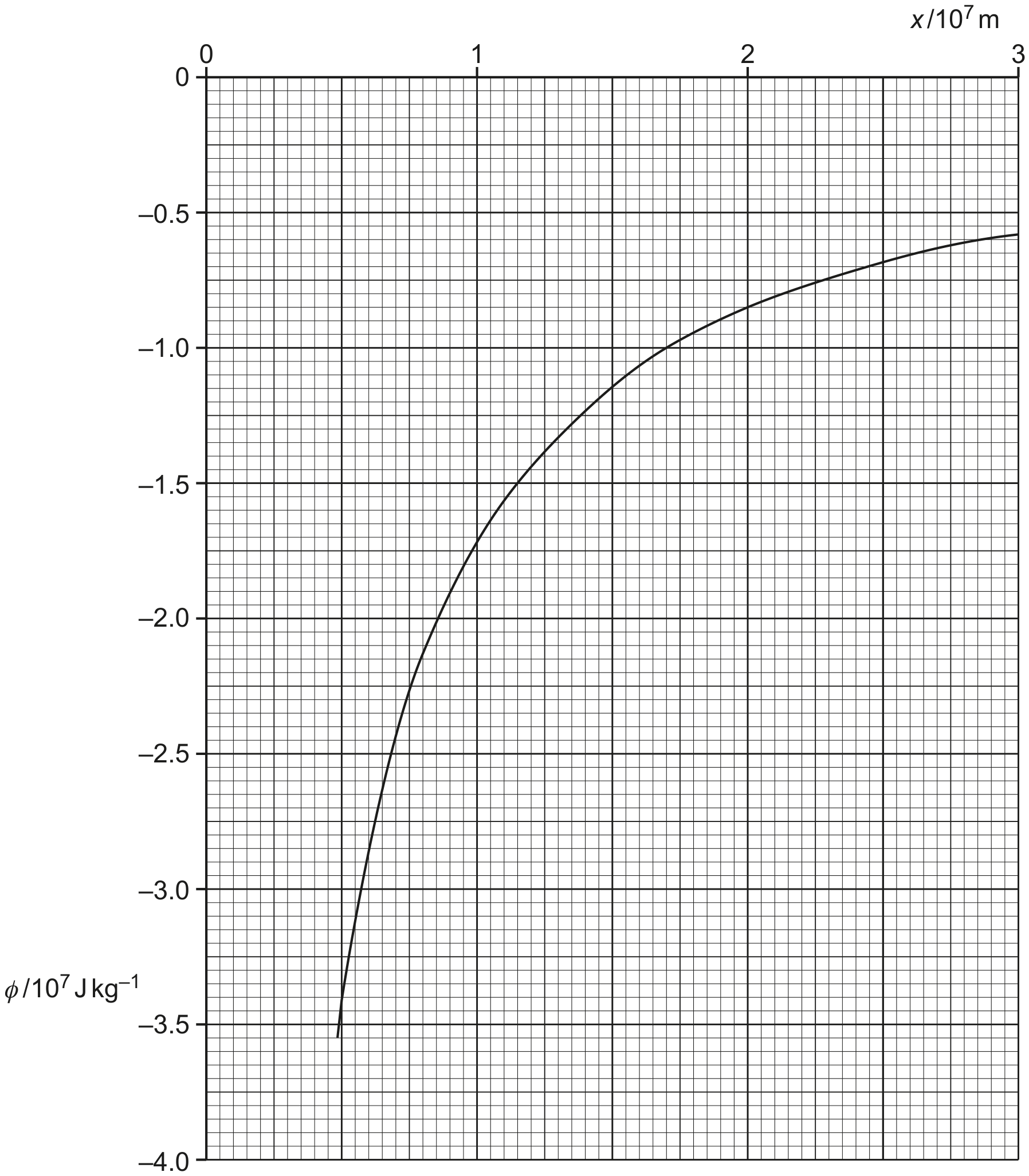
Artemis is a spherical planet that may be assumed to be isolated in space. The variation with distance x from the centre of Artemis of the gravitational potential ϕ\phi is shown in Fig. 1.1.

Fig. 1.1

Fig. 1.1

Question 1(b)(iii)

(i)

Calculate the gravitational field strength g on the surface of Artemis.

Question 1

Question 1(a)

Question 1(a)(ii)

(a)
(i)

Use Newton's law of gravitation to show that the gravitational field strength g at a distance r away from a point mass M is given by

g=GMr2.g=\frac{G M}{r^{2}} .
[ 2 ]

Question 1(b)

(b)

The Earth has a mass of 5.98×1024 kg5.98 \times 10^{24} \mathrm{~kg} and a radius of 6.37×10⁶ m6.37 \times 10^{6} \mathrm{~m}.

The Moon has a mass of 7.35×10²² kg7.35 \times 10^{22} \mathrm{~kg} and a radius of 1.74×10⁶ m1.74 \times 10^{6} \mathrm{~m}.
The Earth and the Moon can both be considered as point masses at their centres. Their centres are a distance of 3.84×10⁸ m3.84 \times 10^{8} \mathrm{~m} apart.

[ 1 ]

Question 1(b)(i)

(i)

Show that the gravitational field strength at the surface of the Moon due to the mass of the Moon is 1.62 N kg11.62 \mathrm{~N} \mathrm{~kg}^{-1}.

[ 1 ]

Question 1

Question 1(a)

Question 1(a)(ii)

(a)
(i)

Use Newton's law of gravitation to show that the gravitational field strength g at a distance r away from a point mass M is given by

g=GMr2.g=\frac{G M}{r^{2}} .
[ 2 ]

Question 1(b)

(b)

The Earth has a mass of 5.98×1024 kg5.98 \times 10^{24} \mathrm{~kg} and a radius of 6.37×10⁶ m6.37 \times 10^{6} \mathrm{~m}.

The Moon has a mass of 7.35×10²² kg7.35 \times 10^{22} \mathrm{~kg} and a radius of 1.74×10⁶ m1.74 \times 10^{6} \mathrm{~m}.
The Earth and the Moon can both be considered as point masses at their centres. Their centres are a distance of 3.84×10⁸ m3.84 \times 10^{8} \mathrm{~m} apart.

[ 1 ]

Question 1(b)(i)

(i)

Show that the gravitational field strength at the surface of the Moon due to the mass of the Moon is 1.62 N kg11.62 \mathrm{~N} \mathrm{~kg}^{-1}.

[ 1 ]

Question 1

[Maximum number: 2]

An isolated spherical planet has a diameter of 6.8×10⁶ m6.8 \times 10^{6} \mathrm{~m}. Its mass of 6.4×10²³ kg6.4 \times 10^{23} \mathrm{~kg} may be assumed to be a point mass at the centre of the planet.

Question 1(a)

(a)

Show that the gravitational field strength at the surface of the planet is 3.7Nkg13.7 \mathrm{Nkg}^{-1}.

[ 2 ]

Question 1

[Maximum number: 2]

An isolated spherical planet has a diameter of 6.8×10⁶ m6.8 \times 10^{6} \mathrm{~m}. Its mass of 6.4×10²³ kg6.4 \times 10^{23} \mathrm{~kg} may be assumed to be a point mass at the centre of the planet.

Question 1(a)

(a)

Show that the gravitational field strength at the surface of the planet is 3.7Nkg13.7 \mathrm{Nkg}^{-1}.

[ 2 ]

Question 1

Question 1(c)

(a)

A spherical planet may be assumed to be an isolated point mass with its mass concentrated at its centre. A small mass m is moving near to, and normal to, the surface of the planet. The mass moves away from the planet through a short distance h.

State and explain why the change in gravitational potential energy ΔEP\Delta E_{\mathrm{P}} of the mass is given by the expression

ΔEp=mgh\Delta E_{\mathrm{p}}=m g h

where g is the acceleration of free fall.

[ 4 ]

Question 1

[Maximum number: 2]

gel and soft tissue,

α=\alpha=

Question 1(b)

(a)

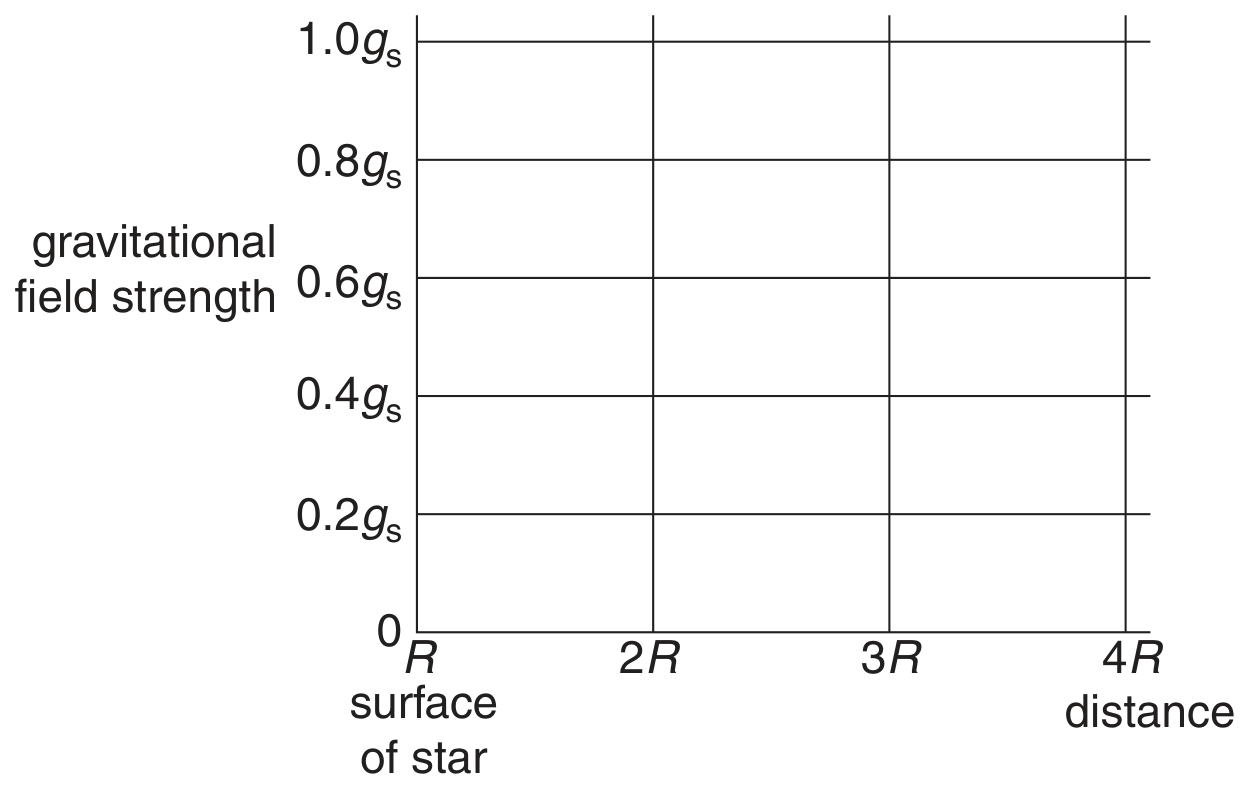
An isolated star has radius R. The mass of the star may be considered to be a point mass at the centre of the star.
The gravitational field strength at the surface of the star is gsg_{\mathrm{s}}.
On Fig. 1.1, sketch a graph to show the variation of the gravitational field strength of the star with distance from its centre. You should consider distances in the range R to 4 R.

Fig. 1.1

Fig. 1.1

[ 2 ]

Question 1

[Maximum number: 3]


2.

Question 1(b)

(a)

The Earth may be considered to be an isolated sphere of radius R with its mass concentrated at its centre.
The variation of the gravitational potential ϕ\phi with distance x from the centre of the Earth is shown in Fig. 1.1.

Fig. 1.1

Fig. 1.1

The radius R of the Earth is 6.4×10⁶ m6.4 \times 10^{6} \mathrm{~m}.

[ 3 ]

Question 1(b)(i)

(i)

By considering the gravitational potential at the Earth's surface, determine a value for the mass of the Earth.

[ 3 ]
0 selected