CAIE A-Level Mathematics 4.5 Energy, Work and Power Question Bank

CAIE A-Level Mathematics 4.5 Energy, Work and Power Question Bank
Cambridge International AS & A Level Mathematics 9709 syllabus for exams in 2028, 2029 and 20302028–2030

Practise calculating work, kinetic and potential energy and power, then applying work-energy or conservation equations to particles, vehicles and connected systems.

Exam points

  • calculate work as force times displacement in its direction, including signed resistance work
  • balance changes in kinetic and gravitational potential energy with work by external forces
  • use P = Fv for a driving force at instantaneous speed or work divided by elapsed time

Question 1

[Maximum number: 3]

A crate is being pushed in a straight line along a horizontal surface by a force of magnitude 25 N inclined at 2020^{\circ} above the horizontal. The crate moves a distance of 12 m in 8 seconds with constant speed.

Question 1(b)

(a)

Find the work done by the 25 N force.

[ 2 ]

Question 1(c)

(b)

Find the power at which the 25 N force is working.

-
.

[ 1 ]

Question 1(b)

[Maximum number: 2]

A car of mass 900 kg is moving along a straight horizontal road against a constant resistance to motion of 350 N . At an instant when the car is moving at 15 ms115 \mathrm{~ms}^{-1} its acceleration is 0.25 ms20.25 \mathrm{~ms}^{-2}.

Find the power of the car's engine at this instant.

Question 3

[Maximum number: 8]

A car of mass 800 kg is moving on a straight road.
When the car is moving at a constant speed of 20 ms120 \mathrm{~ms}^{-1} on a horizontal section of the road, the engine of the car is working at P WP \mathrm{~W}.

When the car is moving at a constant speed of 12 ms112 \mathrm{~ms}^{-1} up a section of the road inclined at sin10.15\sin ^{-1} 0.15 to the horizontal, the engine of the car is also working at P WP \mathrm{~W}.

On both sections of the road there is a constant force of magnitude R NR \mathrm{~N} resisting the motion of the car.

Question 3(a)

(a)

Find the value of R and the value of P.

[ 5 ]

Question 3(b)

(b)

Find the acceleration of the car when it is moving at 10 ms110 \mathrm{~ms}^{-1} up the inclined section of the road with the engine working at 32 kW .

[ 3 ]

Question 4

[Maximum number: 6]
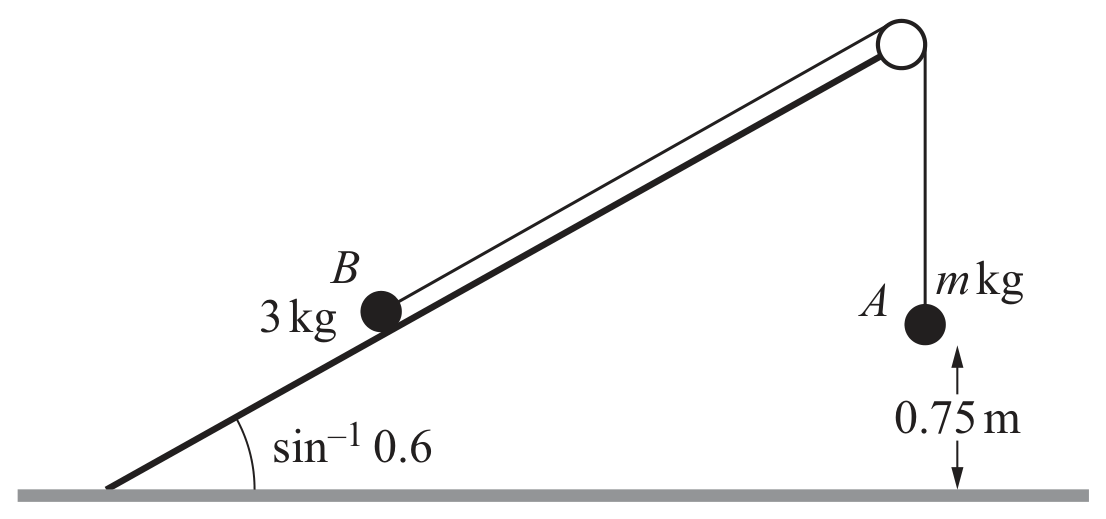
Figure for Question 4 — CAIE A-Level Mathematics

Two particles, A and B, of masses m kgm \mathrm{~kg} and 3 kg respectively, are connected by a light inextensible string. Particle B is on a fixed plane which is at an angle of sin10.6\sin ^{-1} 0.6 to the horizontal ground. The string passes over a fixed smooth pulley at the top of the plane. Particle A hangs vertically below the pulley and is 0.75 m above the ground (see diagram).

The system is released from rest. In the subsequent motion B moves up a line of greatest slope of the plane and does not reach the pulley. As B moves up the plane there is a constant resistance to its motion of magnitude 103 N\frac{10}{3} \mathrm{~N}. The speed of A immediately before it hits the ground is 2 ms12 \mathrm{~ms}^{-1}.

Use an energy method to find the value of m.

Question 5

[Maximum number: 11]

A car of mass 1600 kg travels at constant speed 20 m s120 \mathrm{~m} \mathrm{~s}^{-1} up a straight road inclined at an angle of sin10.12\sin ^{-1} 0.12 to the horizontal.

Question 5(a)

(a)

Find the change in potential energy of the car in 30 s .

[ 3 ]

Question 5(b)

(b)

Given that the total work done by the engine of the car in this time is 1960 kJ , find the constant force resisting the motion.

[ 3 ]

Question 5(c)

(c)

Calculate, in kW , the power developed by the engine of the car.

[ 2 ]

Question 5(d)

(d)

Given that this power is suddenly decreased by 15 %, find the instantaneous deceleration of the car.

[ 3 ]