
Question 3(a)
[Maximum number: 4]
Solve the inequality .
Practise Pure Mathematics 3 techniques for algebra, functions, calculus, vectors and equations through exact and numerical work.
Solve the inequality .
Show that the equation can be written as a quadratic equation in x.
Hence solve the equation , giving your answer correct to 2 decimal places.
The complex number u is given by .
Express u in the form , where r>0 and . Give the exact values of r and .
The complex number v is given by .
Express the complex number in the form where r>0 and .
The polynomial p(x) is defined by
Find the quotient when p(x) is divided by and show that the remainder is -11.
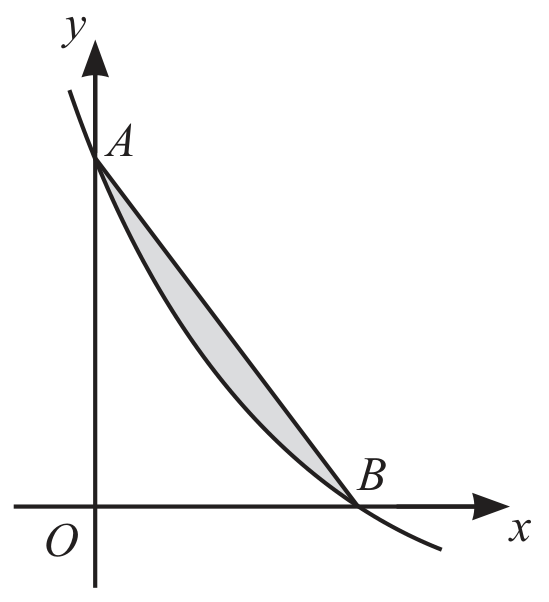
The diagram shows the curve with equation . The curve meets the axes at the points A and B. The shaded region is bounded by the curve and the line segment AB.
Show that the x-coordinate of B is .
Find the area of the shaded region. Give your answer in the form , where p and q are positive integers.
Given that , find the value of the positive constant a.
The equation of a curve is .
Find the exact values of x when the gradient of the curve is .
Find the exact value of .
The polynomial p(x) is defined by
where k is a constant. It is given that (x+2) is a factor of p(x).
Find the value of k.
It is given that the equation p(x)=0 has exactly two real roots, denoted by and , where is an integer and is not an integer.
State the value of and show that satisfies the equation .
Show by calculation that .
Use an iterative formula, based on the equation in part (b), to find the value of correct to 3 significant figures. Give the result of each iteration to 5 significant figures.
The polynomials f(x) and g(x) are defined by
where a and b are constants.
Given that (x+3) is a factor of f(x), find the value of a.
Given that the remainder is 40 when g(x) is divided by (x-2), find the value of b.
Hence solve the equation for .
The diagram shows a tank for holding water. The tank is in the shape of a cube of side 50 cm. At time t seconds, the depth of water in the tank is . Water is poured into the tank at a rate of . Water pours out of the tank through a hole in the bottom at a rate proportional to .
When h=20, the depth of the water is increasing at a rate of .
Show that .
Given that h=0 when t=0, find the time taken for the depth of the water in the tank to reach 20 cm.