
Question 1
[Maximum number: 5]
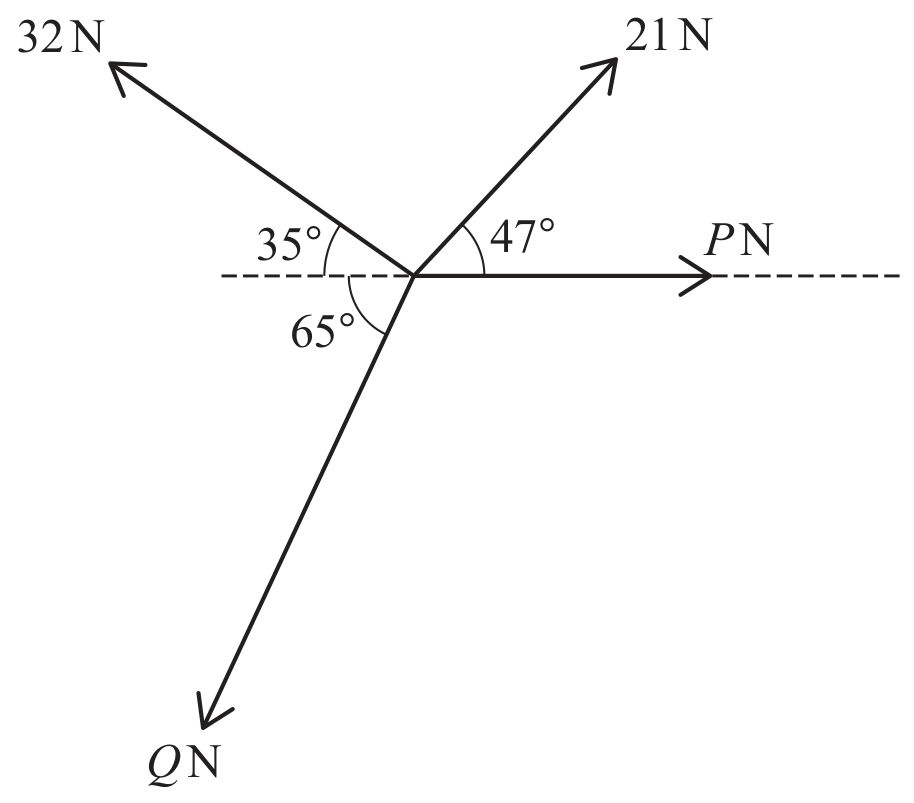
Coplanar forces of magnitudes and 21 N act at a point in the directions shown in the diagram. The forces are in equilibrium.
Find the value of P and the value of Q.
Practise drawing force diagrams, resolving coplanar forces and applying equilibrium or limiting-friction equations to particles, strings, pulleys and inclined planes.
Coplanar forces of magnitudes and 21 N act at a point in the directions shown in the diagram. The forces are in equilibrium.
Find the value of P and the value of Q.
A block of mass 8 kg slides down a rough plane inclined at to the horizontal, starting from rest. The coefficient of friction between the block and the plane is . The block accelerates uniformly down the plane at .
Draw a diagram showing the forces acting on the block.
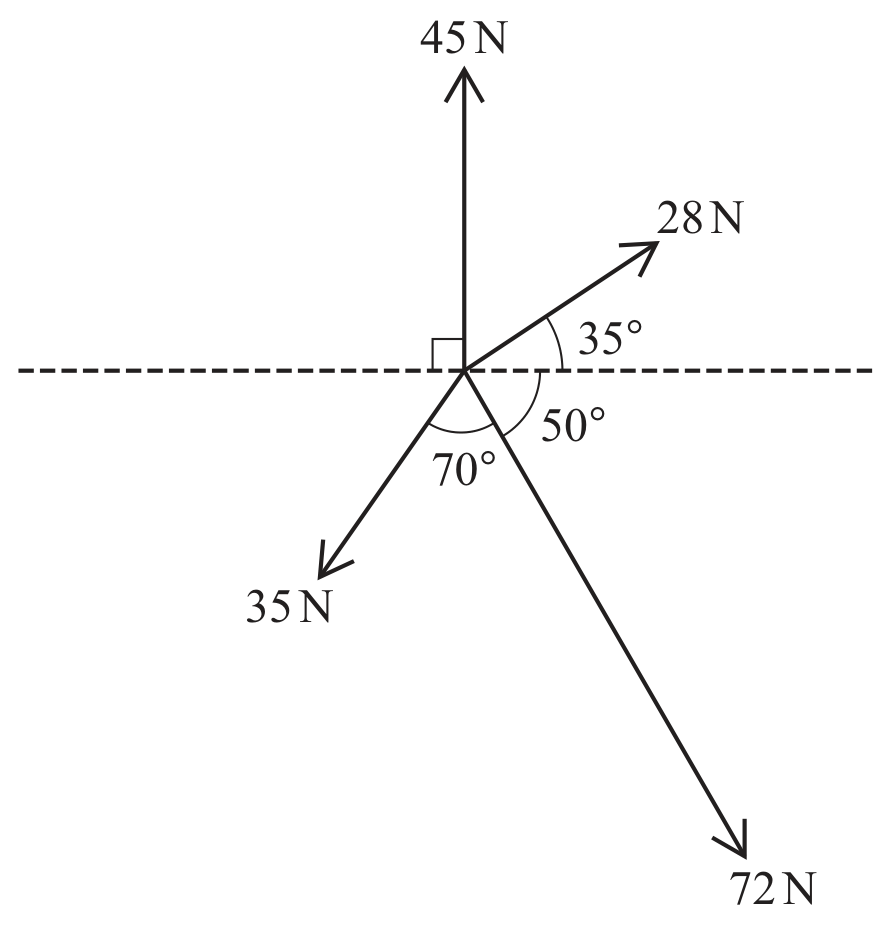
Coplanar forces of magnitudes and 35 N act at a point in the directions shown in the diagram.
Find, in either order, the magnitude and direction of the resultant force.
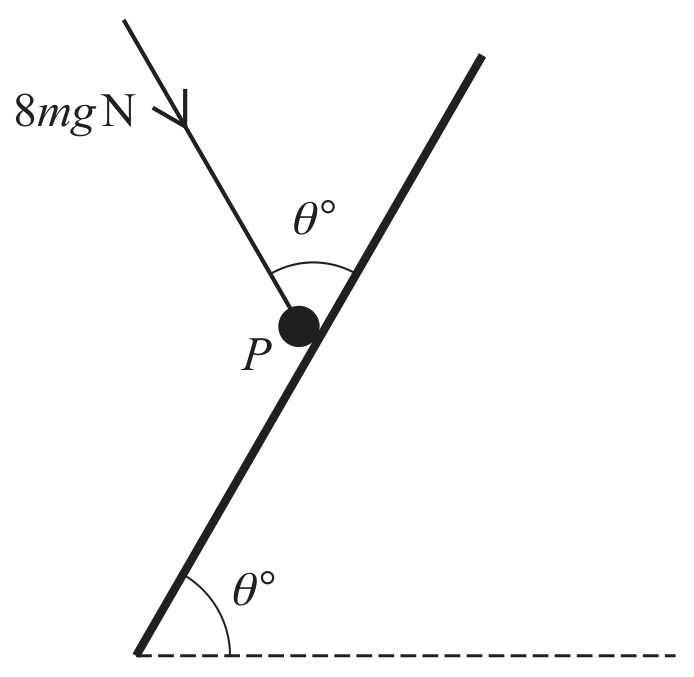
A particle P of mass is in equilibrium on a rough plane inclined at an angle to the horizontal. The equilibrium of P is maintained by a force of magnitude making an angle with a line of greatest slope (see diagram). The coefficient of friction between P and the plane is 0.5 and P is on the point of slipping down the plane.
Find the value of .