CAIE A-Level Mathematics 4 Mechanics Question Bank

CAIE A-Level Mathematics 4 Mechanics Question Bank
Cambridge International AS & A Level Mathematics 9709 syllabus for exams in 2028, 2029 and 20302028–2030

Practise Mechanics through force diagrams, equilibrium, kinematics, Newton's laws, momentum, work, energy and power using connected-particle and inclined-plane models.

Question 1

[Maximum number: 4]

A crate is being pushed in a straight line along a horizontal surface by a force of magnitude 25 N inclined at 2020^{\circ} above the horizontal. The crate moves a distance of 12 m in 8 seconds with constant speed.

Question 1(a)

(a)

Find the constant speed of the crate.

[ 1 ]

Question 1(b)

(b)

Find the work done by the 25 N force.

[ 2 ]

Question 1(c)

(c)

Find the power at which the 25 N force is working.

-
.

[ 1 ]
Question 1

[Maximum number: 4]

A car of mass 900 kg is moving along a straight horizontal road against a constant resistance to motion of 350 N . At an instant when the car is moving at 15 ms115 \mathrm{~ms}^{-1} its acceleration is 0.25 ms20.25 \mathrm{~ms}^{-2}.

Question 1(a)

(a)

Find the driving force of the car's engine at this instant.

[ 2 ]

Question 1(b)

(b)

Find the power of the car's engine at this instant.

[ 2 ]

Question 1

[Maximum number: 5]
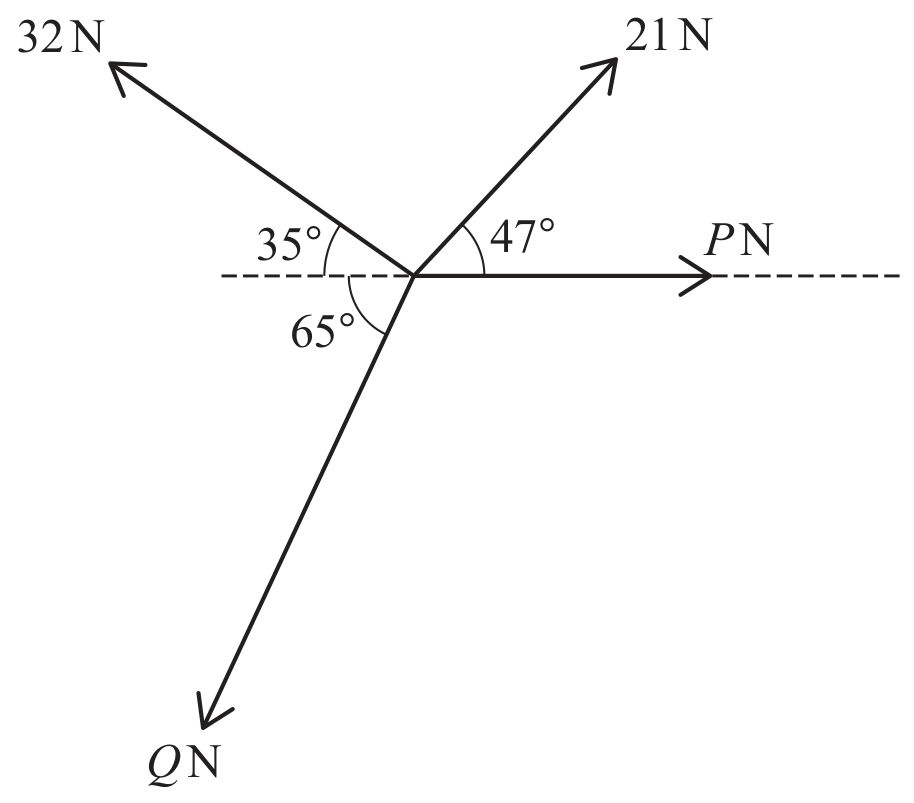
Figure for Question 1 — CAIE A-Level Mathematics

Coplanar forces of magnitudes P N,Q N,32 NP \mathrm{~N}, Q \mathrm{~N}, 32 \mathrm{~N} and 21 N act at a point in the directions shown in the diagram. The forces are in equilibrium.

Find the value of P and the value of Q.

Question 2

[Maximum number: 7]

An athlete runs along a straight horizontal road. The athlete starts from rest and accelerates at 0.5 ms20.5 \mathrm{~ms}^{-2} reaching a speed of V ms1V \mathrm{~ms}^{-1}. The athlete maintains this speed of V ms1V \mathrm{~ms}^{-1} for T s before decelerating at 0.2 m s20.2 \mathrm{~m} \mathrm{~s}^{-2} back to rest. The athlete covers a total distance of 1350 m in 246 seconds.

Question 2(a)

(a)

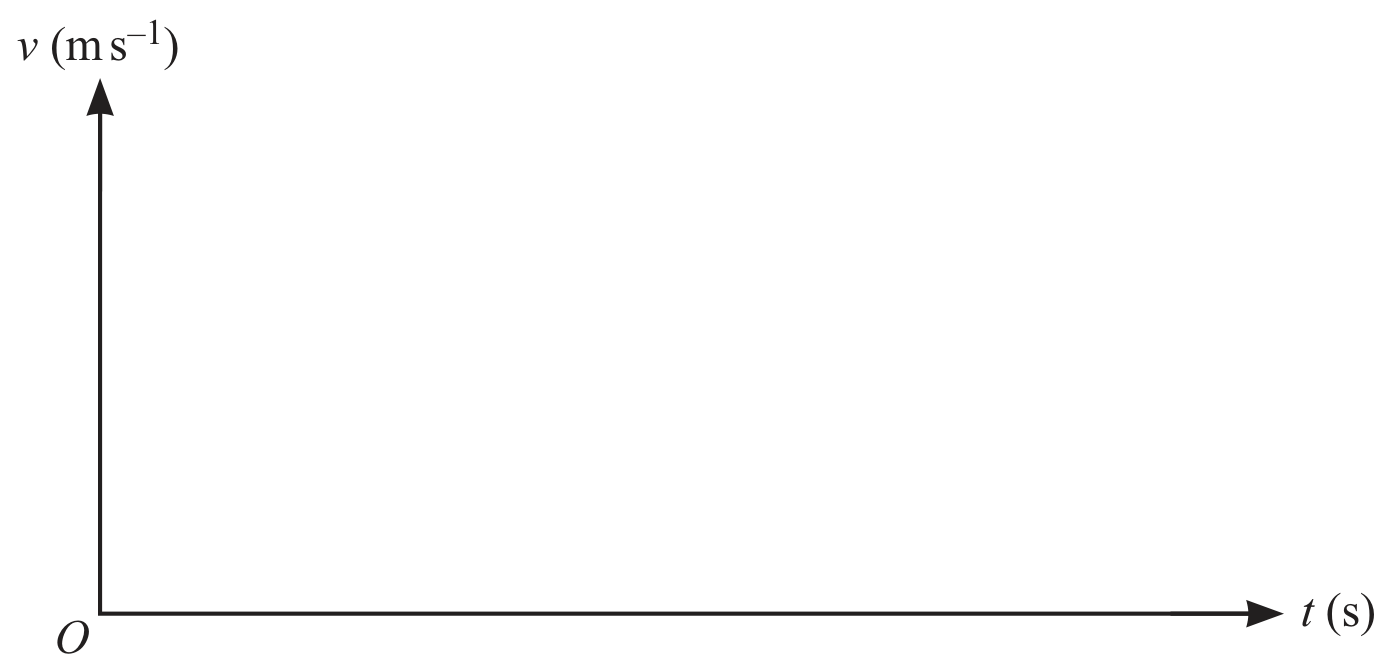
Sketch the velocity-time graph for the motion of the athlete.

Figure for Question 2(a) — CAIE A-Level Mathematics
[ 1 ]

Question 2(b)

(b)

Find T in terms of V, and hence show that 7 V^2-492 V+2700=0.

[ 4 ]

Question 2(c)

(c)

Find the value of V, giving a justification for your answer.

[ 2 ]

Question 2

[Maximum number: 5]

Two particles, P and Q, of masses 3 kg and 5 kg respectively, are at rest on a smooth horizontal plane. P is projected at a speed of 4 ms14 \mathrm{~ms}^{-1} directly towards Q. After P and Q collide, P has speed 1 ms11 \mathrm{~ms}^{-1}.

Question 2(a)

(a)

Find the two possible speeds of Q after the collision.

[ 3 ]

Question 2(b)

(b)

It is given that λJ\lambda \mathrm{J} of kinetic energy, where λ>0\lambda>0, is lost during the collision.

Find the value of λ\lambda.

[ 2 ]

Question 3

[Maximum number: 6]

A block of mass 8 kg slides down a rough plane inclined at 3030^{\circ} to the horizontal, starting from rest. The coefficient of friction between the block and the plane is μ\mu. The block accelerates uniformly down the plane at 2.4 m s22.4 \mathrm{~m} \mathrm{~s}^{-2}.

Question 3(a)

(a)

Draw a diagram showing the forces acting on the block.

[ 1 ]

Question 3(b)

(b)

Find the value of μ\mu.

[ 4 ]

Question 3(c)

(c)

Find the speed of the block after it has moved 3 m down the plane.

[ 1 ]

Question 3

[Maximum number: 6]
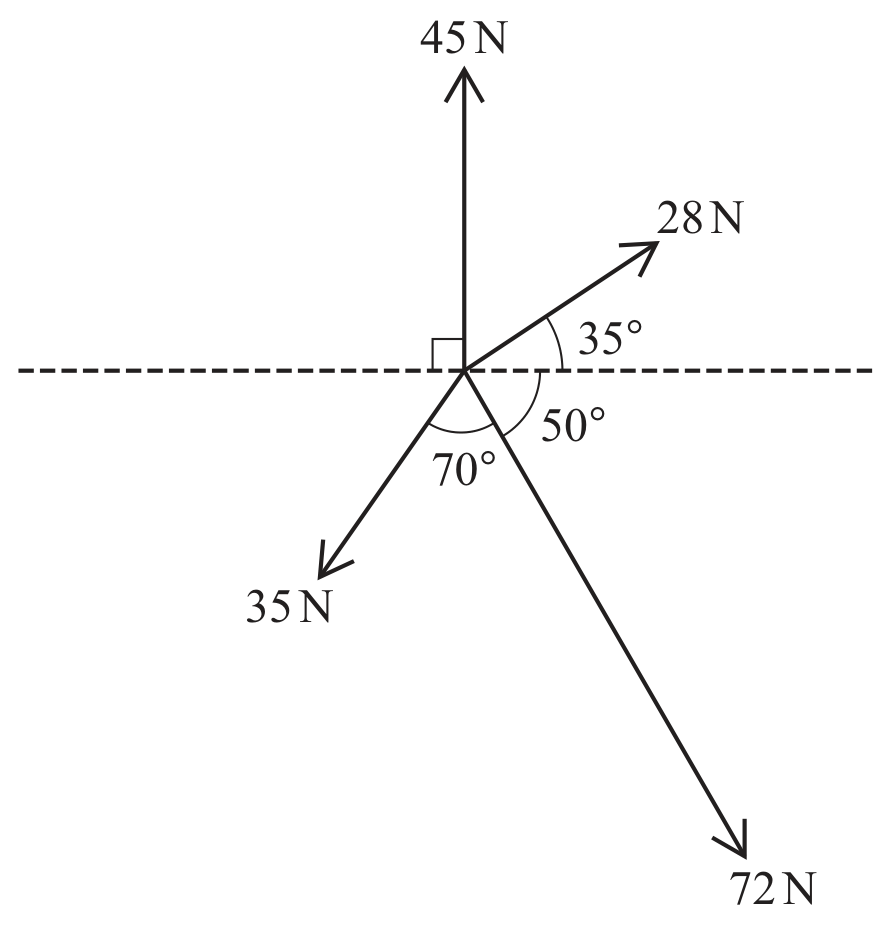
Figure for Question 3 — CAIE A-Level Mathematics

Coplanar forces of magnitudes 45 N,28 N,72 N45 \mathrm{~N}, 28 \mathrm{~N}, 72 \mathrm{~N} and 35 N act at a point in the directions shown in the diagram.

Find, in either order, the magnitude and direction of the resultant force.

Question 4

[Maximum number: 9]

A car of mass 1400 kg is moving on a straight road against a constant force of 1250 N resisting the motion.

Question 4(a)

(a)

The car moves along a horizontal section of the road at a constant speed of 36 m s136 \mathrm{~m} \mathrm{~s}^{-1}.

[ 7 ]

Question 4(a)(i)

(i)

Calculate the work done against the resisting force during the first 8 seconds.

[ 2 ]

Question 4(a)(ii)

(ii)

Calculate, in kW , the power developed by the engine of the car.

[ 2 ]

Question 4(a)(iii)

(iii)

Given that this power is suddenly increased by 12 kW , find the instantaneous acceleration of the car.

[ 3 ]

Question 4(b)

(b)

The car now travels at a constant speed of 32 m s132 \mathrm{~m} \mathrm{~s}^{-1} up a section of the road inclined at θ\theta^{\circ} to the horizontal, with the engine working at 64 kW .

Find the value of θ\theta.

[ 2 ]

Question 5

[Maximum number: 7]

When a particle P of mass m kgm \mathrm{~kg} has speed u m s1u \mathrm{~m} \mathrm{~s}^{-1}, its momentum is 4 Ns and its kinetic energy is 16 J.

Question 5(a)

(a)

Find the value of m and the value of u.

[ 3 ]

Question 5(b)

(b)

P is now projected on a smooth horizontal surface with speed v ms^-1 directly towards a particle Q of mass 1.25 kg which is stationary. After P and Q collide, the velocity of P is w ms^-1 and the velocity of Q is 2 w m s^-1. The loss of kinetic energy in the collision is 25 J.

Find the value of v and the value of w.

[ 4 ]

Question 5

[Maximum number: 11]

A car of mass 1600 kg travels at constant speed 20 m s120 \mathrm{~m} \mathrm{~s}^{-1} up a straight road inclined at an angle of sin10.12\sin ^{-1} 0.12 to the horizontal.

Question 5(a)

(a)

Find the change in potential energy of the car in 30 s .

[ 3 ]

Question 5(b)

(b)

Given that the total work done by the engine of the car in this time is 1960 kJ , find the constant force resisting the motion.

[ 3 ]

Question 5(c)

(c)

Calculate, in kW , the power developed by the engine of the car.

[ 2 ]

Question 5(d)

(d)

Given that this power is suddenly decreased by 15 %, find the instantaneous deceleration of the car.

[ 3 ]