
Question 1
Question 1(a)
(a)
Expand in ascending powers of x up to and including the term in .
[ 3 ]
Question 1(b)
(b)
Hence find the coefficient of in the expansion of .
[ 2 ]
Practise Pure Mathematics 1 through quadratics, functions, coordinate geometry, circular measure, trigonometry, series, differentiation and integration with exact working.
Expand in ascending powers of x up to and including the term in .
Hence find the coefficient of in the expansion of .
Find the set of values of the constant k for which the quadratic equation
has two distinct real roots.
Let .
Find the value of .
Find .
Express in the form , where a, b and c are rational constants to be determined.
The curve with equation and the line y=k have exactly one point of intersection.
Using your answer to part (a) or otherwise, state the value of the constant k.
The equation of a curve is y=f(x), where . The following points lie on the curve. Non-exact values of the y-coordinates are given correct to 6 decimal places.
Find the gradient of the chord AD. Give your answer correct to 4 decimal places.
State what the values in the table suggest about the value of f'(8).
The equation of a curve is y = 4cos(2x) + 3 for 0 <= x <= 2π.
State the greatest and least possible values of y.
Sketch the curve.
Hence determine the number of solutions of the equation 4cos(2x) + 3 = 2x - 1 for 0 <= x <= 2π.
Functions f and g are defined by
State the range of f.
Find an expression for .
Solve the equation gf(x)=69.
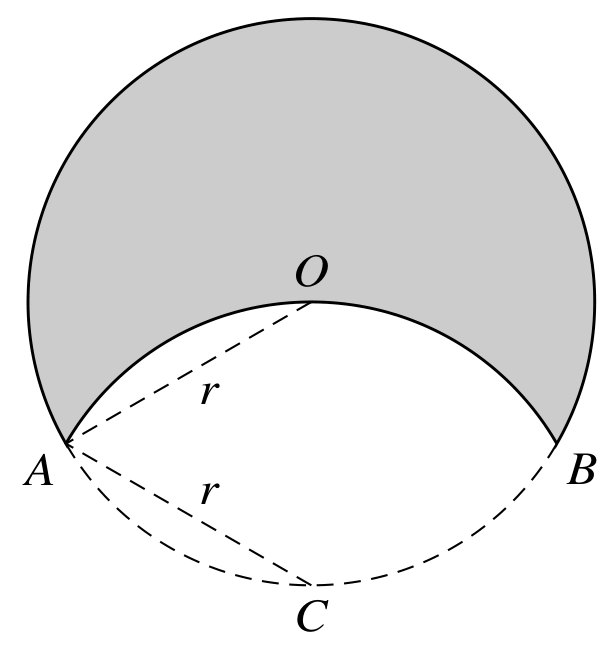
The diagram shows a motif formed by the major arc A B of a circle with radius r and centre O, and the minor of a circle, also with radius r but with centre C. The point C lies on the circle with centre O.
Given that angle radians, state the value of the fraction k.
State the perimeter of the shaded motif in terms of and r.
Find the area of the shaded motif, giving your answer in terms of and .
Functions f and g are defined by
where a is a positive constant.
Find an expression for .
State the domain of the function .
State the range of the function .
Given that , solve the equation gf(x)=0.
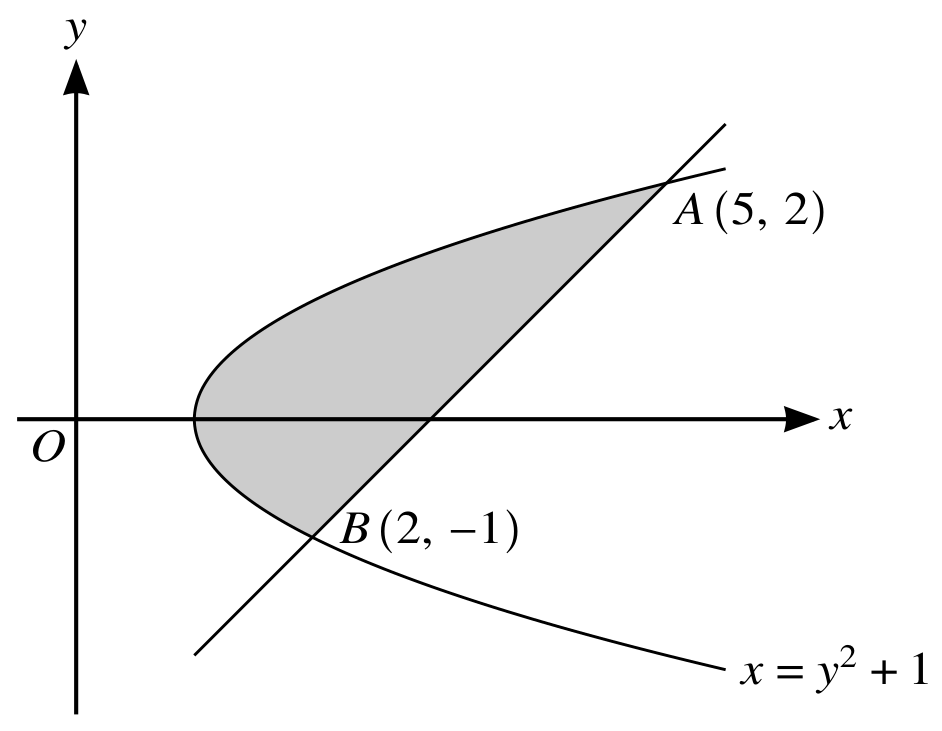
The diagram shows the curve with equation . The points A(5,2) and B(2,-1) lie on the curve.
Find an equation of the line A B.
Find the volume of revolution when the region between the curve and the line A B is rotated through about the y-axis.