CAIE A-Level Mathematics 4.5.3 Work-Energy Principle

CAIE A-Level Mathematics 4.5.3 Work-Energy Principle
Cambridge International AS & A Level Mathematics 9709 syllabus for exams in 2028, 2029 and 20302028–2030

Practise equating change in kinetic energy to net work by applied forces, weight and resistance, including connected particles and paths where acceleration is not constant.

How this is tested

  • set final kinetic energy minus initial kinetic energy equal to the net external work
  • include work by driving forces, resistance and the component of weight over the displacement
  • treat connected particles as one system when internal tension work cancels from the energy balance

Question 4

[Maximum number: 6]
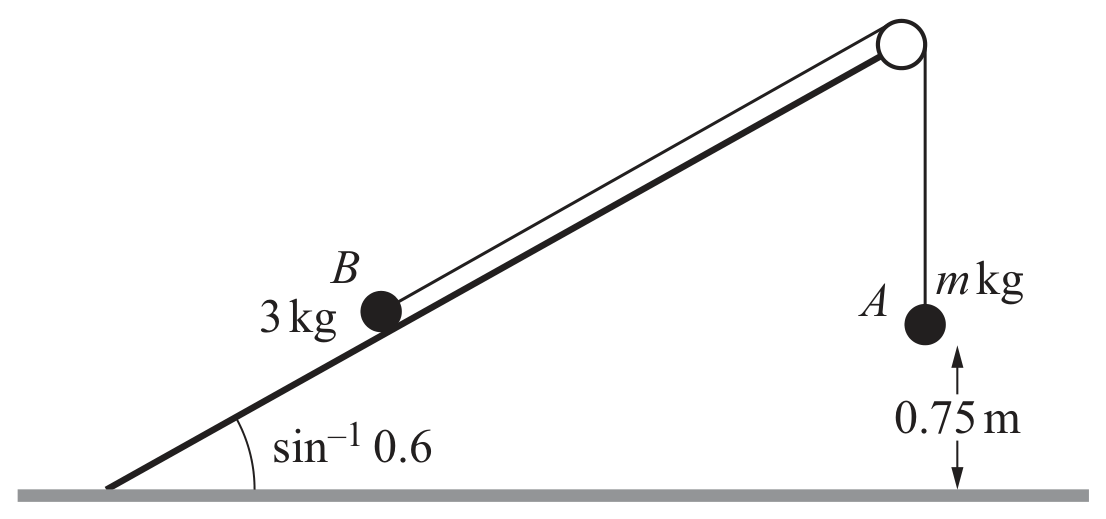
Figure for Question 4 — CAIE A-Level Mathematics

Two particles, A and B, of masses m kgm \mathrm{~kg} and 3 kg respectively, are connected by a light inextensible string. Particle B is on a fixed plane which is at an angle of sin10.6\sin ^{-1} 0.6 to the horizontal ground. The string passes over a fixed smooth pulley at the top of the plane. Particle A hangs vertically below the pulley and is 0.75 m above the ground (see diagram).

The system is released from rest. In the subsequent motion B moves up a line of greatest slope of the plane and does not reach the pulley. As B moves up the plane there is a constant resistance to its motion of magnitude 103 N\frac{10}{3} \mathrm{~N}. The speed of A immediately before it hits the ground is 2 ms12 \mathrm{~ms}^{-1}.

Use an energy method to find the value of m.