CAIE A-Level Mathematics 3.7 Vectors Question Bank

CAIE A-Level Mathematics 3.7 Vectors Question Bank
Cambridge International AS & A Level Mathematics 9709 syllabus for exams in 2028, 2029 and 20302028–2030

Practise 3D vector questions involving lines, positions, intersections, lengths, scalar products and geometric conditions.

Exam points

  • form vector equations of lines from points and direction vectors, then solve for intersections
  • use vector lengths and scalar products to prove geometric facts or find exact angles
  • apply component equations to distinguish parallel, intersecting and skew lines

Question 9

[Maximum number: 9]

The line l1l_{1} passes through the point (3,1,-6) and is parallel to the vector 2 i+j+4 k.
The line l2l_{2} passes through the point (-1,3,-6) and is perpendicular to the vector 3 i-2 j+k. The direction vector for l2l_{2} has no component in the x-direction.

Question 9(a)

(a)

Write down a vector equation for l1l_{1} and find a vector equation for l2l_{2}.

[ 3 ]

Question 9(b)

(b)

Calculate the acute angle between l1l_{1} and l2l_{2}.

[ 3 ]

Question 9(c)

(c)

Find the position vector of the point of intersection of l1l_{1} and l2l_{2}.

[ 3 ]

Question 9

[Maximum number: 10]

The equations of two lines are given by

l1:r=(2i+j+4k)+λ(i+2j3k),l2:r=(3ij+5k)+μ(2i+3j+ak).\begin{aligned} & l_{1}: \mathbf{r}=(2 \mathbf{i}+\mathbf{j}+4 \mathbf{k})+\lambda(\mathbf{i}+2 \mathbf{j}-3 \mathbf{k}), \\ & l_{2}: \mathbf{r}=(3 \mathbf{i}-\mathbf{j}+5 \mathbf{k})+\mu(2 \mathbf{i}+3 \mathbf{j}+a \mathbf{k}) . \end{aligned}

Question 9(a)

(a)

Find the value of a for which l1l_{1} is perpendicular to l2l_{2}.

[ 2 ]

Question 9(b)

(b)

Find the value of a for which l1l_{1} and l2l_{2} intersect.

[ 4 ]

Question 9(c)

(c)

Find the values of a for which the acute angle between l1l_{1} and l2l_{2} is equal to cos1(514)\cos ^{-1}\left(\frac{5}{14}\right).

[ 4 ]

Question 11

[Maximum number: 10]

With respect to the origin O, the points A, B, C and D have position vectors given by

OA=(153),OB=(041),OC=(131) and OD=(354).\overrightarrow{O A}=\left(\begin{array}{l} 1 \\ 5 \\ 3 \end{array}\right), \quad \overrightarrow{O B}=\left(\begin{array}{l} 0 \\ 4 \\ 1 \end{array}\right), \quad \overrightarrow{O C}=\left(\begin{array}{r} 1 \\ -3 \\ 1 \end{array}\right) \quad \text { and } \quad \overrightarrow{O D}=\left(\begin{array}{r} 3 \\ -5 \\ 4 \end{array}\right) .

The line m passes through the points A and B.

Question 11(a)

(a)

Find a vector equation for m.

[ 2 ]

Question 11(b)

(b)

Find the position vector of the point of intersection of m and the line passing through the points C and D.

[ 4 ]

Question 11(c)

(c)

Find the position vector of the foot of the perpendicular from C to m.

[ 4 ]

Question 10

[Maximum number: 8]

With respect to the origin O, the points A, B and C have position vectors given by

OA=2ij6k,OB=bi2j+3k and OC=4i+5j2k.\overrightarrow{O A}=2 \mathbf{i}-\mathbf{j}-6 \mathbf{k}, \quad \overrightarrow{O B}=b \mathbf{i}-2 \mathbf{j}+3 \mathbf{k} \quad \text { and } \quad \overrightarrow{O C}=-4 \mathbf{i}+5 \mathbf{j}-2 \mathbf{k} .

Question 10(a)

(a)

It is given that AB=BC|\overrightarrow{A B}|=|\overrightarrow{B C}|.

Find the value of b.

[ 3 ]

Question 10(b)

(b)

A, B, C and D are the vertices of a rhombus.

Find the position vector of D.

[ 2 ]

Question 10(c)

(c)

Calculate angle ABC.

[ 3 ]

Question 11

[Maximum number: 5]
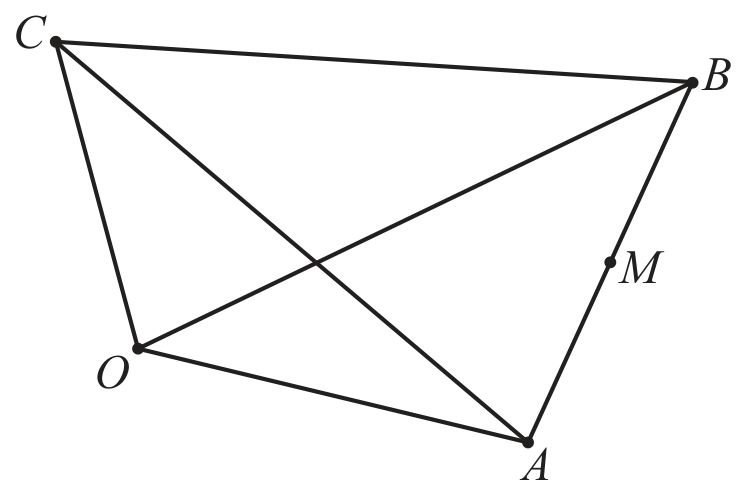
Figure for Question 11 — CAIE A-Level Mathematics

Relative to the origin O, the position vectors of the points A, B and C are

OA=4i2j,OB=2i+8j+4k, and OC=2i+6k\overrightarrow{O A}=4 \mathbf{i}-2 \mathbf{j}, \overrightarrow{O B}=2 \mathbf{i}+8 \mathbf{j}+4 \mathbf{k} \text {, and } \overrightarrow{O C}=-2 \mathbf{i}+6 \mathbf{k}

The midpoint of AB is M, as shown in the diagram.

Question 11(a)

(a)

Find the vectors MB\overrightarrow{M B} and MC\overrightarrow{M C}.

[ 2 ]

Question 11(b)

(b)

Calculate the exact value of the cosine of angle CMB.

[ 3 ]