
Question 3
Question 3(a)
(a)
Show that the equation can be written as a quadratic equation in x.
[ 3 ]
Question 3(b)
(b)
Hence solve the equation , giving your answer correct to 2 decimal places.
[ 2 ]
Practise solving logarithmic and exponential equations and transforming growth or decay relationships into straight-line form to calculate model constants and times.
Show that the equation can be written as a quadratic equation in x.
Hence solve the equation , giving your answer correct to 2 decimal places.
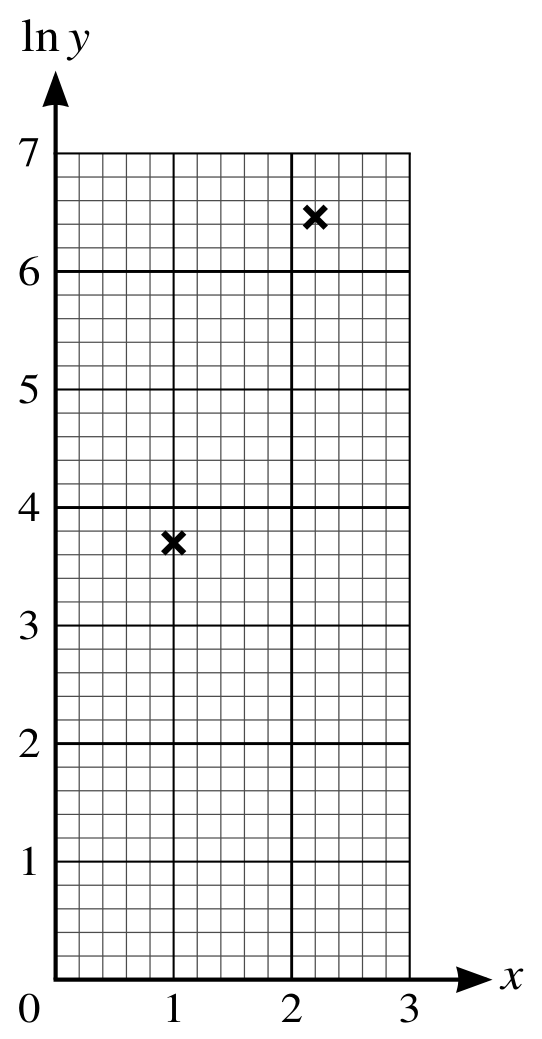
The variables x and y are related by the equation , where a and b are constants. The diagram shows the result of plotting against x for two pairs of values of x and y. The coordinates of these points are ( 1,3.7 ) and ( 2.2,6.46 ).
Use this information to find the values of a and b.
The number of bacteria in a population, P, at time t hours is modelled by the equation , where a and k are constants. The graph of against t, shown in the diagram, has gradient and intersects the vertical axis at (0,3).
State the value of k and find the value of a correct to 2 significant figures.

Find the time taken for P to double. Give your answer correct to the nearest hour.
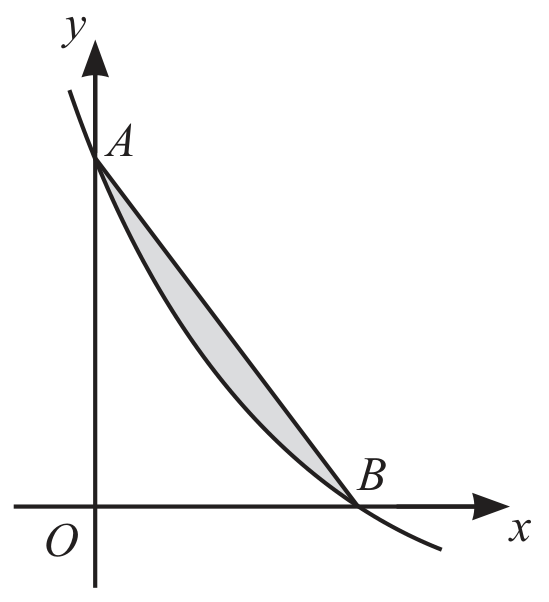
The diagram shows the curve with equation . The curve meets the axes at the points A and B. The shaded region is bounded by the curve and the line segment AB.
Show that the x-coordinate of B is .