EduNinja
IB Maths AI SL/Question Bank/5 Calculus

IB Maths AI SL5 CalculusQuestion Bank

SL55 questions10 previewsSyllabus linked
[Maximum number: 11]

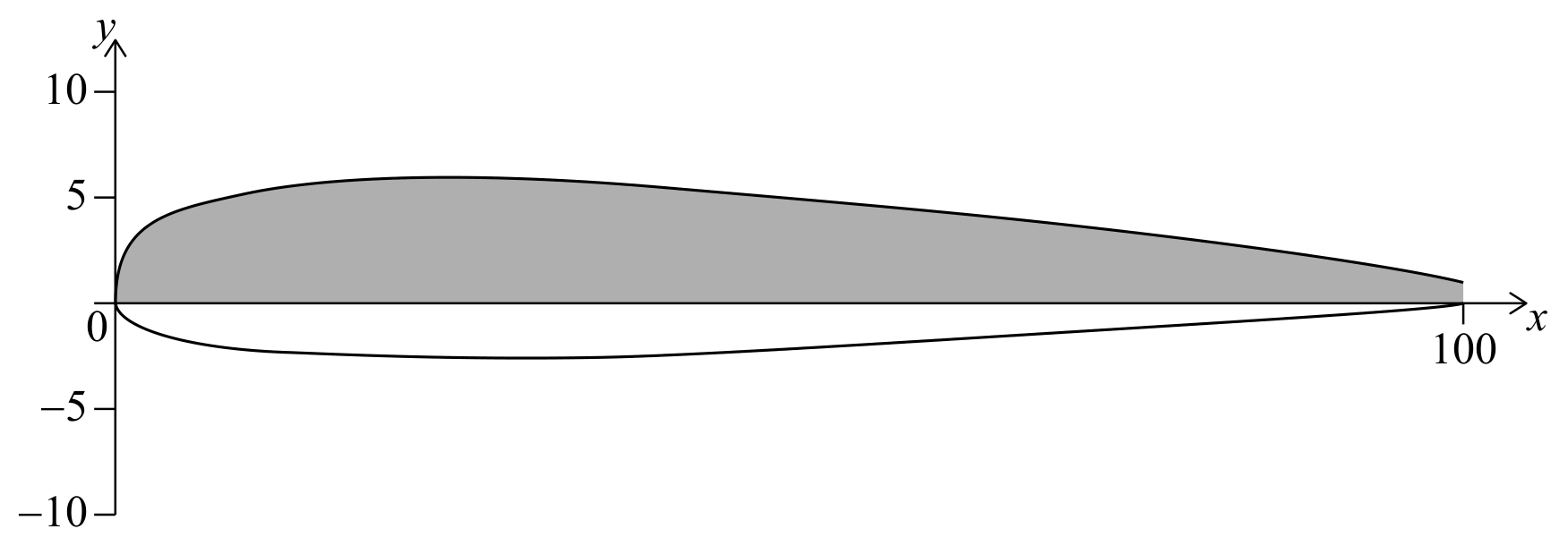
Gabriel is investigating the shape of model airplane wings. A cross-section of one of the wings is shown, graphed on the coordinate axes.
Question image

The shaded part of the cross-section is the area between the x-axis and the curve with equation

y=2xx5+1, for 0x100y=2 \sqrt{x}-\frac{x}{5}+1, \text { for } 0 \leq x \leq 100

where x is the distance, in cm , from the front of the wing and y is the height, in cm , above the horizontal axis through the wing, as shown in the diagram.

(a)

Find Gabriel's estimate of the shaded area of the cross-section.

[ 3 ]
(b)
(i)

Write down the integral that Gabriel can use to find the exact area of the shaded part of the cross-section.

[ 4 ]
(ii)

Hence, use your graphic display calculator to find the area of the shaded part of the cross-section. Give your answer correct to one decimal place.

[ 4 ]
[Maximum number: 11]

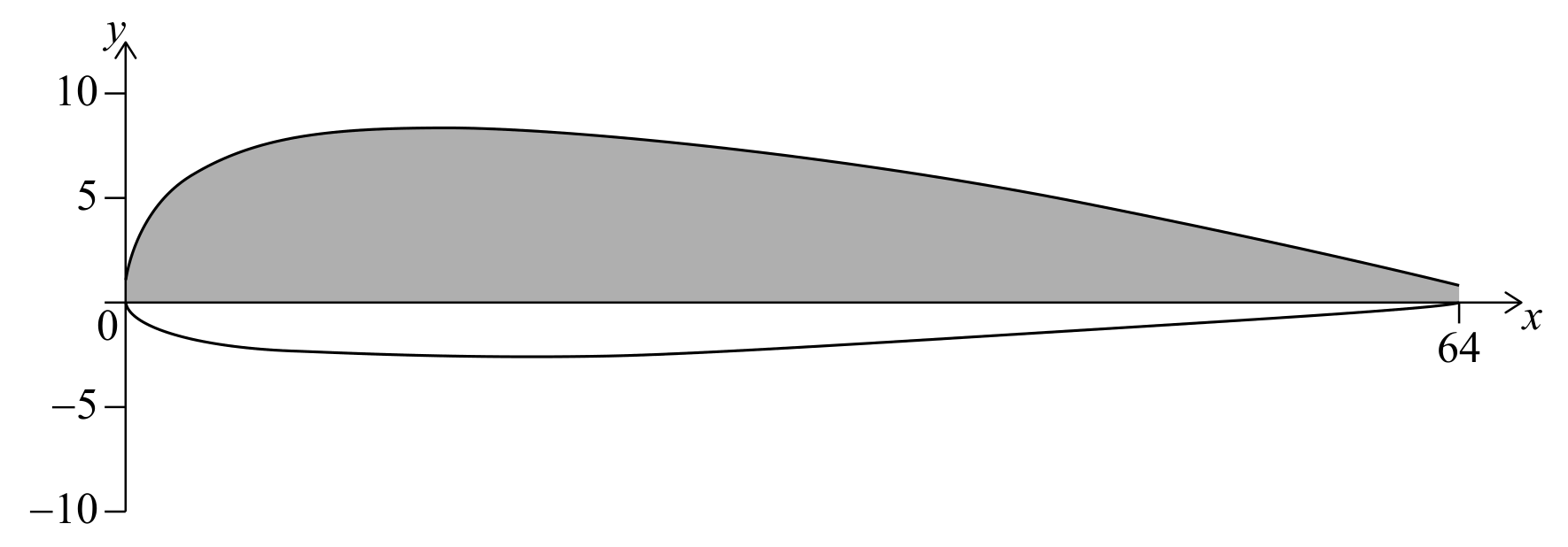
Jan is investigating the shape of model helicopter propeller blades. A cross-section of one of the blades is shown, graphed on the coordinate axes.

Question image

The shaded part of the cross-section is the area between the x-axis and the curve with equation

y=4xx2+1, for 0x64y=4 \sqrt{x}-\frac{x}{2}+1, \text { for } 0 \leq x \leq 64

where x is the distance, in mm , from the edge of the blade and y is the height, in mm , above the horizontal axis through the blade, as shown in the diagram.

(a)

Find Jan's estimate of the shaded area of the cross-section.

[ 3 ]
(b)
(i)

Write down the integral that Jan can use to find the exact area of the shaded part of the cross-section.

[ 4 ]
(ii)

Hence, use your graphic display calculator to find the area of the shaded part of the cross-section. Give your answer correct to one decimal place.

[ 4 ]
[Maximum number: 5]

Consider the graph of the following function:

f(x)=16x+x28, for x0f(x)=\frac{16}{x}+\frac{x^{2}}{8}, \text { for } x \neq 0
(a)

Find f(x)f^{\prime}(x).

[ 3 ]
(b)

Write down the interval in which f(x) is increasing.

[ 2 ]
[Maximum number: 5]

Consider the graph of the following function:

g(x)=8x+x22, for x0g(x)=\frac{8}{x}+\frac{x^{2}}{2}, \text { for } x \neq 0
(a)

Find g(x)g^{\prime}(x).

[ 3 ]
(b)

Write down the interval in which g(x) is increasing.

[ 2 ]
[Maximum number: 4]

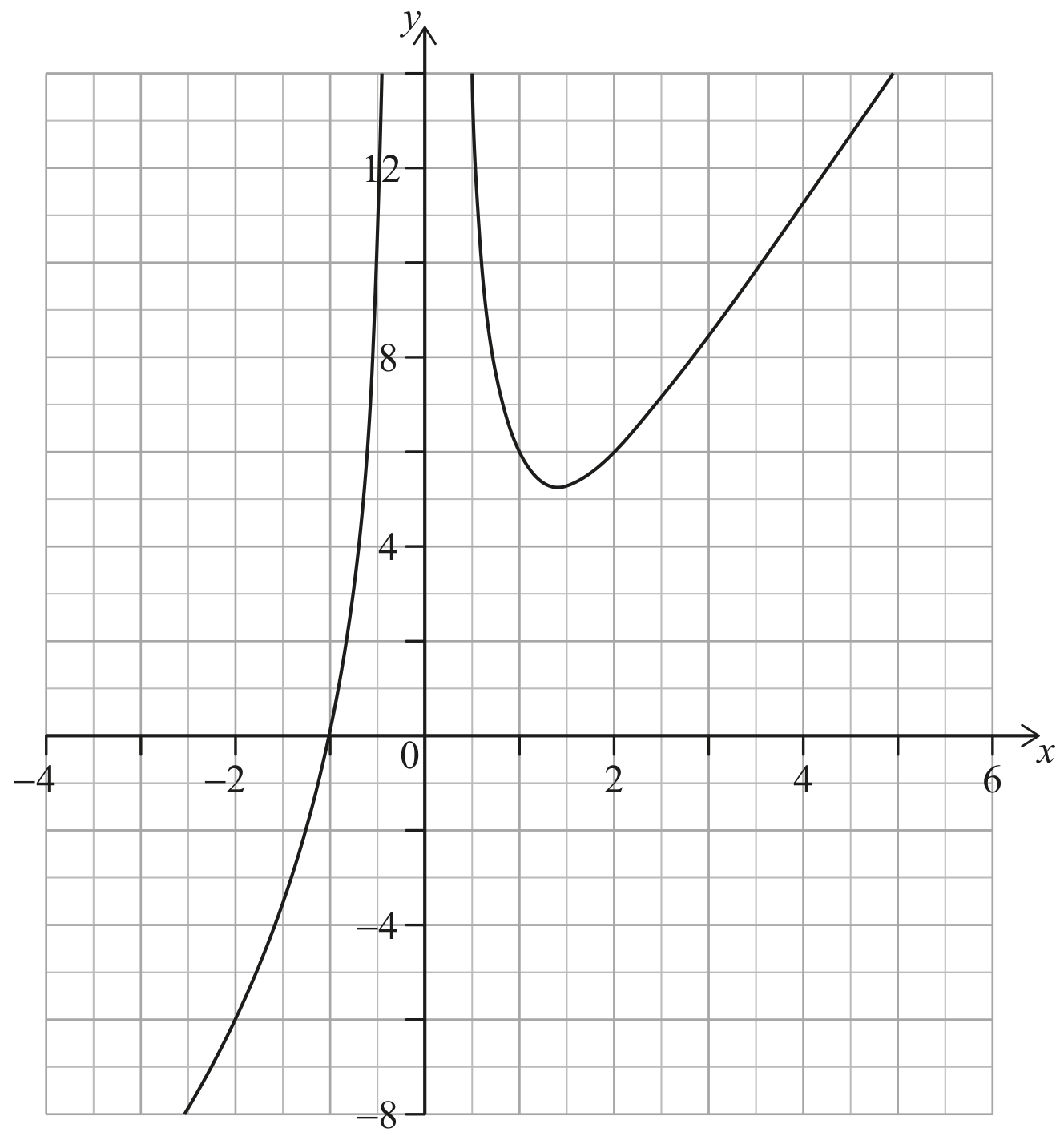
Consider the function f(x)=3x1+4x2f(x)=3 x-1+4 x^{-2}. Part of the graph of y=f(x) is shown below.

Question image

The function is defined for all values of x except for x=a.

(a)

Use your graphic display calculator to find the coordinates of the local minimum.

The equation f(x)=w, where wRw \in \mathbb{R}, has three solutions.

[ 2 ]
(b)

Write down whether the value of m is positive or negative. Justify your answer.

A second function is given by g(x)=kpx9g(x)=k p^{x}-9, where p>0. The graph of y=g(x) intersects the y-axis at point A(0,-5) and passes through point B(3,4.5).

[ 2 ]
[Maximum number: 11]

The height of a plant, h cmh \mathrm{~cm}, depends on the time, t days, after it is planted.
For the first 15 days, the rate of change of the height of the plant is modelled as

dh dt=1.20.1t, where 0t15.\frac{\mathrm{d} h}{\mathrm{~d} t}=1.2-0.1 t, \text { where } 0 \leq t \leq 15 .
(a)
(i)

Find the value of dh dt\frac{\mathrm{d} h}{\mathrm{~d} t} at t=3.

(ii)

Interpret the meaning of your answer to part (a) (i) in context.

[ 2 ]
(b)

Use dh dt\frac{\mathrm{d} h}{\mathrm{~d} t} to find the value of t when the plant reaches its maximum height.

Two days after it is planted, the height of the plant is 6.5 cm .

[ 2 ]
(c)

Find an expression for h in terms of t, for 0t150 \leq t \leq 15.

[ 5 ]
(d)

Hence, find the maximum height of the plant.

A second plant was planted at the same time as the first plant. Its height, H cmH \mathrm{~cm}, is modelled by H=2(1.2)tH=2(1.2)^{t}, where 0t150 \leq t \leq 15.

[ 2 ]
[Maximum number: 6]

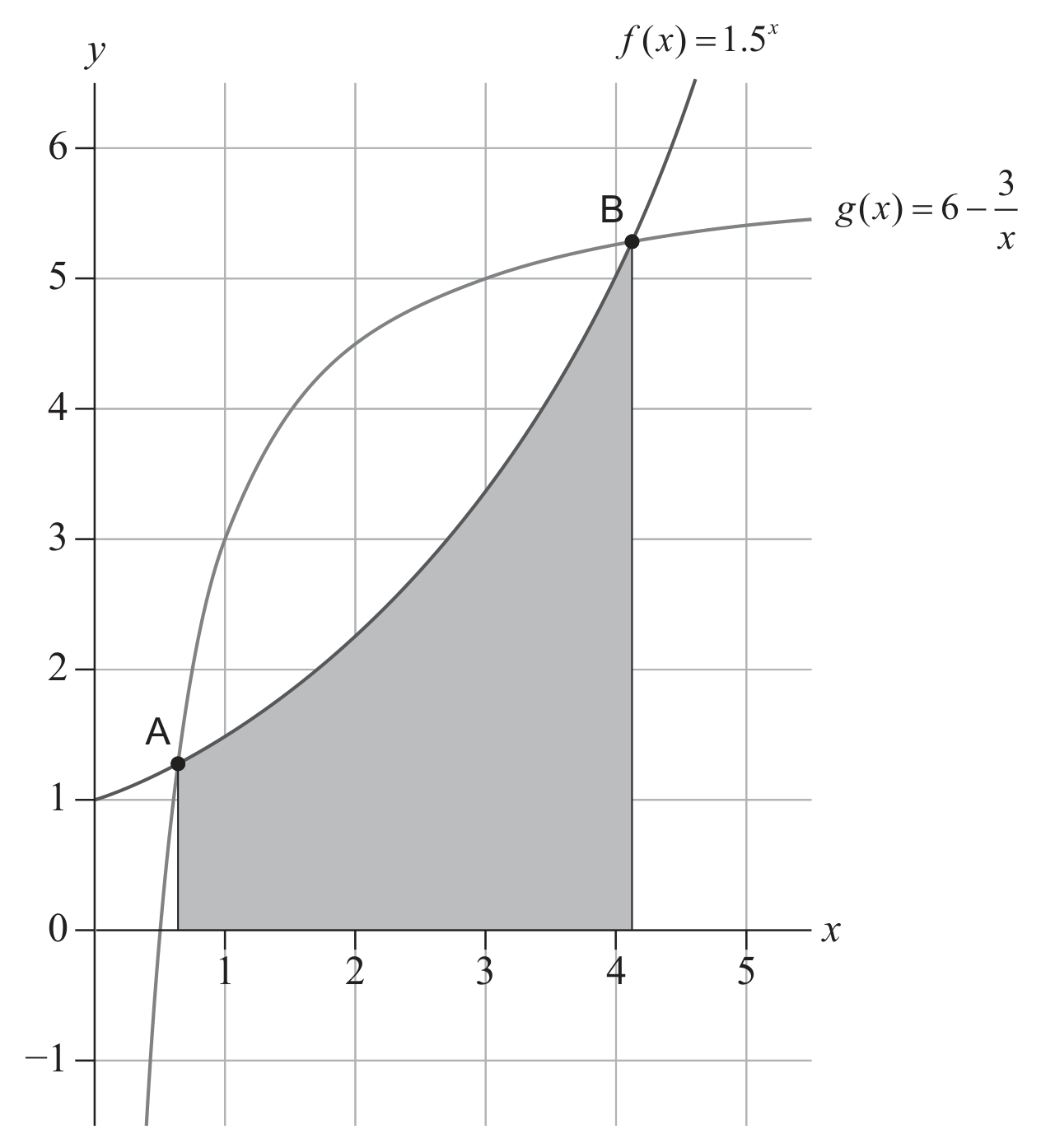
The diagram shows part of the graphs of the functions

f(x)=1.5xx0g(x)=63xx>0\begin{array}{ll} f(x)=1.5^{x} & x \geq 0 \\ g(x)=6-\frac{3}{x} & x>0 \end{array}
Question image
(a)
(i)

Write down the integral that represents the area of the shaded region.

(ii)

Calculate the area of this shaded region.

(iii)

Hence, or otherwise, calculate the area of the region enclosed between the curves y=f(x) and y=g(x).

The tangent to the graph of y=f(x) is parallel to the tangent to the graph of y=g(x) at x=k.

[ 6 ]
[Maximum number: 7]

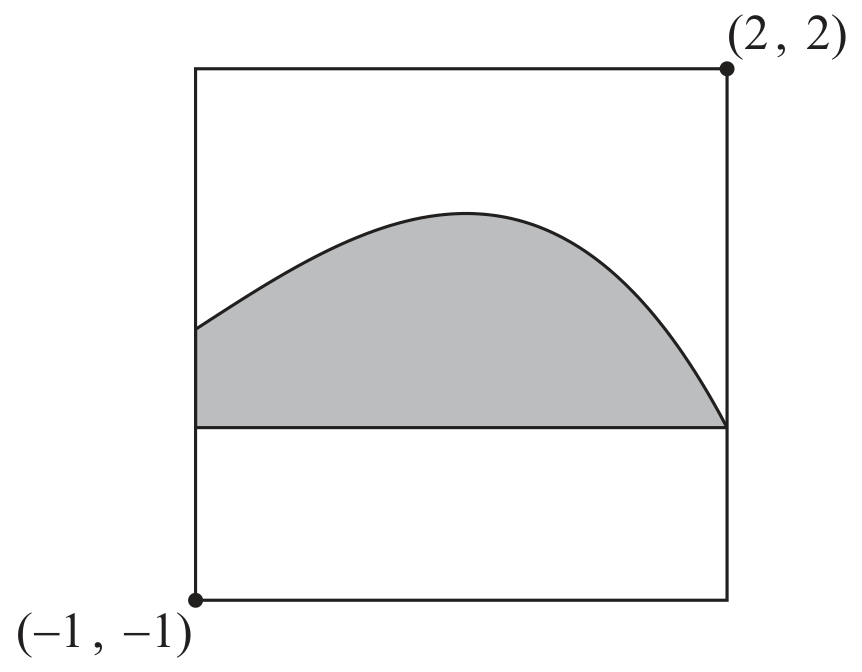
A modern art painting is contained in a square frame. The painting has a shaded region bounded by a smooth curve and a horizontal line.

Question image

When the painting is placed on a coordinate axes such that the bottom left corner of the painting has coordinates (-1,-1) and the top right corner has coordinates (2,2), the curve can be modelled by y=f(x) and the horizontal line can be modelled by the x-axis. Distances are measured in metres.

(a)

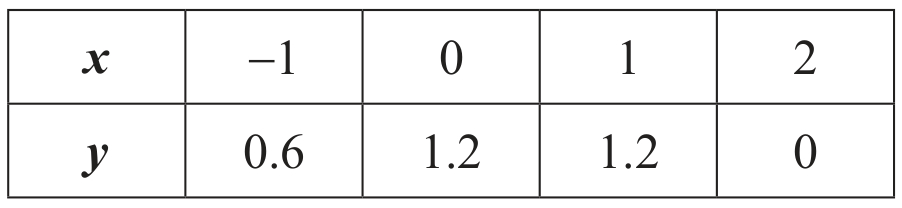
Use the trapezoidal rule, with the values given in the following table, to approximate the area of the shaded region.

Table

The artist used the equation y=x33x2+4x+1210y=\frac{-x^{3}-3 x^{2}+4 x+12}{10} to draw the curve.

[ 3 ]
(b)

Find the exact area of the shaded region in the painting.

[ 2 ]
(c)

Find the area of the unshaded region in the painting.

[ 2 ]
[Maximum number: 4]

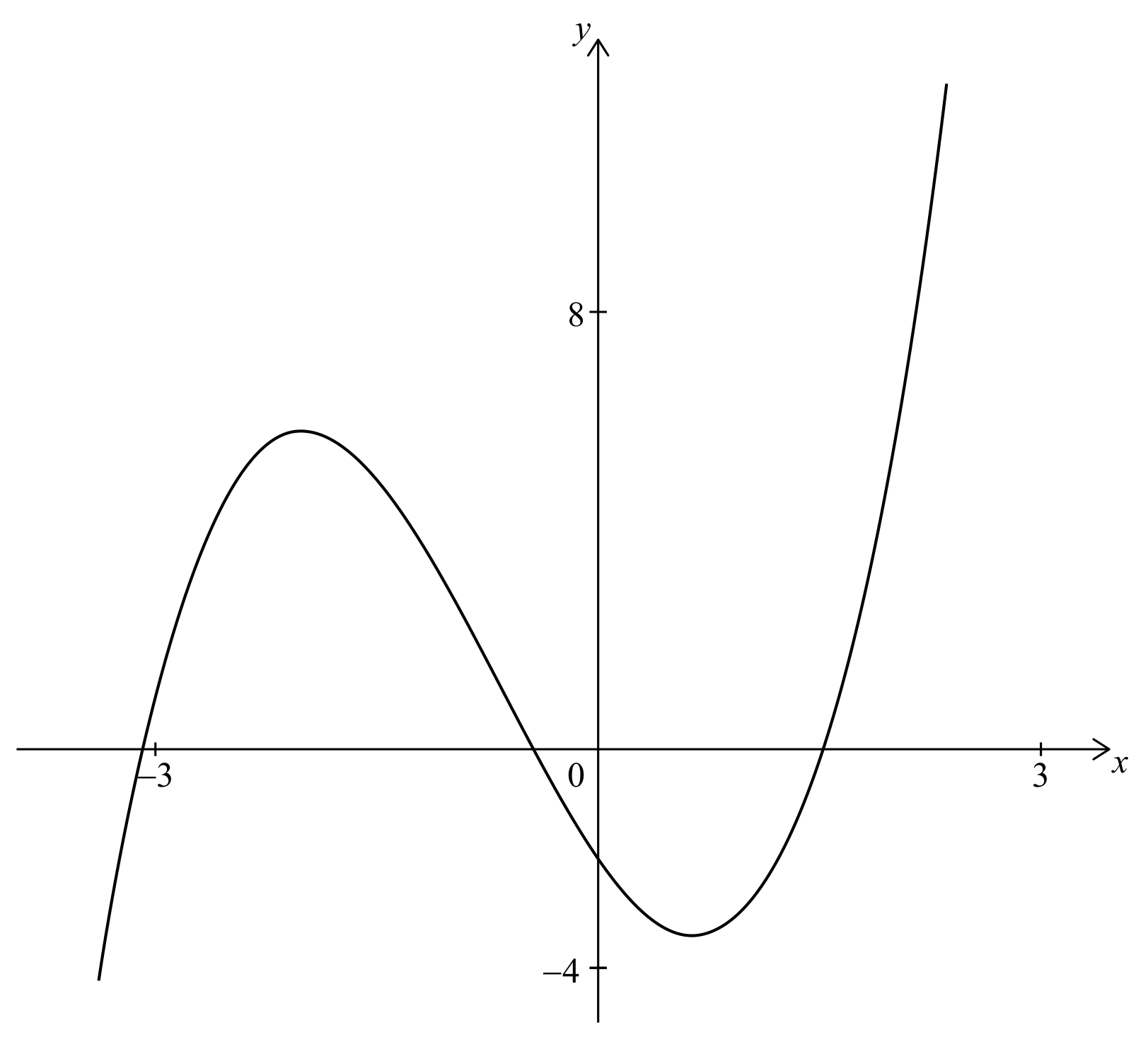
Consider the graph of the cubic function f(x)=x3+2x24x2f(x)=x^{3}+2 x^{2}-4 x-2. Part of the graph of y=f(x) is shown in the following diagram.

Question image
(a)

Write down

[ 4 ]
(i)

the gradient of the tangent.

[ 2 ]
(ii)

the equation of the tangent.

[ 2 ]
[Maximum number: 12]

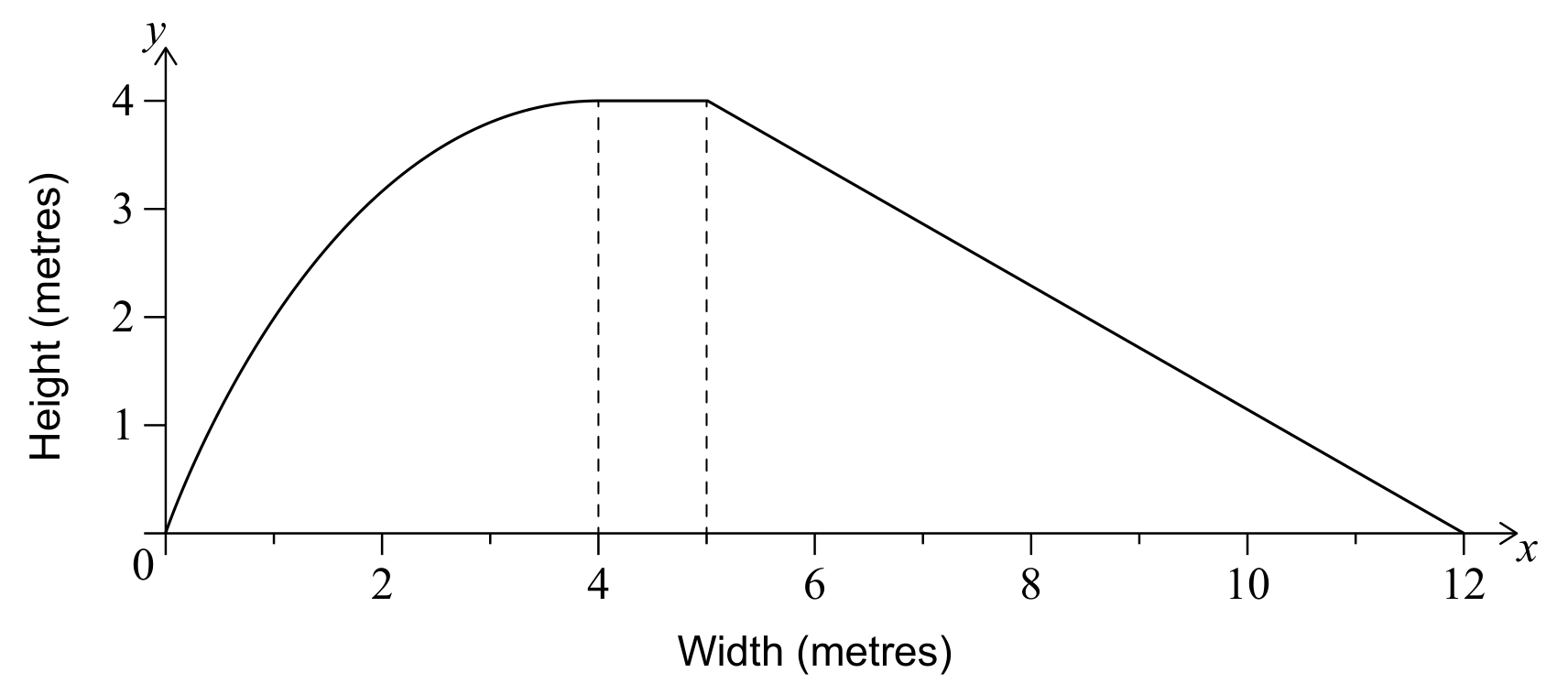
The following diagram shows a model of the side view of a water slide. All lengths are measured in metres.

Question image

The curved edge of the slide is modelled by

f(x)=14x2+2x for 0x4f(x)=-\frac{1}{4} x^{2}+2 x \text { for } 0 \leq x \leq 4

The remainder of the slide is modelled by

g(x)={4, for 4x54874x7, for 5x12g(x)=\left\{\begin{array}{c} 4, \text { for } 4 \leq x \leq 5 \\ \frac{48}{7}-\frac{4 x}{7}, \text { for } 5 \leq x \leq 12 \end{array}\right.
(a)

Use the trapezoidal rule with an interval width of 1 to calculate the approximate area under the model of the slide in the interval 0x40 \leq x \leq 4.

[ 5 ]
(b)

Find (14x2+2x)dx\int\left(-\frac{1}{4} x^{2}+2 x\right) \mathrm{d} x.

[ 3 ]
(c)

Calculate the exact area under the entire model of the slide, for 0x120 \leq x \leq 12.

[ 4 ]
0