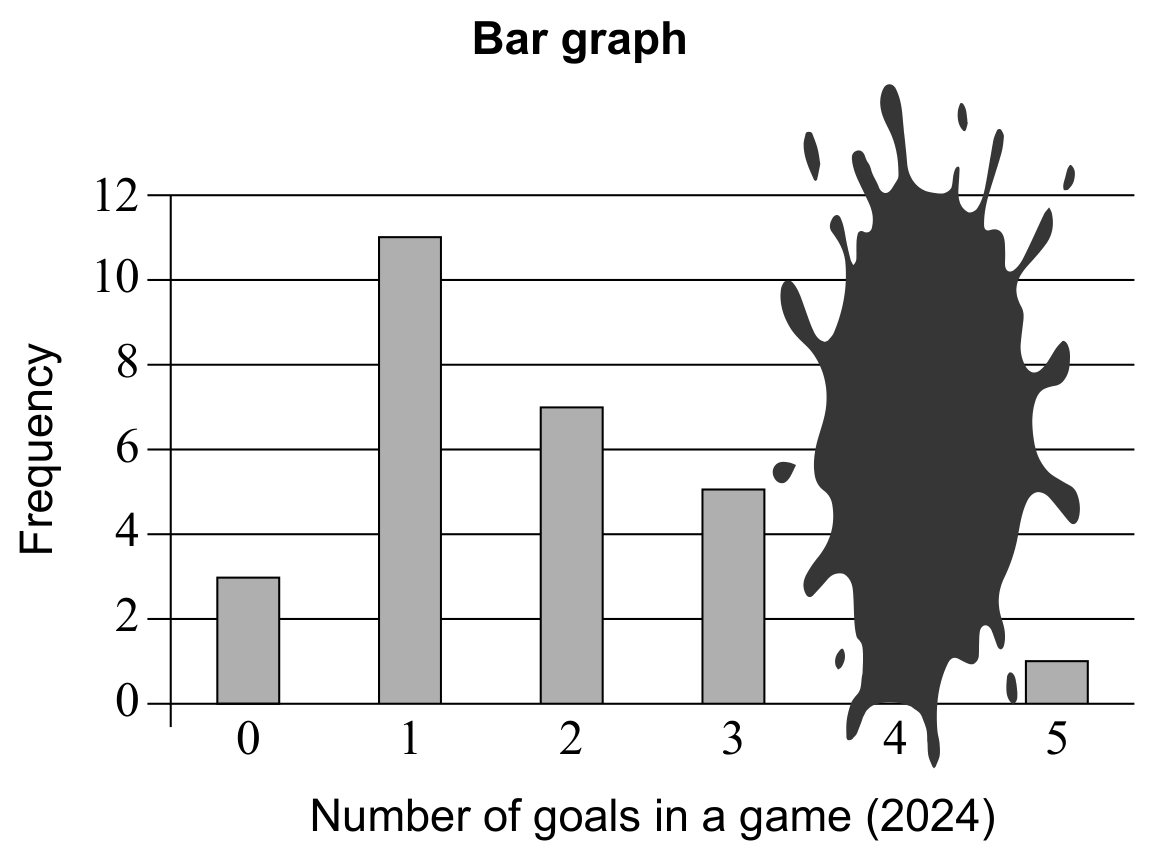
Paul has a bar graph for the total number of goals scored in each game of a soccer tournament in 2024. The bar graph is shown below, however the frequency of 4 goals in a game is unreadable.
Paul uses this bar graph to create a frequency table.
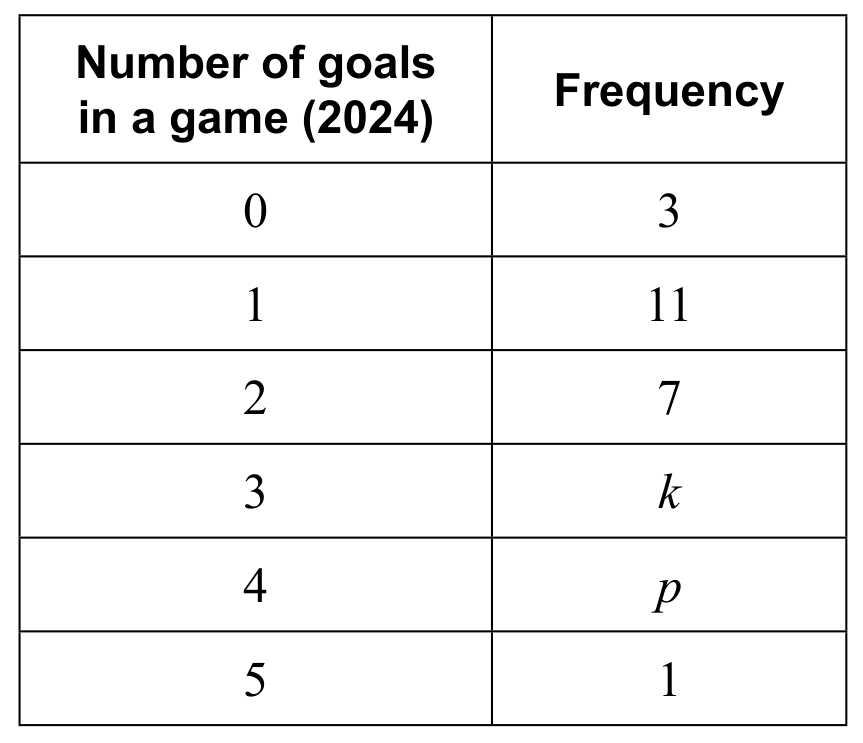
Frequency table
Write down the value of k.
Paul knows that the mean number of goals per game scored during the tournament was 2.2 .
Write down an equation for the mean in terms of p.
Determine the value of p.
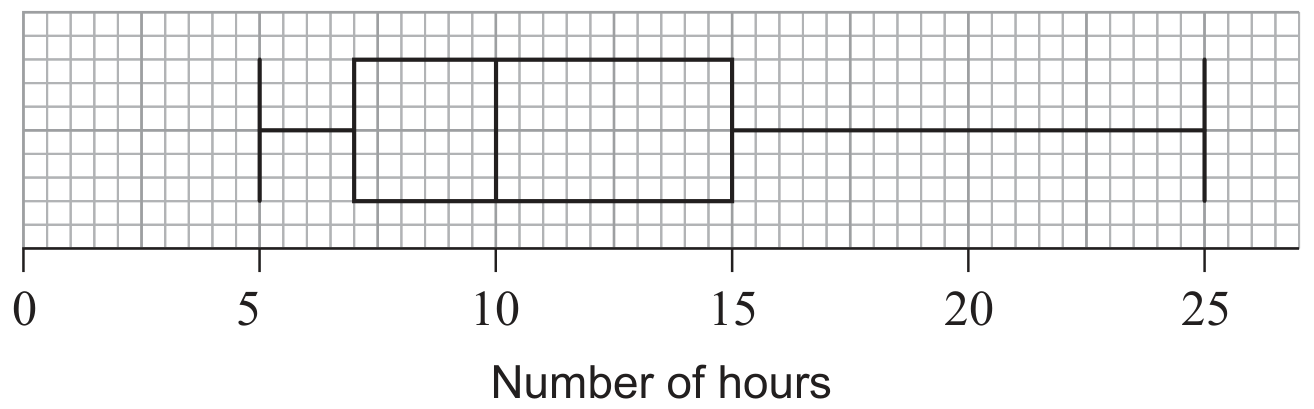
Data for the number of goals per game in the 2025 soccer tournament are shown in the following box and whisker diagram.
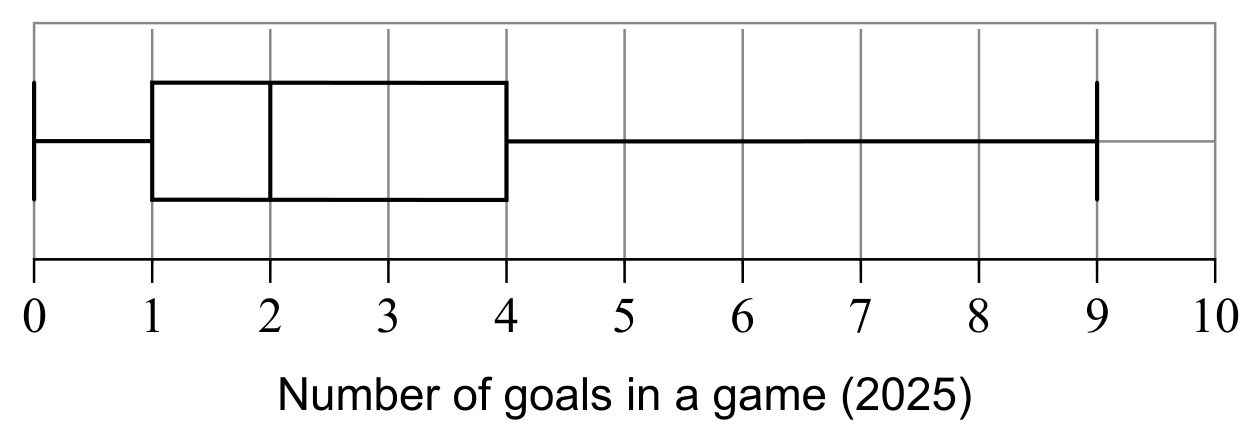
After comparing the box and whisker diagram from the 2025 tournament with the frequency table from the 2024 tournament, Paul concludes that the distribution of goals is consistent between the two tournaments.
State two observations that support Paul's conclusion using values from the data to compare any two of:
range, symmetry, median, and interquartile range.
Paul plans to watch all the games from the 2024 tournament in a random order.
He will watch each game once.
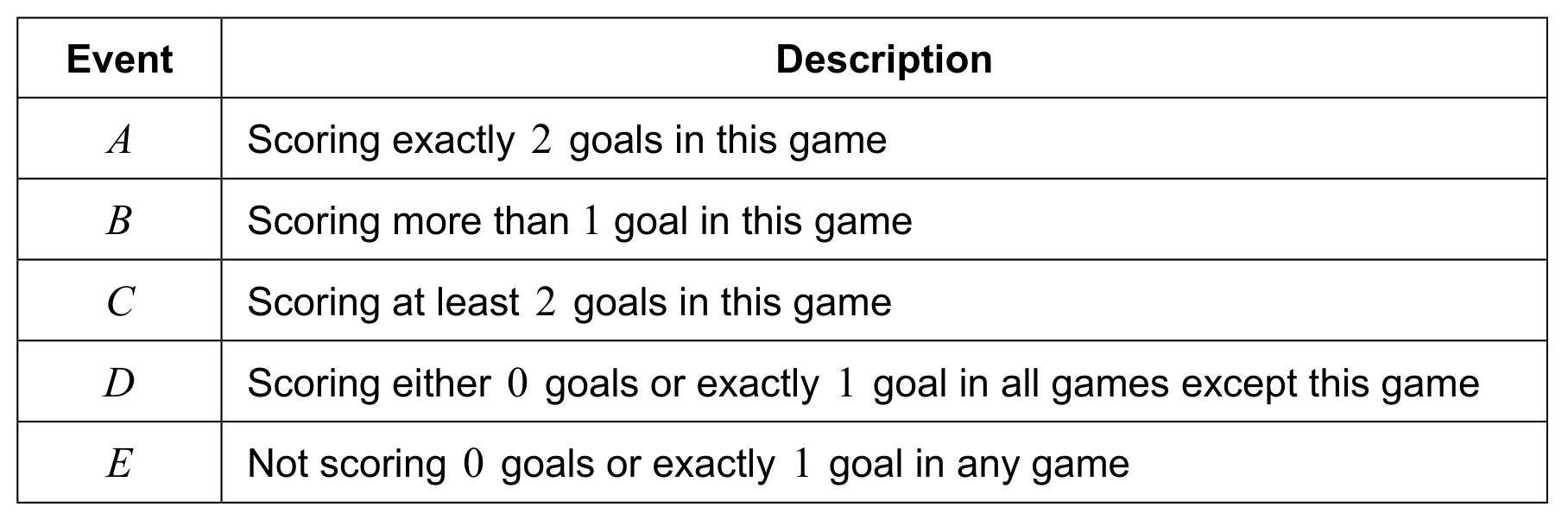
For the first game he watches, he defines event F as:
"scoring either 0 goals or exactly 1 goal".
Write down the event(s) from the table that are equivalent to . There may be more than one correct event.
If exactly 1 goal was scored in the first game Paul watches, write down the probability that exactly 1 goal was scored in the second game he watches. Give your answer as a fraction.
Calculate the probability that 5 goals were scored in the first game that Paul watches and 0 goals were scored in the second game he watches.