[Maximum number: 1]
Chlorine undergoes many reactions.
(a)
2.67 g of manganese(IV) oxide was added to of .
[ 1 ]
(i)
Deduce, referring to oxidation states, whether is an oxidizing or reducing agent.
[ 1 ]
 EduNinja
Chlorine undergoes many reactions.
2.67 g of manganese(IV) oxide was added to of .
Deduce, referring to oxidation states, whether is an oxidizing or reducing agent.
Lithium reacts with water to form an alkaline solution.
The reaction of lithium with water is a redox reaction. Identify the oxidizing agent in the reaction giving a reason.
Ammonium nitrate, , is used as a high nitrogen fertilizer.
Predict, using the given values, the reaction that would take place at the anode and cathode for the electrolysis of an aqueous solution of ammonium nitrate using graphite electrodes.
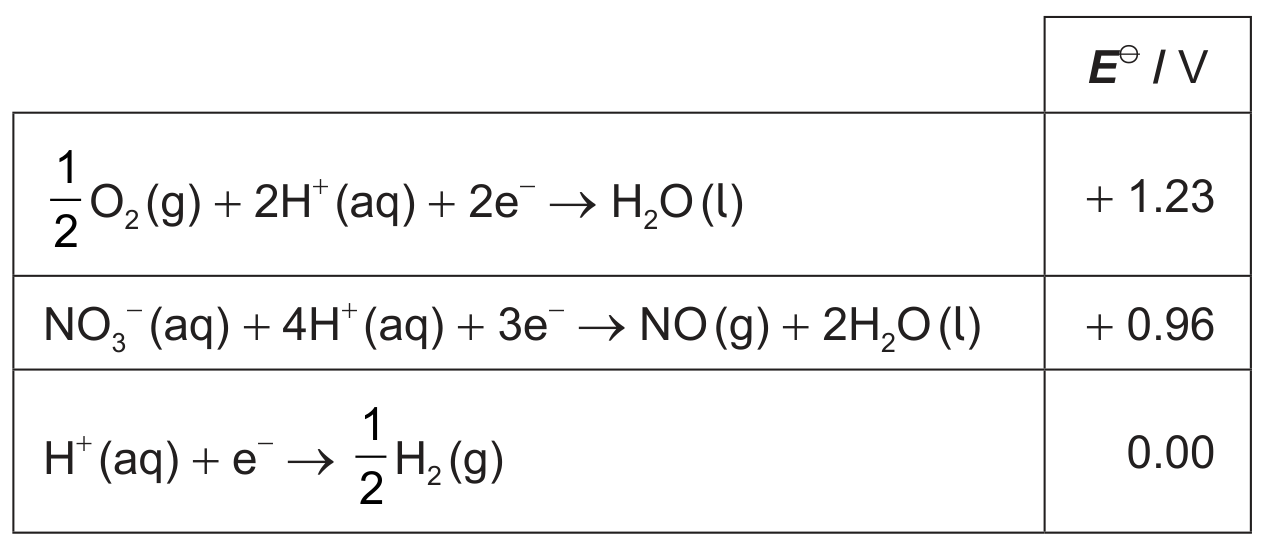
Anode:
Cathode:
Which is the correct equation for the electrolysis of molten sodium chloride?
Pasteurization is used to eliminate pathogenic bacteria. The concentration of vitamin C was monitored over a period of time in pasteurized and unpasteurized orange juice.
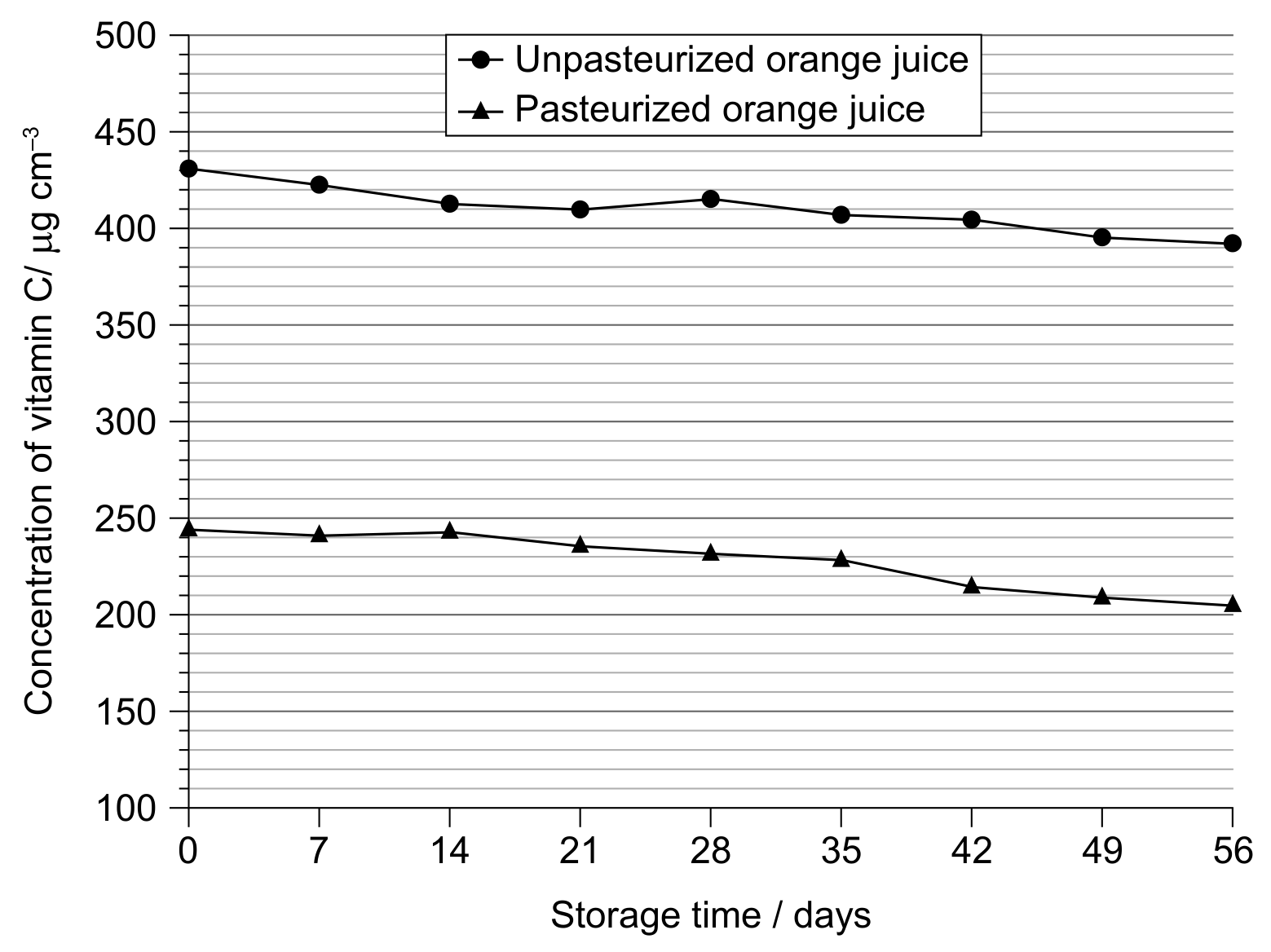
The concentration of vitamin C (ascorbic acid) can be measured by performing a redox titration using acidified iodate, , and iodide ions. Starch reacts with excess iodine once the vitamin C is consumed to produce a dark-blue complex.
Reaction 1:
Reaction 2: ascorbic acid (aq) dehydroascorbic acid (aq)
Identify the oxidizing agent in reaction 1.
Pasteurization is used to eliminate pathogenic bacteria. The concentration of vitamin C was monitored over a period of time in pasteurized and unpasteurized orange juice.
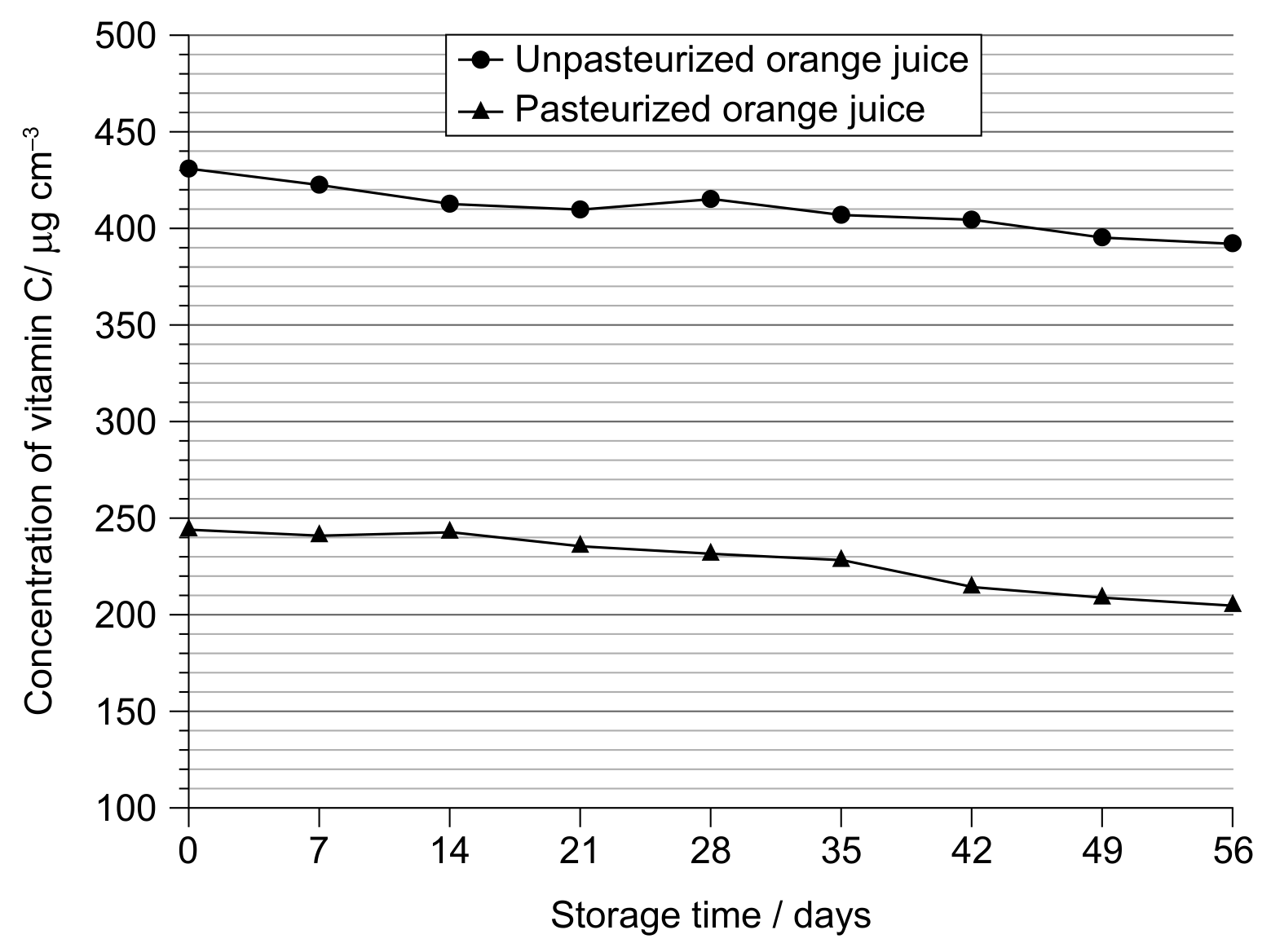
The concentration of vitamin C (ascorbic acid) can be measured by performing a redox titration using acidified iodate, , and iodide ions. Starch reacts with excess iodine once the vitamin C is consumed to produce a dark-blue complex.
Reaction 1:
Reaction 2: ascorbic acid (aq) dehydroascorbic acid (aq)
Identify the oxidizing agent in reaction 1 .
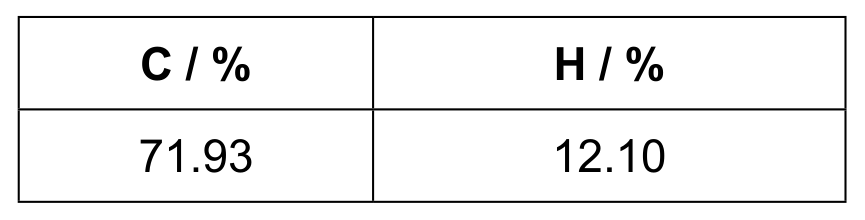
An organic compound, A, has the following composition by mass when its only combustion products, carbon dioxide and water, are analysed.
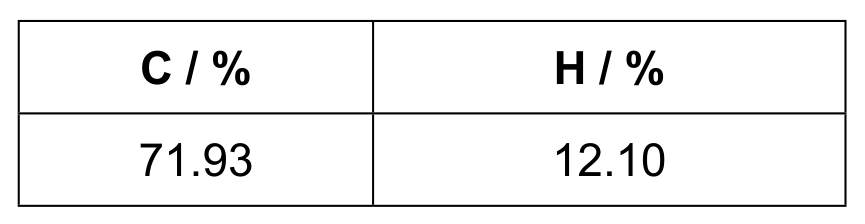
A can be converted to compound E, which has a higher molecular mass, by heating it under reflux with acidified potassium dichromate(VI), .
Identify one functional group present in E, based on this information only.
An organic compound, A, has the following composition by mass when its only combustion products, carbon dioxide and water, are analysed.
A can be converted to compound E, which has a higher molecular mass, by heating it under reflux with acidified potassium dichromate(VI), .
Identify one functional group present in E based on this information only.
Iron(II) sulfide can be produced by heating powdered iron and sulfur together.
A student hypothesised that iron(II) sulfide is ionic and therefore can be converted back to iron and sulfur by electrolysis of the molten salt, using inert electrodes.
Annotate the electrolytic cell with the terms anode and cathode, and show the direction of ion movement.
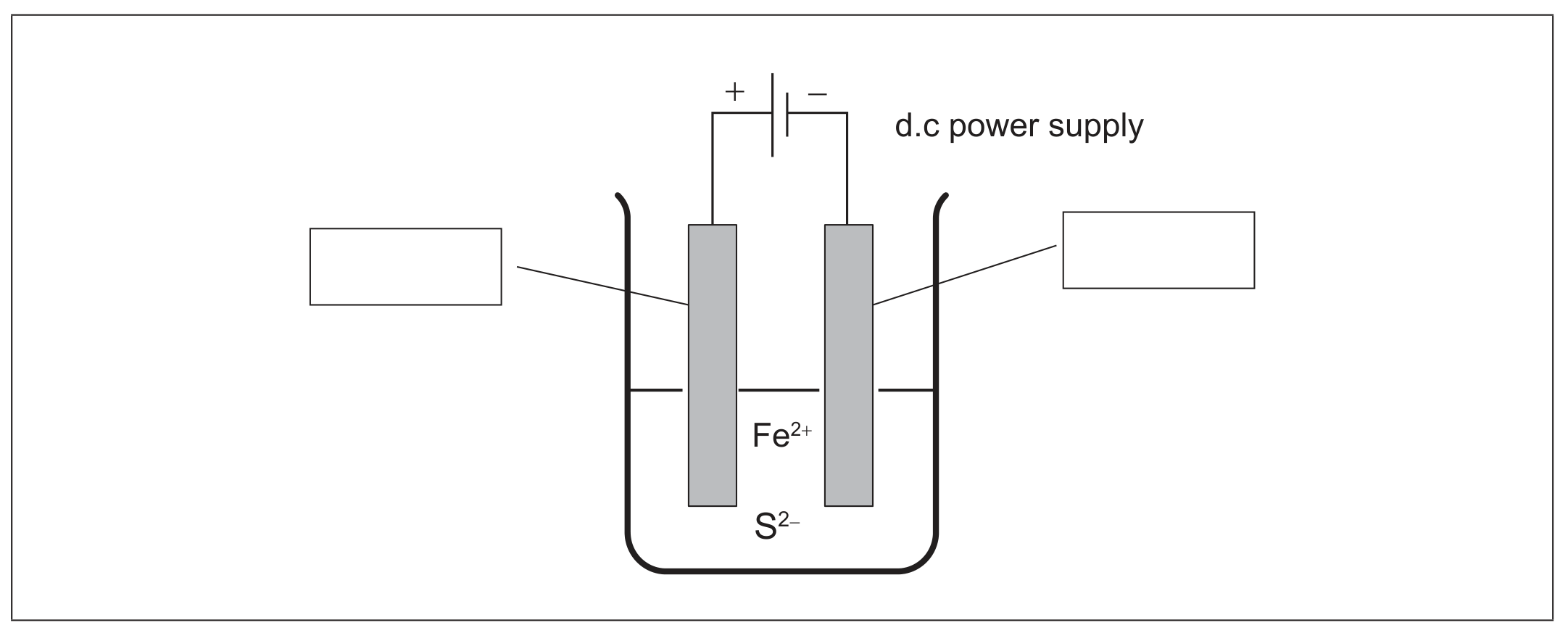
Write half-equations for the reaction occurring at each electrode.
Negative electrode:
Positive electrode:
Hydrogen cyanide, HCN , is a very toxic compound.
The cyanide ion, , can form complex ions, such as .
Outline, giving a reason, whether is a stronger or weaker oxidizing agent than (aq).
Use and section 19 of the data booklet.