EduNinja
[Maximum number: 4]

Methanoic acid (HCOOH) is the first member of the homologous series of carboxylic acids.

(a)

Draw the Lewis (electron dot) structure of methanoic acid.

[ 1 ]
(b)

Methanoic acid and ethanal (CH3CHO)\left(\mathrm{CH}_{3} \mathrm{CHO}\right) both contain a carbonyl group and have similar molar masses.

[ 3 ]
(i)

Explain why, in terms of the strongest intermolecular forces between the molecules, ethanal has a much lower boiling point than methanoic acid.

[ 2 ]
(ii)

Outline why ethanal and methanoic acid are both fully miscible with water.

[ 1 ]
[Maximum number: 5]

Methanoic acid (HCOOH) is the first member of the homologous series of carboxylic acids.

(a)

Methanoic acid and ethanal (CH3CHO)\left(\mathrm{CH}_{3} \mathrm{CHO}\right) both contain a carbonyl group and have similar molar masses.

[ 3 ]
(i)

Explain why, in terms of the strongest intermolecular forces between the molecules, ethanal has a much lower boiling point than methanoic acid.

[ 2 ]
(ii)

Outline why ethanal and methanoic acid are both fully miscible with water.

[ 1 ]
(b)

Methanoic acid acts as a weak monobasic acid in aqueous solution.

[ 2 ]
(i)

Explain why the two carbon-oxygen bonds in the methanoate ion are of equal length, and compare their length to the carbon-oxygen bonds in methanoic acid.

[ 2 ]
[Maximum number: 1]

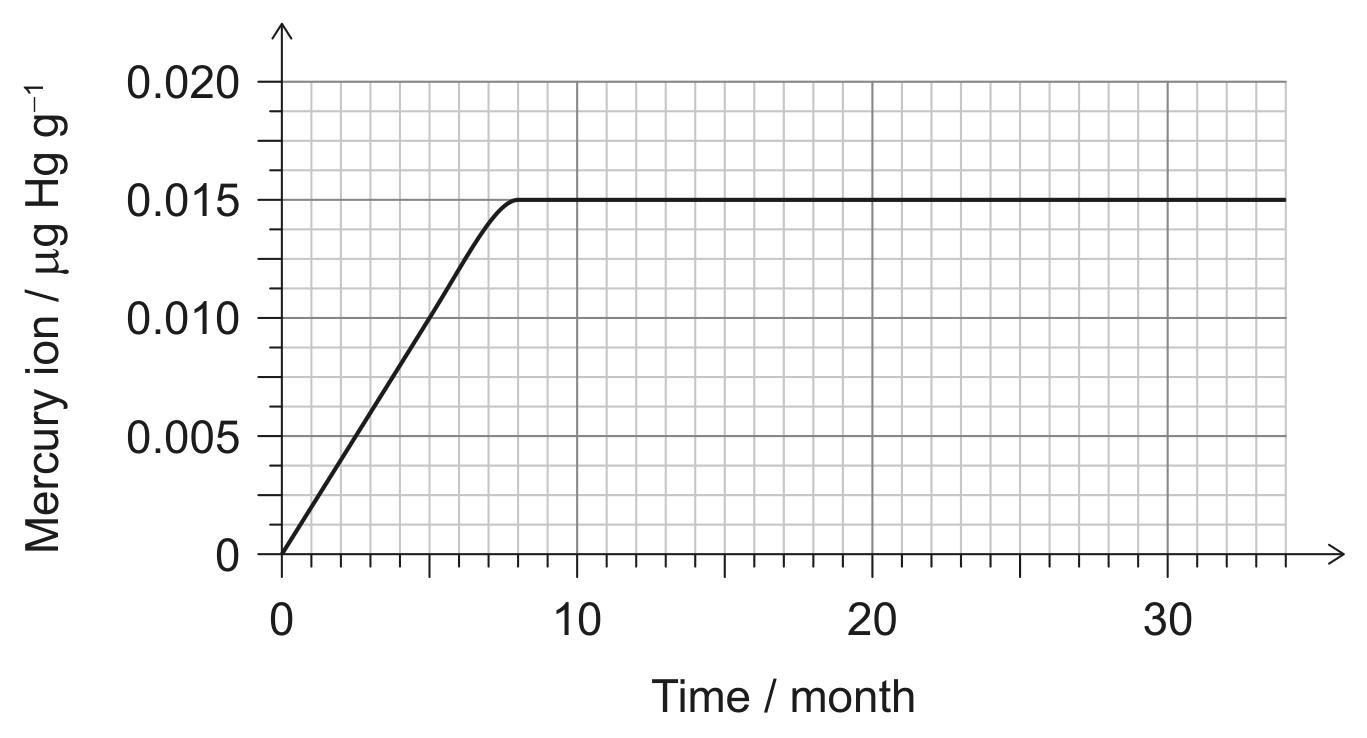
Water contaminated with mercury contains methylmercury ions, CH3Hg+\mathrm{CH}_{3} \mathrm{Hg}^{+}. These ions are absorbed by living organisms, then slowly metabolized and excreted.

Young fish were taken at regular intervals from a mercury contaminated lake and tested to determine mercury ion content.

Mercury ion content in muscle tissue of fish

Mercury ion content in muscle tissue of fish

(a)
(i)

State why CH3Hg+\mathrm{CH}_{3} \mathrm{Hg}^{+}is more likely to be absorbed by fish than mercury, Hg .

[ 1 ]
[Maximum number: 2]

Alkanes are commonly occurring organic compounds.

(a)

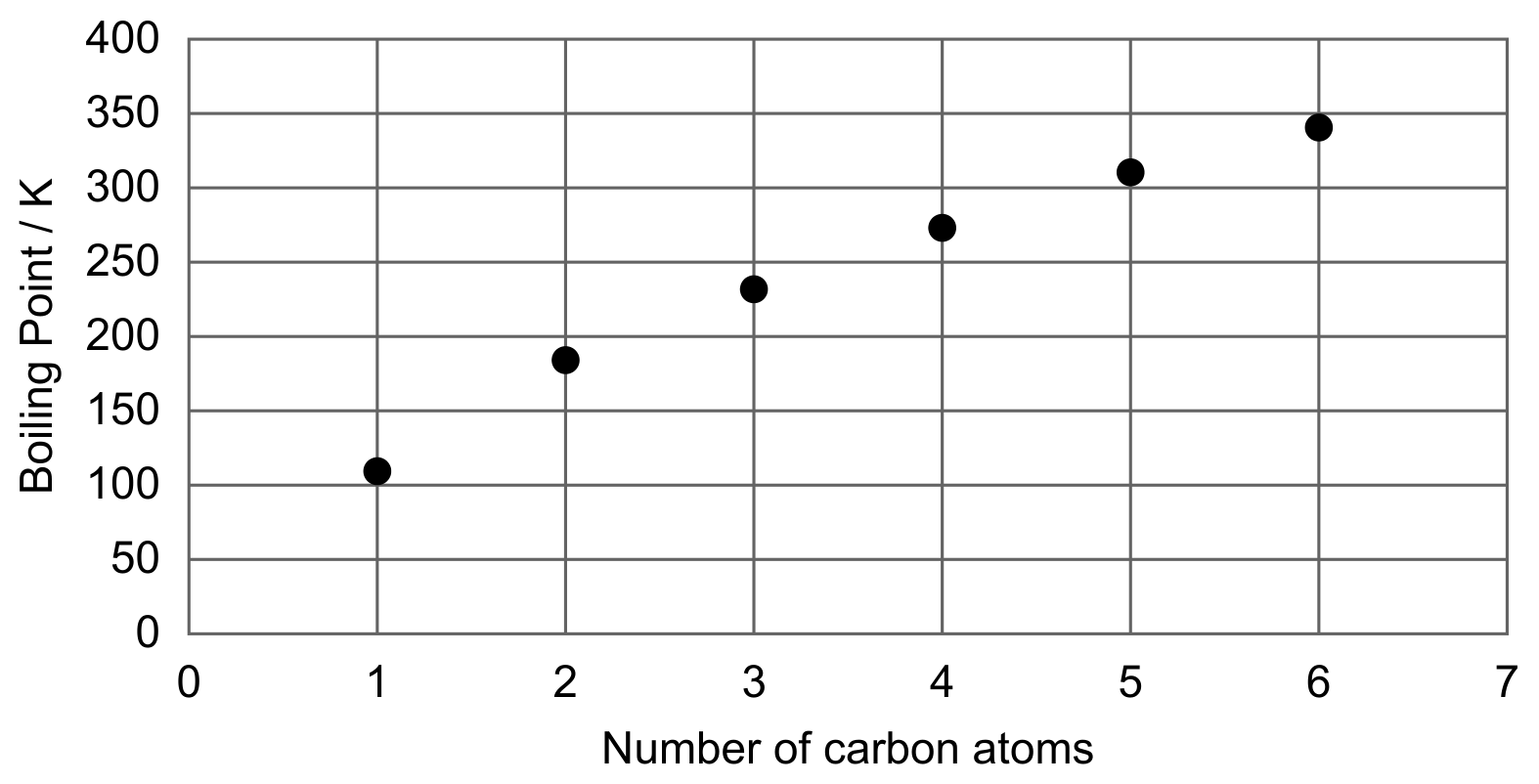
The first four straight chain alkanes are gases at room temperature.

Boiling points of straight chain alkanes

Boiling points of straight chain alkanes

[ 2 ]
(i)

Explain why the boiling point increases from methane to propane.

[ 2 ]
[Maximum number: 1]

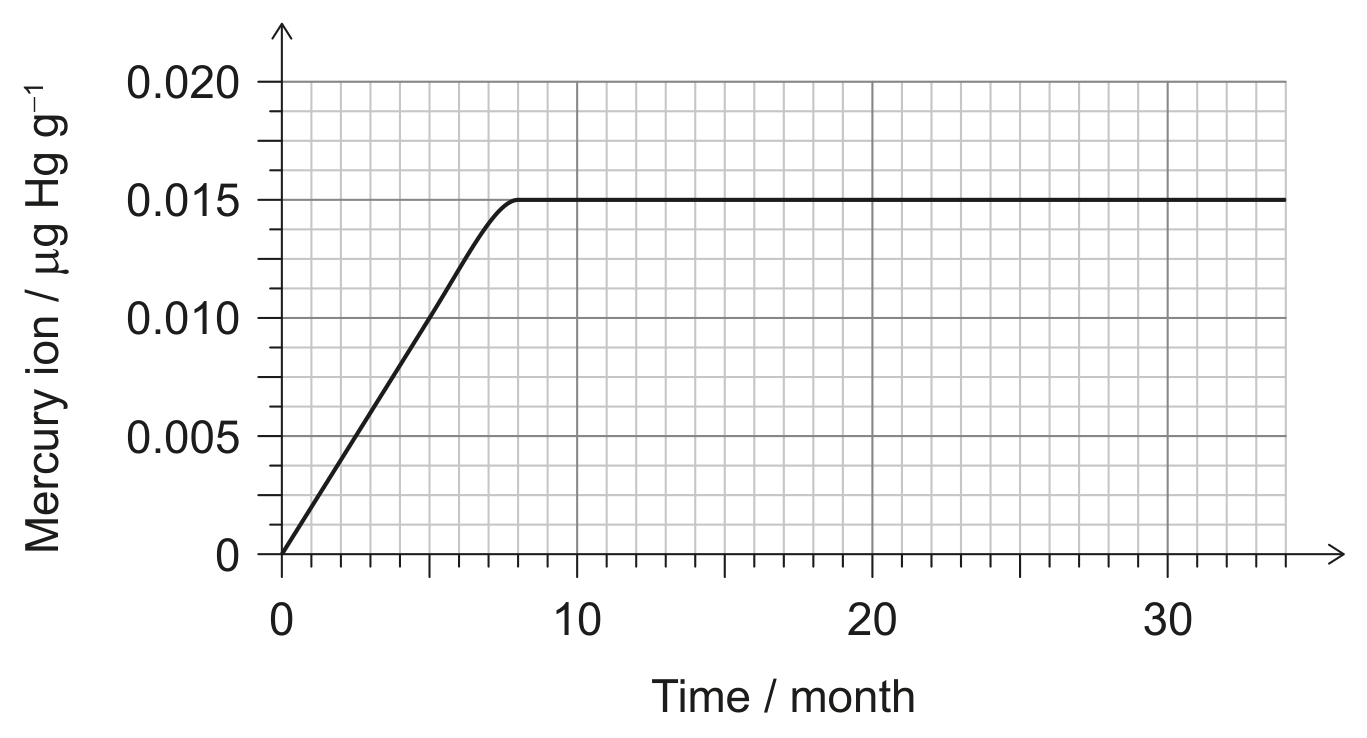
Water contaminated with mercury contains methylmercury ions, CH3Hg+\mathrm{CH}_{3} \mathrm{Hg}^{+}. These ions are absorbed by living organisms, then slowly metabolized and excreted.

Young fish were taken at regular intervals from a mercury contaminated lake and tested to determine mercury ion content.

Mercury ion content in muscle tissue of fish

Mercury ion content in muscle tissue of fish

(a)
(i)

State why CH3Hg+\mathrm{CH}_{3} \mathrm{Hg}^{+}is more likely to be absorbed by fish than mercury, Hg .

[ 1 ]
[Maximum number: 2]

Alkanes are commonly occurring organic compounds.

(a)

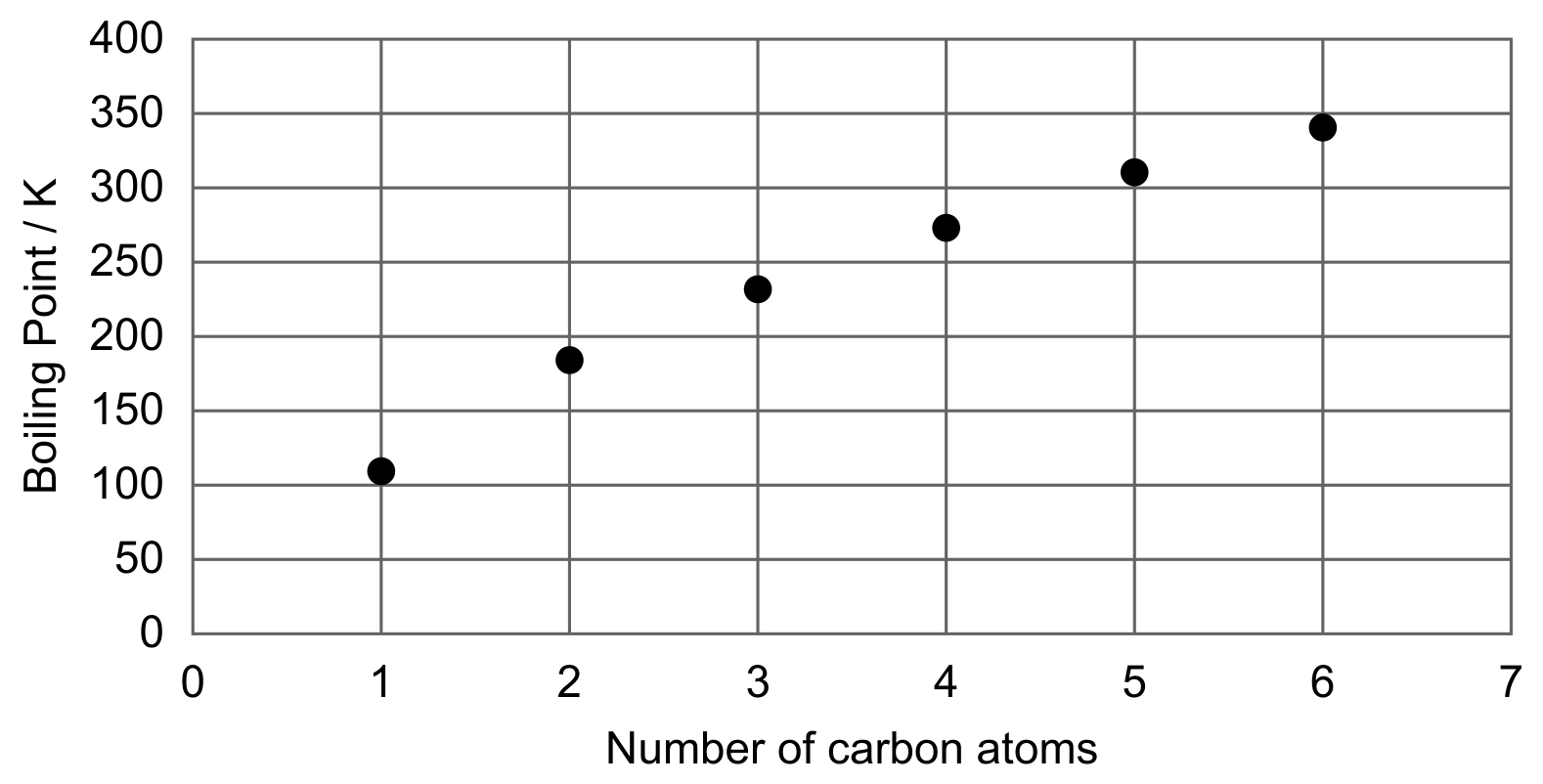
The first four straight chain alkanes are gases at room temperature.

Boiling points of straight chain alkanes

Boiling points of straight chain alkanes

[ 2 ]
(i)

Explain why the boiling point increases from methane to propane.

[ 2 ]
[Maximum number: 5]

Phosphorus is an element that is an essential part of the biological molecules involved in both respiration and photosynthesis.

(a)

7.75 g of phosphorus was combusted in a limited supply of oxygen, the mass of the oxide produced was 13.75 g .

[ 2 ]
(i)

Describe the nature of the bond between oxygen and phosphorus. Use sections 9 and 17 of the data booklet.

[ 2 ]
(b)

Another compound of phosphorus is phosphine, PH3\mathrm{PH}_{3}, it forms a phosphonium ion, PH4+\mathrm{PH}_{4}^{+}.

State the types of bonds present in the phosphonium ion, PH4+\mathrm{PH}_{4}{ }^{+}, and explain how these bonds are formed.

[ 2 ]
(c)

Phosphorus trichloride, PCl3\mathrm{PCl}_{3}, is a common compound of phosphorus.

Deduce the Lewis formula of PCl3\mathrm{PCl}_{3}.

[ 1 ]
[Maximum number: 6]

Hydrogen cyanide, HCN , is a very toxic compound.

(a)

Pure HCN is a volatile liquid, boiling at 26C26^{\circ} \mathrm{C}.

[ 6 ]
(i)

Draw the Lewis formula of the HCN molecule.

[ 1 ]
(ii)

State and explain the molecular geometry of HCN .

Molecular geometry:
Explanation:

[ 2 ]
(iii)

HCN is a polar molecule. Deduce which atom carries a partial positive charge and which carries a partial negative charge.

Partial positive charge:
Partial negative charge:

[ 1 ]
(iv)

Explain why nitrogen gas, N2\mathrm{N}_{2}, has a much lower boiling point than HCN .

[ 2 ]
[Maximum number: 6]

Phosphorus is an element that is an essential part of the biological molecules involved in both respiration and photosynthesis.

(a)

7.75 g of phosphorus was combusted in a limited supply of oxygen, the mass of the oxide produced was 13.75 g .

[ 2 ]
(i)

Describe the nature of the bond between oxygen and phosphorus. Use sections 9 and 17 of the data booklet.

[ 2 ]
(b)

Phosphorus has two chlorides, phosphorus(III) chloride, PCl3\mathrm{PCl}_{3}, and phosphorus(V) chloride, PCl5\mathrm{PCl}_{5}.

[ 4 ]
(i)

Deduce the Lewis formula of PCl3\mathrm{PCl}_{3}.

[ 1 ]
(ii)

Deduce the molecular geometry of PCl3\mathrm{PCl}_{3} and PCl5\mathrm{PCl}_{5}.
PCl3:\mathrm{PCl}_{3}:

PCl5\mathrm{PCl}_{5} :

[ 2 ]
(iii)

Suggest a value for the bond angle in PCl3\mathrm{PCl}_{3}.

[ 1 ]
[Maximum number: 9]

Hydrogen cyanide, HCN , is a very toxic compound.

(a)

Pure HCN is a volatile liquid, boiling at 26C26^{\circ} \mathrm{C}.

[ 8 ]
(i)

Draw the Lewis formula of the HCN molecule.

[ 1 ]
(ii)

Deduce the hybridization of the carbon atom and the number of sigma and pi bonds that it forms.

Hybridization:
Sigma bonds:
Pi bonds:

[ 2 ]
(iii)

State and explain the molecular geometry of HCN without referring to hybridization.

Molecular geometry:
Explanation:

[ 2 ]
(iv)

HCN is a polar molecule. Deduce which atom carries a partial positive charge and which carries a partial negative charge.

Partial positive charge:
Partial negative charge:

[ 1 ]
(v)

Explain why nitrogen gas, N2\mathrm{N}_{2}, has a much lower boiling point than HCN .

[ 2 ]
(b)

The cyanide ion, CN\mathrm{CN}^{-}, can form complex ions, such as [Fe(CN)6]4\left[\mathrm{Fe}(\mathrm{CN})_{6}\right]^{4-}.

[ 1 ]
(i)

State the precise type of bond formation between the cyanide ion and the iron ion.
bond

[ 1 ]
0