EduNinja
[Maximum number: 1]

What happens as ice melts at 0C0^{\circ} \mathrm{C} ?
I. Molecules gain kinetic energy and temperature increases.
II. Added energy overcomes hydrogen bonds between molecules.
III. Molecules gain sufficient energy to move from fixed positions.

A

I and II only

B

I and III only

C

II and III only

D

I, II and III
[Maximum number: 2]

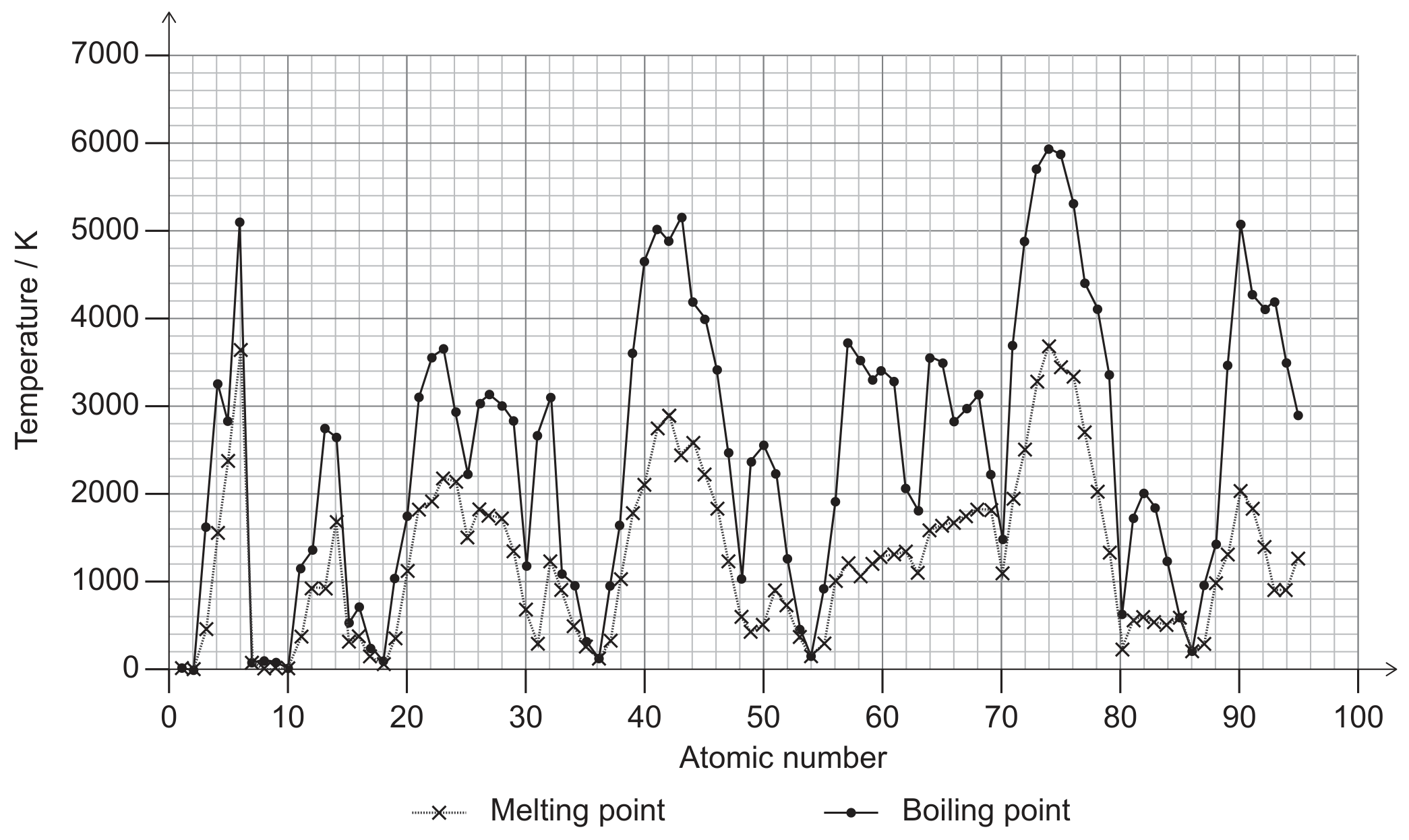
Physical properties of elements vary according to atomic number. Sections 6 to 9 of the data booklet list some of these properties.

Melting points and boiling points of elements 1 to 95

Question image
(a)

Deduce, giving a reason, the group of elements in the periodic table most likely to undergo sublimation.

[ 2 ]
[Maximum number: 2]

Iron(II) sulfide can be produced by heating powdered iron and sulfur together.

(a)

Describe the difference between an element and a compound.

[ 2 ]

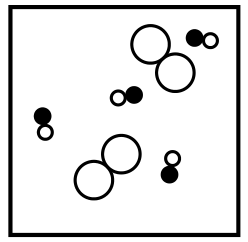
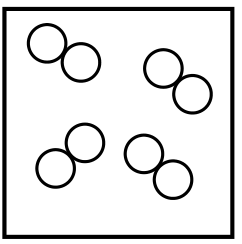
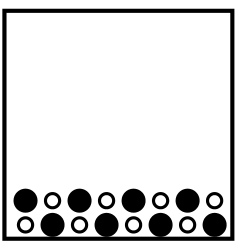
Which diagram represents a heterogeneous mixture?

A
Question image
B
Question image
C
Question image
D
Question image
[Maximum number: 2]

One definition of atomic volume is given by the formula:

 Atomic volume = atomic mass (g mol1) density (g cm3)\text { Atomic volume }=\frac{\text { atomic mass }\left(\mathrm{g} \mathrm{~mol}^{-1}\right)}{\text { density }\left(\mathrm{g} \mathrm{~cm}^{-3}\right)}

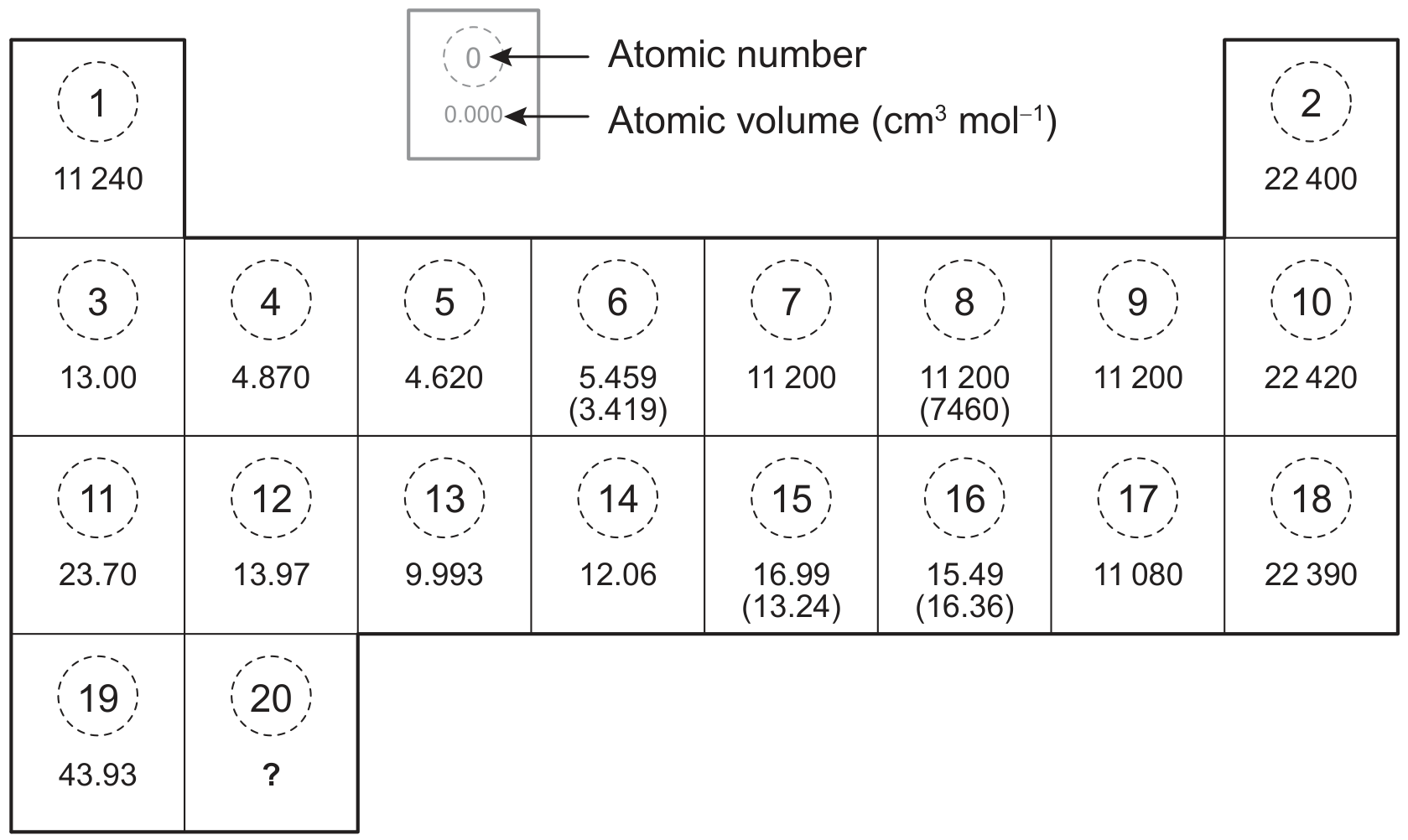
The table gives the atomic volumes of the first nineteen elements, in the form in which they occur at STP.

Key:

Key:

(a)

Outline why many elements have atomic volumes greater than 10000 cm3 mol110000 \mathrm{~cm}^{3} \mathrm{~mol}^{-1}.

[ 1 ]
(b)

Outline why some of those with larger atomic volumes have values 11000 cm3 mol1\sim 11000 \mathrm{~cm}^{3} \mathrm{~mol}^{-1} and others 22000 cm3 mol1\sim 22000 \mathrm{~cm}^{3} \mathrm{~mol}^{-1}.

[ 1 ]
[Maximum number: 1]

What is the name of this change of state?

CO2( g)CO2( s)\mathrm{CO}_{2}(\mathrm{~g}) \rightarrow \mathrm{CO}_{2}(\mathrm{~s})
A

Condensation

B

Deposition

C

Sublimation

D

Freezing

[Maximum number: 1]

Which is a homogeneous mixture?

A

Oil and water

B

Sand and water

C

Ethanol and water

D

Chalk and sand

[Maximum number: 2]

Alkanes are commonly occurring organic compounds.

(a)

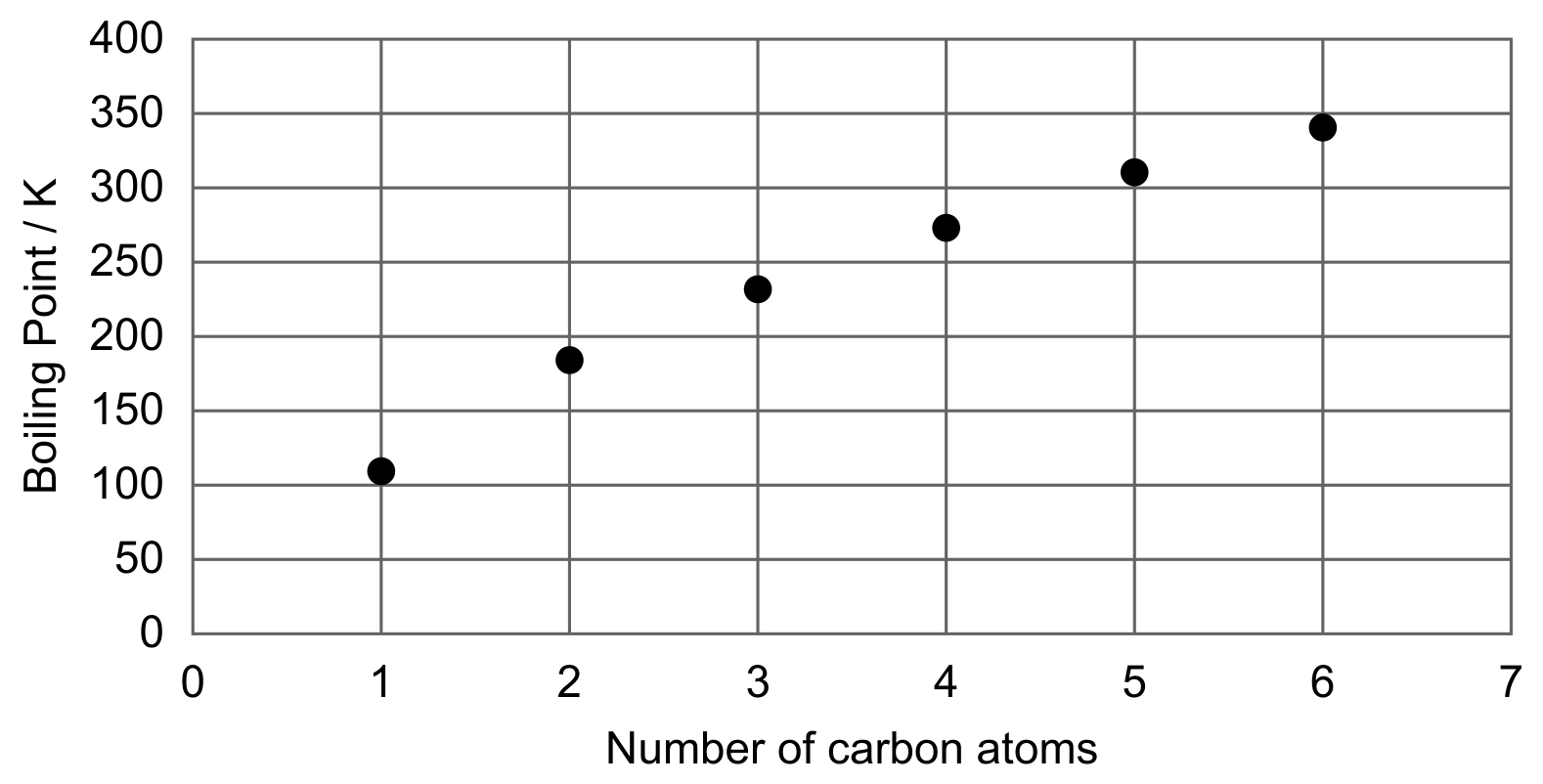
The first four straight chain alkanes are gases at room temperature.

Boiling points of straight chain alkanes

Boiling points of straight chain alkanes

[ 2 ]
(i)

Explain why the volume occupied by a sample of propane increases sharply when the sample is heated up from 200 to 250 K at constant pressure.

[ 2 ]
[Maximum number: 1]

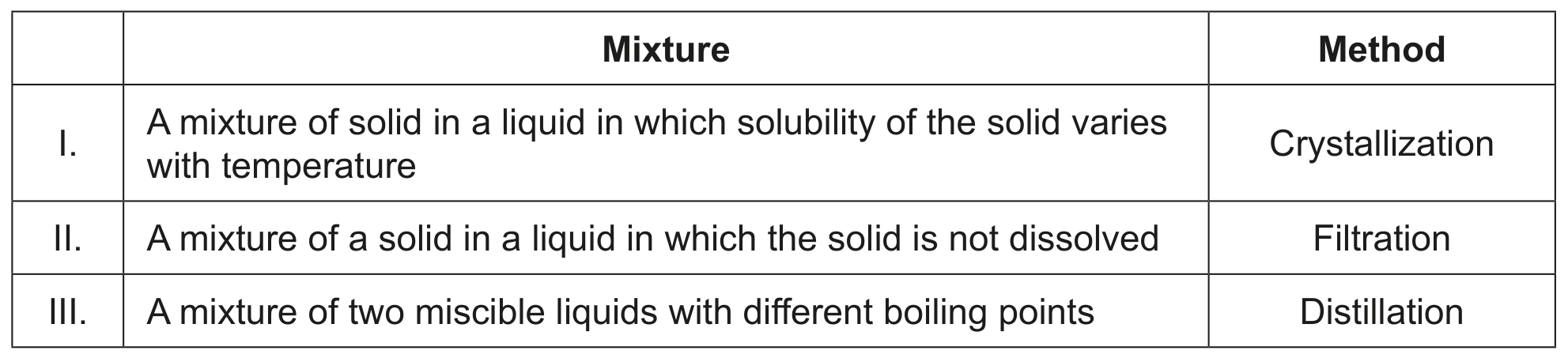
Which methods for separating the given mixtures into their components are correct?

Table
A

I and II only

B

I and III only

C

II and III only

D

I, II and III
[Maximum number: 1]

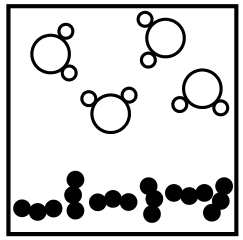
Phosphine (IUPAC name phosphane) is a hydride of phosphorus, with the formula PH3\mathrm{PH}_{3}.

(a)

Phosphine is usually prepared by heating white phosphorus, one of the allotropes of phosphorus, with concentrated aqueous sodium hydroxide. The equation for the reaction is:

P4( s)+3OH(aq)+3H2O(l)PH3( g)+3H2PO2(aq)\mathrm{P}_{4}(\mathrm{~s})+3 \mathrm{OH}^{-}(\mathrm{aq})+3 \mathrm{H}_{2} \mathrm{O}(\mathrm{l}) \rightarrow \mathrm{PH}_{3}(\mathrm{~g})+3 \mathrm{H}_{2} \mathrm{PO}_{2}^{-}(\mathrm{aq})
[ 1 ]
(i)

The first reagent is written as P4\mathrm{P}_{4}, not 4P. Describe the difference between P4\mathrm{P}_{4} and 4 P.

[ 1 ]
0