EduNinja
[Maximum number: 2]

Lithium reacts with water to form an alkaline solution.

(a)

A0.200 g piece of lithium was placed in 500.0 cm3500.0 \mathrm{~cm}^{3} of water.

[ 2 ]
(i)

Calculate the volume of hydrogen gas produced, in cm3\mathrm{cm}^{3}, if the temperature was 22.5C22.5^{\circ} \mathrm{C} and the pressure was 103 kPa . Use sections 1 and 2 of the data booklet.

[ 2 ]
[Maximum number: 4]

Alkanes are commonly occurring organic compounds.

(a)

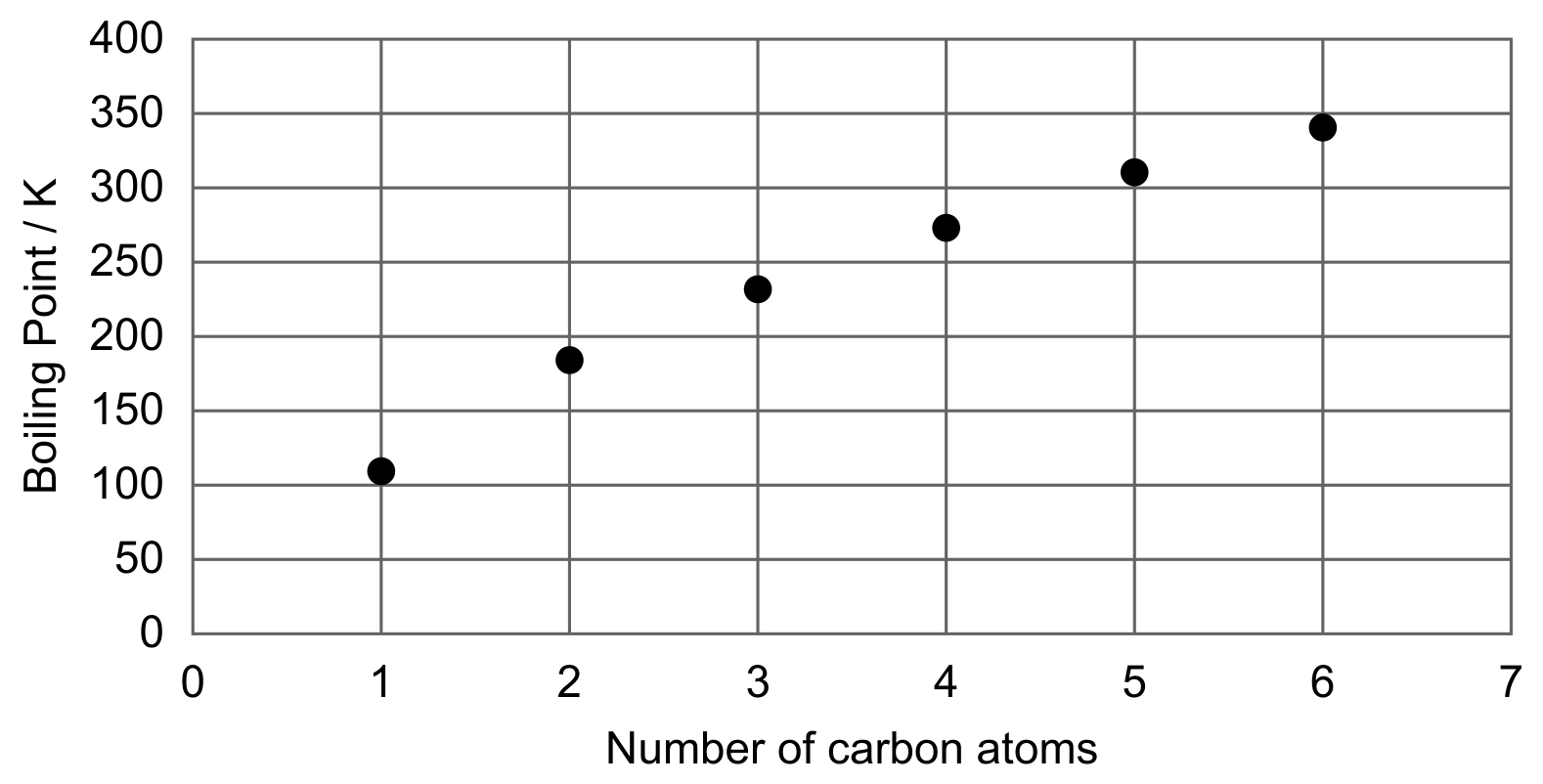
The first four straight chain alkanes are gases at room temperature.

Boiling points of straight chain alkanes

Boiling points of straight chain alkanes

[ 4 ]
(i)

Calculate the volume, in dm3\mathrm{dm}^{3}, occupied by 6.45 g of propane gas at 100 kPa and 15C15^{\circ} \mathrm{C}.

[ 2 ]
(ii)

Outline why the volume occupied by propane(g) at very high pressure is higher than the value calculated using PV=nRT.

[ 2 ]
[Maximum number: 2]

A powder has the following percentage composition by mass:
30.0 % sucrose, C12H22O11\mathrm{C}_{12} \mathrm{H}_{22} \mathrm{O}_{11}
45.0 % citric acid, C6H8O7\mathrm{C}_{6} \mathrm{H}_{8} \mathrm{O}_{7}
25.0 \% sodium hydrogencarbonate, NaHCO3\mathrm{NaHCO}_{3}

In the presence of water, the powder effervesces as the citric acid reacts with the sodium hydrogencarbonate:

3NaHCO3( s)+C6H8O7(aq)Na3(C6H5O7)(aq)+3CO2( g)+3H2O(l)3 \mathrm{NaHCO}_{3}(\mathrm{~s})+\mathrm{C}_{6} \mathrm{H}_{8} \mathrm{O}_{7}(\mathrm{aq}) \rightarrow \mathrm{Na}_{3}\left(\mathrm{C}_{6} \mathrm{H}_{5} \mathrm{O}_{7}\right)(\mathrm{aq})+3 \mathrm{CO}_{2}(\mathrm{~g})+3 \mathrm{H}_{2} \mathrm{O}(\mathrm{l})

(a)
(i)

Determine the volume, in dm3\mathrm{dm}^{3} at SATP, of carbon dioxide released in the reaction in (a)(i). Use sections 1 and 2 of the data booklet.

[ 2 ]
[Maximum number: 3]

Nitrogen monoxide, NO(g), is produced in internal combustion and jet engines.

(a)

Calculate the amount, in moles, of NO in 1.0×10³ m31.0 \times 10^{-3} \mathrm{~m}^{3} of engine exhaust gas which contains 0.10 % NO by volume at 200C200^{\circ} \mathrm{C} and 1.0×10⁵ Pa1.0 \times 10^{5} \mathrm{~Pa}.

Use sections 1 and 2 of the data booklet.

[ 3 ]
[Maximum number: 2]

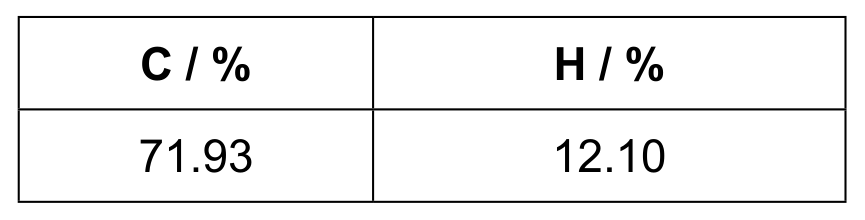
An organic compound, A, has the following composition by mass when its only combustion products, carbon dioxide and water, are analysed.

Table
(a)

A sample of the vapour of A at 200.0C200.0^{\circ} \mathrm{C}, and 1.00×10⁵ Pa1.00 \times 10^{5} \mathrm{~Pa}, has a density of 2.544×10³ g m32.544 \times 10^{3} \mathrm{~g} \mathrm{~m}^{-3}. Determine the molar mass and the molecular formula of A.

[ 2 ]
[Maximum number: 2]

A powder has the following percentage composition by mass:
30.0 % sucrose, C12H22O11\mathrm{C}_{12} \mathrm{H}_{22} \mathrm{O}_{11}
45.0 % citric acid, C6H8O7\mathrm{C}_{6} \mathrm{H}_{8} \mathrm{O}_{7}
25.0 \% sodium hydrogencarbonate, NaHCO3\mathrm{NaHCO}_{3}

In the presence of water, the powder effervesces as the citric acid reacts with the sodium hydrogencarbonate:

3NaHCO3( s)+C6H8O7(aq)Na3(C6H5O7)(aq)+3CO2( g)+3H2O(l)3 \mathrm{NaHCO}_{3}(\mathrm{~s})+\mathrm{C}_{6} \mathrm{H}_{8} \mathrm{O}_{7}(\mathrm{aq}) \rightarrow \mathrm{Na}_{3}\left(\mathrm{C}_{6} \mathrm{H}_{5} \mathrm{O}_{7}\right)(\mathrm{aq})+3 \mathrm{CO}_{2}(\mathrm{~g})+3 \mathrm{H}_{2} \mathrm{O}(\mathrm{l})

(a)
(i)

Determine the volume, in dm3\mathrm{dm}^{3} at SATP, of carbon dioxide released in the reaction in (a)(i). Use sections 1 and 2 of the data booklet.

[ 2 ]
[Maximum number: 2]

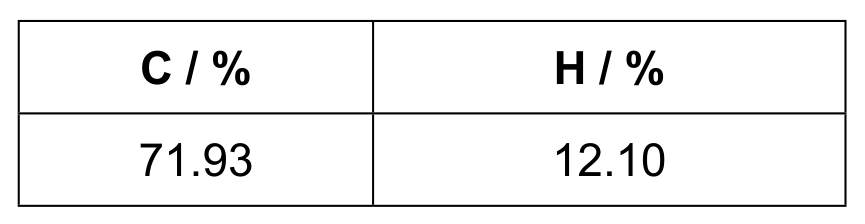
An organic compound, A, has the following composition by mass when its only combustion products, carbon dioxide and water, are analysed.

Table
(a)

A sample of the vapour of A at 200.0C200.0^{\circ} \mathrm{C} and 1.00×10⁵ Pa1.00 \times 10^{5} \mathrm{~Pa} has a density of 2.544×10³ g m32.544 \times 10^{3} \mathrm{~g} \mathrm{~m}^{-3}. Determine the molar mass and the molecular formula of A.

[ 2 ]
[Maximum number: 1]

Phosphine (IUPAC name phosphane) is a hydride of phosphorus, with the formula PH3\mathrm{PH}_{3}.

(a)

2.478 g of white phosphorus was used to make phosphine according to the equation:

P4( s)+3OH(aq)+3H2O(l)PH3( g)+3H2PO2(aq)\mathrm{P}_{4}(\mathrm{~s})+3 \mathrm{OH}^{-}(\mathrm{aq})+3 \mathrm{H}_{2} \mathrm{O}(\mathrm{l}) \rightarrow \mathrm{PH}_{3}(\mathrm{~g})+3 \mathrm{H}_{2} \mathrm{PO}_{2}^{-}(\mathrm{aq})
[ 1 ]
(i)

Determine the volume of phosphine, measured in cm3\mathrm{cm}^{3} at standard temperature and pressure, that was produced.

[ 1 ]
[Maximum number: 4]

Alkanes are commonly occurring organic compounds.

(a)

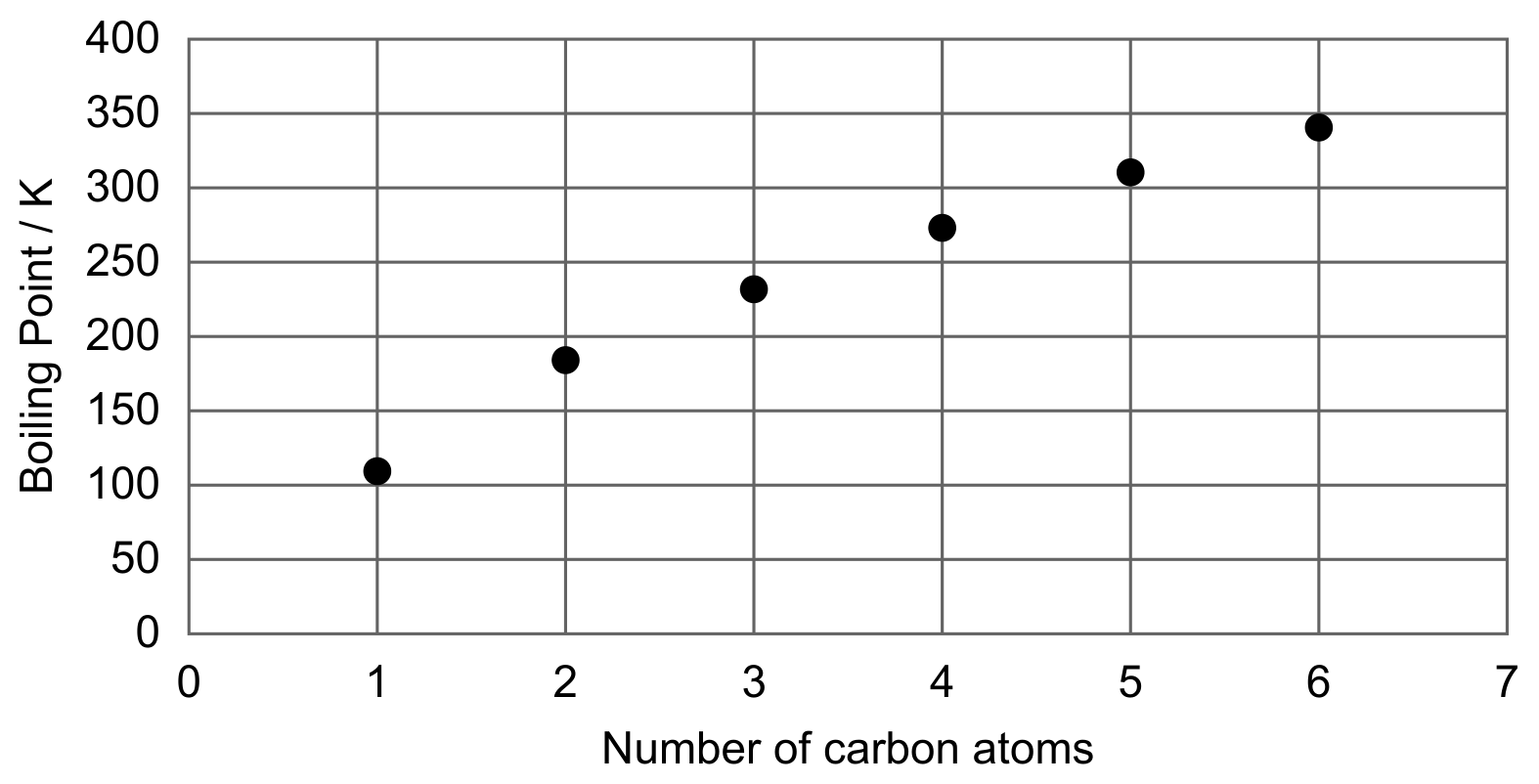
The first four straight chain alkanes are gases at room temperature.

Boiling points of straight chain alkanes

Boiling points of straight chain alkanes

[ 4 ]
(i)

Calculate the volume, in dm3\mathrm{dm}^{3}, occupied by 6.45 g of propane gas at 100 kPa and 15C15^{\circ} \mathrm{C}.

[ 2 ]
(ii)

Outline why the volume occupied by propane(g) at very high pressure is higher than the value calculated using PV=nRT.

[ 2 ]
[Maximum number: 5]

Nitrogen monoxide, NO(g), is produced in internal combustion and jet engines.

(a)

Calculate the amount, in moles, of NO in 1.0×10³ m31.0 \times 10^{-3} \mathrm{~m}^{3} of engine exhaust gas which contains 0.10 % NO by volume at 200C200^{\circ} \mathrm{C} and 1.0×10⁵ Pa1.0 \times 10^{5} \mathrm{~Pa}.

Use sections 1 and 2 of the data booklet.

[ 3 ]
(b)

Outline why NO deviates more than nitrogen, N2\mathrm{N}_{2}, from the ideal gas model.

[ 2 ]
0