EduNinja
[Maximum number: 3]

Chlorine undergoes many reactions.

(a)
(i)

Ethoxyethane (diethyl ether) can be used as a solvent for this conversion.

Draw the structural formula of ethoxyethane.

[ 1 ]
(ii)

Deduce the number of signals and their chemical shifts in the 1H{ }^{1} \mathrm{H} NMR spectrum of ethoxyethane. Use section 27 of the data booklet.

[ 2 ]
[Maximum number: 4]

Chlorine undergoes many reactions.

(a)
(i)

Ethoxyethane (diethyl ether) can be used as a solvent for this conversion.

Draw the structural formula of ethoxyethane.

[ 1 ]
(ii)

Deduce the number of signals and chemical shifts with splitting patterns in the 1H{ }^{1} \mathrm{H} NMR spectrum of ethoxyethane. Use section 27 of the data booklet.

[ 3 ]
[Maximum number: 3]

A4.406 g sample of a compound containing only C, H and O was burnt in excess oxygen. 8.802 g of CO2\mathrm{CO}_{2} and 3.604 g of H2O\mathrm{H}_{2} \mathrm{O} were produced.

(a)

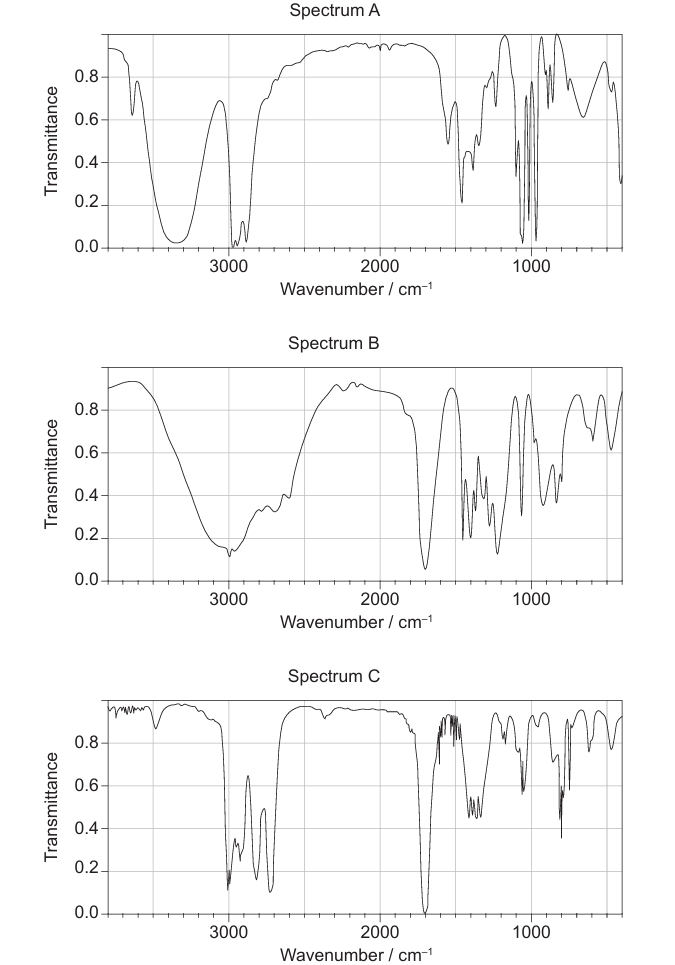
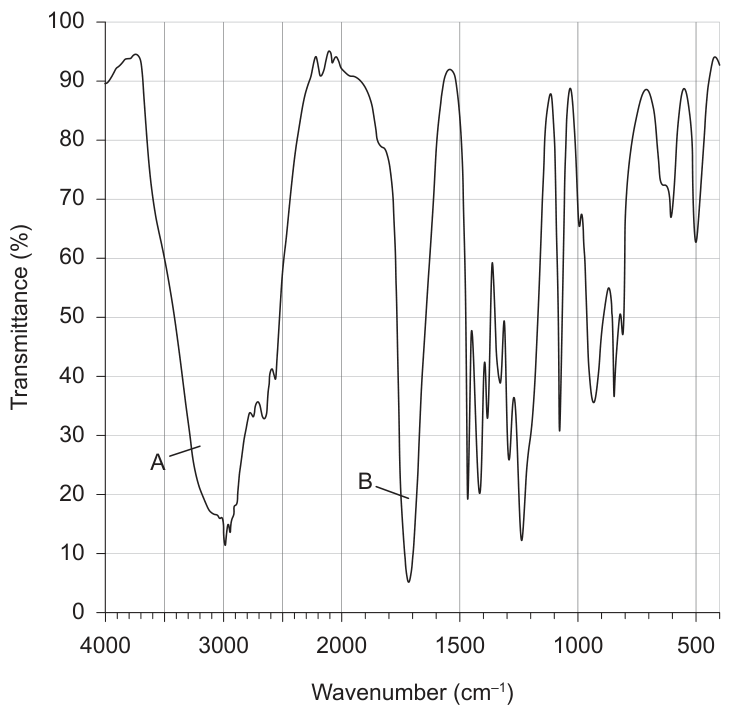
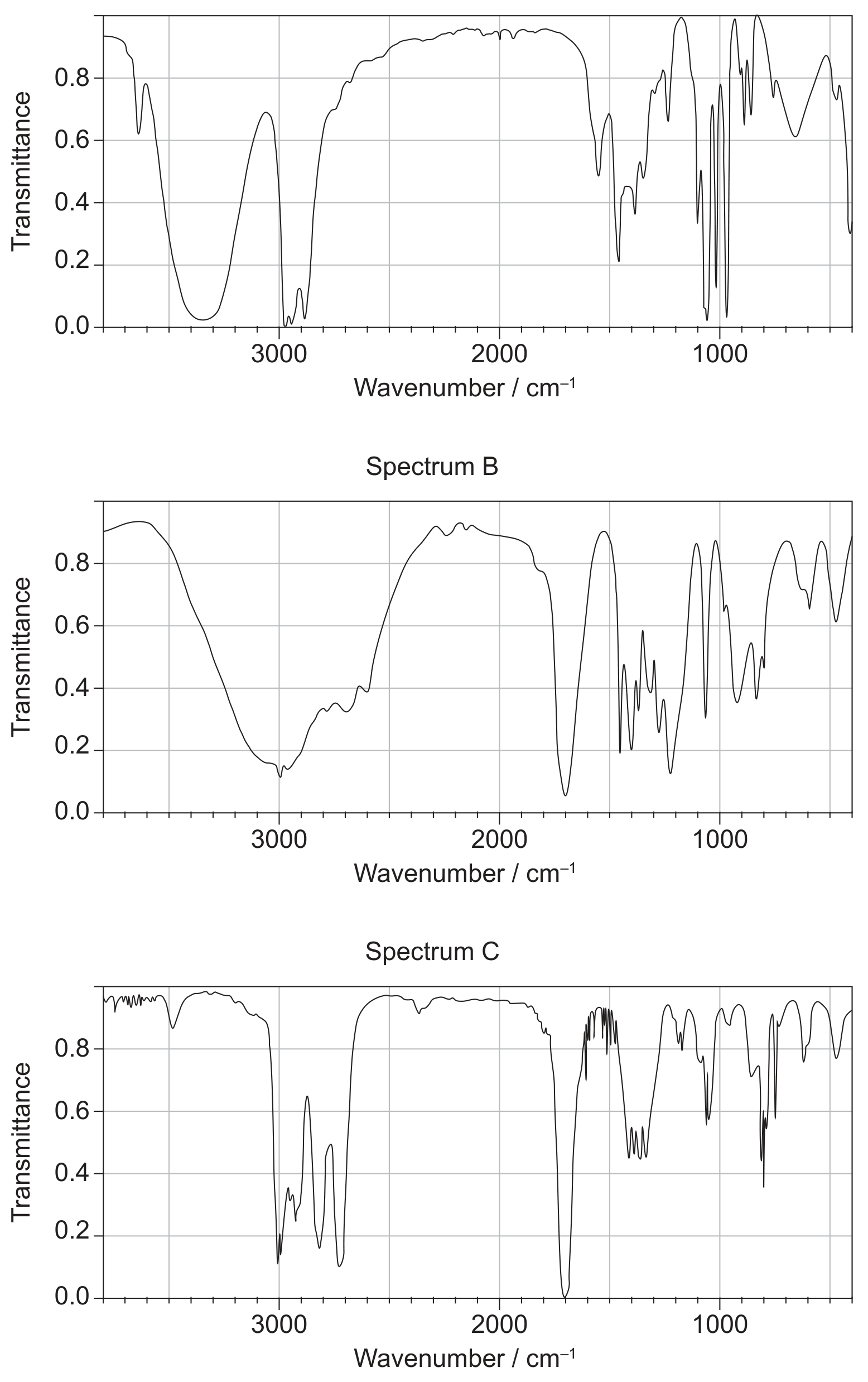
The following spectrums show the Infrared spectra of propan-1-ol, propanal and propanoic acid.

Spectrum A

Spectrum A

Identify each compound from the spectra given, use absorptions from the range of 1700 cm11700 \mathrm{~cm}^{-1} to 3500 cm13500 \mathrm{~cm}^{-1}. Explain the reason for your choice, referring to section 26 of the data booklet.

Table
[ 3 ]
[Maximum number: 6]

A4.406 g sample of a compound containing only C, H and O was burnt in excess oxygen. 8.802 g of CO2\mathrm{CO}_{2} and 3.604 g of H2O\mathrm{H}_{2} \mathrm{O} were produced.

(a)

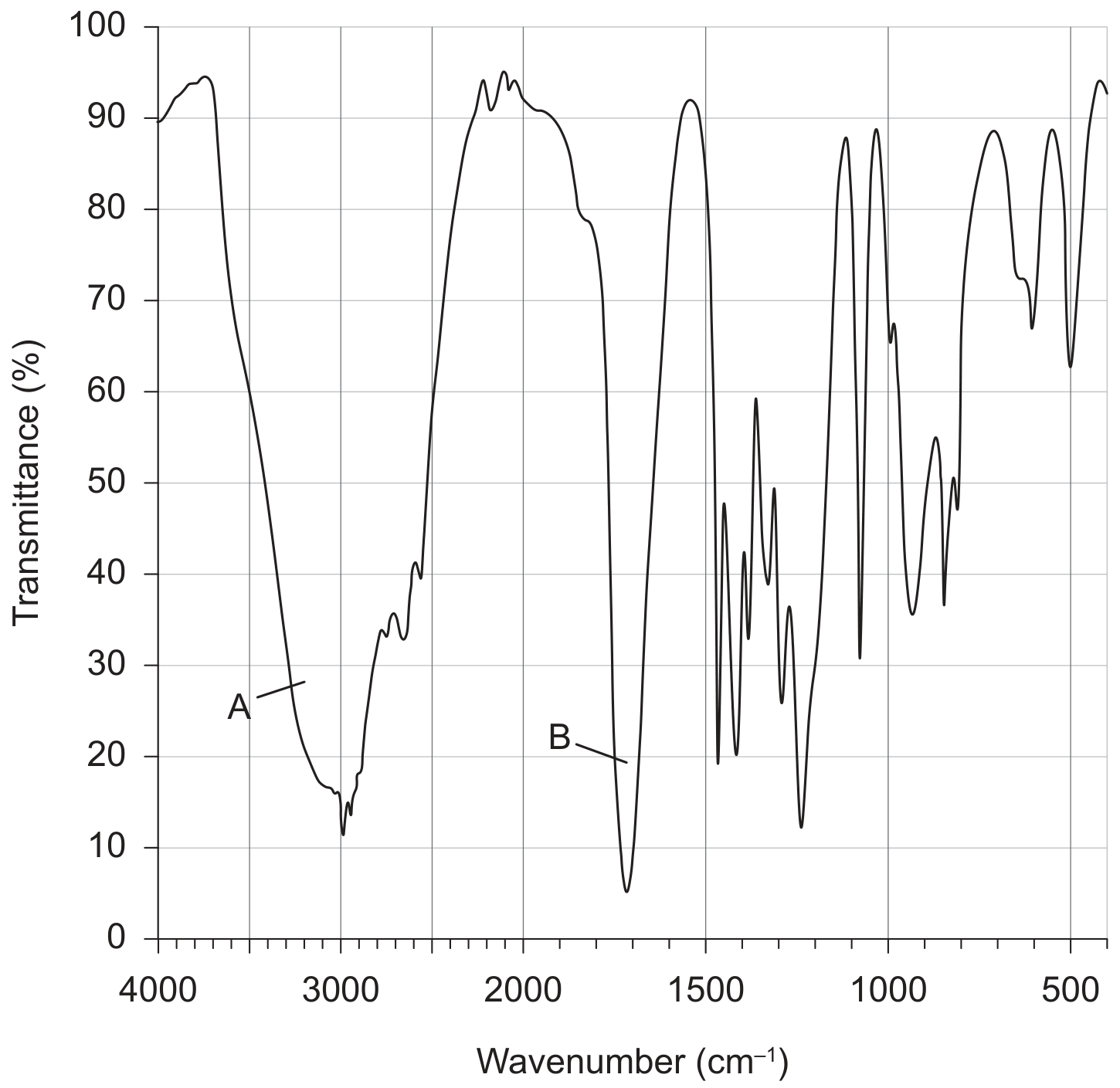
The following spectrums show the Infrared spectra of propan-1-ol, propanal and propanoic acid.

Question image

Identify each compound from the spectra given, use absorptions from the range of 1700 cm11700 \mathrm{~cm}^{-1} to 3500 cm13500 \mathrm{~cm}^{-1}. Explain the reason for your choice, referring to section 26 of the data booklet.

Table
[ 3 ]
(b)

Predict the number of 1HNMR{ }^{1} \mathrm{H} \mathrm{NMR} signals, and splitting pattern of the CH3-\mathrm{CH}_{3} seen for propanone (CH3COCH3)\left(\mathrm{CH}_{3} \mathrm{COCH}_{3}\right) and propanal (CH3CH2CHO)\left(\mathrm{CH}_{3} \mathrm{CH}_{2} \mathrm{CHO}\right).

Table
[ 2 ]
(c)

Predict the fragment that is responsible for a m / z of 31 in the mass spectrum of propan-1-ol. Use section 28 of the data booklet.

[ 1 ]
[Maximum number: 4]

Analytical and spectroscopic techniques enable chemists to identify and determine structures of compounds.

(a)

Identify fragments responsible for the peaks at m / z 74 and 45 using section 28 of the data booklet.
m / z 74 :
m / z 45:

[ 2 ]
(b)

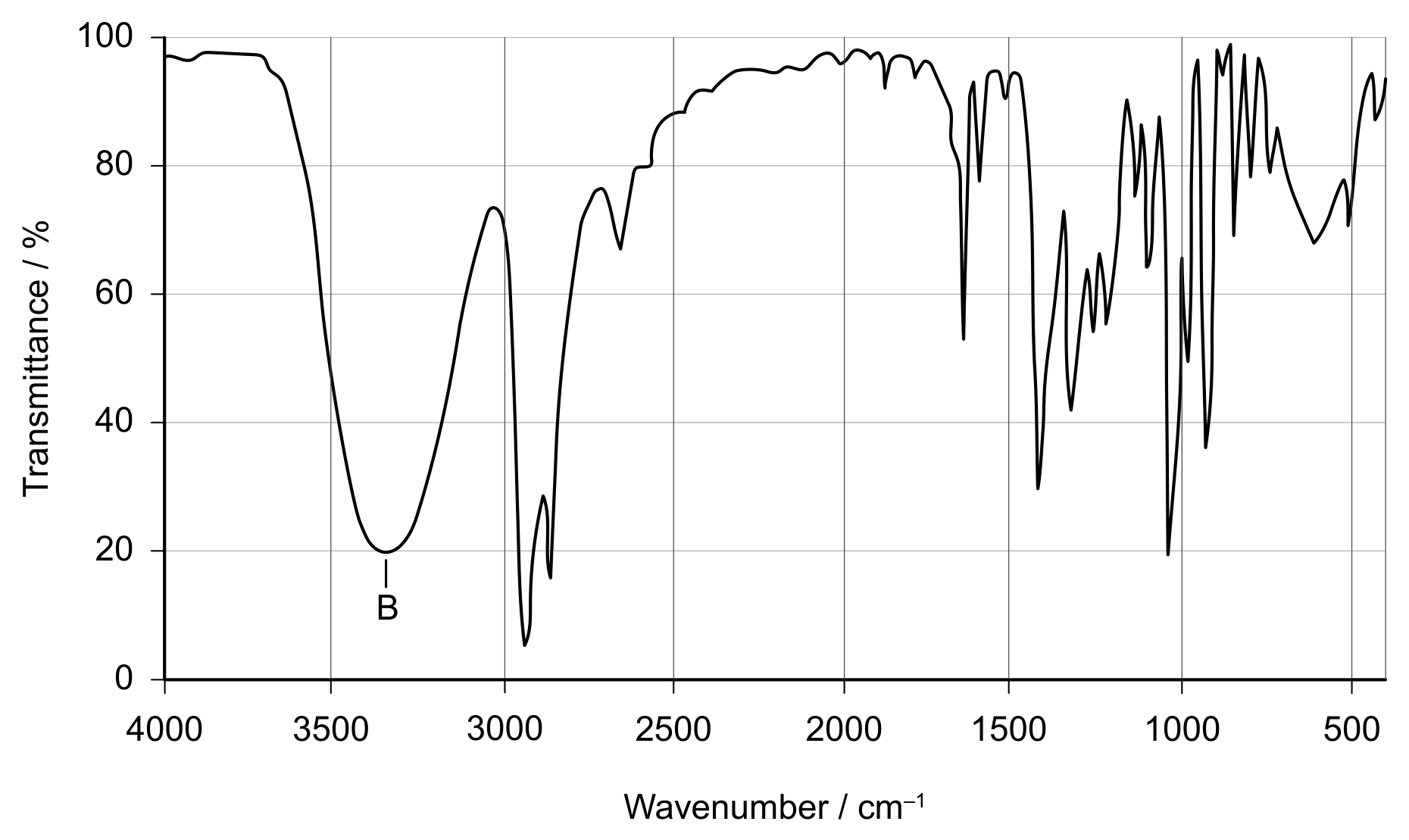
The infrared spectrum of X is shown.
Infrared spectrum of X

Question image

Identify the bonds making the major contribution to peaks A and B using section 26 of the data booklet.

A:
B:

[ 2 ]
[Maximum number: 5]

Analytical and spectroscopic techniques enable chemists to identify and determine structures of compounds.

(a)

An unknown organic compound, X, comprising of only carbon, hydrogen and oxygen was found to contain 48.6 % of carbon and 43.2 % of oxygen.

[ 5 ]
(i)

Identify fragments responsible for the peaks at m / z 74 and 45 using section 28 of the data booklet.

m / z 74 :
m / z 45:

[ 2 ]
(ii)

The infrared spectrum of X is shown.

Question image

Identify the bonds making the major contribution to peaks A and B using section 26 of the data booklet.

A:

B:

[ 2 ]
(iii)

Deduce the structural formula of X.

[ 1 ]
[Maximum number: 1]

Methanoic acid (HCOOH) is the first member of the homologous series of carboxylic acids.

(a)

Outline what is meant by the term "homologous series".

[ 1 ]
[Maximum number: 1]

Methanoic acid (HCOOH) is the first member of the homologous series of carboxylic acids.

(a)

Outline what is meant by the term "homologous series".

[ 1 ]
[Maximum number: 2]

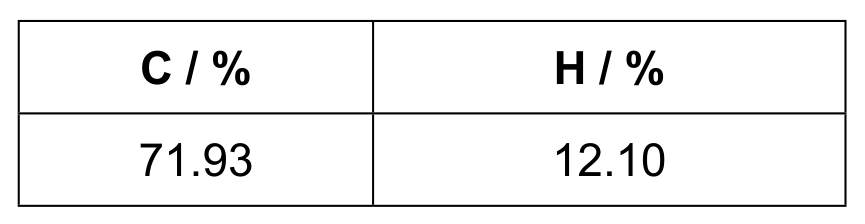
An organic compound, A, has the following composition by mass when its only combustion products, carbon dioxide and water, are analysed.

Table
(a)

Outline why this compound is not a hydrocarbon.

[ 1 ]
(b)

The infrared (IR) spectrum of A is shown below.

Question image

Identify the bond responsible for the absorption labelled B in the IR spectrum. Use section 26 of the data booklet.

[ 1 ]
[Maximum number: 1]

A powder has the following percentage composition by mass:
30.0 % sucrose, C12H22O11\mathrm{C}_{12} \mathrm{H}_{22} \mathrm{O}_{11}
45.0 % citric acid, C6H8O7\mathrm{C}_{6} \mathrm{H}_{8} \mathrm{O}_{7}
25.0 \% sodium hydrogencarbonate, NaHCO3\mathrm{NaHCO}_{3}

In the presence of water, the powder effervesces as the citric acid reacts with the sodium hydrogencarbonate:

3NaHCO3( s)+C6H8O7(aq)Na3(C6H5O7)(aq)+3CO2( g)+3H2O(l)3 \mathrm{NaHCO}_{3}(\mathrm{~s})+\mathrm{C}_{6} \mathrm{H}_{8} \mathrm{O}_{7}(\mathrm{aq}) \rightarrow \mathrm{Na}_{3}\left(\mathrm{C}_{6} \mathrm{H}_{5} \mathrm{O}_{7}\right)(\mathrm{aq})+3 \mathrm{CO}_{2}(\mathrm{~g})+3 \mathrm{H}_{2} \mathrm{O}(\mathrm{l})

(a)
(i)

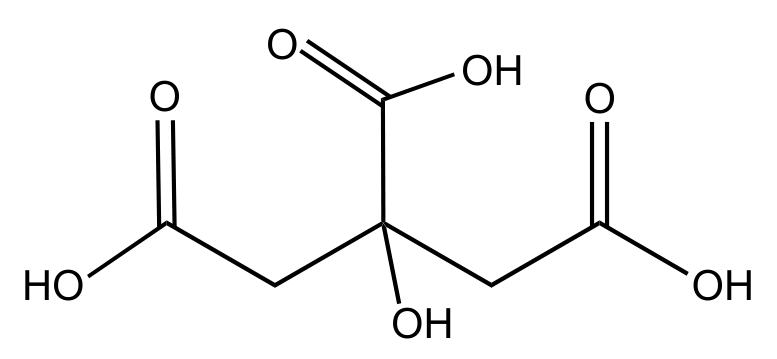
State the number of acidic hydrogens in the citric acid molecule shown.

Question image
[ 1 ]
0