EduNinja
[Maximum number: 1]

Two groups of students (Group A and Group B) carried out a project* on the chemistry of some group 7 elements (the halogens) and their compounds.

(a)

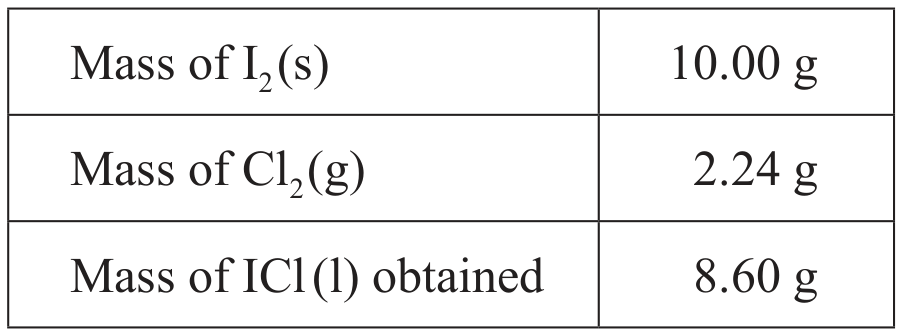
In the first part of the project, the two groups had a sample of iodine monochloride (a corrosive brown liquid) prepared for them by their teacher using the following reaction.

I2( s)+Cl2( g)2ICl(l)\mathrm{I}_{2}(\mathrm{~s})+\mathrm{Cl}_{2}(\mathrm{~g}) \rightarrow 2 \mathrm{ICl}(\mathrm{l})

The following data were recorded.

Table
[ 1 ]
(i)

Calculate the percentage yield of ICl(l).

[ 1 ]
[Maximum number: 1]

Two groups of students (Group A and Group B) carried out a project* on the chemistry of some group 7 elements (the halogens) and their compounds.

(a)

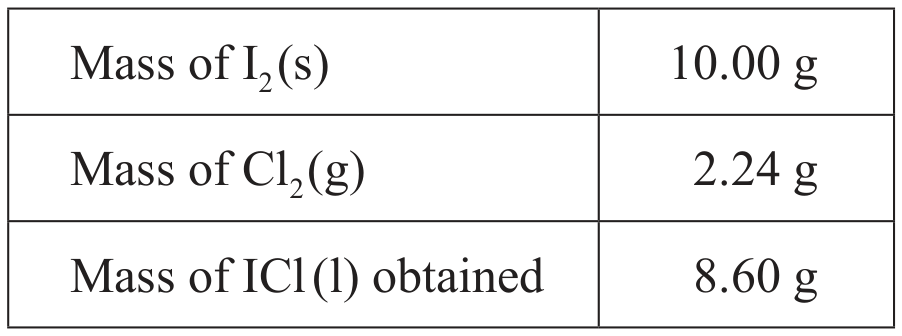
In the first part of the project, the two groups had a sample of iodine monochloride (a corrosive brown liquid) prepared for them by their teacher using the following reaction.

I2( s)+Cl2( g)2ICl(l)\mathrm{I}_{2}(\mathrm{~s})+\mathrm{Cl}_{2}(\mathrm{~g}) \rightarrow 2 \mathrm{ICl}(\mathrm{l})

The following data were recorded.

Table
[ 1 ]
(i)

Calculate the percentage yield of ICl(l).

[ 1 ]
[Maximum number: 1]

Iron tablets are often prescribed to patients. The iron in the tablets is commonly present as iron(II) sulfate, FeSO4\mathrm{FeSO}_{4}.

(a)

During the rough titration, the students found that a brown precipitate, X, formed.

[ 1 ]
(i)

State the balanced chemical equation for the decomposition of hydrogen peroxide.

[ 1 ]
[Maximum number: 1]

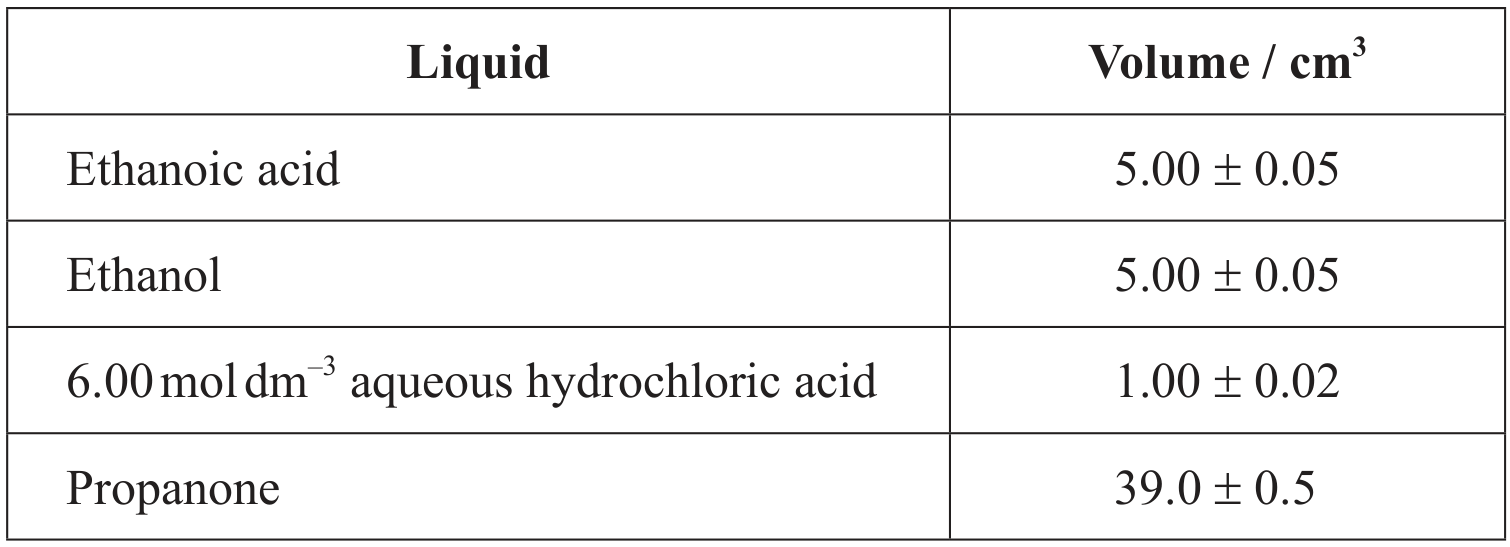
A class studied the equilibrium established when ethanoic acid and ethanol react together in the presence of a strong acid, using propanone as an inert solvent. The equation is given below.

CH3COOH+C2H5OHCH3COOC2H5+H2O\mathrm{CH}_{3} \mathrm{COOH}+\mathrm{C}_{2} \mathrm{H}_{5} \mathrm{OH} \rightleftharpoons \mathrm{CH}_{3} \mathrm{COOC}_{2} \mathrm{H}_{5}+\mathrm{H}_{2} \mathrm{O}

One group made the following initial mixture:

Table
(a)

Referring back to your answer for part (a), calculate the percentage of ethanoic acid converted to ethyl ethanoate.

[ 1 ]
[Maximum number: 1]

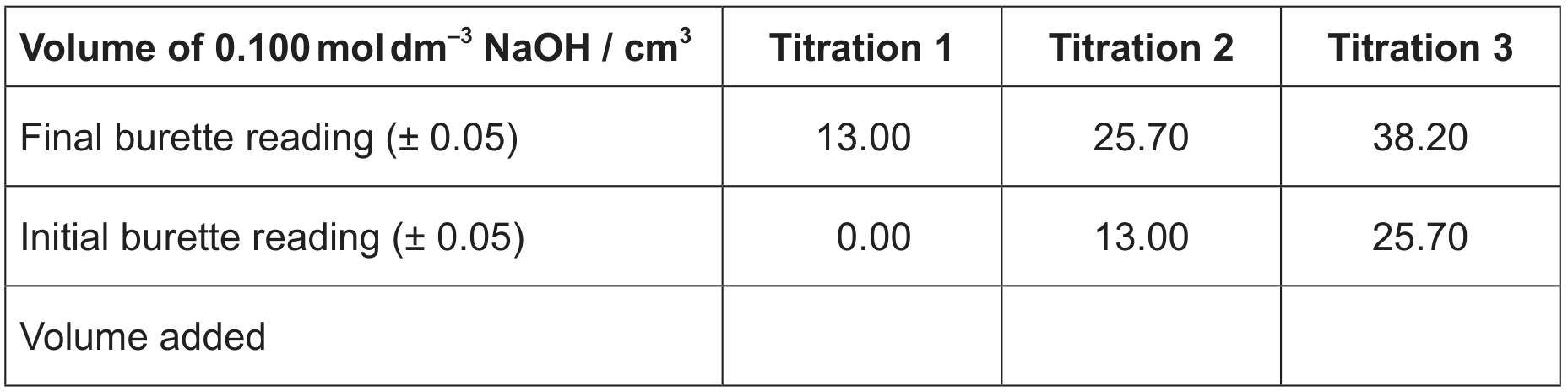
Ethanedioic acid is a diprotic acid. A student determined the value of x in the formula of hydrated ethanedioic acid, HOOCCOOH×H2O\mathrm{HOOC}-\mathrm{COOH} \bullet \times \mathrm{H}_{2} \mathrm{O}, by titrating a known mass of the acid with a 0.100 moldm30.100 \mathrm{~mol} \mathrm{dm}^{-3} solution of NaOH(aq).
0.795 g of ethanedioic acid was dissolved in distilled water and made up to a total volume of 250 cm3250 \mathrm{~cm}^{3} in a volumetric flask.
25 cm325 \mathrm{~cm}^{3} of this ethanedioic acid solution was pipetted into a flask and titrated against aqueous sodium hydroxide using phenolphthalein as an indicator.

The titration was then repeated twice to obtain the results below.

Table
(a)
(i)

The equation for the reaction taking place in the titration is:

HOOCCOOH(aq)+2NaOH(aq)NaOOCCOONa(aq)+2H2O(l)\mathrm{HOOC}-\mathrm{COOH}(\mathrm{aq})+2 \mathrm{NaOH}(\mathrm{aq}) \rightarrow \mathrm{NaOOC}-\mathrm{COONa}(\mathrm{aq})+2 \mathrm{H}_{2} \mathrm{O}(\mathrm{l})

Determine the amount, in mol, of ethanedioic acid that reacts with the average volume of NaOH (aq).

[ 1 ]
[Maximum number: 1]

Combustion of ethanol takes place according to the following unbalanced equation.

C2H5OH(l)+O2( g)CO2( g)+H2O(l){ }^{-} \mathrm{C}_{2} \mathrm{H}_{5} \mathrm{OH}(\mathrm{l})+\ldots \mathrm{O}_{2}(\mathrm{~g}) \rightarrow \ldots \mathrm{CO}_{2}(\mathrm{~g})+\ldots \mathrm{H}_{2} \mathrm{O}(\mathrm{l})

What is the mole ratio of ethanol to oxygen in the balanced equation?

A

1: 1

B

2: 1

C

1: 3

D

2: 7

[Maximum number: 1]

4.0 g of solid sodium hydroxide is added to 0.10dm30.10 \mathrm{dm}^{3} of 1.0moldm31.0 \mathrm{moldm}^{-3} aqueous sulfuric acid.

2NaOH( s)+H2SO4(aq)Na2SO4(aq)+2H2O(l)2 \mathrm{NaOH}(\mathrm{~s})+\mathrm{H}_{2} \mathrm{SO}_{4}(\mathrm{aq}) \rightarrow \mathrm{Na}_{2} \mathrm{SO}_{4}(\mathrm{aq})+2 \mathrm{H}_{2} \mathrm{O}(\mathrm{l})

Which statement is correct?

A

Neither reactant is in excess.

B

0.10 molNa2SO40.10 \mathrm{~mol} \mathrm{Na}_{2} \mathrm{SO}_{4} is formed.

C

Excess H2SO4\mathrm{H}_{2} \mathrm{SO}_{4} remains in solution.

D

Excess NaOH remains in solution.

[Maximum number: 2]

Phosphine (IUPAC name phosphane) is a hydride of phosphorus, with the formula PH3\mathrm{PH}_{3}.

(a)

2.478 g of white phosphorus was used to make phosphine according to the equation:

P4( s)+3OH(aq)+3H2O(l)PH3( g)+3H2PO2(aq)\mathrm{P}_{4}(\mathrm{~s})+3 \mathrm{OH}^{-}(\mathrm{aq})+3 \mathrm{H}_{2} \mathrm{O}(\mathrm{l}) \rightarrow \mathrm{PH}_{3}(\mathrm{~g})+3 \mathrm{H}_{2} \mathrm{PO}_{2}^{-}(\mathrm{aq})
[ 2 ]
(i)

This phosphorus was reacted with 100.0 cm3100.0 \mathrm{~cm}^{3} of 5.00 moldm35.00 \mathrm{~mol} \mathrm{dm}^{-3} aqueous sodium hydroxide. Deduce, showing your working, which was the limiting reagent.

[ 1 ]
(ii)

Determine the excess amount, in mol, of the other reagent.

[ 1 ]
[Maximum number: 1]

What is the sum of the coefficients when the equation is balanced with whole numbers?

8C18( g)+O2( g)_CO( g)+_H2O(l)-_{8} \mathrm{C}_{18}(\mathrm{~g})+\ldots \mathrm{O}_{2}(\mathrm{~g}) \rightarrow \_\mathrm{CO}(\mathrm{~g})+\_\mathrm{H}_{2} \mathrm{O}(\mathrm{l})
A

26.5

B

30

C

53

D

61

[Maximum number: 2]

3.26 g of iron powder are added to 80.0 cm380.0 \mathrm{~cm}^{3} of 0.200 moldm30.200 \mathrm{~mol} \mathrm{dm}^{-3} copper(II) sulfate solution. The following reaction occurs:

Fe( s)+CuSO4(aq)FeSO4(aq)+Cu( s)\mathrm{Fe}(\mathrm{~s})+\mathrm{CuSO}_{4}(\mathrm{aq}) \rightarrow \mathrm{FeSO}_{4}(\mathrm{aq})+\mathrm{Cu}(\mathrm{~s})
(a)
(i)

Determine the limiting reactant showing your working.

[ 2 ]
0