3.1.5—Metal/non-metal continuum
- Syllabus
- First assessment 2025
- Objective
- 3.1.5
- Level
- SL
| Region | Typical oxide character | Water/reaction reasoning |
|---|---|---|
| Metal side | Basic | Can form alkaline solution with water |
| Boundary | Amphoteric | Can react as acid or base in the appropriate context |
| Non-metal side | Acidic | Can form an acid with water |
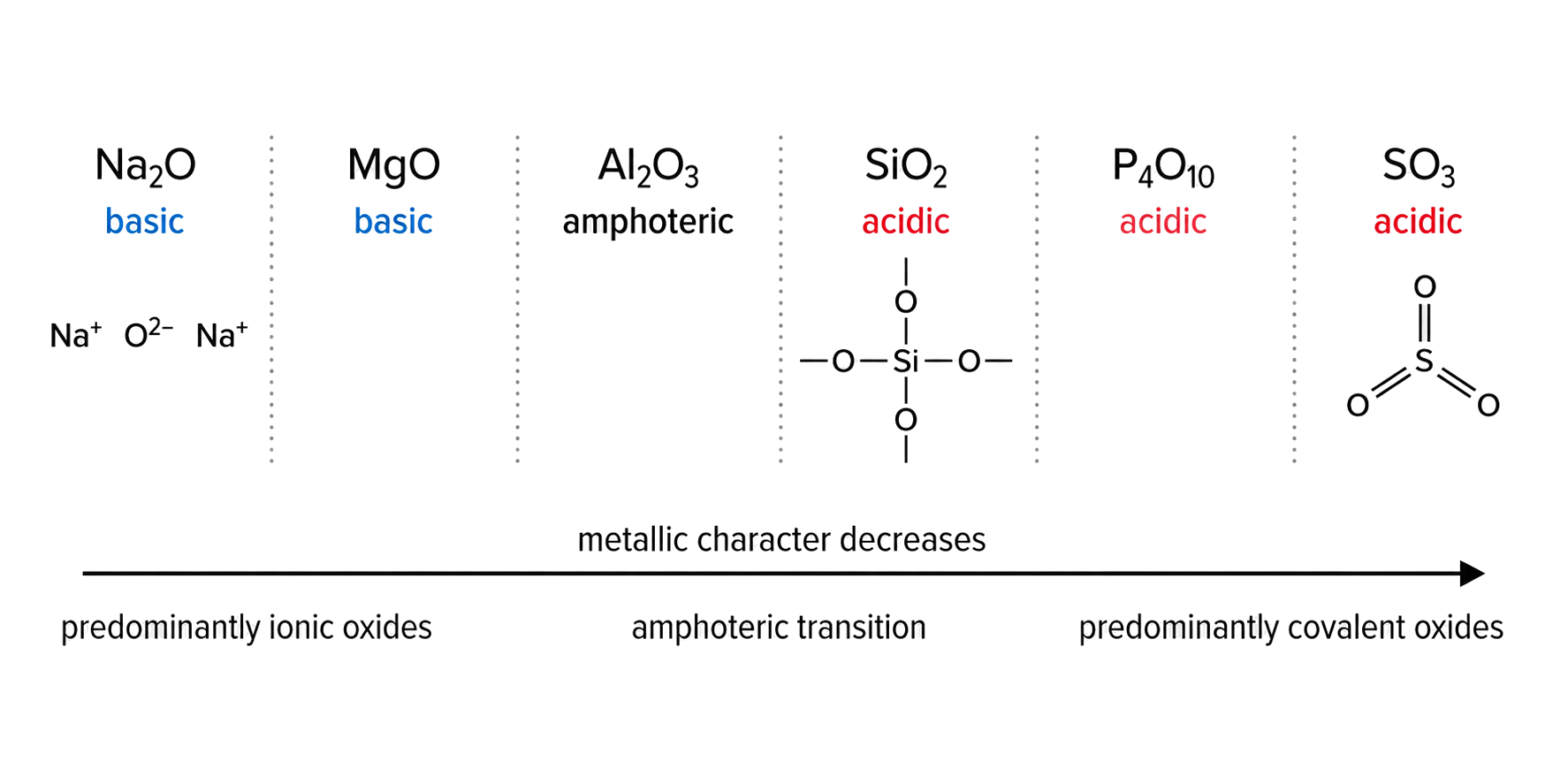
Use balanced equations as evidence for the classification: Na₂O + H₂O → 2NaOH and SO₃ + H₂O → H₂SO₄ are representative basic and acidic cases. The bonding/electronegativity trend explains why the character changes across the period, but it does not guarantee that every oxide reacts readily with water.
Al₂O₃ is the useful boundary case: it is amphoteric, so it can react with an acid such as HCl and with a strong base such as NaOH. Do not label an oxide from the element's position alone—check the stated reaction and distinguish a water reaction from acid–base behaviour in another medium.
Environmental link: sulfur oxides dissolve and can be oxidized to acids that increase in rainwater, causing acid rain. Atmospheric dissolves in seawater and participates in , increasing and lowering ocean pH. These are acidification mechanisms; do not treat every non-metal oxide as reacting with water in exactly the same way.