Structure 3. Classification of matter
- Syllabus
- First assessment 2025
- Section
- —
- Level
- SL
| Feature | Meaning |
|---|---|
| Period | Row; highest occupied main energy level |
| Group | Column with related valence pattern |
| Block | Region associated with the outermost s, p, d, or f subshell |
| Region | Metals, metalloids, and non-metals occupy characteristic areas |
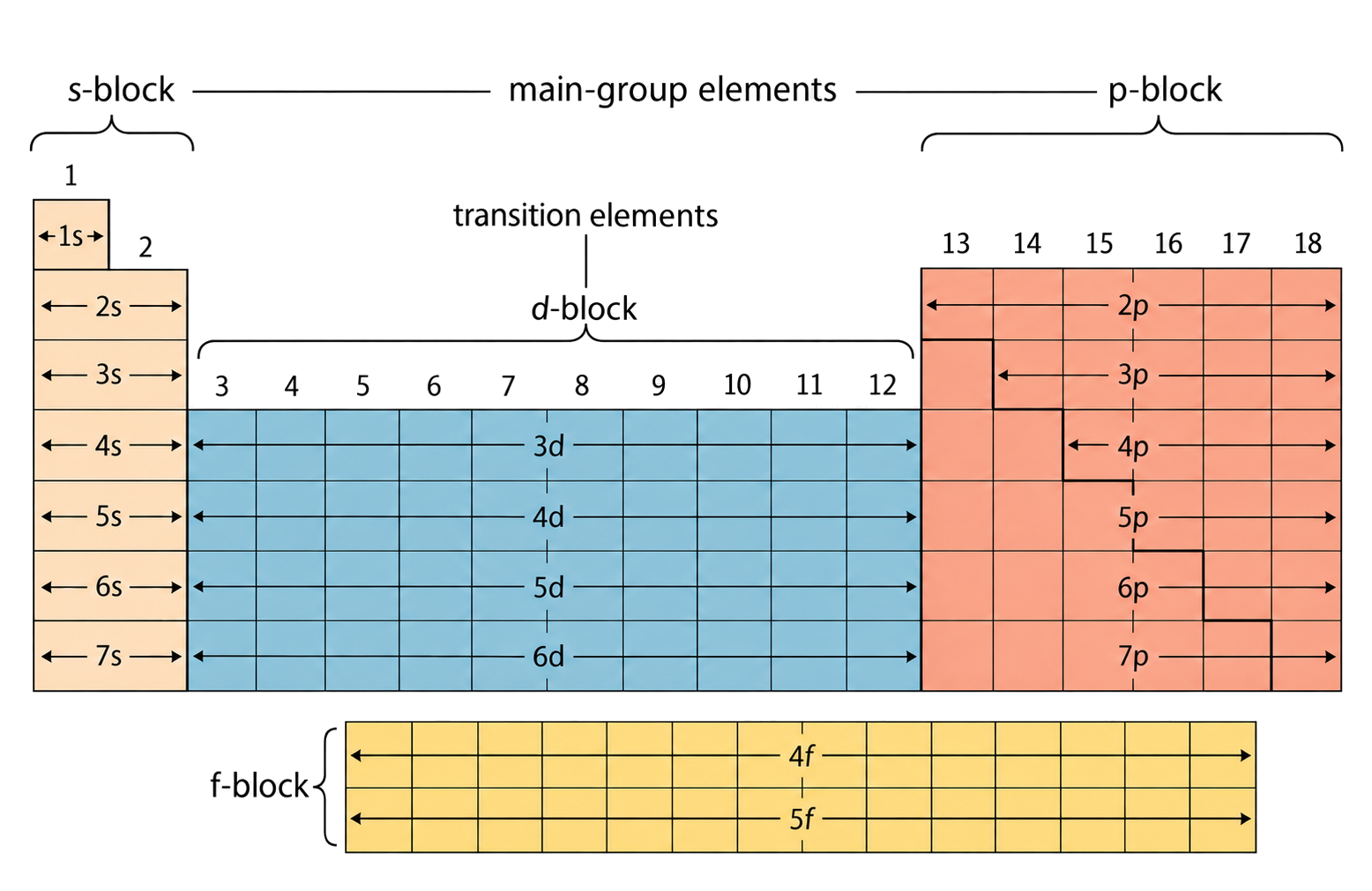
Use the table's row, column, and block together; do not substitute period number for group or block identity.
Use bromine as a three-coordinate check: it lies in period 4, group 17 and the p block, so its outer shell is n = 4 with a p-subshell being filled. Block describes the subshell pattern, period the highest occupied main level, and group the repeating valence pattern—three related but different labels.
| Configuration evidence | Position evidence |
|---|---|
| Highest occupied energy level | Period |
| Valence-electron pattern | Group pattern |
| Outermost subshell type | s, p, d, or f block |
Read the configuration in both directions: position predicts the outer pattern, and the outer pattern identifies the position.
The configuration 1s²2s²2p⁶3s²3p⁵ ends at n = 3 and p⁵, placing the element in period 3, group 17 and the p block. Reverse the reasoning by using a table position to predict the outer configuration, then check that the total electron count matches the atomic number.
| Quantity | Across a period | Down a group |
|---|---|---|
| Atomic/ionic radius | Generally decreases | Generally increases |
| First IE | Generally increases | Generally decreases |
| Electronegativity | Generally increases | Generally decreases |
| Electron affinity | Interpret with the stated convention and attraction evidence | Interpret with shell and shielding evidence |
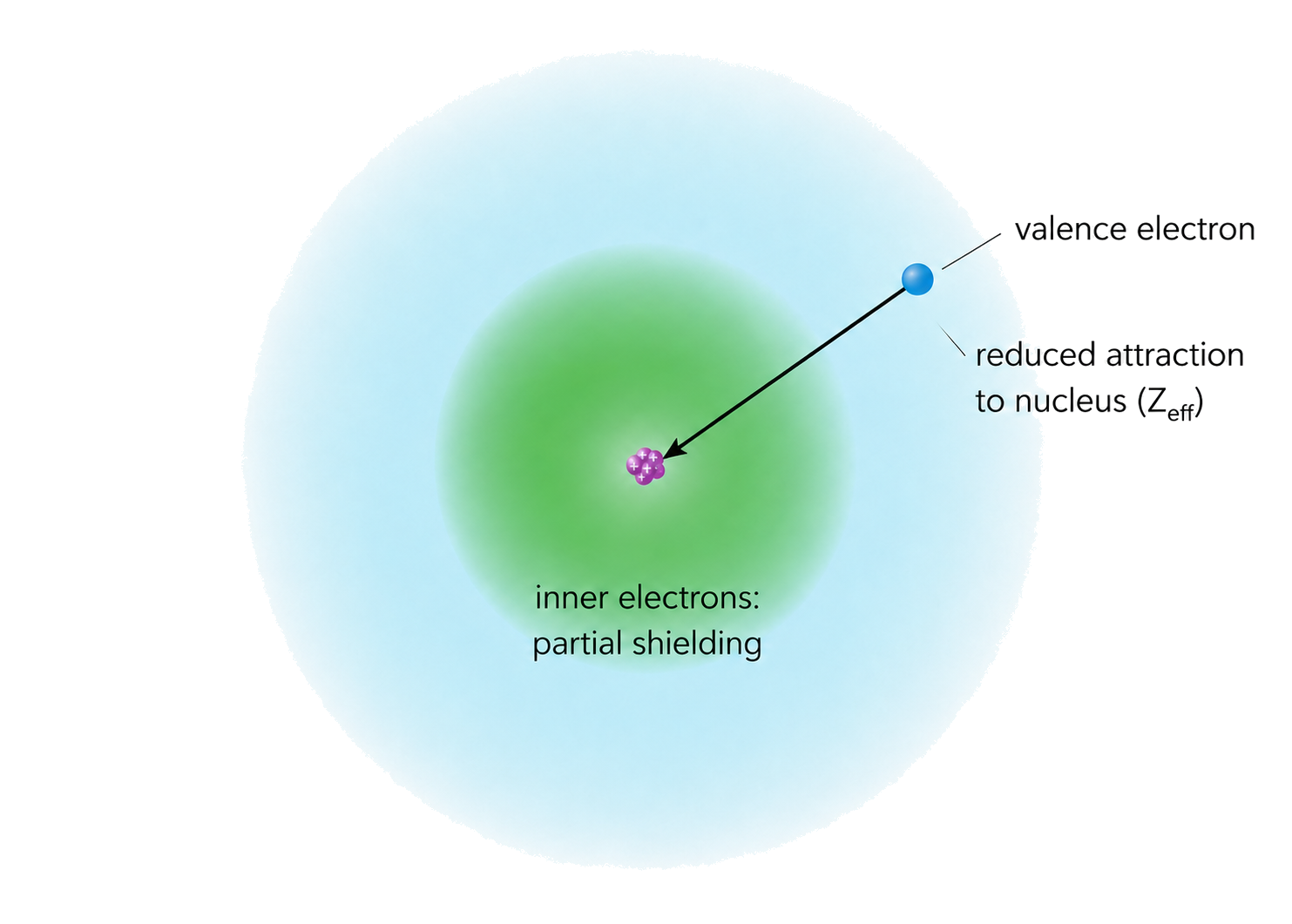
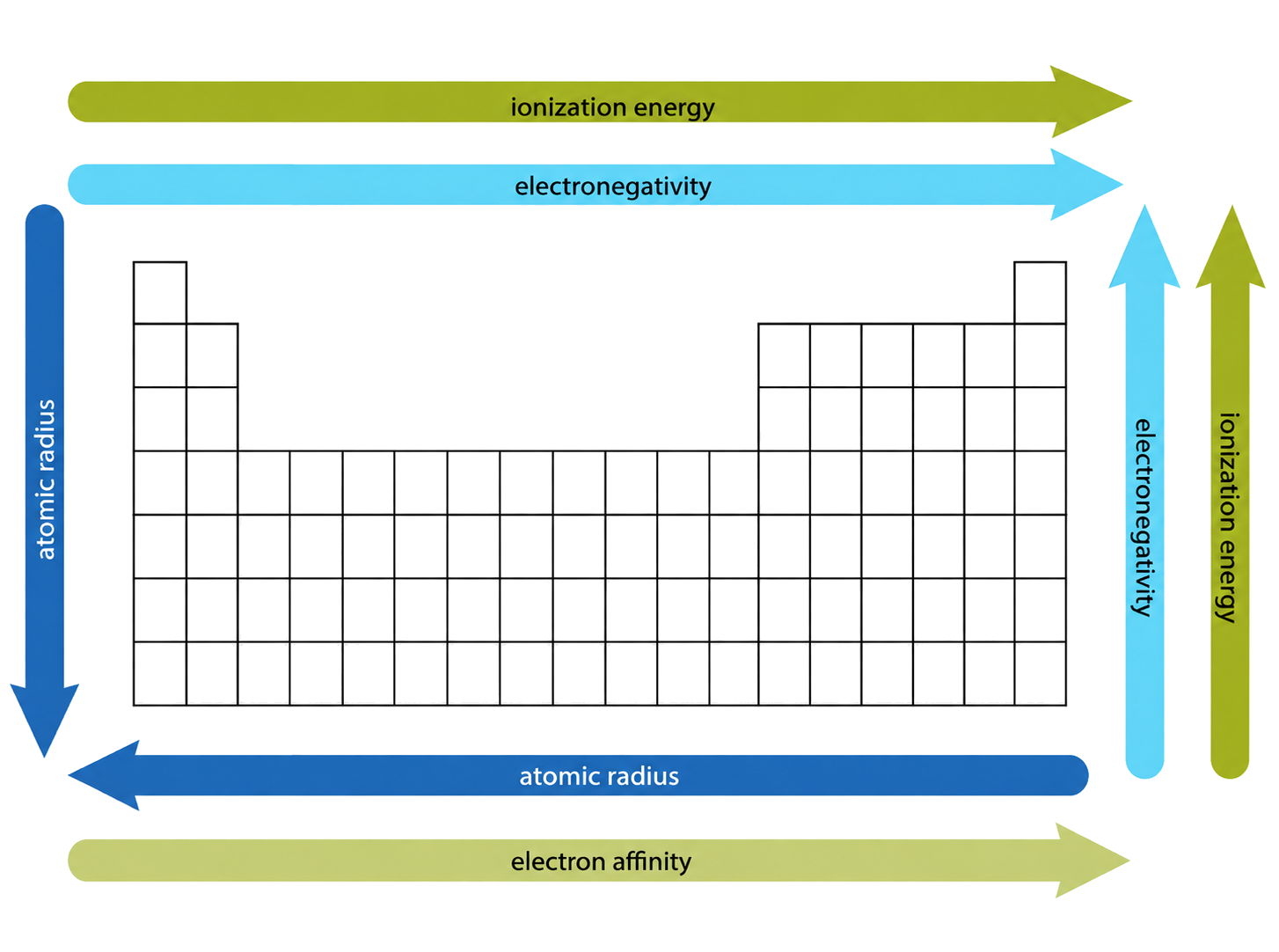
Explain a trend with effective nuclear charge, shielding, shell, distance, and attraction; a direction alone is not a complete explanation.
Across period 3, nuclear charge rises while added electrons enter the same main shell, so effective attraction generally increases, radius falls and first ionization energy rises. For ions, compare electron count and charge as well as position; an isoelectronic species with more protons is smaller.
Electron affinity needs a sign check. Under the enthalpy-change convention, a more favourable first electron gain is more negative: it generally becomes more negative across a period as nuclear attraction increases, and less negative down a group as distance and shielding increase. Sublevel energy and electron repulsion cause exceptions, so compare the stated data rather than forcing every element into a smooth trend.
| Region | Typical oxide character | Water/reaction reasoning |
|---|---|---|
| Metal side | Basic | Can form alkaline solution with water |
| Boundary | Amphoteric | Can react as acid or base in the appropriate context |
| Non-metal side | Acidic | Can form an acid with water |
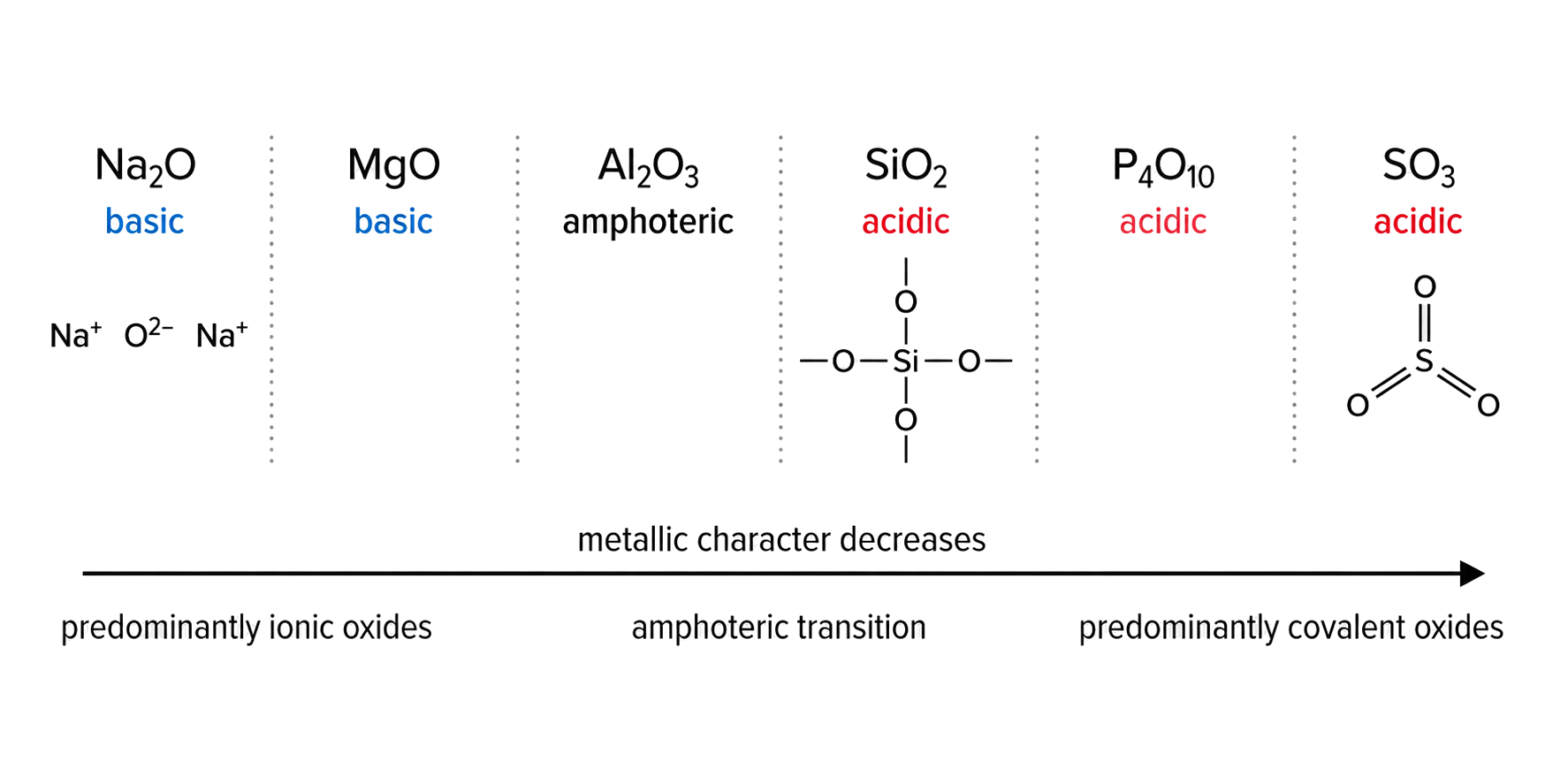
Use balanced equations as evidence for the classification: Na₂O + H₂O → 2NaOH and SO₃ + H₂O → H₂SO₄ are representative basic and acidic cases. The bonding/electronegativity trend explains why the character changes across the period, but it does not guarantee that every oxide reacts readily with water.
Al₂O₃ is the useful boundary case: it is amphoteric, so it can react with an acid such as HCl and with a strong base such as NaOH. Do not label an oxide from the element's position alone—check the stated reaction and distinguish a water reaction from acid–base behaviour in another medium.
Environmental link: sulfur oxides dissolve and can be oxidized to acids that increase in rainwater, causing acid rain. Atmospheric dissolves in seawater and participates in , increasing and lowering ocean pH. These are acidification mechanisms; do not treat every non-metal oxide as reacting with water in exactly the same way.
| Representation | What it preserves or shows |
|---|---|
| Empirical | Simplest whole-number atom ratio |
| Molecular | Actual atom counts |
| Structural/condensed | Connectivity in compact form |
| Skeletal | Carbon framework and implied hydrogen |
| Stereochemical/3D | Spatial arrangement |
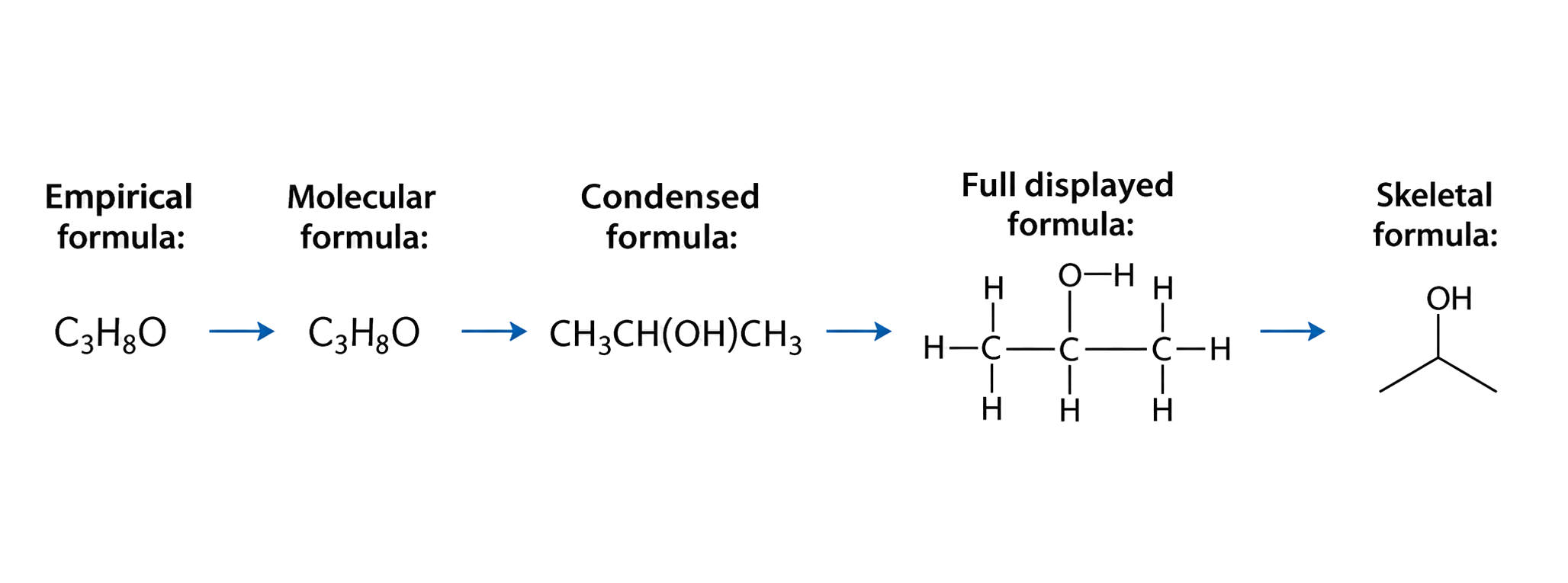
Translate representations without changing atom connectivity. For a skeletal formula, count every vertex and line end as carbon, add enough hydrogens to give carbon four bonds, and write heteroatoms explicitly. Then verify both the molecular formula and the connectivity.
An empirical formula is a ratio, not necessarily the complete molecule: hydrogen peroxide has molecular formula H₂O₂ but empirical formula HO. Reduce all subscripts by their greatest common factor; if no common factor exists, the molecular and empirical formula are identical.
Matching atom totals alone cannot prove two drawings are the same compound: connectivity and, where relevant, stereochemistry must also agree. Do not reduce a molecular formula when the subscripts already have no common factor.
| Family | Complete recognition pattern | Bounded characteristic cue |
|---|---|---|
| Halogenoalkane | C–F/Cl/Br/I | polar C–X bond |
| Alcohol / hydroxyl | C–OH, not the –OH inside –COOH | can donate and accept hydrogen bonds |
| Aldehyde | terminal –CHO carbonyl | polar C=O; terminal carbonyl |
| Ketone | –CO– between carbons | polar C=O; internal carbonyl |
| Carboxylic acid | –COOH | acidic proton and hydrogen bonding |
| Ether / alkoxy | C–O–C | oxygen accepts hydrogen bonds but has no O–H donor |
| Amine / amino | C–N without adjacent carbonyl | basic lone-pair chemistry; N–H species may donate H bonds |
| Amide / amido | –CONH₂/–CONHR/–CONR₂ | nitrogen directly attached to carbonyl |
| Ester | –COO– between carbon groups | carbonyl and single-bond O in one group |
| Phenyl | C₆H₅– attached as a substituent | aromatic ring pattern |
Identify the whole local bonding pattern before naming the group; these cues support classification, not a complete reaction mechanism.
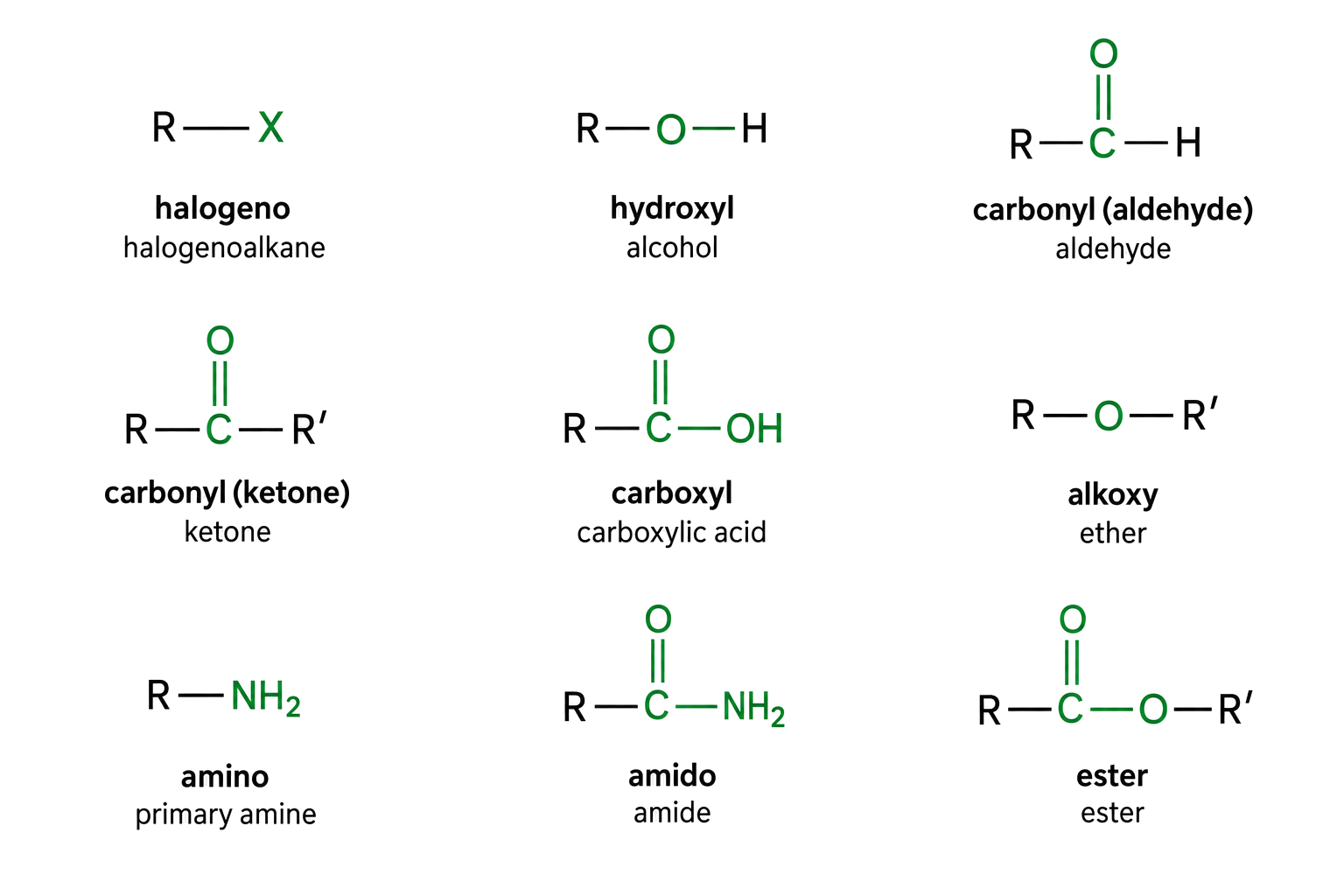
Identify the characteristic atoms and bonding pattern first, then give the functional-group name and relevant property context.
Identify the complete bonding pattern: an aldehyde has a terminal –CHO carbonyl, a ketone has C=O between carbons, and an ester contains –C(=O)–O–. Do not label every O–H as an alcohol or every C–N as an amine without checking the neighbouring carbonyl.
Saturation describes carbon-carbon bonding: a saturated compound has only C-C single bonds, while an unsaturated compound contains at least one C=C or C≡C bond. A carbonyl C=O does not by itself make the carbon skeleton unsaturated. Identify saturation separately from identifying hydroxyl, carbonyl, carboxyl or other functional groups.
| Step | Naming decision |
|---|---|
| 1 | Choose the longest parent chain |
| 2 | Number to give the relevant feature the lowest locant |
| 3 | Identify unsaturation and functional group |
| 4 | Assemble prefixes, locants, and suffix |
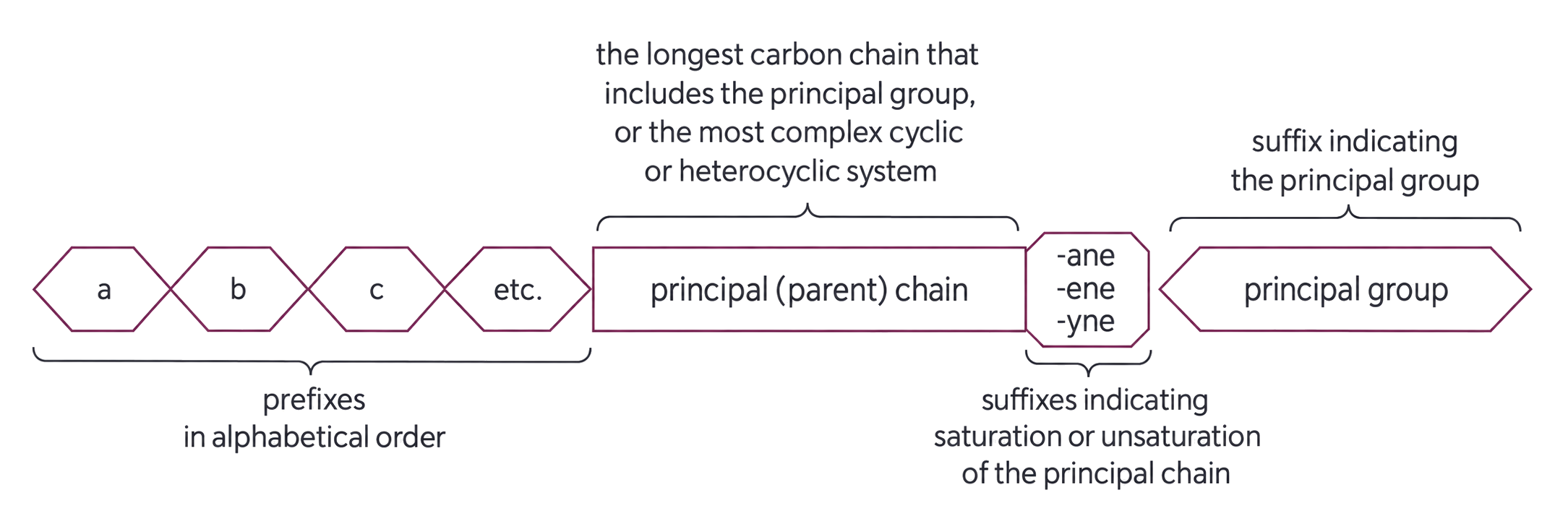
Apply the systematic sequence to saturated or mono-unsaturated compounds with up to six carbons and one functional-group type.
For CH₃CH(OH)CH(CH₃)CH₃, choose the four-carbon chain containing –OH, number from the end that gives –OH the lower locant, and name 3-methylbutan-2-ol. The principal suffix controls numbering before a substituent does; check locants, punctuation and retained unsaturation at the end.
Structural isomers have the same molecular formula but different atom connectivities. Types include straight-chain/branched, position, and functional-group isomers.
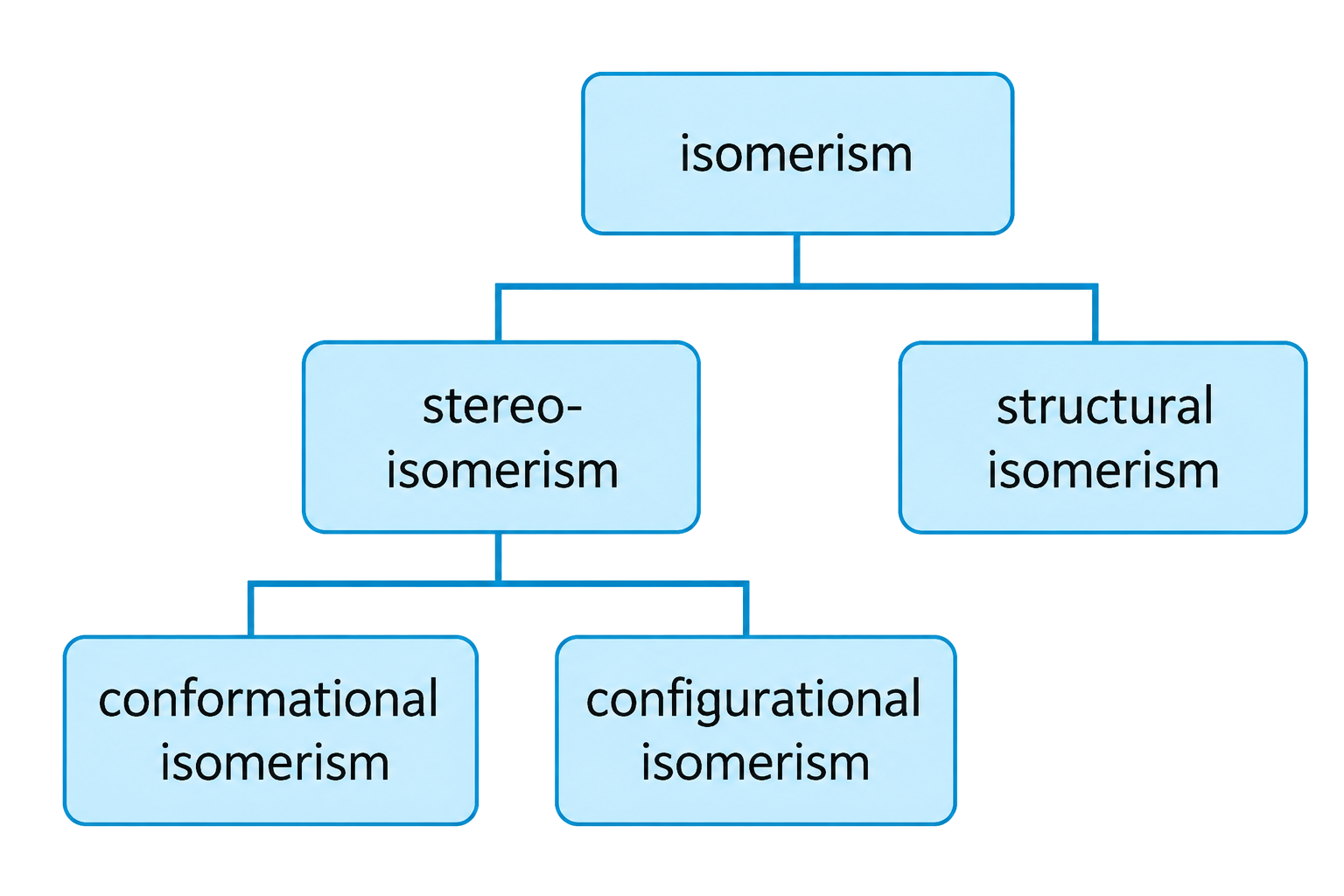
Classify primary, secondary, and tertiary alcohols, halogenoalkanes, and amines by the carbon or nitrogen environment attached to the functional group.
| Family | Primary / secondary / tertiary test |
|---|---|
| Alcohol | count carbon groups attached to the carbon bearing -OH: 1 / 2 / 3 |
| Halogenoalkane | count carbon groups attached to the carbon bearing X: 1 / 2 / 3 |
| Amine | count carbon groups attached directly to N: 1 / 2 / 3 |
C₄H₁₀O can represent different carbon skeletons, different –OH positions, or an ether instead of an alcohol. Draw each connectivity once, then compare molecular formulae. Rotating or redrawing one connectivity does not create a new structural isomer.
For alcohols and halogenoalkanes, classify the carbon carrying the functional group; for amines, classify the nitrogen by how many carbon groups are bonded to it. Do not use the position number alone: butan-2-ol is secondary because its OH-bearing carbon is attached to two other carbons.
