A1.1 Water

Water’s polarity and hydrogen bonding create solvent, thermal, cohesive and adhesive properties that support metabolism, transport, cooling and aquatic life.

Syllabus
First assessment 2025
Topic
A1.1
Level
SL

Learning objectives

Life runs in a shared liquid environment

The earliest cells arose in water, where the surrounding ocean reduced exposure to ultraviolet radiation. Modern cells still contain a high proportion of water, and most cellular chemistry occurs in an aqueous phase.

As a biological medium, water allows:

  • dissolved reactants to diffuse and encounter one another
  • enzymes and substrates to interact in the same liquid phase
  • solutes to move through cytoplasm, blood, tissue fluid and plant transport systems

A medium provides the environment for a process. Water is a reactant only in reactions that chemically consume it. Its value as a medium depends on the molecular interactions developed next.

Molecular shape turns bond polarity into a polar molecule

Oxygen attracts the shared electrons in each O–H covalent bond more strongly than hydrogen. Oxygen therefore carries a partial negative charge, δ−, while each hydrogen carries δ+. Because the molecule is bent, the two bond polarities do not cancel.

A hydrogen bond is the attraction between a δ+ hydrogen on one water molecule and a δ− oxygen on another. It is an intermolecular attraction, not the covalent bond holding O and H together inside one molecule.

Two bent water molecules with solid covalent O–H bonds, partial charges, and a dashed hydrogen bond between different molecules.

One hydrogen bond is weak compared with an O–H covalent bond. Water's unusual properties arise because enormous numbers of hydrogen bonds act together while continually breaking and reforming.

Cohesion has a bulk effect and a surface effect

Cohesion is attraction between water molecules. Many hydrogen bonds together allow a body of water to transmit force without the molecules separating easily.

In xylem, evaporation from leaves creates tension. Cohesion keeps water molecules connected, so the pull is transmitted down a continuous column and the column resists breaking.

At the surface, water molecules have no neighbours above them, so cohesive attractions have a net inward effect. The surface resists stretching or breaking; a small pond skater with water-repellent legs can spread its weight without rupturing it.

A pond skater depresses the water surface beside molecular views of hydrogen bonding and inward attraction at the surface.

Cohesion maintains the xylem column but does not create the transpiration pull. Surface tension supports an organism at a boundary; buoyancy supports an immersed body through displaced fluid.

Adhesion depends on what water is touching

Force Attractive contact Main biological consequence
Cohesion water ↔ water maintains a connected xylem column that can resist tension
Adhesion water ↔ polar or charged surface wets cellulose and pulls water along narrow spaces
Water molecules in a xylem vessel show cohesion between water molecules and adhesion between water and the vessel wall.

In narrow soil pores and spaces between cellulose fibres, adhesion pulls water along the hydrophilic wall. Cohesion draws neighbouring water molecules with it, producing capillary movement and keeping leaf cell walls moist.

Adhesion helps water enter and wet narrow spaces, but cohesion is the dominant force preventing a transpiring xylem column from breaking under tension.

Partial charges predict what water can carry

Around Na+, the δ− oxygen ends of water face inward; around Cl−, the δ+ hydrogen ends face inward. Water–ion attractions separate the ions and stabilize a mobile hydration shell around each one.

Hydration shells around sodium and chloride ions, with oxygen ends facing Na+ and hydrogen ends facing Cl−.
Substance Interaction with water Biological result
ions and polar molecules charges or polar groups attract water; polar groups may hydrogen-bond dissolution enables diffusion, reactions and transport
non-polar molecules or regions no equivalent favourable attraction poor solubility helps form water-excluding boundaries such as membrane interiors

O₂ and N₂ are non-polar and only slightly soluble. Respiratory pigments such as haemoglobin therefore raise the oxygen-carrying capacity of blood far above that of water alone.

Water changes the costs of temperature control and movement

Property of water compared with air Opportunity Constraint
higher specific heat capacity habitat and water-rich body temperatures change slowly much energy is exchanged before water temperature changes
higher thermal conductivity heat moves readily through the surrounding water a warm animal loses heat faster than in air
much greater density and buoyancy displaced water supports body mass upthrust must be overcome during a dive
greater viscosity feet and flippers can push against the fluid drag raises the cost of movement

Specific heat capacity describes the energy needed to change temperature; thermal conductivity describes how readily heat passes through a material. Water can therefore provide a stable habitat while still removing heat quickly from a warm animal.

Predict the adaptation from the constraint: insulation limits heat transfer, streamlining reduces drag, broad propulsive surfaces push water backward, and increased mass or reduced trapped air helps an animal dive.

A loon and a seal meet the same habitat in different ways

Aquatic challenge Black-throated loon Ringed seal
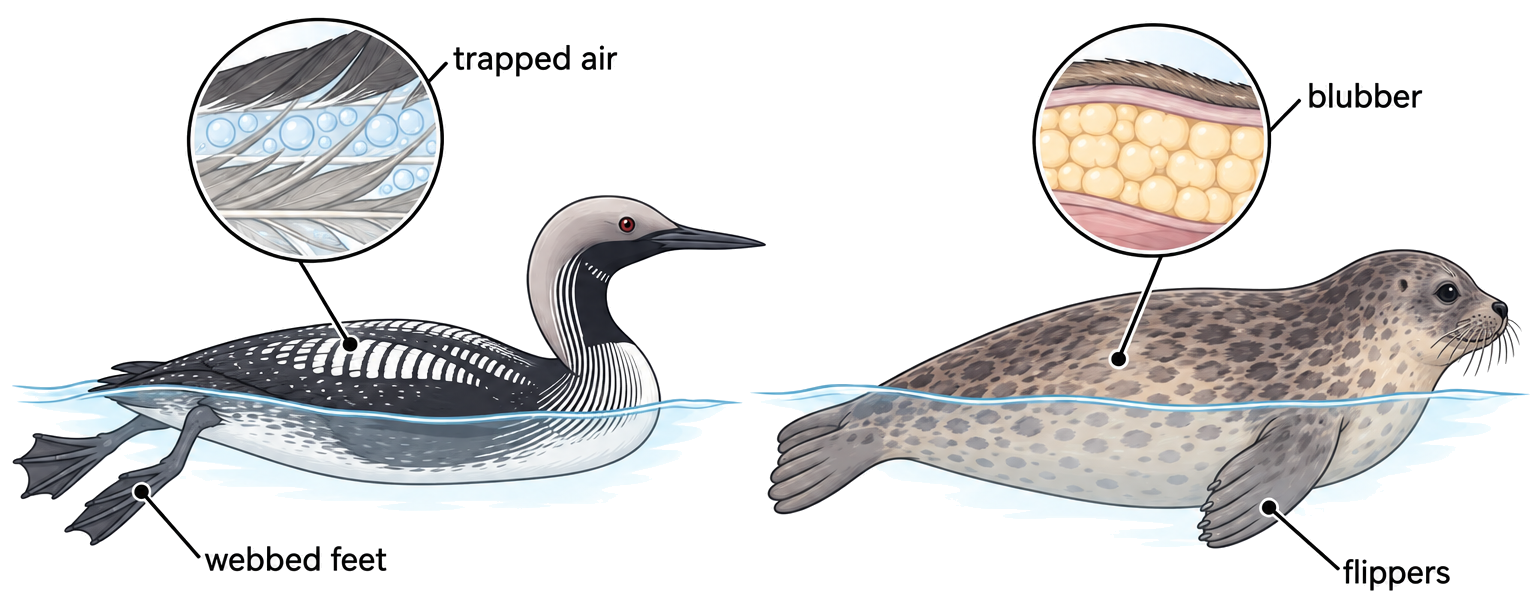
reduce heat loss trapped air in feathers limits conduction and convection thick blubber insulates beneath the skin
produce thrust with low drag streamlined body; rear webbed feet push water backward streamlined body; flippers provide propulsion
manage buoyancy while diving solid bones and compressed air reduce upthrust blubber adds buoyancy, so swimming force is needed to descend
A black-throated loon and ringed seal with labels for webbed feet, flippers, trapped air and blubber.

An adaptation is explained by linking a structural feature to the relevant property of water and then to its consequence for heat balance, propulsion or diving—not by listing the feature alone.

Recover the chain from molecule to biological consequence

Unequal electron sharing + bent geometry → a polar molecule → hydrogen bonding and attraction to charged or polar matter. Begin every explanation from the interaction that produces the property.

Interaction or physical property Biological opportunity Constraint or boundary
water–water attraction xylem continuity; surface tension cohesion does not create transpiration pull
water–surface attraction capillary movement and wet cell walls adhesion is not the main force resisting xylem tension
attraction to ions and polar solutes reactions, diffusion and transport non-polar O₂ and N₂ remain poorly soluble
heat capacity, conductivity, buoyancy and viscosity stable habitat, support and propulsion heat loss, diving cost and drag require adaptations

Connect cohesion to a biological consequence

1 mark

Water shows strong cohesive properties. Which of the following can occur because of the cohesive properties of water?

Recognise adhesion from the contact pair

1 mark

Which of the following is a consequence of the adhesive properties of water?

Explain a hydrogen bond precisely

3 marks

Outline how hydrogen bonds form in water.

Use solvent behaviour to explain transport

1 mark

Which can be explained by the solvent properties of water?

Make a comparison, not two isolated descriptions

2 marks

Distinguish between the physical properties of water and air.